
Risk of Melanoma Recurrence: Circulating Tumor DNA (ctDNA) Offers New Guidance

In this article
In the treatment of early-stage melanoma , being able to predict whether the disease will return offers a major advantage for both patients and physicians. This is precisely where tumor DNA in the bloodstream, known as circulating tumor DNA – ctDNA, shows promise as a next-generation biomarker. A large study conducted by researchers at New York University and published in The Lancet Oncology on April 15, 2025, found that ctDNA levels can predict the risk of early recurrence in patients with stage III melanoma receiving adjuvant targeted therapy. This new approach also appears to outperform conventional prognostic markers.
How Was ctDNA Measured? What Is ddPCR, and How Does It Work?
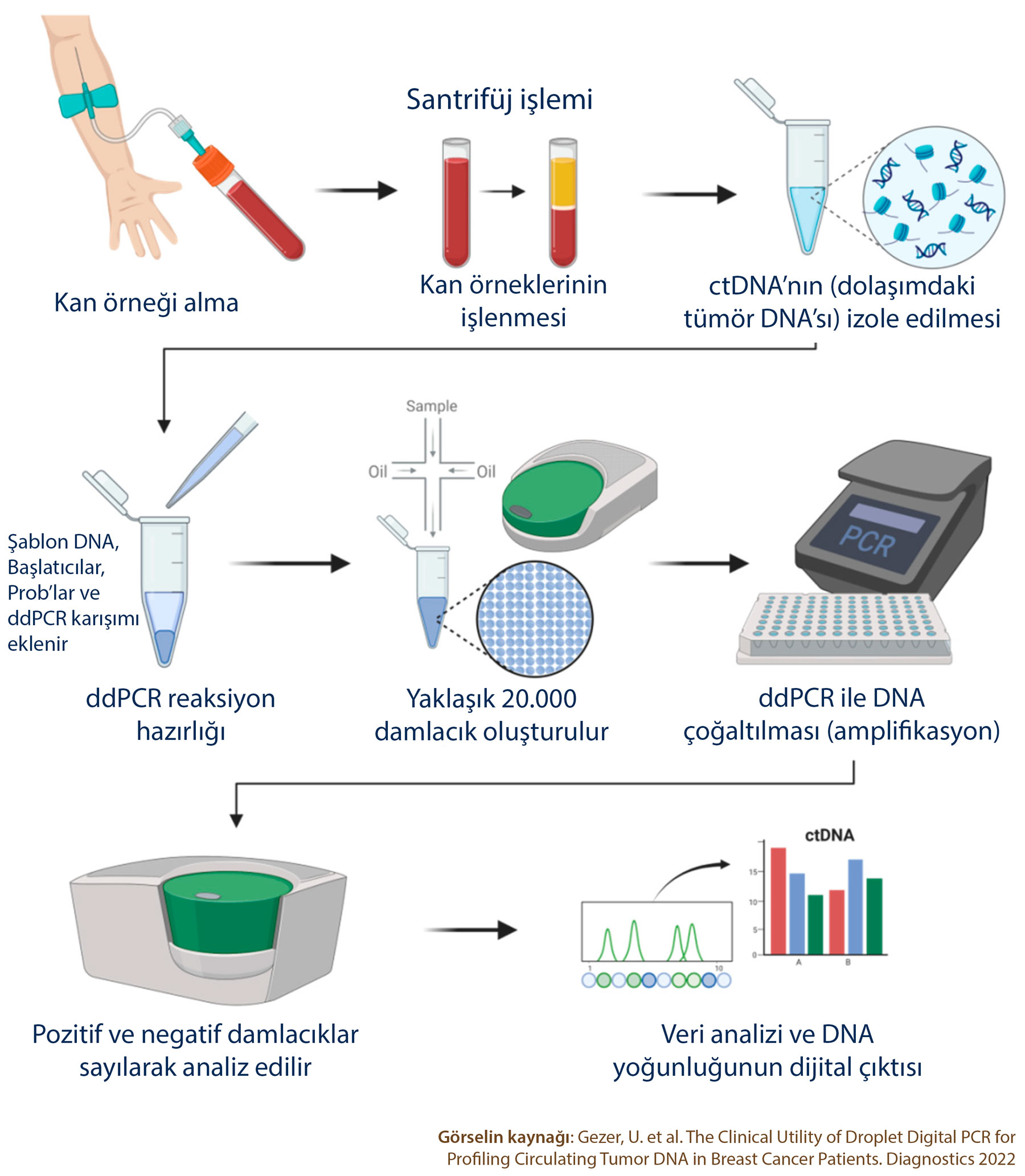
Image description: The droplet digital PCR (ddPCR) method used to detect ctDNA in patients with cancer. DNA obtained from each blood sample is divided into microdroplets, amplified, and quantified by distinguishing positive from negative droplets. As noted in the study, this method can measure ctDNA levels with very high sensitivity.
How Was the Study Conducted?
COMBI-AD was the large-scale phase 3 clinical trial whose data were used. The research team analyzed data from patients diagnosed with stage III melanoma harboring a BRAF V600E or V600K mutation, comprising 870 adult patients in total. Pretreatment plasma samples were obtained from 597 of these patients, and follow-up samples were collected from 118 patients during treatment.
Patients were randomized to one of the following groups:
-
Dabrafenib (150 mg, 2 times daily) + trametinib (2 mg, 1 time daily)
-
Matched placebo group
The follow-up period was quite long:
-
In the combination therapy group, an average of 60 months (IQR: 39-66),
-
In the placebo group, an average of 58 months (IQR: 21-66).
What Did ctDNA Reveal? What Do the Findings Show?

1. ctDNA Positivity at Baseline:
-
Of the total 597 patients, 13% (79 patients) had detectable ctDNA.
-
In patients with more advanced disease substages, the ctDNA detection rate and mutant copy number were significantly higher.
2. A Strong Marker of Recurrence Risk:
-
In the placebo group:
-
Median recurrence-free survival in ctDNA-positive patients: 3.71 months
-
In ctDNA-negative patients: 24.41 months
-
HR: 2.91 (Markedly increased risk; p < 0.001)
-
-
In the combination therapy group:
-
In ctDNA-positive patients: 16.59 months
-
In ctDNA-negative patients: 68.11 months
-
HR: 2.98 (p < 0.001)
-
These results demonstrate that ctDNA positivity is associated with significantly worse survival in both the treated and untreated groups.
Outperforming Conventional Biomarkers
Baseline ctDNA levels, compared with interferon gamma gene expression or tumor mutational burden, predicted recurrence risk more strongly. This suggests that ctDNA may be a more sensitive and targeted biomarker in melanoma.
Molecular Dynamics: The Role of ctDNA During Follow-up
ctDNA measurements taken during the course of the diseaseare particularly valuable for assessing recurrence risk:
-
Molecular relapse (becoming positive again) was associated with:
-
Median recurrence-free survival: 8.31 months
-
-
In patients who remained consistently positive:
-
Median recurrence-free survival: 5.32 months
-
-
In patients who converted from positive to negative (zero conversion):
-
Median recurrence-free survival: 19.25 months
-
-
In patients who remained persistently negative:
-
Median recurrence-free survival: Not yet reached
-
These differences were significant at p < 0.001 .
What Does This Mean for Clinical Practice?
The research team states:
"ctDNA tests showed moderate sensitivity and nearly 100% specificity for detecting disease recurrence. Considering pretreatment and on-treatment ctDNA measurements together enables earlier and more accurate detection, particularly of molecular relapse or zero conversion."
Looking ahead, this means that ctDNA could guide clinical decisions in both diagnosis and post-treatment monitoring .
What Were the Study's Limitations?
-
Most participants were White , which may limit the generalizability of the results.
-
The number of follow-up samples was smaller than the number of baseline samples. This may not fully reflect long-term ctDNA kinetics.
-
No samples were collected beyond 12 months , creating a risk of missing the burden of minimal residual disease that progresses insidiously after treatment.
-
In addition, the relationships of radiological measurements and ctDNA levels with tumor burden were not matched in detail.
Conclusion: A Key to Personalized Monitoring in Melanoma?
This study shows that circulating tumor DNA (ctDNA) may be more than a laboratory parameter and could also serve as a powerful molecular compass for predicting early recurrence . In particular, when used alongside adjuvant targeted therapy in patients with stage III BRAF-mutant melanoma, monitoring ctDNA levels could help shape treatment decisions and support patients' psychological preparation.
This development takes the idea of predicting disease recurrence through a blood test a step further.
Sources
2. Gezer, U.; Bronkhorst, A.J.; Holdenrieder, S. The Clinical Utility of Droplet Digital PCR for Profiling Circulating Tumor DNA in Breast Cancer Patients. Diagnostics 2022, 12, 3042. https://doi.org/10.3390/diagnostics12123042
Was this article helpful?
Your feedback helps us improve our content.




Reader comments
Share your comment
Your name and comment are published only after administrator approval. Your email address is never shown to visitors.
Be the first to comment.