
Second-Line Treatment for Small Cell Lung Cancer Is Being Rewritten

In this article
🫁 Current Treatment Challenges and Needs in SCLC
Small cell lung cancer (SCLC) is an aggressive tumor accounting for approximately 15% of lung cancers. First-line treatment generally uses platinum–etoposide chemotherapy + immunotherapy (e.g., atezolizumab or durvalumab), and the tumor usually responds well initially. However, most patients relapse rapidly within months , and 5-year survival in advanced SCLC is below 2%.
In second-line treatment , meaningful progress has been limited for many years. Topotecan has traditionally been standard in many countries; although lurbinectedin or amrubicin are also used in some countries, median survival with these regimens has not exceeded 7.5–9.3 months , and serious hematologic toxicities (anemia, neutropenia, thrombocytopenia) have been common.
These modest outcomes and high adverse effect rates demonstrate an urgent need for more effective and safer second-line treatments . Immunotherapies alone have also failed to deliver the hoped-for benefit here; for example, checkpoint inhibitors such as nivolumab, tested as post-platinum maintenance or second-line treatment, did not demonstrate in large phase 3 trials a significant overall survival improvement . Consequently, for SCLC patients whose disease progresses after first-line treatment, the search for innovative approaches directed at new targets continues.
🎯 The DLL3 Target and Tarlatamab's Mechanism of Action
DLL3 (Delta-like ligand 3)is an inhibitory ligand of the Notch signaling pathway and is expressed at abnormally high levels on SCLC tumor cell surfaces, while being virtually absent from normal healthy tissues . Studies show that among patients with SCLC, 85–95% have DLL3 protein expressed on tumor cell surfaces. DLL3 has therefore emerged as a tumor-specific biomarker and an ideal target for drug development.
Tarlatamab (Imdelltra)is a bispecific T-cell engager immunotherapy molecule developed by Amgen. In other words, it has a dual-ended antibody structure: One end binds to DLL3 protein and the other to the CD3 receptor on T lymphocytes . Tarlatamab thereby brings a cancer cell and an immune cell physically close together to form an “immunological synapse.”
This binding activates the T cell, which secretes cytotoxic enzymes such as perforin and granzyme against the target tumor cell, destroying it through apoptosis (programmed cell death). In brief, tarlatamab acts as a “smart” biological bridge that redirects the body's T cells toward SCLC tumor cells and enables their destruction .
This targeted approach is not entirely new: An antibody-drug conjugate previously developed against DLL3, rovalpituzumab tesirine (Rova-T) , failed in phase 3 trials. Tarlatamab, however, introduces a new immunotherapy paradigm using T-cell activation against DLL3 through the BiTE ( Bispecific T cell Engager) principle. This aims to reduce tumor burden and achieve lasting immune-mediated control, particularly in SCLC patients whose disease rapidly recurs after other treatments.
🧪 The DeLLphi-304 Study: Design and Patient Criteria
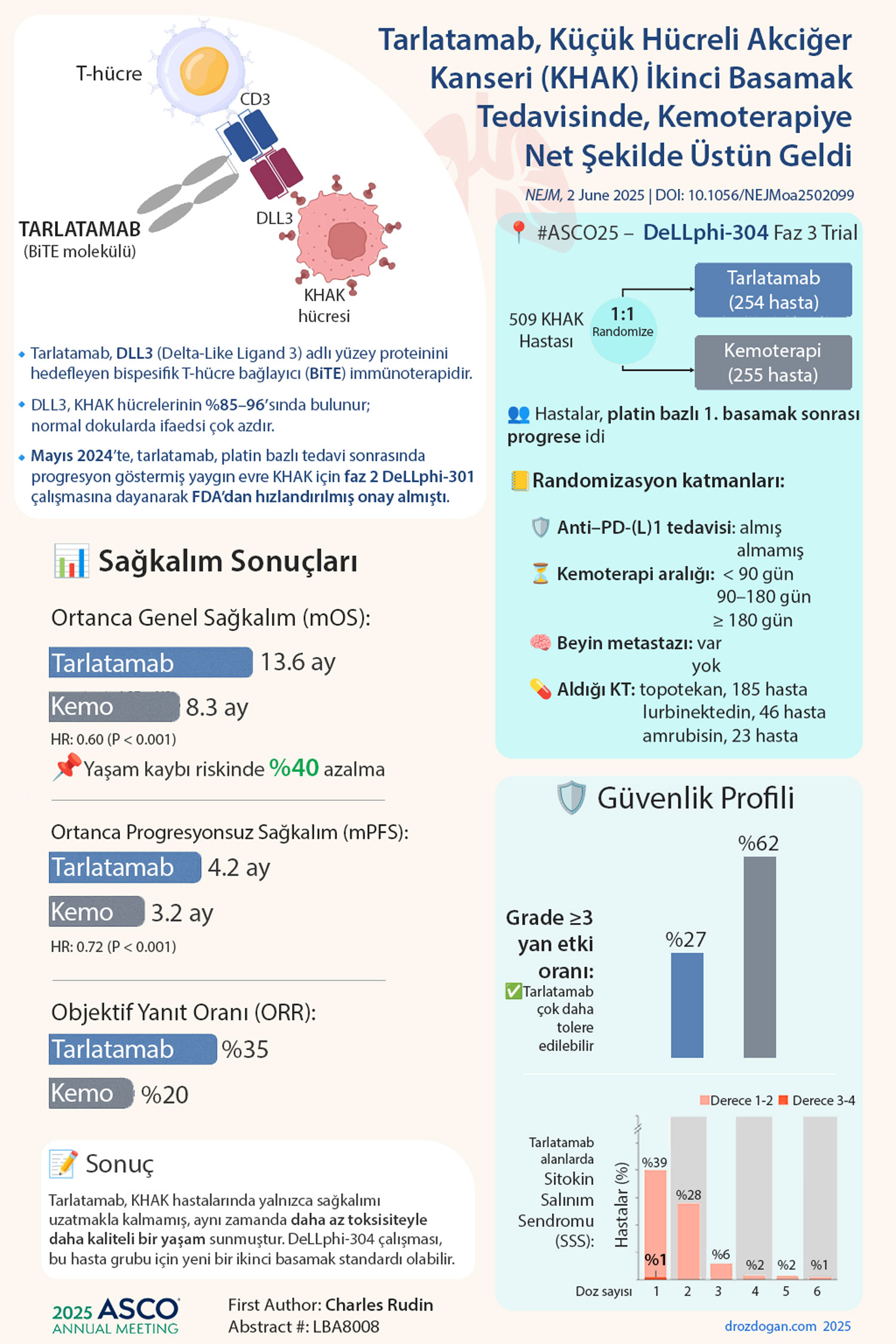
Presented at the ASCO 2025 Congress, DeLLphi-304was designed to assess tarlatamab's second-line efficacy in a global phase III clinical trial . The study enrolled patients whose disease progressed during or after platinum-based first-line treatment for advanced SCLC. Of participants, 71% had previously received anti-PD-1/PD-L1 immunotherapy.
Inclusion criteria included:
- Histologically confirmed SCLC
- Measurable disease
- ECOG performance status 0–1
- Age ≥ 18 years
- Asymptomatic brain metastases were permitted
💊 Treatment Arms
- Tarlatamab arm: Weekly infusions for the first 3 weeks (days 1, 8 and 15), followed by every 2 weeks a 10 mg IV infusion. Initial doses were given under close hospital monitoring because of the risk of CRS (Cytokine Release Syndrome).
- Chemotherapy arm: Physician's choice of topotecan, lurbinectedin or amrubicin. Topotecan/amrubicin were given every 21 days, and lurbinectedin every 28 days . More than 75% of participants received topotecan.
🎯 Primary and Secondary Endpoints
- Primary endpoint: Overall survival (OS)
- Secondary endpoints:
- Progression-free survival (PFS)
- Objective response rate (ORR)
- Duration of response (DoR)
- Disease control rate
- Patient-reported quality of life and symptom scores
- Safety
The study was open-label and had no placebo arm. However, this design was considered scientifically acceptable for objective endpoints such as OS.
📊 Patient Profile
- 509 patients in total: 254 tarlatamab, 255 chemotherapy
- Median age: 64 years; most were male and had a smoking history
- Brain metastases: 44–45%
- Liver metastases: 33–37%
- DLL3 positivity: ≈94% (in both arms)
- Platinum-resistant relapse (within <90 days): 43–45%
📈 Efficacy Results: Tarlatamab's Survival and Response Advantage
DeLLphi-304 The study met its primary endpoint and demonstrated significantly longer survival with tarlatamab than with chemotherapy. Tarlatamab extended survival, slowed disease progression and increased the tumor response rate.
📊 Main Efficacy Findings
- Overall Survival (OS):
- Tarlatamab: 13.6 months
- Chemotherapy: 8.3 months
- HR=0.60 (95% CI 0.47–0.77; p<0.001) → 40% reduction in the risk of death
- 6-month OS: 76% (tarlatamab) vs 62% (chemotherapy)
- 12-month OS: 53% (tarlatamab) vs 37% (chemotherapy)
- Interpretation: At 1 year, 1 in every 2 patients receiving tarlatamab was alive, compared with only 1 in every 3 receiving chemotherapy.
- Progression-Free Survival (PFS):
- Tarlatamab: 4.2 months
- Chemotherapy: 3.7 months
- HR=0.71; p=0.002
- 12-month PFS: 20% (tarlatamab) vs 4% (chemotherapy) → longer-lasting tumor control
- Objective Response Rate (ORR):
- 35% (tarlatamab) vs 20% (chemotherapy)
- Tumor shrinkage success was statistically significantly higher
- Disease control rate: 69% (tarlatamab) vs 64% (chemotherapy)
- Duration of Response (DoR):
- Median DoR: 6.9 months (tarlatamab) vs 5.5 months (chemotherapy)
- Ongoing response at 12 months: 41% (tarlatamab) vs 13% (chemotherapy)
- Subgroup Analyses:
- Platinum-resistant patients retained the OS advantage (HR ~0.60)
- Brain metastases were associated with a 55% reduction in the risk of death (HR ~0.45)
- Consistent efficacy across all subgroups
💬 Expert Comment: The study's lead investigator, Dr. Charles Rudin: “These data establish tarlatamab as a new standard second-line treatment and initiate a new paradigm for using bispecific T-cell engager immunotherapies in lung cancer.”
🛡 Safety Profile: Adverse Effects and Quality of Life
Tarlatamab's immune-targeting mechanism naturally carries some distinctive adverse effect risks. DeLLphi-304 The study found the expected safety profile, but better overall tolerability than chemotherapy .
📊 Overall Safety Findings
- Incidence of any adverse event: 99–100% in both arms (including minor events).
- Severe (Grade ≥3) adverse events: 54% (tarlatamab) vs 80% (chemotherapy)
- Severe treatment-related adverse events: 27% (tarlatamab) vs 62% (chemotherapy) → approximately half as frequent
- In the chemotherapy arm, as expected, anemia, neutropenia and thrombocytopenia were common and severe hematologic toxicities.
- In the tarlatamab arm, conventional chemotherapy toxicities were uncommon; T-cell activation-related effects (CRS, neurological symptoms) were more prominent.
🔥 Important Adverse Effects
- Cytokine Release Syndrome (CRS):
- Incidence: 55–60% (mostly mild, Grade 1–2)
- Grade ≥3 CRS: 1%
- Usually occurred during the first 1–2 infusions, within the first 24 hours
- Protocol changes reduced hospital observation after the first dose from 48 hours to 6–8 hours
- CRS leading to treatment interruption: 0.5%
- Neurological Adverse Effects (ICANS):
- Incidence: 6% (any grade)
- Grade ≥3 neurological effects: 4%
- Mostly mild (headache, dizziness, sleep disturbances)
- More common initially, becoming less frequent with subsequent doses
- Other common adverse effects:
- Tarlatamab: dysgeusia, fever, reduced appetite, fatigue (generally mild–moderate)
- Chemotherapy: Grade 3–4 anemia (28% vs 4% with tarlatamab), neutropenia, leukopenia, thrombocytopenia
- Blood transfusion requirements were substantially higher in the chemotherapy arm
💬 Quality-of-Life Findings
- Patient-reported outcomes (EORTC-QLQ-C30, LC13) favored tarlatamab
- At week 18, mean improvement in dyspnea scores: +9 points (p<0.001)
- Substantial improvement in cough: 16% (tarlatamab) vs 9% (chemotherapy), p=0.01
- Trend favoring tarlatamab for chest pain (not significant)
- Respiratory symptoms tended to worsen with chemotherapy
💬 Expert Comment: Dr. Rudin: “Symptoms we frequently see in SCLC patients, such as dyspnea and cough, improved substantially with tarlatamab, whereas they worsened with chemotherapy.”
💬 Expert Views and Implications for Clinical Practice
DeLLphi-304 is considered the first development in decades with the potential to change the second-line treatment paradigm in small cell lung cancer (SCLC).
🏛 Investigator Views
The study's lead investigator, from Memorial Sloan Kettering Cancer Center, Dr. Charles M. Rudin, described the OS and PFS advantages as “overwhelmingly positive” .
“Tarlatamab has provided a game-changing benefit for people living with this devastating disease,” he said, emphasizing the drug's potential.
🔍 Independent Expert Views
- Dr. Anne Chiang (Mayo Clinic): With tarlatamab, some patients experienced long-lasting, durable responses , which she noted was rare in SCLC.
- Panel discussions reported that survival curves separated from chemotherapy from month 6 onward and some patients lived unexpectedly long.
- This was interpreted as an encouraging sign that immunotherapies might offer, albeit in a small proportion of SCLC patients, a “potential curative effect” .
⚠️ Clinical Application and Logistics
Although tarlatamab is not a miracle solution for every patient, it is superior to chemotherapy in appropriately selected cases . However, centers must be prepared, particularly for CRS management during administration. Hospital observation during initial dosing (initially 48 hours, later reduced to 6–8 hours) creates logistical requirements .
A multidisciplinary team (oncologist, nurse, intensive care team, etc.) can manage the process safely. Administration protocols are expected to become standardized as experience grows.
🔮 Future Perspectives
Dr. Rudin reported that ongoing studies such as DeLLphi-305 and DeLLphi-306 are also testing tarlatamab in earlier stages or first-line treatment. Positive results could further expand the role of bispecific agents in SCLC treatment.
📌 Conclusion: Tarlatamab stands out in second-line SCLC as extending survival, preserving quality of life and improving the toxicity profile , the first new treatment to offer these benefits. In appropriate patients expressing DLL3 with good performance status, its clinical benefits may substantially outweigh its potential risks.
🌍 Tarlatamab in Turkey: Access and Approval Process
🇺🇸 United States
The US Food and Drug Administration (FDA), in May 2024, granted tarlatamab (brand name Imdelltra) accelerated approval . This decision was based on promising data from the phase 2 DeLLphi-301 study, such as a 40% objective response rate . Approval covers patients with extensive-stage SCLC progressing after platinum-based treatment .
The phase 3 DeLLphi-304 trial was planned as a confirmatory study to support continued approval. Tarlatamab can already be prescribed for eligible patients in the United States.
🇪🇺 Europe
The European Medicines Agency (EMA) has not yet (as of 2025) granted full approval for tarlatamab; however, the drug has received orphan drug designation and entered accelerated assessment. The application is expected to result in conditional approval .
The UK MHRA, in January 2025, granted tarlatamab conditional marketing authorization . This applies to SCLC progressing after at least two lines of treatment. Conditional approval provides early access for patients with serious unmet treatment needs; transition to full approval is planned with additional evidence.
🇹🇷 Turkey
Tarlatamab is not yet licensed in Turkey. No official approval is recorded by TİTCK.
However, through the Overseas Drug Supply procedure, a physician may apply for eligible SCLC patients to import the drug with special permission . Patient reports and a physician's application are submitted to TİTCK; after approval, the drug is obtained from abroad.
This operates along the lines of an “early access program.” Until official licensing and reimbursement decisions are issued, it can reach only a limited number of patients.
💰 Reimbursement Status
Because the drug is unlicensed, it is not reimbursed by the Social Security Institution . The cost of medicines obtained from abroad is generally borne by patients. As EMA/FDA approvals become established, licensing and reimbursement processes are expected to begin in Turkey as well.
📌 Summary: Tarlatamab is a groundbreaking second-line SCLC treatment that extends survival, increases tumor response rates and offers a manageable adverse effect profile . Early access use has begun in Turkey; following official approval, it has the potential to become a new standard.
Was this article helpful?
Your feedback helps us improve our content.




Reader comments
Share your comment
Your name and comment are published only after administrator approval. Your email address is never shown to visitors.
Be the first to comment.