The Code of DNA: Three Papers, One Photograph and the Question of Whose Story It Is (1953)
In this article
The Code of DNA: Three Papers, One Photograph and the Question of Whose Story It Is (1953)
Yesterday we saw the source of the beam change (Day 128); the day before, a drug working by imitating a building block of the cell (Day 127). How those blocks, the purines and pyrimidines, are arranged inside the cell, nobody had shown. On Day 118 we noted that DNA was the molecule pointed to as the carrier of heredity; what that molecule looked like was an open question until the spring of 1953. This article tells the answer to that question, and the question of whom the answer belongs to.
Two laboratories, one question
In London, in the biophysics unit at King's College, two researchers were looking at the same molecule. The relationship between Maurice Wilkins and Rosalind Franklin was strained; according to a 2019 piece in Nature, Franklin had stopped sharing her data with Wilkins and was planning to move to Birkbeck College. Her measurements contained details that would later prove decisive: a helix in the wet B form of DNA, a repeat of 34 angstroms, a very large unit cell and C2 symmetry for the dry A form (according to Cobb and Comfort's 2023 assessment).
In Cambridge, in the Cavendish Laboratory, in a unit of the Medical Research Council (MRC), James Watson and Francis Crick were building models. They were not the only competitors: Linus Pauling and Robert Corey had proposed a three-chain model with the phosphates near the axis. Watson and Crick found it unsatisfactory in their own paper for two reasons (conceptual summary: the phosphates would repel one another, and some interatomic distances looked too short). The ratio found by Erwin Chargaff in the late 1940s was also on the table: adenine equal to thymine, guanine equal to cytosine, always, in DNA.
The photograph, the report and three papers
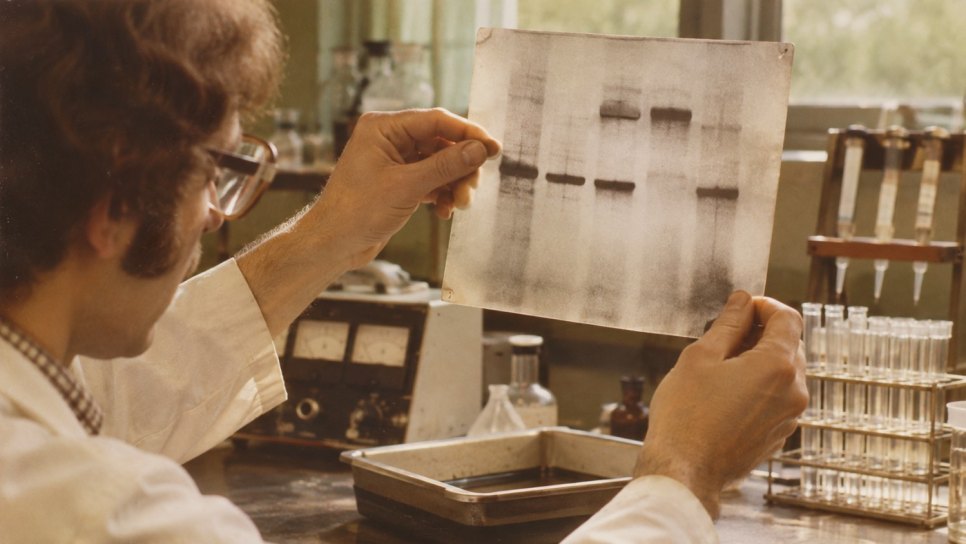
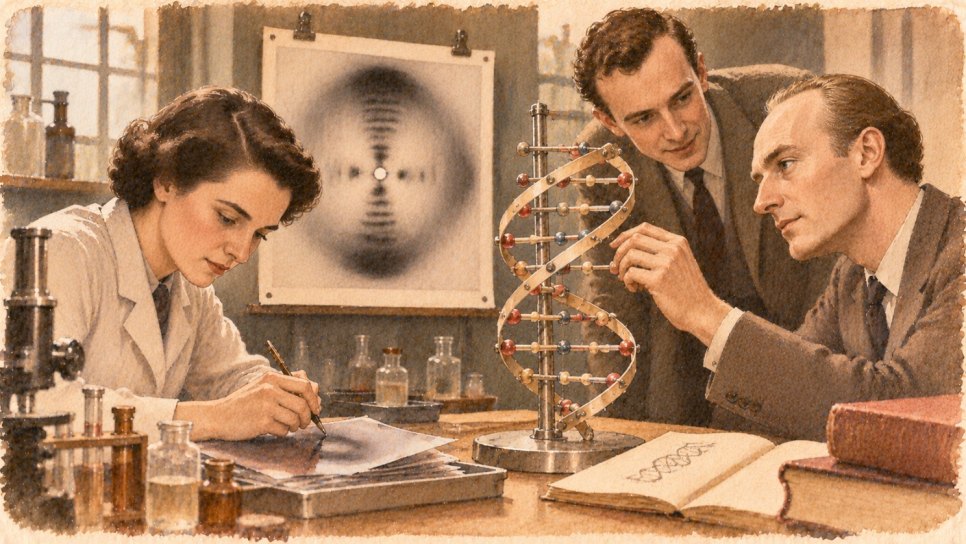
At King's College, Raymond Gosling, Franklin's doctoral student, sent X-rays through a DNA fibre; the frame taken in May 1952 was named "Photo 51" because it was the fifty-first he had taken (Nature, 2013). The photograph showed the B form. Franklin put it aside and turned to the A form. Gosling later gave the photograph to Wilkins, and Wilkins showed it to Watson. The main text of one source says "a few days later"; a footnote in the same source gives the date as 30 January 1953. Watson is reported, in telling it, to have written that his pulse quickened (second-hand).
In December 1952 Franklin's unit received an official MRC visit and an informal report of its work was produced. Max Perutz passed this report to Crick shortly after Watson saw the photograph (Cobb and Comfort). On 25 April 1953 three papers appeared side by side in the same issue of Nature: Watson and Crick's proposal of the double helix (page 737), the paper by Wilkins, Stokes and Wilson (738) and the paper by Franklin and Gosling (740). None of the three went through peer review; publication was arranged through conversations between the editors and the heads of the laboratories. It was John Randall, head of the unit at King's, who persuaded the Nature co-editor Lionel Brimble to publish Wilkins's paper; Franklin's paper was added after she petitioned for it (Nature, 2013). The drawing of the double helix was made by hand by Crick's wife, Odile Crick.
Complementary pairing and the "copying mechanism"
The core of the model was this: two chains coil around a common axis, with the bases inside and the phosphates outside; adenine always pairs with thymine and guanine always with cytosine. That explained Chargaff's ratios: if every adenine is paired with a thymine, the two must be equal in number. At the end of their paper Watson and Crick wrote that this specific pairing immediately suggests a possible copying mechanism (conceptual summary). The second paper, published on 30 May 1953 (Nature 171:964-967), spelled it out: when the chains separate, each becomes a template for a new complementary chain, so that exact duplication of the genetic material becomes possible. It was also proposed that the base sequence along the chain carries the information; how that sequence directs proteins was not explained in the paper.
A molecular address for Boveri's hypothesis
The subject of the 1953 papers is not cancer; the word was not on the agenda of those pages. But a chain can be built. In 1914 Boveri had thought that a tumor might arise from a chromosome defect (Day 98); Avery's work had pointed to heredity being carried in DNA (Day 118). Watson and Crick's model said that hereditary information is held as a sequence and that during copying the new chain is read from the old one. What follows is my inference, not a sentence from the papers: an error made in copying could become a permanent change passed to the cell's descendants. The idea that cancer is a "hereditary but somatic" disease could thus find a physical expression. The proof would come in the following decades.
Watson's own path also turned in this direction after a while: when he became director of Cold Spring Harbor Laboratory in 1968, he chose cancer as the lab's research focus and set up a tumor-virus program (CSHL archive). In the same year his book on the discovery of the structure of DNA was published.
Cost and limit: the question of whose it was
The first cost is a question of fairness. In their paper Watson and Crick wrote that they had been stimulated by knowing the general nature of unpublished results from King's, and stated that they were not aware of the details. Cobb and Comfort find this last claim strained: the photograph had reached them through Wilkins and the MRC report through Perutz, without permission being asked. According to the same assessment, a 1954 paper stated that without Franklin's data the finding of the structure would have been most unlikely (conceptual summary; second-hand). Gosling's name does not appear in the 1953 paper.
The second is the limit of the single-photograph story. The same two authors argue that one photograph cannot establish an exact structure, and that Franklin's other measurements were more decisive. In their view Franklin was not a victim but an equal member of the quartet that solved the double helix; that is an interpretation, and whether Franklin could have solved the structure on her own appears in secondary sources as "hotly debated". According to Gosling, Franklin was not angry; she said that everyone stands on one another's shoulders.
The third is Franklin's own story. She lost her life on 16 April 1958, aged 37; the official record gives ovarian cancer. It is sometimes written that exposure to X-rays may have been a possible factor, and there were other cancers in the family; but the sources do not establish a cause, and neither do I. The 1962 Nobel Prize in Physiology or Medicine was shared equally by Watson, Crick and Wilkins; Franklin's loss of life coincided with the practice that the prize is not awarded to people who have lost their lives.
What remains
- Complementary base pairing and the idea of copying from a template
- The frame that information is carried in the base sequence
- A molecular language able to connect error with hereditary change
What fell or was limited
- The "one photograph, one discovery" story
- The simple tale that Franklin did not grasp the meaning of her own data
- Remembering the discovery as the work of only two names
Events around the double helix, May 1952 to May 1953. The axis runs from 1 April 1952 to 1 July 1953. That Photo 51 was taken in May 1952, that an MRC report appeared in December 1952, that the photograph was shown to Watson in January 1953 and that the three papers were published on 25 April 1953 rests on the sources; the date of 30 January comes from a footnote, and the day in December 1952 comes from no source, which is why it is drawn as a month.
I did not look for a local link in this article
I could not find a verified source on when the double-helix model was first introduced in Türkiye, or on a Turkish name in this story, and I did not invent a link. A general inference (not from a source): the genetic tests done in hospitals in Türkiye today, whether for inherited cancer predisposition or tumor sequencing, rest on the base-sequence framework described in this article.
From 1944 to today
What was confirmed, what conflicts
- Publication date: 25 April 1953, Nature 171:737 (Nature pieces of 2019 and 2013). A web transcription of the paper shows the text dated "2 April"; the printing date and the signing date may differ. I did not see the original printing.
- Paper pages: Watson-Crick 737, Wilkins-Stokes-Wilson 738-740; the Franklin-Gosling paper begins on 740. I did not verify its end page.
- Date of Photo 51: May 1952 (Nature, 2013); a secondary source says 2 May 1952. I could not verify the "62-hour exposure" found on a blog, and did not use it.
- The showing of the photograph: "a few days later" (main text) or 30 January 1953 (footnote); the 2019 Nature piece says "early 1953". Whether it was shown with or without permission is disputed: according to one account Franklin was not asked; according to others Gosling gave the photograph to Wilkins when Franklin was leaving. A secondary source reports Gosling saying in 2013 that Franklin knew her data had been used.
- The MRC report: December 1952, from Perutz to Crick (Cobb and Comfort). Perutz's later defence of himself in Science is undated in the source.
- The "not aware of the details" statement: from the transcription of the paper; the label "strained" belongs to Cobb and Comfort. I did not see the statement in the 1954 paper directly; I report it from this summary.
- Franklin's move to Birkbeck: mid-March 1953 (secondary source).
- Franklin's loss of life: 16 April 1958, aged 37. Official record: bronchopneumonia, secondary carcinomatosis and ovarian cancer (secondary source). For radiation exposure, the source says it is "sometimes considered a possible factor" and its citation is unclear; the same goes for family history. I read nothing about BRCA in any source, and did not write it.
- The Nobel rule: one source says the committee does not nominate people who have lost their lives; Wikipedia's main text and its footnote describe it differently. I did not reach the full text of the rule.
- Watson's pulse: through Melinda Baldwin's account, second-hand.
- The Cobb-Comfort thesis: "equal contribution" is an interpretation; on the other side, the source summary notes that whether Franklin could have solved the structure alone is debated and that Gulland had put forward the sequence idea earlier, in 1947.
- The Eagle pub, 28 February 1953: a weak institutional page; I did not use it.
- Chargaff's year: the source says "late 1940s"; I did not verify the year in the paper's reference list.
- Content of the second paper: the source summaries do not mention mutation; the bridge to cancer is therefore my inference.
- Watson, 1968: the CSHL archive page links this period with the grants of the national cancer program that would come in 1971; the law is from 1971, and I did not take this anachronistic wording.
- Wikipedia: used as a secondary source only for a few dates; not entered in the source list.
Lasker and Congress (1954)
So far we have seen laboratories, hospitals and papers. But who found the money for all of it? In 1954, who steered the race to set a budget for cancer research in Congress? What sort of figure was Mary Lasker, how was the NCI's drug program born, and what was the price of that money? Tomorrow I will tell it, after checking the dates and the records.
Author's note: The easiest route for this article was a discovery story with two names; I told a story with four names, three papers and sources that do not always agree. I did not draw the bridge to cancer from the papers; I marked it as my own inference. I noted the publications I did not read in the fact-check box and in the sources.
Sources and Further Reading
- Watson JD, Crick FHC. A structure for deoxyribose nucleic acid. Nature 1953;171:737-738 (a web transcription was read; the original printing was not seen).
- Wilkins MHF, Stokes AR, Wilson HR. Nature 1953;171:738-740 (citation only; the paper was not read).
- Franklin RE, Gosling RG. Molecular configuration in sodium thymonucleate. Nature 1953;171:740 and the following page (citation only; the paper was not read).
- Watson JD, Crick FHC. Genetical implications of the structure of deoxyribonucleic acid. Nature 1953;171:964-967 (only source summaries were read).
- Cobb M, Comfort N. What Rosalind Franklin truly contributed to the discovery of the structure of DNA. Nature 2023 (doi:10.1038/d41586-023-01313-5; read; secondary).
- Nature. Piece for the 60th anniversary of the 1953 papers, Nature 2013;496:270 (read; secondary; title not verified).
- Nature. 2019 piece on the 1953 papers, doi:10.1038/d41586-019-02554-z (read; secondary).
- Nobel Prize Outreach. The Nobel Prize in Physiology or Medicine 1962 (nobelprize.org; read).
- Cold Spring Harbor Laboratory Archives. "1968: A Banner Year for Watson" (read; institutional page).
- Cosmos Magazine. "This week in science history: the dark lady of DNA dies" (read; secondary).
- Maddox B. Rosalind Franklin: The Dark Lady of DNA. HarperCollins, 2002 (not read; further reading).
- Mukherjee S. The Emperor of All Maladies: A Biography of Cancer. New York: Scribner, 2010. (Not separately verified for this article.)
This article is Day 129 of the "365 Days of Cancer History" series and tells the publication of the double-helix model of DNA in 1953 as a historical event. It is historical-popular content; it is not a diagnosis or treatment recommendation. Consult your physician for decisions about your health. Sources have been verified; details that rest only on a secondary source are noted in the fact-check notes.
Was this article helpful?
Your feedback helps us improve our content.