A Protein of Unknown Identity: The First Appearance of p53, 1979
In this article
A Protein of Unknown Identity: The First Appearance of p53, 1979
On Day 164 we saw an example suggesting that cancer comes neither from the environment alone nor from genes alone. Today that thought moves down to the level of the molecule, though nobody knew it at the time: in 1979 several laboratories saw a band of about 53 thousand in weight on a gel and gave it different names. Eleven years later this band would turn out to be the product of the gene behind the Li-Fraumeni families we left as a question mark on Day 148. Under the shadow of the oncogene idea from Day 160, it would long be searched for in the wrong place. As I promised in yesterday's tomorrow box, I verified who published it, in which journal and in which month; I explain why it was taken for an oncogene; and I leave the detail of the identity change of 1989 for that day.
A band beside a viral protein
The story begins with a monkey virus. SV40 (simian virus 40) is a virus that can make rodent cells behave like tumour cells; to do so it writes the large T antigen, which is needed to start and maintain the transformation. According to the Embryo Project Encyclopedia, when Peter Tegtmeyer and colleagues at Stony Brook precipitated this protein in the mid-1970s (Journal of Virology 1975 and 1977), they also found a protein of about 50 thousand in weight in the samples and did not pursue it. This is a detail reported by a single secondary source; I did not read the papers myself.
London: the cell protein that T antigen sticks to
According to the same source, David Lane had been a postdoctoral researcher in Lionel Crawford's laboratory at Imperial College in London since 1976 and, with the technician Alan Robbins, had prepared better T antigen sera. Lane and Crawford's paper in Nature (volume 278, pp. 261-263; March 1979) reported that in an SV40-transformed mouse cell line T antigen forms an oligomeric complex with "a specific cell-coded protein" (free rendering of the abstract). The protein weighed about 53 thousand. So the question was no longer the viral protein alone: the virus was clinging to a protein of the cell itself.
Where does the name "p53" come from?
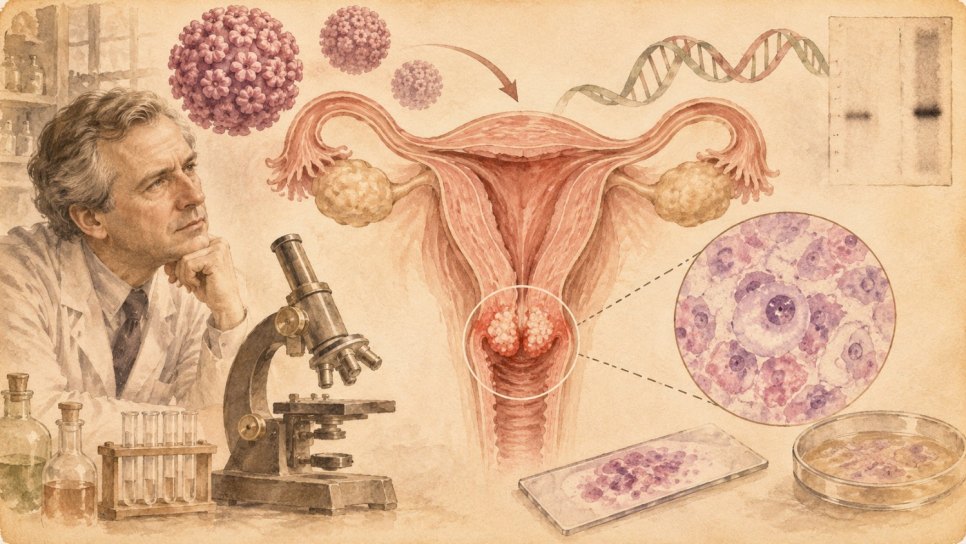
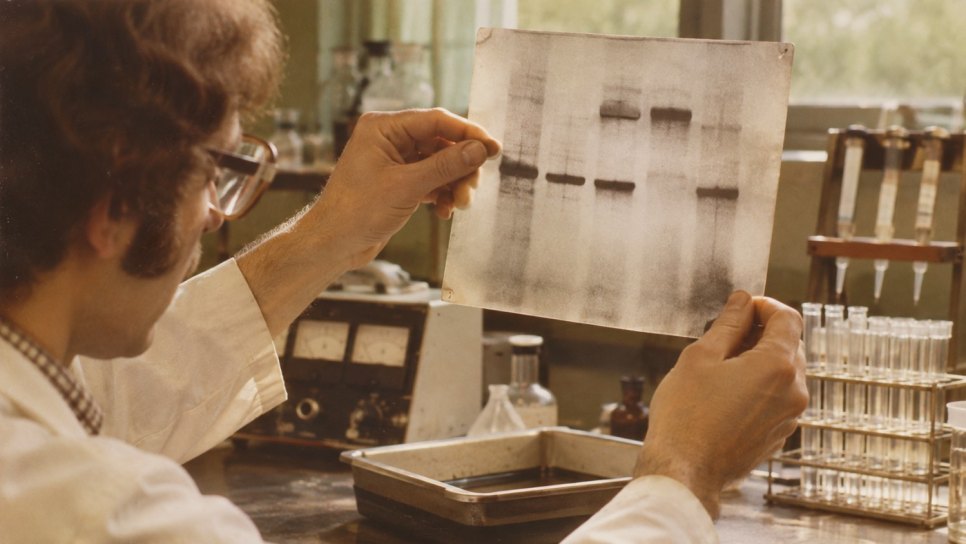
A protein is weighed by the position at which it runs on a gel; the unit is the "dalton", and a protein of 53 thousand daltons is called "53K" or "p53" (p stands for "protein"). The name itself is a measurement result, not a function. That is why it was not surprising that different laboratories reported the same protein with different numbers between 48 and 55 thousand; the explanation proposed by the Embryo Project is that gel conditions differed. This is a plausible guess, not something proven.
The same band, five laboratories
About two months after Lane and Crawford, Daniel Linzer and Arnold Levine at Princeton reported in Cell (volume 17, pp. 43-52) a 54-thousand cellular protein in SV40-transformed cells and in embryonal carcinoma cells that had never met the virus. According to peptide mapping, this protein was not a piece of T antigen itself. In other words, the protein looked like a product of the cell rather than of the virus, and it was found in cells without the virus too. Levine's laboratory called it "54K".
In May 1979 a third step came. Albert DeLeo, Lloyd Old and colleagues, from a cancer research centre in New York, reported in PNAS (volume 76, pp. 2420-2424) that sera prepared against the Meth A sarcoma recognised a protein of 53 thousand in weight in transformed BALB/c cells, and gave it the name p53 (according to the Embryo Project). According to the abstract the protein was absent from normal adult mouse fibroblasts and from lymphoid and haematopoietic cells, and from embryo and 3T3 cells; it was present in chemically induced sarcomas, in leukaemias and in all cells transformed by SV40 or by murine sarcoma virus. The authors suggested that the protein was coded by cellular genes, but did not exclude an endogenous virus or the transforming virus as its source.
This picture recalls the trio of Days 97, 98 and 99: virus (Rous), chromosome (Boveri), chemical (Yamagiwa). DeLeo and colleagues' tumours had been produced both by viruses and by chemicals, and the same protein was present in both. This is not proof of causation but an observation of an association: the protein was found in tumour cells, but what the protein did remained an open question.
In the same year Chang and colleagues and Kress and colleagues in the Journal of Virology (volume 31, pp. 463-471 and 472-483), Melero and colleagues in Virology (volume 93, p. 466) and Smith, Smith and Paucha in Cell (volume 18, p. 335) reported similar proteins. These reports came from independent laboratories; Oren's account of 2019 writes that the minor reports were in time "pushed into the backstage". Whose name is attached depends on who is telling. For this reason I do not point to a single person or laboratory as the "discoverer"; that Lane and Levine shared the Brupbacher Prize in 1993 is also from the Embryo Project.
1982-1985: cloning a protein
In 1982 Sarnow and colleagues (Cell) showed that the E1B 58K protein of adenovirus and SV40 T antigen bind the same 54K cellular protein: two different viruses had turned toward the same cell protein. In 1983 Oren and Levine cloned the cDNA of mouse p53. The human p53 cDNA was published in 1984-85 (Matlashewski et al., EMBO J; Harlow et al., Mol Cell Biol; Zakut-Houri et al., EMBO J).
At this stage one could ask what the protein of a "cell gene" did, and the answer came out, unexpectedly, in the direction of "it advances cancer".
Did overproduced p53 disturb the behaviour of cells?
In 1984 the papers of the separate teams of Eliyahu, Parada and Jenkins in Nature reported that p53 together with the ras oncogene could transform primary cells and could allow rodent cells to multiply without limit; in 1985 Eliyahu and colleagues showed that overproduction made established cells tumour-forming. The grounds supported one another: p53 was often at high levels in tumour and transformed cells; it formed stable complexes with viral transforming proteins such as SV40 large T antigen and adenovirus E1B-55K; and when overproduced in experiments it disturbed the behaviour of cells. The field therefore counted p53 as an oncogene; according to Oren it was not as prominent an oncogene as Myc.
This was a hypothesis, and the reliability of the experiments rested on a single assumption: that "the clones used are the normal p53 gene". When and how this assumption collapsed, which clone turned out to be different, and the reversal of 1989 I will tell separately; in the plan this topic falls on another day (by plan number, Day 180). Today I say only this: the sentence "p53 is an oncogene" was in the mid-1980s not a wrong conclusion but a conclusion in keeping with the experiments of the day. The motif of science correcting itself begins right here.
According to Oren's account, at this time some observations pointed in a different direction: the studies by Rotter, and by Benchimol and Bernstein, reporting that p53 expression was lost in some tumour cells had largely been ignored. This could be another example of the "rejected precursor" motif; but it comes from a single source, and from the pen of a participating scientist.
Cost and limits
The first limit is that this was a laboratory finding. DeLeo and colleagues' tumours were mouse tumours; Lane and Crawford's cells were a mouse cell line. In 1979 it brought no test, no diagnosis and no treatment to any patient. That the p53 protein was found in tumour cells did not mean it could be read as a sign of a cancer in humans; there was no data to say so.
The second limit is the question of "the same protein". Five laboratories reported different numbers between 48 and 55 thousand, and that these were the same protein was settled not by the reports but by later accumulated work (the shared binding of Sarnow 1982, the cloning). The third limit is naming: who was "first" and which laboratory's finding was pushed forward is in part the weight of history; small reports were in time pushed into the backstage (Oren). The fourth cost is time: according to the Embryo Project, it took about ten years to understand that p53 was not an oncogene product but a tumour suppressor. Some of the experiments run in that decade were, as later understood, done with mutant clones; the detail is on Day 180.
The last cost is human. The Li-Fraumeni families we described on Day 148 had been a question mark since 1969. Malkin and colleagues found germline p53 mutations in all five families examined in 1990: that means "five out of five", and it could come only in 1990. Between the band of 1979 and this finding lie eleven years.
What remained
- The complex of SV40 T antigen with a cell protein (Lane and Crawford, 1979)
- The idea that the protein is a product of the cell, not of the virus (Linzer and Levine; DeLeo et al.)
- The naming and the method: immunoprecipitation, weight on the gel, cloning
What fell or was limited
- The belief that "p53 is a viral protein"
- The conclusion that "p53 is an oncogene" (1984-85); detail on Day 180
- The story of a discovery by a single laboratory
The first years of p53: 1975-1990. The axis runs from 1970 to 1993. Green marks are dates confirmed by more than one record; the blue mark rests on a single source. Dates known only by year are drawn mid-year; the May 1979 dates are placed in the middle of the month.
When you see "TP53" in a report
I could not find a verified Türkiye link for these first years of p53, and I did not invent one. I write a general inference: when a patient sees "p53" or "TP53" in a report, what is being read is the name of a band of about 53 thousand daltons measured on a gel in 1979; inside the name there is no function, only a leftover of a measurement. The name is not a conclusion about a gene; what a result means needs to be discussed with the physician, within the patient's own situation.
From 1975 to today
What was verified, what remained uncertain
- Day 158: Köhler and Milstein are still unwritten; the promise in the Day 157 tomorrow box was not kept.
- "First" claim: According to the Embryo Project, Lane and Crawford published in March 1979, Linzer and Levine about two months later, and DeLeo and colleagues in May 1979. The day of the Nature issue and the month of the Cell issue were not read directly; I relied on the order in the sources. All are described as "independent"; I named the parallel discoverers.
- Precursor: Tegtmeyer's 1975-77 observation comes from a single source (Embryo Project); I did not read the papers.
- Name: That the name "p53" comes from DeLeo and colleagues' PNAS paper is written in the Embryo Project; Levine's laboratory said "54K". The explanation that attributes size differences to gel conditions is that source's guess, not proven.
- Institutions: Which institution Kress and Chang belonged to is not matched in the source (an institute in France and a US institution are mentioned); I did not match them either.
- Participant accounts: Oren (2019) is the piece of a person inside the p53 work; the "pushed into the backstage" reports, the ignoring of Rotter and Benchimol-Bernstein, and the phrase "an oncogene not as prominent as Myc" come from this account. I verified only the citation of the Levine and Oren (2009) review; I did not read its text.
- Oncogene papers: I did not verify the page numbers of the Nature 1984 papers of Eliyahu, Parada and Jenkins or the citation of the 1985 paper; I wrote only volume and year. The citations of Matlashewski, Harlow and Zakut-Houri (EMBO J 1984, Mol Cell Biol 1985, EMBO J 1985) are from a secondary source; I did not read the papers.
- Mutant clone: The abstract of Finlay, Hinds and Levine's 1989 paper (read as a PDF summary) says the earlier p53 clones carried activating mutations; Oren's account writes that the Pennica clone was the only "wild-type" clone. Here I indicated only the direction; the detail is on Day 180.
- Baker 1989 and Malkin 1990: The abstracts were read; the author list was read in full only for Malkin, and for Baker I wrote "et al.".
- Lane 1992: Only the citation and title were verified; I did not read the content of the piece and wrote no claim beyond the title.
- Awards: The 1993 Brupbacher Prize (Embryo Project) and Science "Molecule of the Year" (Oren) come from a single source each; no independent verification.
- Plan: p53 appears twice in the plan (172 and 187). This article covers the discovery and the oncogene era; the 1989 reversal and the tumour suppressor identity will come later.
- Türkiye: No verified link was found; written as a general inference.
The Belmont Report, 1979: three principles that protect the person in research
Today we left the laboratory of 1979; tomorrow I will turn to another document of the same year, a text that contains no cells but changed cancer research: the Belmont Report. On Day 121 I told the story of the Nuremberg Code; tomorrow I will follow the continuation of that line in the United States. Before writing I will verify the publication date of the report, the name of the commission that prepared it, and the names of the three principles; I will mention Tuskegee only as context, because it is a subject large enough to deserve its own day.
Author's note: What I watched most closely in this article was not answering the question "who discovered it" with a single name: several laboratories saw the same band in the same year, and which of them is put forward depends in part on the narrator. My second care was to tell the oncogene belief not as a mistake but as a hypothesis in keeping with the experiments of its time, and to leave its detail, as I promised, for Day 180.
Sources and Further Reading
- Lane DP, Crawford LV. T antigen is bound to a host protein in SV40-transformed cells. Nature 1979;278(5701):261-263 (abstract read).
- Linzer DIH, Levine AJ. Characterization of a 54K dalton cellular SV40 tumor antigen present in SV40-transformed cells and uninfected embryonal carcinoma cells. Cell 1979;17:43-52 (citation from the Embryo Project; paper not read).
- DeLeo AB et al. Detection of a transformation-related antigen in chemically induced sarcomas and other transformed cells of the mouse. Proc Natl Acad Sci USA 1979;76(5):2420-2424 (abstract read).
- Levine AJ, Oren M. The first 30 years of p53: growing ever more complex. Nat Rev Cancer 2009;9:749-758 (citation only verified; participant account).
- Oren M. p53: not just a tumor suppressor. J Mol Cell Biol 2019;11(7):539-543 (read; participant account).
- Finlay CA, Hinds PW, Levine AJ. The p53 proto-oncogene can act as a suppressor of transformation. Cell 1989;57(7):1083-1093 (read through a PDF summary).
- Baker SJ et al. Chromosome 17 deletions and p53 gene mutations in colorectal carcinomas. Science 1989;244(4901):217-221 (abstract read).
- Malkin D, Li FP, Strong LC, Fraumeni JF et al. Germ line p53 mutations in a familial syndrome of breast cancer, sarcomas, and other neoplasms. Science 1990;250(4985):1233-1238 (abstract read).
- Embryo Project Encyclopedia. The Discovery of p53 Protein, embryo.asu.edu (read through a summarising tool; secondary source) and Lane DP. p53, guardian of the genome. Nature 1992;358:15-16 (citation only).
- Mukherjee S. The Emperor of All Maladies: A Biography of Cancer. New York: Scribner; 2010 (general context; the relevant pages were not re-read for this article).
This article is Day 165 of the "365 Days of Cancer History" series and presents the first reports of the p53 protein as a historical reading. It is historical-popular content; it is not diagnostic or treatment advice. For the results in a report, consult your physician. The sources have been verified; details that rest on a single secondary source, on a summary only, on a participant's account or on a text that could not be read are marked in the fact-check notes.
Was this article helpful?
Your feedback helps us improve our content.