From Wart to Cervical Cancer: zur Hausen's Hypothesis and the Trace of HPV, 1976
In this article
From Wart to Cervical Cancer: zur Hausen's Hypothesis and the Trace of HPV, 1976
On Day 160 we saw that a cancer gene came not from the virus but from inside the cell itself. Today we turn the view around: could a DNA virus from outside be the cause of cervical cancer? Let us keep the fronts of this disease together: on Day 93 we told treatment through Wertheim, on Day 103 early detection through Papanicolaou, and on Day 106 we looked at Shope's rabbit papillomavirus. Today comes the third front: cause. As I promised in yesterday's "tomorrow" box, I checked Harald zur Hausen's 1970s work (its citation and date), the later HPV-16 and HPV-18 findings, and the 2008 Nobel citation against their sources, keeping hypothesis and evidence apart.
Turning to the wart while looking for herpes
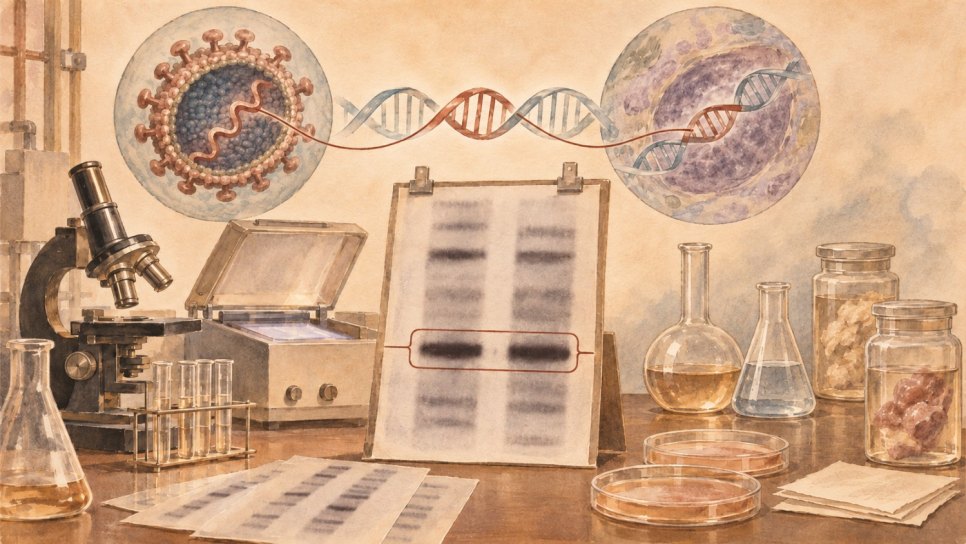
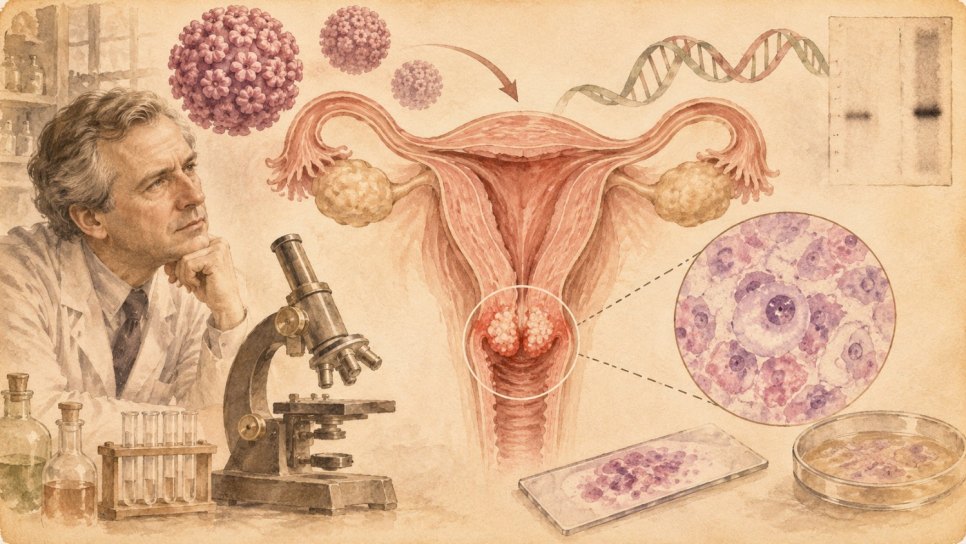
In the 1970s the leading suspect for the possible cause of cervical cancer was herpes simplex virus type 2 (HSV-2); the Nobel Committee's 2008 advanced-information page calls it "the prevailing HSV-2 hypothesis" of the time. According to the chronology of the ASU Embryo Project, zur Hausen, at the Institute of Clinical Virology in Erlangen-Nuremberg, searched cervical samples for HSV-2 DNA by nucleic acid hybridization and repeatedly failed to find it; the source places this work in 1972-1977. These negative results turned him in another direction: HPV DNA had been found in genital warts. The Nobel page also notes that the link between genital warts and malignant conversion had long been known.
An important distinction applies here. A hypothesis was not evidence but a heading: a proposal to look where nobody was looking. And the place to look was not easy even by the standards of the day. According to the Nobel page, zur Hausen added a criterion to Koch's postulates; in the summary of the ASU Embryo Project this is that the tumour of a virus-caused cancer must contain viral DNA. In other words, proof would come from finding the genetic trace of the virus inside the tumour. I am relaying this from two secondary pages that I read with a summarising tool.
"Condylomata acuminata and human genital cancer"
The hypothesis appeared in Cancer Research in 1976 under the title "Condylomata acuminata and human genital cancer" (volume 36, first page 794; the ASU Embryo Project page gives only the first page and the month of publication as February 1976, which I could not confirm in another source). According to what the Nobel page reports, zur Hausen wrote in this piece that the genital wart agent had so far been entirely neglected in epidemiological and serological studies of cervical and other genital cancers (conceptual summary). In the Embryo Project's summary, his proposal was this: genital warts caused by HPV could lead to cervical cancer, and the tumour of a virus-caused cancer should contain viral DNA. I did not read the paper itself; I read only the account on these two secondary pages.
In the same years another profession was approaching the same door: cytologists. According to Kari Syrjänen's 2017 article in Acta Cytologica, the 1976 paper by Meisels and Fortin (volume 20, 505-509) and the 1977 paper by Purola and Savia (volume 21, 26-31) recognised koilocytotic cells in Pap smears and, in the source's wording, were the first to recognise that cervical dysplasias are of viral origin. The same article, citing Koss's testimony, reports that the Purola and Savia paper reached the journal on 13 May 1975 and the Meisels and Fortin paper on 11 December 1975, but that the order was reversed in publication. These come from a single secondary source; I have not seen the original papers. This parallel path is a rare moment when the early-detection test we told on Day 103 supplied evidence for the question of cause.
HPV type (genotype)
Human papillomavirus (HPV) is not a single virus but a family with many types; the types are numbered according to their DNA sequences. Types differ in which tissue and what kind of lesion they are associated with. Two clusters matter in this story: HPV-6 and HPV-11, found in genital warts, and HPV-16 and HPV-18, frequently found in cervical cancers. This is a simplified definition that gives the main line.
The arrival of evidence: 1983 and 1984
The first guess turned out to be partly wrong. According to the ASU Embryo Project, between 1980 and 1982 zur Hausen and his team (Gissmann, Dürst, Boshart, Ikenberg, Wagner) at the Institute of Virology of the University of Freiburg identified the two types in genital warts, HPV-6 and HPV-11; but these types were rare in tumours. So the initial assumption "the wart virus is the cancer virus" did not hold. What stayed right was the direction of the search. According to the Nobel page, probes based on HPV-11 gave weak but persistent cross-hybridization with some cervical cancers; this DNA was cloned and named HPV-16. The citation: Dürst, Gissmann, Ikenberg and zur Hausen, PNAS 1983, volume 80, pages 3812-3815 ("A papillomavirus DNA from a cervical carcinoma and its prevalence in cancer biopsy samples from different geographic regions").
As relayed by the Embryo Project, cervical biopsies from German, Brazilian and Kenyan patients were examined; HPV-16 was found in more than half of the German biopsies and in fewer than half of the Brazilian and Kenyan ones. This is a qualitative summary from a single secondary source; I have not verified the numbers myself. A year later, in 1984, low-stringency hybridization with a mixed HPV-9/10/11 probe led to the cloning of HPV-18 (Boshart et al., EMBO J 1984, volume 3, pages 1151-1157; I took the citation from the Nobel page's reference list and the chronology and did not read the paper's content).
This is an example of how a finding becomes proof of causation. Finding viral DNA in a tumour shows an association; further steps were needed to show that the association was causal. The Nobel page's reference list gives Schwarz and colleagues' 1985 report in Nature that HPV DNA is integrated into the genome of cervical cancer cells (integration) and transcribed there (transcription); I have not read that detail itself. Then came epidemiology: Walboomers and colleagues in the Journal of Pathology in 1999 re-examined 66 cases that had tested HPV-negative in an earlier study; with inadequate specimens excluded, the two studies together reported a worldwide HPV prevalence of 99.7% in cervical carcinomas. The paper's title declares HPV a "necessary cause" of invasive cervical cancer; that is the authors' own inference.
In 2008 half of the Nobel Prize in Physiology or Medicine went to zur Hausen, with the citation "for his discovery of human papilloma viruses causing cervical cancer". The other half went to Barré-Sinoussi and Montagnier for the discovery of HIV. While stating that the vaccines gave more than 90% protection in phase III trials (what they protected against is not specified in the text I read), the same Nobel page says openly that whether the vaccines truly prevent cervical cancer and the loss of life from it depends on epidemiological data to be collected over the coming decades. In other words, even when the prize was awarded, the question was not entirely closed.
Limits and cost
The hypothesis began with a wrong detail: the wart types first suspected (HPV-6 and HPV-11) were rare in cancer; the types frequent in cancer, HPV-16 and HPV-18, were found later. Finding the virus also treated no patient; vaccines and screening programmes belong to a time long after the finding. The 2008 Nobel page's own cautions still sketch a valid frame: the duration of vaccine protection is uncertain, and it is unknown whether other types will gain importance in the future. The frequency of HPV-16 also varied by region (the German, Brazilian and Kenyan samples), so type distribution can differ by geography.
One more distinction: a positive HPV result is not a cancer diagnosis. This is general medical knowledge that this article's sources do not treat separately. For interpretation of results, screening and treatment decisions, a physician should be consulted.
What remained
- That cervical cancer is virus-caused and that certain HPV types (especially 16 and 18) are associated with this cancer
- Searching for viral DNA in tumours by hybridization, as a type of evidence in the discussion of causation
- The idea that blocking an infection could prevent a cancer
What fell or was limited
- The initial assumption "the wart virus is the cancer virus" (HPV-6 and HPV-11)
- The view that HSV-2 was the main suspect for cervical cancer (HSV-2 DNA could not be found)
- The impression that a single virus type carries the same share in every geography
From papillomavirus to the Nobel: 1933-2008. The axis runs from 1930 to 2010. Green marks are dates confirmed in more than one record or in the primary record; blue marks and bars rest on a single source or are ranges. Dates known only to the year are drawn mid-year.
Looking for HPV in a national screening programme
I found no verified link between zur Hausen and Türkiye and I do not construct one. I relay the present state of the subject in Türkiye from Euronews Türkçe's report of 18 August 2026 (author: Çağla Üren); this is a news text, not an original study, and the figures are the values the report relays. According to the report, Türkiye moved cervical cancer screening to HPV-DNA testing in 2014; women aged 30-65 are offered a free test every five years. In the national programme's 2018 data on the first one million women, HPV positivity is relayed as 3.5%, and in 2020, among 4,099,230 women, as 4.39% (about 180,000 women). The type distribution among HPV-positive women is listed as: HPV-16 20.7%, HPV-51 10.8%, HPV-31 8.7%, HPV-52 7.1%, HPV-18 5.1%. The report also relays that an Istanbul hospital study of 2018-2020 found 36.3% positivity and notes that this reflects a group presenting to hospital, not the general population.
According to the report, the ICO/IARC note on Türkiye attributes about 67.6% of invasive cervical cancers to HPV-16 or HPV-18; the report also writes that worldwide these two types are held responsible for roughly three quarters of cancers (about 76%, a WHO/IARC 2024 analysis). The same report writes that, as of 18 August 2026, the HPV vaccine was not part of the national immunisation programme ("Aşılama programı halen başlatılmadı", the vaccination programme has still not started); it also relays the Health Minister's remarks of 15 August, which prompted debate about whether it would be added to the national programme. This article is not an evaluation of vaccine policy; I have not verified later developments.
From 1933 to today
What was confirmed, what stayed uncertain
- Day 158: Köhler and Milstein are still unwritten; the promise in Day 157's "tomorrow" box has not been kept.
- Citation and date: zur Hausen, "Condylomata acuminata and human genital cancer", Cancer Research 1976;36:794. Two sources give the year (the Nobel advanced-information page, the ASU Embryo Project); only the first page number is given. The month of February is from the Embryo Project alone. Syrjänen (2017) writes that the hypothesis was formulated in zur Hausen's 1975 and 1976 publications and most fully in a 1977 review (Curr Top Microbiol Immunol 1977;78:1-30). So the plan's 1976 is the known publication year of the hypothesis, but the idea is said to reach back to 1975.
- Nobel citation: "for his discovery of human papilloma viruses causing cervical cancer", half of the prize (the Nobel Prize summary page). The press-release page could not be opened; the advanced-information page was read with a summarising tool, and the page's own title reads "The discoveries of human papilloma viruses that cause cervical cancer and of human immunodeficiency virus".
- HPV-6/11 and HPV-16: the 1980-82 wart work and the rarity of HPV-6/11 in tumours are from the ASU Embryo Project (a single secondary source); the same page has inconsistencies: the title says 1977-1987, the Erlangen work is 1972-1977, a 1984 J Invest Dermatol paper is cited for the 1980-82 work; "Kenyan" is used in 1983 and "African" in 1984. I did not use the numbers on how often HPV-16 occurs by region, and wrote only the qualitative summary. The Dürst 1983 citation is consistent across three sources (the Nobel page, the Embryo Project, a medical-history bibliography); the paper's abstract could not be read because of the verification wall at PubMed and PMC.
- HPV-18: the Boshart 1984 citation is from the chronology and the Nobel page's reference list; the content was not read directly. The Nobel page does not give the year in the text, only in the reference list.
- The percentages seem to conflict; they do not, but I could not reconcile them: on the Nobel 2008 page HPV-16 and HPV-18 are in 82% of patients with invasive cervical cancer; in Euronews about 76% worldwide (WHO/IARC 2024) and 67.6% for Türkiye (ICO/IARC); in Walboomers all HPV types together 99.7%. These are different datasets, periods and definitions; I did not convert them into one another.
- Walboomers 1999: read from an abstract page (qxmd); the author list, volume and page numbers were not on the page, so I did not write them. "Necessary cause" is the paper's title; the 99.7% was calculated by excluding inadequate specimens and combining two studies.
- Cytologists: the Meisels-Fortin and Purola-Savia citations, the dates of reaching the journal (Koss's testimony) and the "first to recognise" characterisation are from a single secondary source (Syrjänen, Acta Cytol 2017;61:316-337); the original papers were not seen, so I attributed the "first" claim to the source.
- Shope: the sources I used do not base zur Hausen's hypothesis on Shope; the Nobel advanced-information page does not mention Shope. The link with Day 106 should be read only as a sequence within the papillomavirus family, not as a chain of influence.
- Vaccine efficacy: "more than 90% protection in phase III trials" is a sentence of the Nobel 2008 page; the endpoint it refers to was not in the text I read, so absolute and relative reductions could not be given.
- Türkiye: the Euronews report (18 August 2026) is a news text; the 2018 and 2020 programme data and the ICO/IARC and WHO/IARC citations were not verified in their original sources. The status of the vaccine programme is as of the report's date.
- Unreadable sources: PubMed, PMC and PNAS (the zur Hausen obituary article) could not be read because of access barriers; they were not used.
A Drug for the Hormone Axis: Tamoxifen, 1977
Today we followed a virus; tomorrow we return to the hormone axis. On Day 91 we told Beatson's removal of the ovaries, and on Day 105 Lacassagne's experiment with oestrogen and tumours. In the plan, tamoxifen appears as 1977. Before writing I will verify the dates of the molecule's synthesis and first clinical use, what the 1977 date is the date of (a publication, an approval, a clinical milestone) and when its mechanism of action was understood, keeping chemistry and clinical evidence apart.
Author's note: What I watched most closely in this article was keeping the 1976 hypothesis apart from the 1983-84 evidence, and saying plainly that the first guess (the wart types) proved wrong while the direction of the search proved right. My second care was to attribute details resting on a single secondary source (the month of publication, regional frequencies, the cytologists' priority claim) to that source, and to pass no verdict in the vaccine and Türkiye sections.
Sources and Further Reading
- zur Hausen H. Condylomata acuminata and human genital cancer. Cancer Res 1976;36:794 (citation from the Nobel advanced-information page and the ASU Embryo Project; the paper itself was not read).
- Dürst M, Gissmann L, Ikenberg H, zur Hausen H. A papillomavirus DNA from a cervical carcinoma and its prevalence in cancer biopsy samples from different geographic regions. Proc Natl Acad Sci USA 1983;80:3812-3815 (citation from a medical-history bibliography and other pages; abstract could not be read).
- Boshart M, Gissmann L, Ikenberg H et al. EMBO J 1984;3:1151-1157 (citation from the chronology and the Nobel page's reference list; paper not read).
- The Nobel Prize in Physiology or Medicine 2008. nobelprize.org: prize summary page (citation and shares) and "Advanced information" page (read with a summarising tool).
- ASU Embryo Project Encyclopedia. Harald zur Hausen's Experiments on Human Papillomavirus Causing Cervical Cancer (1976-1987). embryo.asu.edu (read with a summarising tool; secondary source; the page has inconsistencies).
- Syrjänen KJ. Two landmark studies published in 1976/1977 paved the way for the recognition of human papillomavirus as the major cause of the global cancer burden. Acta Cytol 2017;61(4-5):316-337, karger.com (read with a summarising tool; secondary source).
- Walboomers JMM et al. Human papillomavirus is a necessary cause of invasive cervical cancer worldwide. J Pathol, September 1999 (abstract page, qxmd.com; author list and page citation were not on the page).
- Üren Ç. Kanser yapan türler ve dağılımları: Türkiye'nin HPV profili gerçekten farklı mı? Euronews Türkçe, 18 August 2026, tr.euronews.com (news report; read with a summarising tool).
- Mukherjee S. The Emperor of All Maladies: A Biography of Cancer. New York: Scribner; 2010 (general context; the relevant part was not reread for this article).
This article is Day 161 of the "365 Days of Cancer History" series and presents the recognition of HPV as the cause of cervical cancer as a historical reading. It is historical-popular content; it is not diagnostic or treatment advice. Consult your physician for treatment and screening decisions. Sources have been verified; details that rest on a single secondary source, on only an abstract, or on a text that could not be read are marked in the fact-check notes.
Was this article helpful?
Your feedback helps us improve our content.