The Cancer Face of a Normal Gene: Stehelin, Varmus, Bishop and the Cellular Origin of the Oncogene, 1976
In this article
The Cancer Face of a Normal Gene: Stehelin, Varmus, Bishop and the Cellular Origin of the Oncogene, 1976
On Day 159 we saw the idea of giving a drug after surgery; today we turn the question around: where does the thing that starts a cancer come from? On Day 97 we told Rous's chicken sarcoma of 1911 and named the src gene; the question of that day was still open: did the gene that makes Rous's virus cancerous belong to the virus, or had the virus taken it from somewhere? As I promised in the tomorrow box of Day 159, I have verified today the citation of the Nature paper, its dates and the 1989 Nobel motivation against their sources. The answer was that the cancer gene was not an invention of the virus but a copy of a gene living in the chicken's own cells.
Where had the virus's gene come from?
By the 1960s Rous sarcoma virus was a well-known experimental system. According to a 1988 commentary by Vogt, Hanafusa and colleagues had shown in 1963 that Rous virus was defective, that is, unable to produce infectious progeny yet able to transform the cell; this suggested that some genes were not needed for transformation, and that the viral genome might carry specific "cancer information". Vogt writes that this foreshadowed the later discovery of oncogenes. According to the historical page of the National Library of Medicine (NLM), the oncogene of Rous virus, SRC, was identified in 1970; the page does not say who did it.
In 1969 Robert Huebner and George Todaro of the NIH had published the "virogene-oncogene" hypothesis in PNAS (volume 64, pages 1087-1094): vertebrate cells carry the information to produce C-type RNA viruses; this information includes cellular oncogenes that cause transformation; carcinogens, radiation and ageing act by awakening these inherent oncogenes and lead to cancer. According to Huebner's own assessment in 1981, the idea was controversial from the very start. So I present it not as "confirmed" but as "a precursor partly tested later"; below I write separately what remained.
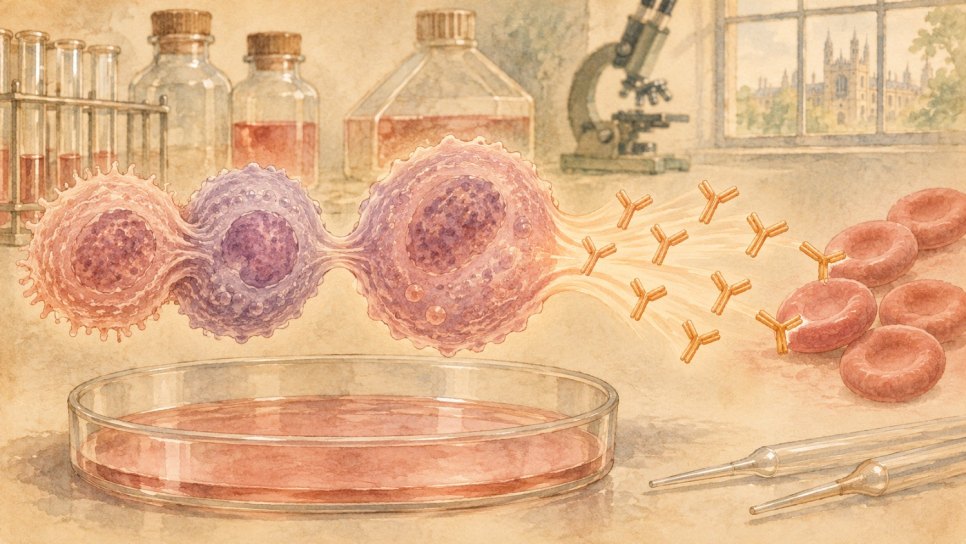
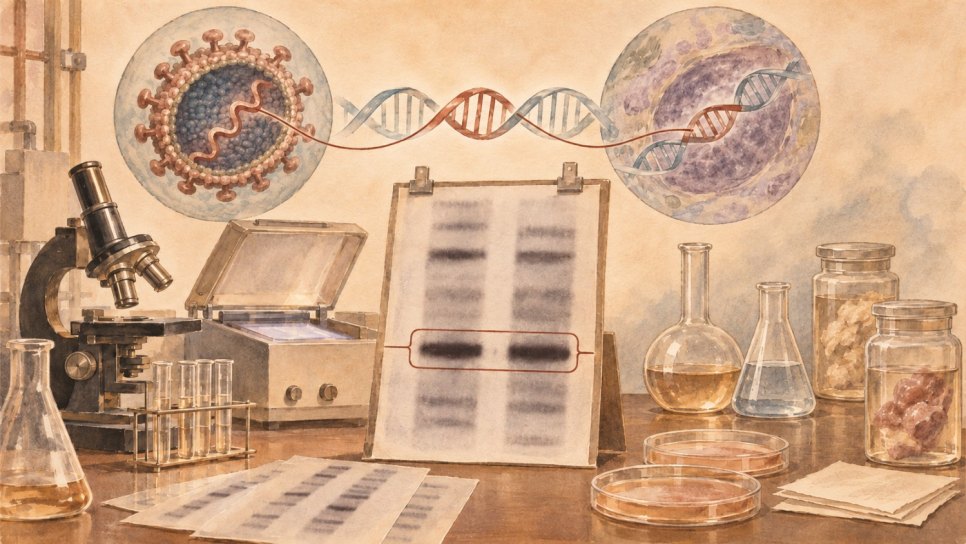
According to Bishop's 1989 Nobel lecture, his group began work on cellular src in 1972-73; the aim was not to look for the origin of oncogenes, but to test the viral oncogene hypothesis. The technical key was Peter Vogt's transformation-defective mutants of Rous virus (Varmus gives their isolation as 1971): these mutants had lost the src region. According to Varmus's lecture, Dominique Stehelin, who is associated with an address in Villejuif, France, selected exactly that missing region to make a radioactive DNA probe (cDNA) and incubated it with normal chicken DNA.
The trace of "src" in normal chicken DNA
The paper of Stehelin, Varmus, Bishop and Vogt appeared in Nature on 11 March 1976: "DNA related to the transforming gene(s) of avian sarcoma viruses is present in normal avian DNA" (volume 260, pages 170-173). The date the paper reached the journal was read as 10 November 1975 and the acceptance date as 2 January 1976. The probe was made from the Prague-C strain and represented about 16% of the genome (about 1,600 nucleotides). It bound to chicken, quail, turkey and duck DNA at about 45-52%; to emu DNA at 24%; and to mouse and calf thymus DNA at under 5%. The melting temperature of the duplex between cellular DNA and the probe was 77 °C for chicken and 81 °C for the provirus; this difference corresponded to about 3% base mismatch, and in other birds to about 5-8% mismatch. The authors wrote that the similar sequence was present in single or a few copies in the haploid genome, that the sequence seemed to have arisen and diverged during avian speciation, and that part or all of the viral transforming gene might have come from the chicken's (or a closely related species') genome; the function of the sequence was unknown and could be structural or regulatory.
I read this through a summarising tool; I did not look directly at the printed tables and figures of the paper, and the numbers are the values that this summary passed on.
Proto-oncogene
A gene found in the normal cell that takes part in regulating growth and division; its altered or overactive form can push the cell toward cancer. The form carried by the virus is called v-src, the cell's own normal form c-src. According to Bishop, the term was at first "cellular oncogene"; he called it "proto-sarc", chosen as a tip of the hat to Temin's provirus idea (Day 149); "proto-oncogene" soon settled. According to the transcript of the lecture, Bishop later regarded the "proto" prefix as a source of embarrassment, because it suggests "prototype" rather than "progenitor" (conceptual summary); for the gene is not already a cancer gene but a normal gene. This is a simplified definition.
What was inference and what was proof
The 1976 experiment is a hybridisation experiment; it was sufficient to say "the viral oncogene has a counterpart in the normal chicken genome". The sentence "the virus took this gene from the cell" was an inference. In his lecture Bishop today calls the line that closed the group's paper, the one saying the gene might be involved in normal growth regulation, "pure bravado": at that time they were not even sure that cellular src was a complete gene. The inference found its footing over the next two years: the gene was transcribed in normal cells and its product was a protein kinase. According to Bishop, the substrate of this kinase surprisingly turned out to be tyrosine, and src was the first example of protein tyrosine kinases. Cloning and sequencing showed that the cellular and viral forms were close relatives, and that subtle mutations between them made the viral one an oncogene. According to the NLM page, in the Varmus-Bishop laboratory Deborah Spector found the src proto-oncogene in fish and in many mammals including mice, cattle and humans; the page gives no date.
At this point the idea of Huebner and Todaro split half and half. What stayed right: there were genes inside cells related to viral oncogenes. What fell: these genes were not dormant, inherited virus information. According to the NLM page, Varmus and Bishop found the hypothesis faulty on two points: proto-oncogenes are part of the machinery of the normal cell, and they are also found in cells with no sign of virus infection. Varmus's Nobel lecture reaches the same conclusion by a different route: when the probe showed that the chicken sequences were conserved in other birds, it became clear that this gene was not the inherited "virogene" that Huebner and Todaro had foreseen.
This story brings together the "cause trio" that we built in the series: Rous (Day 97) said that cancer could be transmitted by a virus, Boveri (Day 98) that a disorder of the hereditary material could lead to cancer, Yamagiwa (Day 99) that a substance from outside could trigger it. The experiment of Stehelin, Varmus and Bishop brought down the wall between "virus" and "the cell's own genes": the cancer gene of the virus was an altered copy of the cell's own gene. The sources this article rests on do not say that this experiment proved Boveri's hypothesis; neither do I. The question merely widened, with an example showing that the dichotomy "is the cause of cancer outside or inside" is a narrow doorway.
Limits and cost
This is a chicken experiment. According to Varmus's lecture, under looser conditions the src probe bound to the genomes of all vertebrates including humans, and this raised the possibility that retroviral proto-oncogenes might play a role in human cancer; that is, a "possibility". In the same lecture Varmus also writes that they could not say what benefit src gives normal organisms or cells. Bishop in 1989 likewise states that cellular src had not been persuasively linked to human cancer, and that its importance came more from the general principle.
The Nobel press release keeps the same balance: the role of retroviruses in natural human cancer may be limited; the known human example is HTLV-1-associated lymphomas in Japan. The release also lists as other human examples increased erbB in some glioblastomas, increased neu activity in some breast cancers, and myc translocation in many Burkitt lymphomas (Day 136 for Burkitt, Day 155 for translocation). Bishop also writes that most of the big words in early cancer research proved exaggerated, that a treatment repairing genes was distant, and that drugs aimed at proteins were closer. The discovery itself did not give a treatment; the story that reaches drugs is the subject of later days.
What remained
- The idea that cancer genes exist in the normal genome, as proto-oncogenes
- The understanding that cellular growth signalling can be grasped through kinases (src, tyrosine kinase)
- The method of searching normal DNA with a viral probe (hybridisation)
What fell or was limited
- The assumption that the viral oncogene was the virus's own invention
- Huebner and Todaro's model of the "dormant inherited virogene", as described
- The impression that a virus is decisive everywhere in the origin of cancer
From hypothesis to Nobel: 1969-1989. The axis runs from 1965 to 1995. Green markers are dates confirmed in more than one record or in the primary record; blue markers and bars rest on a single source or are a range; the amber bar shows a date on which the sources conflict. Dates known only to the year are drawn mid-year.
A proto-oncogene family, a Turkish cohort
Bishop and Varmus have no verified link with Türkiye; I draw none. For an example of proto-oncogene logic in Türkiye I looked at a thesis abstract in the open-science record of the Council of Higher Education: "Determination of H-ras and K-ras gene mutations at codons 12 and 61 in Turkish female breast cancer patients" (Turkish title: Meme kanserli türk kadın hastalarda kodon 12 ve kodon 61 bölgelerindeki H-ras, K-ras gen mutasyonlarının belirlenmesi). The record page gives no author, university, year or supervisor; it says the blood samples came from the Radiology and Pathology departments of the Faculty of Medicine of Ankara University.
According to the abstract, 100 breast cancer patients and 100 healthy people were examined, DNA was isolated from blood samples, and point mutations were searched for by PCR-RFLP. No mutation was found at H-ras codon 12, H-ras codon 61 and K-ras codon 12. The title names codons 12 and 61 for both H-ras and K-ras, while the result sentence lists three sites; I could not explain the difference. The abstract says that ras gene profiles had been determined in other populations and that a similar study had not been done in the Turkish population. From the abstract I could not tell whether tumour tissue was used; so I do not interpret what the result says about ras mutations in tumours. I read only the abstract on the record, not the full text of the thesis. We will return to RAS in its own history, in a separate article.
From 1911 to today
What was confirmed, what stayed uncertain
- Day 158: Köhler and Milstein is still unwritten; the promise in the tomorrow box of Day 157 has not been kept.
- Nature citation: Stehelin D, Varmus HE, Bishop JM, Vogt PK. Nature 1976;260:170-173, doi:10.1038/260170a0. The page range is 170-173 in two sources (the Nature doi page; Vogt's 1988 "Citation Classic" piece), while in the tool that summarised the paper's text it appeared as "170-172 (inferred from page markers)". I used 170-173. The dates 11 March 1976, 10 November 1975 (received) and 2 January 1976 (accepted) come only from the header of the paper's text as read by a summarising tool; Nature's own page showed no date.
- Date conflict: the Nobel press release writes that the result was published in 1976, while it also writes that the laureates "showed it in 1975". Since the paper appears to have reached the journal on 10 November 1975, it is plausible that the experiment was done in 1975; but that is my inference.
- Hybridisation numbers: 45-52%, 24% for emu, under 5% in mammals, the Tm values and the 3% versus 5-8% mismatch are values that a summarising tool passed on from the paper; the original tables were not looked at directly.
- Institutions: the summarising tool read "Villejuif, France" for Stehelin and a UCLA department for Vogt from the paper's header; I did not verify this independently and wrote no other details on institutions.
- 1970 and 1971: the NLM page says SRC was identified in 1970 but does not say who identified it; since I could not verify whose name to cite, I cited no one. The 1971 date for Vogt's mutants is from Varmus's Nobel lecture; the NLM page writes that Varmus designed the probe in 1971.
- Huebner and Todaro: the citation PNAS 1969;64:1087-1094 is from Huebner's 1981 "Citation Classic" commentary. The claim that the hypothesis was controversial from the start and later "proved" is Huebner's own assessment, not an independent verification. The "faulty" judgement rests on the Varmus-Bishop assessment on the NLM page.
- Bishop's lecture: read as an automatic transcript, and the transcript contains errors (such as "sarc"); so I passed on the term and the "pure bravado" quotation as a conceptual summary. The numbers also conflict: the same transcript has more than twenty retroviral oncogenes and more than sixty proto-oncogenes, Varmus's lecture has more than forty cellular genes, and a secondary source has more than forty retrovirus oncogenes; so I gave no number.
- Rous date: the Nobel press release writes that Rous found the virus "in 1916"; on Day 97 we told the 1911 publication. I could not reconcile the two in this article; I left 1911 as the date within the series.
- Stehelin and the Nobel: Varmus's lecture writes that Stehelin produced the probe. A Basque science portal reports that Stehelin says he deserves the prize too, and that the English- and French-speaking scientific communities judge his role differently; a single secondary source. I did not verify this dispute, and I write no judgement.
- Spector: the finding of src in fish and mammals is from the NLM page, undated and without a citation; so I wrote no year.
- The "first" claim: one source calls this paper the "first oncogene discovery"; I did not write that. The "first example" of tyrosine kinases is Bishop's phrase and was passed on as such.
- Türkiye thesis: only the record abstract was read; author, university, year and supervisor are not on the page; the codon difference between the title and the result sentence could not be explained; the blood-sample wording does not make clear whether tumour tissue was used.
While Searching for the Cause of Cervical Cancer: zur Hausen and the Trace of HPV, 1976
Today we saw that a cancer gene came from inside the cell. Tomorrow we turn to the "cause" front of cervical cancer: on Day 106 we told Shope's rabbit papillomavirus, on Day 103 the Pap smear, on Day 93 Wertheim. Before writing, I will verify the citation and date of Harald zur Hausen's work of the 1970s on the relation between human papillomavirus (HPV) and cervical cancer (listed as 1976 in the plan), the later HPV-16 and HPV-18 findings and the 2008 Nobel Prize, separating what was hypothesis from what was evidence.
Author's note: What I paid most attention to in this article was keeping apart what the 1976 experiment proved (the viral oncogene has a counterpart in the chicken genome) and the inference (the virus took the gene from the cell). My second point of care was not to generalise a chicken finding to human cancer, and not to judge the dispute over Stehelin's exclusion from the prize on the basis of a single secondary source.
Sources and Further Reading
- Stehelin D, Varmus HE, Bishop JM, Vogt PK. DNA related to the transforming gene(s) of avian sarcoma viruses is present in normal avian DNA. Nature 1976;260:170-173. doi:10.1038/260170a0 (the Nature doi page and the paper's text, read with a summarising tool; the printed tables were not looked at).
- Huebner RJ, Todaro GJ. Oncogenes of RNA tumor viruses as determinants of cancer. Proc Natl Acad Sci USA 1969;64:1087-1094 (citation from Huebner's 1981 "Citation Classic" commentary; the paper itself was not read).
- Bishop JM. Nobel Lecture, 1989 (read as an automatic transcript; the transcript contains errors; passed on as a conceptual summary).
- Varmus HE. Nobel Lecture, 1989, nobelprize.org (read with a summarising tool).
- The Nobel Prize in Physiology or Medicine 1989. nobelprize.org: prize page and press release (motivation: "for their discovery of the cellular origin of retroviral oncogenes").
- National Library of Medicine. Retroviruses and the Genetic Origins of Cancer, 1970-1993. profiles.nlm.nih.gov (historical summary; contains undated details; secondary source).
- Vogt PK. Citation Classic commentary on "Avian tumor viruses" (Adv Virus Res 1965;11:293-385). Current Contents, 1988, garfield.library.upenn.edu (for the page range of the 1976 paper).
- Nobel Prize 1989. zientzia.eus (Basque science portal; secondary source; for Stehelin's remarks on the prize).
- Meme kanserli türk kadın hastalarda kodon 12 ve kodon 61 bölgelerindeki H-ras, K-ras gen mutasyonlarının belirlenmesi (Determination of H-ras and K-ras gene mutations at codons 12 and 61 in Turkish female breast cancer patients). Thesis, acikbilim.yok.gov.tr (the abstract on the record page was read; author and year are not on the page).
- Mukherjee S. The Emperor of All Maladies: A Biography of Cancer. New York: Scribner; 2010 (general context; the relevant part was not re-read for this article).
This article is Day 160 of the "365 Days of Cancer History" series and presents the discovery of the cellular origin of the oncogene as a historical reading. It is historical-popular content; it is not diagnostic or treatment advice. Consult your physician for treatment decisions. Sources have been verified; details that rest on a single secondary source, on only an abstract, or on a text that could not be read are marked in the fact-check notes.
Was this article helpful?
Your feedback helps us improve our content.