Chemotherapy After Surgery: Bonadonna, Fisher and Adjuvant Therapy, 1975-1976
In this article
Chemotherapy After Surgery: Bonadonna, Fisher and Adjuvant Therapy, 1975-1976
This is Day 159; Day 158 has been skipped. The tomorrow box of Day 157 promised Köhler and Milstein (monoclonal antibodies, 1975); that promise is not kept for now, and that day will be written later. Today we turn to a neighbouring question: once a cancer has been removed by surgery, should a drug be given against the disease that cannot be seen? On Day 104 we told Patey's idea of "cutting less"; on Day 100 we discussed the systemic treatment sprouting beside the two local pillars. Today those two threads meet: alongside the evidence that reduced surgery, the first large controlled trials of drugs given after surgery.
One team, two questions
A mastectomy removes the visible tumour, but in some women the disease returned years later in bone, liver or lung. Two ideas about why lived side by side: either the surgeon's knife had not been wide enough, or the cells had already left before the operation. The NSABP (National Surgical Adjuvant Breast and Bowel Project), chaired by Bernard Fisher, tested both questions in the same years. First: does less surgery give the same result? The B-04 trial included 1,765 women; total mastectomy, with or without radiotherapy, gave results sufficiently similar to radical mastectomy (first results Cancer 1977;39:2827; 25-year follow-up N Engl J Med 2002;347:567, as cited from a review source). Second: does adding a drug after surgery change the outcome? This article is about that second question.
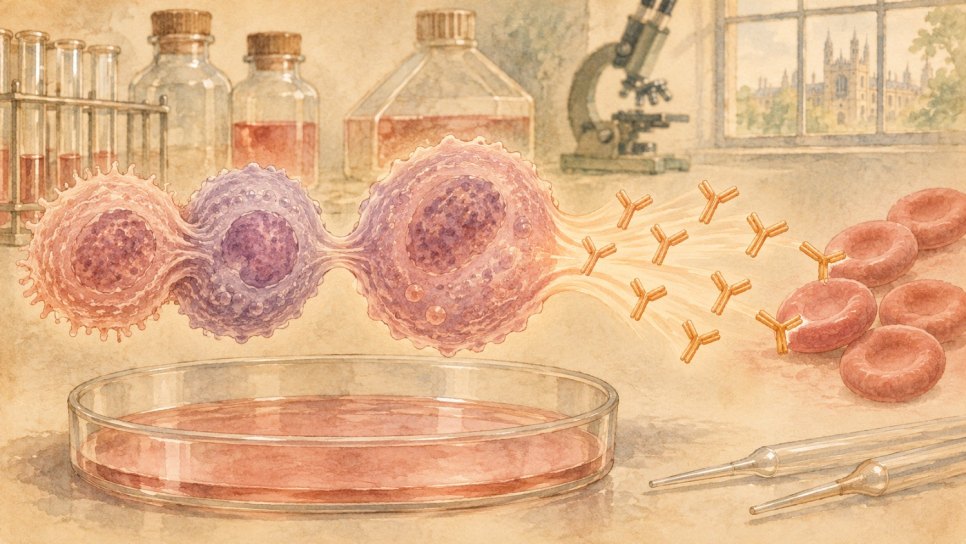
The two drug combinations in today's story contain familiar faces from the series. The "C" of CMF is cyclophosphamide, a descendant of nitrogen mustard (Days 115 and 120); the "M" is methotrexate, a relative of Farber's aminopterin (Day 122); the "F" is 5-fluorouracil (Day 131). Three separate stories were now to be given together, after surgery. L-PAM (L-phenylalanine mustard), by contrast, was a single drug used in Fisher's arm.
A national report and interim results
According to the 4 October 1974 issue of The Cancer Letter, the National Cancer Institute's "Breast Cancer Report" was scheduled for Monday 30 September 1974; Betty Ford's radical mastectomy had taken place two days earlier, and the report had suddenly become national news. In the same report, Fisher's L-PAM trial was a double-blind, placebo-controlled study in women with positive axillary nodes, run at 37 centres; drug or placebo was given for five days every six weeks for two years. In the interim result, among premenopausal women 1 of 30 on L-PAM had recurred, against 11 of 37 who had surgery alone; in postmenopausal women the reduction was present but less marked and was "under review". According to the report, a Milan study of 100 patients was consistent with these results. The same article carries a note of caution: some felt the findings might be pushed into practice prematurely, and the L-PAM results would not be proven until patients had built up enough survival time.
I read this through a summarising tool; I did not see the original page of the report or the full text of Fisher's 1975 paper. The numbers in the interim result belong to very small groups and short follow-up.
Adjuvant therapy
Adjuvant means "helping": additional treatment given after the tumour has been removed by surgery, aimed at residual cells that cannot be seen on imaging. It cannot be proven in a single patient, because after the operation the patient already looks "clean"; benefit can be shown only in large groups, by comparing the relapse and survival of those who received the treatment with those who did not. For that reason a good control arm is needed. This is a simplified definition.
A data exchange in Milan
The CMF trial at the Istituto Nazionale Tumori in Milan, run by the surgeon Umberto Veronesi and the medical oncologist Gianni Bonadonna, began in February 1973, according to a history on Oncopedia, after Paul Carbone shared his CMF data with Bonadonna in May 1972; Carbone is also among the authors of Fisher's L-PAM paper (the paper's citation), so there was a personal bridge between the two trials. The reasons given on the same page for doing the study in Italy are: uniform surgery, lower cost, and fewer ethical concerns about an untreated control group. The last point matters from today's viewpoint: in the control arm there was only surgery. Doses were reduced in older women and those over 75 were excluded.
The report of Bonadonna and colleagues examined prolonged, cyclical CMF in women with positive axillary nodes who had undergone radical mastectomy (N Engl J Med, 19 February 1976, volume 294, pages 405-410; eleven authors including Veronesi). I could not read the numbers of the 1976 publication. The twenty-year follow-up of the same study appeared in 1995: 386 women had been enrolled in the Milan study that began in 1973; 179 received no additional treatment after surgery, 207 received twelve months of CMF. Median follow-up was 19.4 years. For relapse the relative risk was 0.71 in the unadjusted analysis (95% confidence interval 0.56-0.90; P = 0.004) and 0.65 adjusted; for overall survival it was 0.78 (0.62-0.99; P = 0.04) and 0.76 adjusted. The benefit was seen in all subgroups except postmenopausal women (N Engl J Med 1995;332:901-906).
A relative risk of 0.71 means a relative reduction in relapse of about 29%. The absolute equivalent of this (how many relapses were prevented per hundred women at twenty years) is not given in the abstract I read, so I do not write the absolute difference. The effect is not too small to ignore, but it is not equally large for everyone: in postmenopausal women the 1995 abstract found no benefit.
The same question, two drugs, two continents
The paper by Fisher and colleagues appeared in the N Engl J Med on 16 January 1975 (volume 292, issue 3, pages 117-122); the one-sentence abstract on the record page says it evaluated prolonged L-PAM in addition to mastectomy, in a prospective randomised trial, in primary breast cancer with pathologically positive axillary nodes. Patient numbers and relapse rates are not in that abstract. A review source states that the trial enrolled 380 women between 1972 and 1974, whereas the interim report in The Cancer Letter spoke of about 250 patients. I could not verify the difference between these two numbers (it could be an interim report versus the completed record). The same sources show that Fisher's 1975 paper preceded Bonadonna's 1976 paper by about thirteen months. The question of who was "first" is not the subject of this article; I did not investigate whether earlier trials of a similar idea existed at other centres, so I do not say "first".
The common result connects with Day 104's "cutting less" from the opposite side: while surgery was shrinking, the share of systemic treatment was growing. In the same years this was seen in Fisher's B-06 trial (2,163 patients; modified radical mastectomy versus lumpectomy and lumpectomy plus radiotherapy; first results N Engl J Med 1985;312:665, twenty-year results 2002;347:1233): at twenty years there was no significant difference in overall survival, disease-free survival or distant disease-free survival. The pair "reduce surgery, take systemic therapy seriously" comes from here; I write this sentence as a summary, and I am not claiming that the two studies proved a common principle.
Limits and cost
Not every woman benefited equally from this treatment. In Milan the benefit was not seen after menopause; in Fisher's interim report that group was "under review". So some patients may have carried the side effects without benefit. The drug burden was real: L-PAM five consecutive days, every six weeks, for two years; CMF twelve months. Doses were reduced by age and those over 75 were excluded; surgeons feared the side effects of chemotherapy. I did not read detailed rates of side effects, so I give no figures here.
Care is needed with the measure of benefit too. "Eleven women against one" in the interim report is impressive; but it was an interim result in very small groups with short follow-up, and according to The Cancer Letter some were concerned that the findings would be pushed into practice too early. In both studies the control arm had no additional drug (placebo in Fisher's, surgery alone in Milan); setting up the same control today may be harder ethically. This article is not treatment advice.
What remained
- The idea of systemic treatment after surgery and the randomised control arm that tested it
- Multi-drug combination (the logic of Day 142) in the post-surgical setting
- Following relapse and survival for twenty years as the measure of benefit
What fell or was limited
- The assumption that "surgery alone is enough" in node-positive disease
- The assumption that "benefit is the same for everyone" (except postmenopausal women in the 1995 abstract)
- The design in which the control arm gets no additional treatment at all
Fisher and Bonadonna: 1972-2005. The axis runs from 1970 to 2010. Green markers are events whose date is confirmed in more than one record or in the primary record; blue markers and bars rest on a single source or are a date range. Dates known only to the year are drawn mid-year.
Six courses or twelve?
I could not verify when adjuvant chemotherapy was first used in Türkiye, and I draw no Türkiye link to Fisher and Bonadonna. There is one example that touches Milan's question of "twelve months": a thesis in the open-science record of the Council of Higher Education, titled "The effect on survival of giving 6 or 12 courses of adjuvant chemotherapy in breast cancer". The record page gives no author, university, year or supervisor; it says it is a retrospective study of premenopausal patients treated between 1980 and 1985.
According to the abstract, in stage II the five-year disease-free survival is given as about 40% with six courses and "5.4%" with twelve (this figure is most likely a typographical error; it may be 54%, unverified); overall survival 48% and 57%. In stage III disease-free survival is 30% in both arms and overall survival 40% and 50%. The difference between the arms was not found statistically significant. The authors' conclusion: the need for adjuvant chemotherapy is well supported, but the ideal duration and form are unresolved. I read only the abstract on the record page, not the full text of the thesis.
From 1972 to today
What was confirmed, what stayed uncertain
- Skipped sequence: Day 158 (Köhler and Milstein) has not been written at this stage; the promise in the tomorrow box of Day 157 is not yet kept, and that day will be filled in later.
- Fisher citation: Fisher B, Carbone P, Economou SG and others. N Engl J Med 1975;292(3):117-122, 16 January 1975, doi:10.1056/NEJM197501162920301; the record page gives only a one-sentence abstract, so patient numbers and relapse rates could not be read. In the citation heading of one review source "1-phenylalanine" is written; in the text "L-phenylalanine". The "1" in the heading is most likely a typographical error; I used "L-".
- B-05 patient number: one review source says 380 women between 1972 and 1974; the 1974 interim report in The Cancer Letter speaks of 250 patients. I found no source that explains the difference (it may be an interim versus a completed record); unresolved.
- Interim result (1/30 and 11/37): only from the 4 October 1974 news item in The Cancer Letter (read with a summarising tool); I could not verify whether it is the same as the results in Fisher's 1975 paper. The date of 28 September 1974 was inferred from the detail "Betty Ford's mastectomy two days earlier" in the item.
- Bonadonna 1976: the citation (volume 294, issue 8, pages 405-410, 19 February 1976, doi:10.1056/NEJM197602192940801, eleven authors) is from a record page; patient numbers, relapse rates and toxicity could not be read. The numbers 386, 179 and 207 in the 1995 abstract belong to the final cohort; I do not assume that they are the same as the patient numbers in the 1976 report.
- Start date: Oncopedia (2026) gives February 1973 and Carbone's data sharing in May 1972; the 1995 abstract says only "1973". The Oncopedia page contains typographical errors and a regimen inconsistency (CMFP/CMF); I treat the detail as a single source.
- 1995 results: the relative risks of 0.71 and 0.65 for relapse and 0.78 and 0.76 for overall survival are from an abstract; absolute results and subgroup numbers were not read.
- B-04 and B-06: patient numbers and citations are from a review page (1,765; 2,163); the original papers were not read.
- 2005 BMJ: only from a "Nature" summary note; the BMJ paper was not read.
- The "first" claim: I did not investigate whether earlier adjuvant trials existed at other centres; so I do not say "first" anywhere.
- Türkiye thesis: only the abstract on the record page was read (the full view of the original record was closed to robot access); the author, university and year are not on the page; "5.4%" is most likely a typographical error.
The Cancer Face of a Normal Gene: Bishop, Varmus and the Cellular Origin of the Oncogene, 1976
Today we saw a drug added to surgery. Tomorrow we return to Rous's chicken sarcoma, which we told on Day 97: did the viral gene that causes it have a relative in the chicken's own cells? Tomorrow I will write, with verification, the citation and date of the publication by the Bishop and Varmus team, the 1989 Nobel Prize, what the finding added to the idea that "cancer genes live in the healthy cell", and what remained only a hypothesis.
Author's note: What I paid most attention to in this article was not to confuse a small interim result of 1974 (1/30 and 11/37) with the twenty-year follow-up of 1995, and not to write an absolute difference where I had not read it. My second point of care was to state openly that Day 158 had been skipped.
Sources and Further Reading
- Fisher B, Carbone P, Economou SG, Frelick R, Glass A, Lerner H, Redmond C, Zelen M, Band P, Katrych DL, Wolmark N, Fisher ER. L-Phenylalanine mustard (L-PAM) in the management of primary breast cancer. N Engl J Med 1975;292(3):117-122. doi:10.1056/NEJM197501162920301 (record page; one-sentence abstract).
- Bonadonna G, Brusamolino E, Valagussa P, Rossi A, Brugnatelli L, Brambilla C, De Lena M, Tancini G, Bajetta E, Musumeci R, Veronesi U. Combination chemotherapy as an adjuvant treatment in operable breast cancer. N Engl J Med 1976;294(8):405-410. doi:10.1056/NEJM197602192940801 (record page; numbers could not be read).
- Bonadonna G, Valagussa P, Moliterni A, Zambetti M, Brambilla C. Adjuvant cyclophosphamide, methotrexate, and fluorouracil in node-positive breast cancer: the results of 20 years of follow-up. N Engl J Med 1995;332(14):901-906. doi:10.1056/NEJM199504063321401 (read at abstract level).
- Monfardini S, Costa A, Rutgers E. CMF adjuvant chemotherapy for operable breast cancer: a change of paradigm. Oncopedia (ESO), 25 February 2026, oncopedia.wiki (read with a summarising tool; secondary source; contains typographical errors).
- The Cancer Letter. Breast cancer report to the profession suddenly is a report to the nation; treatment progress noted. 1(35), 4 October 1974, cancerhistoryproject.com (read with a summarising tool; contemporary news report).
- Milestone clinical trials of the National Surgical Adjuvant Breast and Bowel Project (NSABP). Chinese Clinical Oncology, cco.amegroups.org (read with a summarising tool; review; citations of B-04, B-05, B-06).
- Adjuvant CMF in breast cancer: 30 years' experience. Nature Clinical Practice Oncology 2005;2:118, doi:10.1038/ncponc0113 (only the summary note was read; on Bonadonna et al., BMJ 2005).
- The effect on survival of giving 6 or 12 courses of adjuvant chemotherapy in breast cancer (Turkish title: Meme kanserinde adjuvant kemoterapinin 6 kür veya 12 kür yapılmasının sağ kalıma etkisi). Thesis, acikbilim.yok.gov.tr (the abstract on the record page was read; author and year are not on the page).
- Mukherjee S. The Emperor of All Maladies: A Biography of Cancer. New York: Scribner; 2010 (general context; the relevant part was not re-read for this article).
This article is Day 159 of the "365 Days of Cancer History" series and presents the origins of adjuvant chemotherapy in breast cancer as a historical reading. It is historical-popular content; it is not diagnostic or treatment advice. Consult your physician for treatment decisions. Sources have been verified; details that rest on a single secondary source, on only an abstract, or on a text that could not be read are marked in the fact-check notes.
Was this article helpful?
Your feedback helps us improve our content.