One Antibody from One Cell: Köhler, Milstein and the Hybridoma, 1975
In this article
One Antibody from One Cell: Köhler, Milstein and the Hybridoma, 1975
On Day 96 we looked at Paul Ehrlich's dream of a "magic bullet": a substance that finds only its target. This article is not about the bullet but about something that could guide it, the production of a single, uniform antibody. I say at the outset: the 1975 paper is not about cancer, it is about sheep red blood cells. This article was written late; it should have followed Day 157 directly, and the promise made in the tomorrow box of Day 157 had not been kept. Today I keep it.
A postdoctoral researcher and an immunologist
Georges Köhler was born in Munich on 17 April 1946. He studied biology in Freiburg and did his doctorate in 1974 at the Basel Institute for Immunology under Fritz Melchers, on the enzyme beta-galactosidase. From April 1974 to March 1976, on a long-term EMBO fellowship, he worked in César Milstein's group at the Medical Research Council's Laboratory of Molecular Biology; his Nobel biography describes the work as lymphocyte fusion.
Milstein was born on 8 October 1927 in Bahía Blanca, Argentina. In 1958 he went to Cambridge on a British Council fellowship; when political pressure forced him out of his post in Argentina he returned to Cambridge, to Fred Sanger, and joined the laboratory's scientific staff in 1963. At Sanger's suggestion he moved from enzymology to immunology.
The abstract of the 1975 paper states the problem plainly. Myeloma cell lines produced antibodies, but it was not possible to choose in advance what they were directed against; screening existing lines for antibody activity was, in the authors' words, not a satisfactory way. What was wanted was the reverse: choose the target first, then obtain a continuously growing cell line that makes an antibody against that target.
This question is the laboratory counterpart of Ehrlich's "side chain" theory, which we met on Day 96: a molecule that fits a target binds only that target. Ehrlich set it down as a hypothesis; what was done in 1975 was a repeatable way of obtaining such a molecule. An antibody from a single cell lineage would be the same every time; antibodies from an animal's serum, by contrast, were a mixture of many lineages, and each bottle could turn out a little different.
Joining a myeloma to a lymphocyte
Köhler and Milstein, Nature 256:495-497
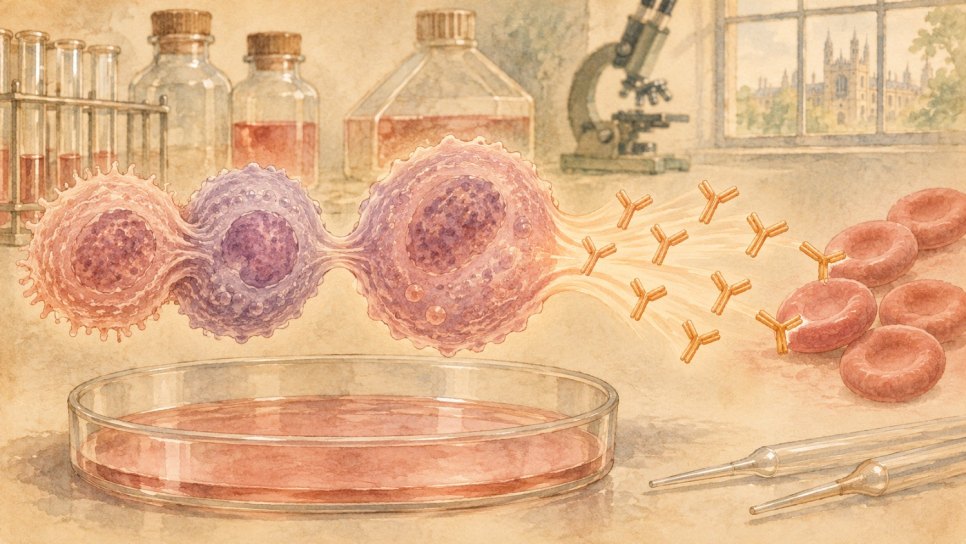
The title means "Continuous cultures of fused cells secreting antibody of predefined specificity." According to the abstract, a mouse myeloma line was fused with spleen cells from an immunized mouse; the target was sheep red blood cells, and the resulting cell lines secreted antibody against sheep red blood cells. The authors also fused two known mouse myeloma lines with each other to study how the immunoglobulin chains of the parent cells are expressed and interact. The abstract names no specific application.
A side note: Lara Marks's historical article says the first viable monoclonal antibodies were obtained on 24 January 1975. That is a single secondary source; if correct, about half a year passed between the experiment and the publication. The University of Cambridge obituary of Milstein, for its part, says the commercial potential was noted in the last sentence of the paper; since I did not read the full text, I leave that too as a detail resting on one source.
Monoclonal antibody and hybridoma
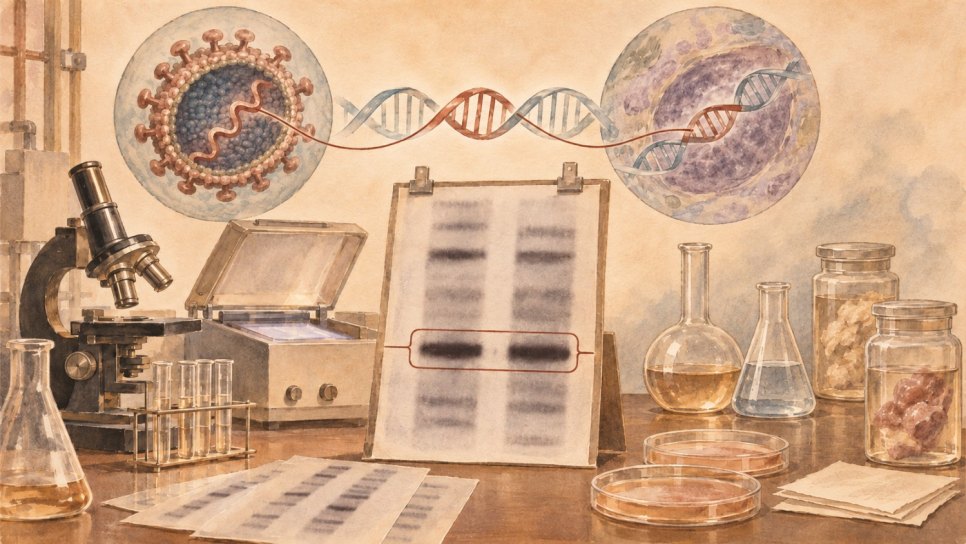
Each B-cell lineage makes only one kind of antibody, and that antibody binds only a particular part of an antigen. The antibody from this single lineage is "monoclonal." The problem is that normal B cells do not keep multiplying in culture for long. The solution was to fuse an antibody-producing B cell with a cancer cell that multiplies without limit, a myeloma: the resulting hybrid, the hybridoma, makes a chosen antibody and goes on multiplying. The growth ability of a cancer lineage is borrowed here as a tool.
The link of this method to cancer is not direct but indirect. Tumor cells enter, in a way, twice: the myeloma, a cancer of plasma cells, supplies the hybridoma's unlimited growth; later, antibodies made by this method will be used to recognize markers on the surface of tumor cells. These two sides are the common ground of the 1982 and 1984 events described below.
A patent never applied for
According to the obituary on Milstein, the MRC did not apply for a patent; at that time the National Research Development Corporation (NRDC) held a monopoly over MRC inventions, and Milstein had submitted the manuscript for commercial evaluation. Prime Minister Margaret Thatcher publicly criticized Milstein and the MRC over this; Milstein found the criticism unfair and blamed "the bureaucracy."
Marks's article completes the picture: the NRDC declined, saying it could see no immediate commercial application; the first two monoclonal antibody patents, in October 1979 and April 1980, went to American scientists who had received cells from Milstein; and Milstein said he found patents distasteful and that the lack of one allowed him to share findings freely. All these details rest on Marks, so I marked them as single-source in the fact-check box. A balanced reading: the absence of a patent brought the MRC no early income, but the method spread quickly among laboratories.
Anti-idiotype in lymphoma, "possibility" at the Nobel
On 4 March 1982 the New England Journal of Medicine carried "Treatment of B-cell lymphoma with monoclonal anti-idiotype antibody" by Miller, Maloney, Warnke and Levy (volume 306, issue 9, pages 517-522). The abstract I could reach is truncated: it says that the unique variable region of the immunoglobulin of each lymphoma lineage, the idiotype, can be a tumor-specific marker, and that anti-idiotype antibodies can be used to monitor B-cell tumors. I could not read the number of patients or the result; the index record classifies the study as a case report. So I do not say "an effective treatment"; I only give the citation of one of the first cancer trials.
The 1984 Nobel Prize in Physiology or Medicine went to Niels Jerne, Georges Köhler and César Milstein; the grounds were "specificity in the development and control of the immune system" and "the principle for production of monoclonal antibodies." The Nobel press release lists uses: mapping antigens, purification (for example interferon, see Day 135, by affinity chromatography), identifying cell-surface markers to tell tumor types apart, and the usefulness of antibodies against white blood cells in transplantation. It presents tumor treatment as a possibility, not as an established result.
A drug twenty-three years later
From 1976 Köhler worked at the Basel Institute for Immunology and later became director of the Max Planck Institute of Immunobiology in Freiburg; he lost his life on 1 March 1995. Milstein lost his life on 24 March 2002. On 25 September 1998, the day the FDA approved trastuzumab (Herceptin), about 23.1 years had passed since 7 August 1975 (Day 174). Rituximab and trastuzumab are the subjects of separate days in the plan (192 and 193). What we will see there is the adaptation of a method born from mouse cells to human treatment; in this article I describe only the birth of the method and its first traces in cancer. Köhler and Milstein's 1975 paper is the first page of that story, not the last.
Costs and limits
First, the 1975 experiment was done with mouse cells and sheep red blood cells; it was the description of a method, not data on treatment in humans. Second, knowing the citation of a trial in cancer is not knowing its effect: in the 1982 study of Levy's group I could not read the number of patients or the result. Third, even the Nobel announcement presented tumor treatment as a possibility. Fourth, the patent debate cuts both ways: early income was lost, but the method spread freely; according to Marks, the MRC later earned more than 486 million pounds from patents on improvements to monoclonal antibody drugs. That figure rests on a single source.
The time after the publication. Bar lengths show the years between two dates; the full length is 25 years. The first bar runs from 24 January 1975 to the publication of 7 August 1975 (single source); the next two bars run from 7 August 1975 to the lymphoma paper of 4 March 1982 and to the Nobel Prize about 9 years later (at year level); the green bar runs to the trastuzumab approval of 25 September 1998.
I found no verified local link
I found no verified source on the first use of the hybridoma method in Türkiye, so I am not building such a link. General information: in oncology reports today, drugs whose names end in "-mab" are monoclonal antibodies, and each is a descendant of the idea in this article. For the drug in your own report, consult your physician.
From 1974 to 2002
What was verified, what stayed uncertain
- Day 158 was written late: Köhler and Milstein, promised in the tomorrow box of Day 157, were written after Days 159-174; the file numbering is therefore out of sequence.
- The Nature citation: title, authors, volume, pages and abstract are from the journal site's abstract page; the issue (5517) and the date (7 August 1975) are from a data record. Received and accepted dates were not on the page. I did not read the full text.
- 24 January 1975, patent and income details: Lara Marks's article (History & Policy) is the only source; the NRDC refusal, the dates of the first two patents, the 486 million pounds and the Spinks working party come only from there. I did not write Marks's claim that the Nature editors shortened the paper. The University of Cambridge obituary separately supports that the MRC did not apply, Thatcher's criticism and Milstein's reaction.
- The last sentence of the paper: the note on commercial potential is from the obituary; the full text of the paper was not consulted.
- The Nobel Prize: the grounds and the uses are from the press release; the date of the announcement was not on the page, so I showed it at year level (about 9 years) in the figure.
- Levy's group 1982: the citation is from an academic index; the abstract was truncated and the number of patients and the result were not read.
- The biographies of Köhler and Milstein: from the Nobel biographies. Köhler's page does not name Cambridge, gives no date for the Max Planck directorship, and has no place or cause of passing; I did not write them either.
- The "first" claim: the hybridoma method is attributed to Köhler and Milstein; in this article I did not research earlier or parallel cell-fusion work, so I tied the word "first" to the paper rather than to the method.
- The polyclonal serum mixture and the Ehrlich link: that antibodies in an animal's serum are a mixture of many lineages, and the tie to Ehrlich's side-chain idea, are general knowledge; they were not separately verified against a source for this article.
- The "-mab" suffix: general knowledge, not separately verified against a source for this article. The dates of rituximab and trastuzumab will be verified on Days 192 and 193; the date of 25 September 1998 is from Day 174.
The same year, another end: Bonadonna, Fisher and adjuvant therapy, 1975
Today an antibody whose target can be chosen was born in the laboratory; tomorrow, in the same year 1975, we return to the operating table and to the question of how a drug given after surgery changed fates: adjuvant therapy.
Author's note: Writing this article I paid attention to two things. First, to say openly that the hybridoma paper concerns a method and not cancer, and that even in 1984 cancer treatment was presented as a possibility. Second, not to hide that I told the patent story from a single source.
Sources and Further Reading
- Köhler G, Milstein C. Continuous cultures of fused cells secreting antibody of predefined specificity. Nature 1975;256(5517):495-497 (from the abstract page).
- Nobel Foundation. The Nobel Prize in Physiology or Medicine 1984, press release, nobelprize.org.
- Nobel Foundation. Georges J.F. Köhler, biography, Les Prix Nobel 1984, nobelprize.org.
- Nobel Foundation. César Milstein, biography, nobelprize.org.
- Marks L. Overlooked scientific innovation reaps rewards 40 years on. History & Policy, historyandpolicy.org (24 January 1975, patent and income details; single source).
- University of Cambridge. César Milstein 1927-2002, obituary, cam.ac.uk.
- Miller RA, Maloney DG, Warnke R, Levy R. Treatment of B-cell lymphoma with monoclonal anti-idiotype antibody. N Engl J Med 1982;306(9):517-522 (from the truncated abstract).
- Mukherjee S. The Emperor of All Maladies: A Biography of Cancer. New York: Scribner; 2010 (general context; the relevant pages were not re-read for this article).
This article is Day 158 of the "365 Days of Cancer History" series and presents the history of the production method of monoclonal antibodies as a historical reading. It is historical-popular content; it is not a recommendation on diagnosis, screening or treatment. For treatment options, consult your physician. The sources have been verified; details that rest on a single secondary source, a truncated abstract or an unreadable text are marked in the fact-check notes.
Was this article helpful?
Your feedback helps us improve our content.