A Turning Point in Testicular Cancer: Larry Einhorn and Cisplatin, 1974
In this article
A Turning Point in Testicular Cancer: Larry Einhorn and Cisplatin, 1974
On Day 156 we used a bacterial plate to ask whether a substance causes cancer. Today we ask the reverse: in a cancer of young men, could a drug combination cure most patients? In yesterday's box I wrote that I would tie this to "the cisplatin story on Day 148"; that number was wrong. Cisplatin was Day 141 (Day 148 was Li-Fraumeni syndrome), so I make the link there. On Day 141 we mentioned Einhorn only through his dates and the 1977 abstract. Today we look at the same events through a physician's design decisions: how many courses, which drugs, why that number. Both parts of yesterday's promise are below: the start date of the study and the citation of the first publication.
Before 1974: there were drugs, but not cures
Picture a man in his twenties, one testicle already removed, with tumour spread to the lymph nodes behind the abdomen and to the lungs. By Einhorn's own account, in the early 1970s metastatic testicular cancer was associated with only 5% survival (PNAS, 2002). That was not for lack of drugs. On 5 November 1960 Min Chiu Li, Willet Whitmore, Robert Golbey and Harry Grabstald published in JAMA (volume 174) a paper titled "Effects of combined drug therapy on metastatic cancer of the testis." Li is the same Min Chiu Li we met on Day 132 with choriocarcinoma. According to Einhorn's summary, Li's group at the cancer hospital in New York showed that testicular cancer was sensitive to chemotherapy, using dactinomycin alone or with methotrexate and chlorambucil: about 50% objective responses, 10-20% complete remissions and 5-10% cures. Read side by side, those three numbers show the gap: half responded, but lasting cure was one in twenty to one in ten. (That inference is mine.)
At M.D. Anderson in Houston, Samuels and colleagues combined vinblastine with bleomycin. Einhorn describes the pair as synergistic in laboratory studies and gives 25% long-term disease-free survival (Samuels et al., Cancer Treat Rev 1976; I know this only from Einhorn's account and have not read the paper). Cisplatin entered the picture through a different door. On Day 141 we told the story of Rosenberg's platinum-electrode experiment and the first clinical trials. The phase I study by Higby and colleagues appeared in Cancer in May 1974; according to Einhorn the drug had been tested in early trials from 1973, and among 11 patients who had not responded to dactinomycin there were three complete and three partial responses. The toxicity was obvious from the first day: severe nausea, vomiting and kidney injury. But one property suited a combination: it suppressed the bone marrow relatively little. Einhorn's idea joined the two pieces: add cisplatin to Samuels's vinblastine and bleomycin. The combination would be known as PVB (cisplatin, vinblastine, bleomycin).
Four courses, two years of maintenance
According to Einhorn's 2002 account, the PVB study began at Indiana University Medical Center in August 1974. The skeleton was this: four courses (rounds of treatment) repeated every three weeks, followed by monthly vinblastine maintenance, for two years in total. The number of courses was capped at four because of concern about the cumulative kidney toxicity of cisplatin. In the first series, 33 of 47 patients (70%) had a complete response; five patients (11%) were rendered free of disease by surgical removal of masses that remained after treatment. Einhorn gives a cure rate of 53% and describes it as roughly a tenfold increase over the dactinomycin results of the same period.
I read this with a summarising tool; I did not look directly at the full text in the journal. The month "August 1974" appears only in this account; Indiana University's 2024 article says only "1974."
Complete response, disease-free, cure
A complete response means no trace of disease on imaging and tumour markers after treatment. "Disease-free" (NED) also includes cases in which remaining masses were removed surgically and no disease was detected. Cure means the disease does not return over long follow-up; its definition and the length of follow-up vary from study to study. Below I use "course" for a round of treatment and "cure" for lasting recovery. This is a simplified definition.
Seventh of October: after three failed regimens
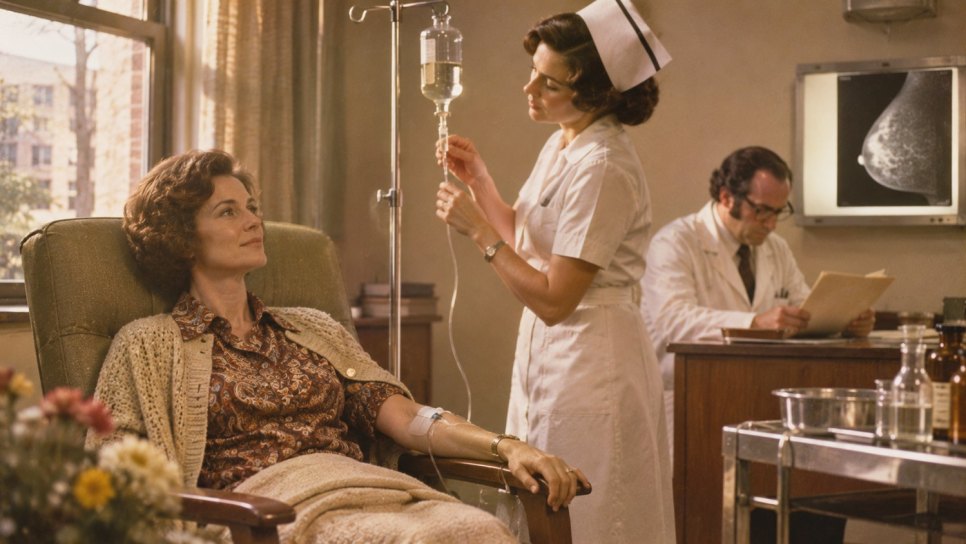
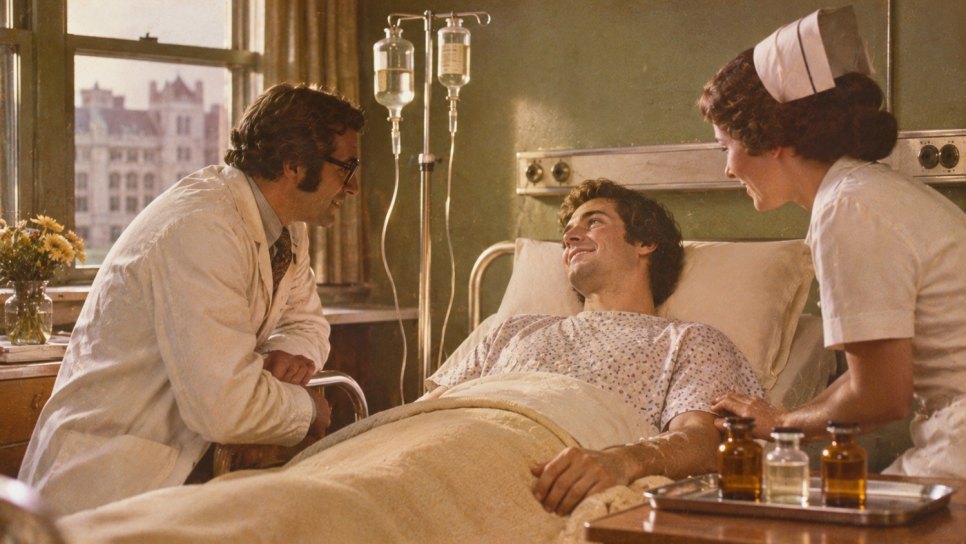
One of the first patients on the protocol was John Cleland. According to CureToday's patient story (Winter 2004 issue), Cleland, a Purdue University student, noticed a hard spot on his testicle in August 1973; in November 1973 the testicle was removed, and of 53 nodes removed in the retroperitoneal dissection, two held microscopic tumour. In February 1974 the disease returned. A regimen of Adriamycin, bleomycin and vincristine caused severe mouth sores, and his weight fell from 158 to 106 pounds. In July 1974 he was switched to dactinomycin. By September 1974 the disease had spread to his lungs. Einhorn offered cisplatin, then experimental; according to the patient's account the protocol was designed with fluids to protect the kidneys and with anti-nausea drugs. The first treatment was given on 7 October 1974, during a five-day hospital stay.
At the second visit his lung images were clear; in the story, the radiologist suspected the films belonged to another patient. Einhorn is reported to have told him that day that he had a chance of cure (conceptual summary; I am not writing a verbatim quote). Two more courses followed; a nurse gave one at his home on Thanksgiving Day. At six months there was no relapse, and around one year the word "cure" began to be used. According to the same article, Cleland celebrated 25 years of remission in 1999. This is one patient's story: a single patient, a single secondary account. Two details whose dates conflict are in the fact-check box.
One series, two accounts
Einhorn and Donohue's report appeared in the Annals of Internal Medicine (volume 87, pages 293-298, 1977). We gave its abstract on Day 141: 50 patients, 74% complete response, and, with five partial responders made disease-free by surgery, 85% disease-free overall, with follow-up of 6 to more than 30 months. In 2002 Einhorn describes the same first series as 47 patients, 70% complete response and 53% cure. The two need not contradict each other; they do not measure the same thing: the 1977 abstract is a snapshot of short follow-up, the 2002 figure is an account of long follow-up. But I could not find in any source an explicit reason why 50 became 47, 74% became 70% and 85% became 53%; possible reasons are length of follow-up, reclassification of patients and the definition of "cure." The move from 5% to 53% is roughly tenfold in relative terms; in absolute terms, fifty-three people out of a hundred instead of five. But this is a single-centre, non-randomised series, and the comparison is with historical periods.
Later years simplified the combination. Between 1981 and 1984 the Southeastern Cancer Study Group randomised 244 patients from 24 institutions to PVB or BEP (etoposide in place of vinblastine); according to Einhorn's summary, complete response was seen in 74 of 121 patients (61%) on PVB and 74 of 123 (60%) on BEP. After surgery the disease-free rate was 74% with PVB and 83% with BEP; BEP had a survival advantage in advanced disease (P = 0.02) and markedly lower neuromuscular toxicity (Williams et al., N Engl J Med 1987). BEP has been cited as the standard first-line treatment since 1984.
The second simplification concerned duration and the number of courses; it is the drug-treatment counterpart of the principle of "cutting less" that we discussed on Day 104. In a randomised study described by Einhorn, after 12 weeks of PVB 113 patients were assigned to 21 months of vinblastine maintenance or to no further treatment; relapse was 5% in both arms, so maintenance brought no visible gain (that reading is mine). In good-risk patients three or four courses of BEP were equivalent; in the EORTC study of 812 patients progression-free survival was 90.4% with three courses and 89.4% with four. A path was opened for those who relapsed as well: with vinblastine, ifosfamide and cisplatin, 49.6% of 135 patients became disease-free and 23.7% stayed disease-free for at least five years; in high-dose therapy begun at Indiana in 1986, 35 of 65 patients (54%) were followed disease-free for at least two years.
Limits and costs
The first cost was the treatment itself. According to Einhorn, in the early years cisplatin caused severe nausea, vomiting and kidney injury, and supportive care later reduced them markedly. Vinblastine carried significant neuromuscular and bone-marrow toxicity; lowering the dose from 0.4 to 0.3 mg/kg reduced toxicity without lowering remission or cure rates. Bleomycin is associated with lung fibrosis, and cisplatin with nerve and hearing damage; these are among Einhorn's reasons for shortening treatment. The 1977 abstract we mentioned on Day 141 reported two drug-related losses of life. Late relapse occurs in about 2-3%, and the latest relapse has been seen 32 years after treatment. Cleland's hospital admission in 1983 with viral cardiomyopathy is described in the article as a late effect; a causal link with the treatment cannot be confirmed from this account.
The second limit is generalisation. Testicular germ cell tumours proved extraordinarily sensitive to this combination; that does not mean the same result can be expected in other cancers. The third is the nature of the numbers: the percentages above have different denominators, different follow-up and different sources; to say "cancer was cured" with a single figure would be wrong. This article is not treatment advice.
What remained
- Cisplatin-based combination: BEP, the standard first-line treatment since 1984
- Cure first, then shorten treatment: three courses in good-risk patients
- Managing side effects: easing nausea and kidney injury with supportive care
What fell or was limited
- Single-agent dactinomycin as the standard
- Two years of vinblastine maintenance (relapse 5% in both arms)
- The expectation that cisplatin would be abandoned because of kidney toxicity
From Li's 1960 paper to Einhorn's 2002 assessment: 1960-2002. The axis runs from 1955 to 2005. Green markers are events whose date is confirmed in several records or in the primary record; blue markers rest on a single source; the amber bar shows a date range where sources conflict (Higby: study 1973, publication May 1974). Dates known only by year are drawn mid-year.
PVB at Gülhane: patients of 1987-1994
I could not verify when PVB or cisplatin was first used for testicular cancer in Türkiye; I am not drawing a Turkish link to Einhorn or to the birth of PVB. I give one example: Ahmet Bekir Öztürk's thesis "Germ hücreli testis kanserlerinde 78 aylık izlem ve kemoterapi sonuçları" (the results of 78 months of follow-up and chemotherapy in testicular germ cell cancers), prepared at the Gülhane Military Medical Academy (advisor Mustafa Kutlu), recorded with the date 1994 (the record was added in 2018; the record lists the thesis as a doctoral thesis).
According to the abstract, of 65 patients diagnosed between 1987 and 1994, 10 were left out because they had received no chemotherapy and 17 because they were lost to follow-up; 38 patients, with a mean age of 21.89, were evaluated. Thirty-one patients (82%) received PVB; three received BEP; 15 patients (40%) who relapsed received VIP (etoposide, ifosfamide, cisplatin) as salvage. Overall survival is reported as 69.22%; severe treatment side effects occurred in 11 patients (29%). Two cautions: the median follow-up was only 14.49 months, the longest 78 months, so this percentage should not be set beside Einhorn's long-term results. Also, the BEP share in the abstract is given as "0.8%," but three of 38 patients is about 8%. I read only the abstract.
From 1960 to today
What was verified, what stayed uncertain
- Yesterday's promise and the numbering error: the Day 156 tomorrow box pointed to the cisplatin story as "Day 148"; the correct day is 141 (the plan number had been confused with the written day number; Day 148 is Li-Fraumeni syndrome). Corrected here.
- Start date: that the PVB study began in August 1974 comes from Einhorn's 2002 PNAS article (read with a summarising tool); Indiana University's 2024 article says only 1974. Cleland's first treatment date (7 October 1974) rests on a single patient story.
- Main publication: Einhorn LH, Donohue J. Ann Intern Med 1977;87(3):293-298, doi:10.7326/0003-4819-87-3-293; read at abstract level, full text not read. I note that the author names are verified not from this page but from Einhorn's reference list.
- Number conflict: the 1977 abstract gives 50 patients, 74% complete response, 85% disease-free (follow-up 6 to more than 30 months); the 2002 account gives 47 patients, 70% complete response, 53% cure. I found no source that explicitly explains the difference (length of follow-up, reclassification and a difference in definition are possible); unresolved.
- Page numbers of Li 1960: the record page (doi 10.1001/jama.1960.03030100059013) gives 5 November 1960, volume 174, issue 10, pages 1291-1299; Einhorn's 2002 reference list prints 145-153 for the same DOI. I took the record page as the basis; the page number in Einhorn is most likely a printing error. The abstract of the paper could not be read, so drugs and patient numbers are not given.
- Higby and the date: the citation (Cancer 1974;33:1219-1225, May 1974 issue from the DOI string) is from Einhorn's reference list; the statement "tested in 1973" is from Einhorn's text. There is a small difference in wording between the "partial responses in 11 patients, complete in three" given on Day 141 for the Oxford 1973 meeting and the "three complete, three partial" reported here; I could not verify whether these are the same 11 patients.
- Williams et al. 1987: the title and the phrase "261 men" are from a record page's abstract; the citation (volume 316, pages 1435-1440) and the figure of 244 patients are from Einhorn's reference list and account. I could not verify the difference between 261 and 244 (it may be the number of evaluable patients). The values 61, 60, 74 and 83% are from Einhorn's summary; I did not read the paper's full abstract.
- Hydration: the Cleland story says the protocol was designed with fluids that protect the kidneys; the text drawn from Einhorn's 2002 article does not mention fluids. The details of fluid support in the first protocol could not be verified.
- Cleland story: there are two internal conflicts. The article says the lung tumours vanished about ten days after the first treatment, but also that the second treatment came three weeks later; both cannot be true together. His age is given as both 22 and 23. The page metadata says 2009, the issue label Winter 2004. The word "cure" is not defined.
- Samuels 25%: only from Einhorn's summary; Samuels's paper was not read.
- Türkiye thesis: only the abstract on the record page was read; the full text of the thesis was not consulted; the BEP percentage ("0.8%") is inconsistent in the abstract; the record lists the thesis type as doctoral, and the record date is 2018.
Turning One Cell into an Antibody Factory: Köhler, Milstein and Monoclonal Antibodies, 1975
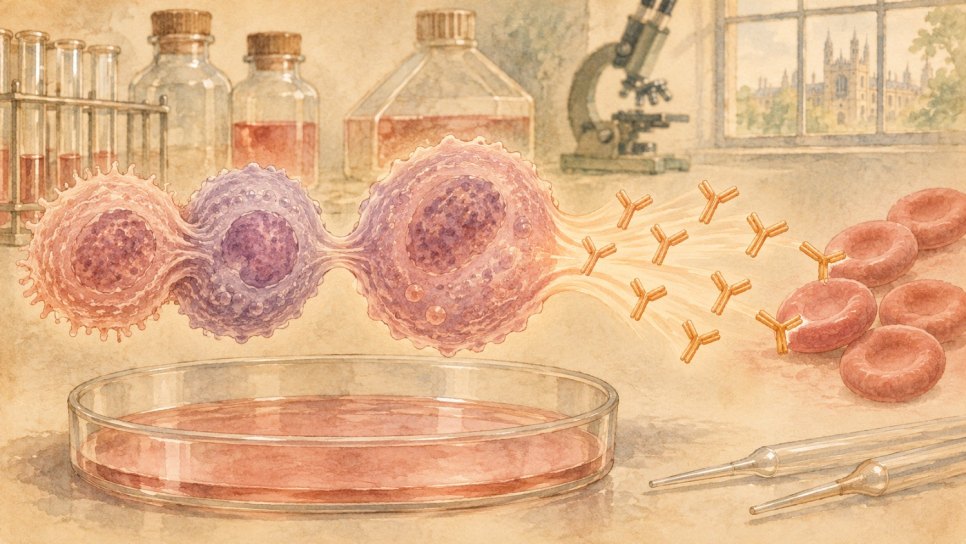
Today we saw how far a drug combination could go; but drugs mostly touched healthy cells too. Tomorrow's story opens a new road to Ehrlich's "magic bullet" dream, which we told on Day 96: making an antibody that recognises a single target, in unlimited amounts, in a laboratory. Tomorrow I will verify the citation and date of Köhler and Milstein's 1975 publication, the 1984 Nobel Prize, and the claim that the discovery was not patented.
Author's note: What I paid most attention to in this piece was not squeezing Einhorn's numbers into a single figure: the 85% of 1977 and the 53% of 2002 are two photographs of the same series, and I found no source that explains the gap. My second concern was to correct the day-number error in yesterday's box without hiding it.
Sources and Further Reading
- Einhorn LH. Curing metastatic testicular cancer. Proc Natl Acad Sci USA 2002;99(7):4592-4595. PubMed Central: PMC123692 (read with a summarising tool).
- Einhorn LH, Donohue J. Cis-diamminedichloroplatinum, vinblastine, and bleomycin combination chemotherapy in disseminated testicular cancer. Ann Intern Med 1977;87(3):293-298. doi:10.7326/0003-4819-87-3-293 (read at abstract level).
- Li MC, Whitmore WF, Golbey R, Grabstald H. Effects of combined drug therapy on metastatic cancer of the testis. JAMA 1960;174(10):1291-1299. doi:10.1001/jama.1960.03030100059013 (record page; abstract could not be read).
- Higby DJ, Wallace HJ, Albert DJ, Holland JF. Cancer 1974;33(5):1219-1225 (citation from Einhorn's 2002 reference list; title and abstract not read).
- Samuels ML, Lanzotti VJ, Holoye PY, Boyle LE, Smith TL, Johnson DE. Cancer Treat Rev 1976;3:185-204 (citation from Einhorn's reference list; not read).
- Williams SD, Birch R, Einhorn LH, Irwin L, Greco FA, Loehrer PJ. Treatment of disseminated germ-cell tumors with cisplatin, bleomycin, and either vinblastine or etoposide. N Engl J Med 1987;316:1435-1440 (title from a record page, citation from Einhorn's reference list; full abstract not read).
- Rosenberg B, VanCamp L, Krigas T. Inhibition of cell division in Escherichia coli by electrolysis products from a platinum electrode. Nature 1965;205:698-699. doi:10.1038/205698a0 (citation; see Day 141).
- CureToday. Cured: the John Cleland story. Winter 2004, curetoday.com (read with a summarising tool; patient story, secondary source).
- Indiana University Simon Comprehensive Cancer Center. Einhorn: 50 years of the cure. 16 September 2024 (read on Day 141; secondary source).
- Öztürk AB. Germ hücreli testis kanserlerinde 78 aylık izlem ve kemoterapi sonuçları. Gülhane Military Medical Academy, 1994, acikbilim.yok.gov.tr (abstract on the record page read).
- Mukherjee S. The Emperor of All Maladies: A Biography of Cancer. New York: Scribner; 2010 (general background; the relevant part was not re-read for this piece).
This piece is Day 157 of the "365 Days of Cancer History" series and presents the birth of the cisplatin combination in testicular cancer as a historical reading. It is historical-popular content; it is not diagnostic or treatment advice. Consult your physician for treatment decisions. Sources have been verified; details that rest on a single secondary source, on an abstract only, or on a text that could not be read are marked in the fact-check notes.
Was this article helpful?
Your feedback helps us improve our content.