
The Era of Gene Editing Has Officially Begun – A New Chapter in Medicine

In this article
Recent approvals in the United States and the United Kingdom of exagamglogene autotemcel (exa-cel [Casgevy, Vertex Pharmaceuticals/CRISPR Therapeutics]) for sickle cell disease (SCD) and transfusion-dependent β-thalassemia mark the beginning of a new era of gene editing in medicine.
From the Laboratory to Clinical Practice in Just a Few Years
This important development came only a short time after the first report on transforming the bacterial immune system clustered regularly interspaced short palindromic repeats (CRISPR) – Cas9 into a programmable gene-editing nuclease, and after the paper's two senior authors, Jennifer Doudna and Emmanuel Charpentier, shared the Nobel Prize in Chemistry just 3 years earlier. This rapid transformation in genetic medicine represents a dynamic process that continually advances academic medicine: laboratory findings are rapidly integrated into clinical practice, and clinical experience informs new research. However, although exa-cel is the first of a promised wave of treatments that directly edit and repair disease-associated genetic mutations, substantial challenges remain in ensuring access to this potentially curative therapy, even for the most severely affected among the millions of people with SCD worldwide.
Linus Pauling: "The First Molecular Disease"
In 1949, Linus Pauling called sickle cell anemia "the first molecular disease" in a paper detailing the difference between normal hemoglobin and that associated with sickle cell disease. We now know that the most common form of SCD results from a single point mutation, GAG to GTG, causing a single amino acid substitution at the sixth position in adult hemoglobin (HbS): valine replaces glutamic acid. Red blood cells change shape, resulting in inadequate oxygen delivery to tissues, severe pain, and oxygen deprivation. In SCD carriers, these pain crises generally begin at about 6 months of age, when fetal hemoglobin (HbF), which carries oxygen more effectively during fetal life, gives way to adult hemoglobin (HbS).
One Mutation, Different Outcomes
In a human genome of 3 billion base pairs, a single point mutation inherited from both parents is enough to cause SCD. Doctors have long observed wide variation in disease severity, suggesting that mutations elsewhere in the genome modify SCD. A rare condition called hereditary persistence of fetal hemoglobin (HPFH) reduces painful crises and disease-related health problems by maintaining high fetal hemoglobin levels. This observation suggested a strategy: directing red blood cells to produce fetal hemoglobin again could mimic the benefits of HPFH and substantially alleviate SCD symptoms.
Exa-cel: The First Steps of CRISPR-Cas9
Just as curiosity-driven studies of bacterial adaptive immunity led to the discovery of CRISPR-Cas9, exa-cel's gene-editing success rests on basic research into globin gene regulation. Over the past two decades, Orkin and colleagues at Boston Children's Hospital and Harvard Medical School, together with many collaborators, uncovered the fundamental molecular mechanisms of globin switching and identified the genomic target for the CRISPR-Cas9 editing now approved as exa-cel.
Discovery of the molecular target for reactivating HbF relied on modern genomics, particularly genome-wide association studies mapping the chromosomal locations of genetic variants that determine HbF levels.
In a feat of scientific detective work, Thein, Cao, Orkin, and colleagues identified a genomic region of interest around BCL11A, a gene associated with high HbF levels and low rates of SCD pain crises. Subsequent molecular studies by Sankaran and Orkin established that BCL11A is a repressor protein that silences gene transcription in mature adult red blood cells. As proof of a potential treatment, Orkin's group showed that deleting BCL11A in a mouse model of SCD normalized pathological hemolytic anemia, restored red cell counts and hemoglobin levels, and eliminated sickling. Bauer's and Orkin's groups then extensively mutated BCL11A transcriptional control regions using CRISPR-Cas9, identifying the precise sites to target with CRISPR-Cas9 to mimic HPFH and restore HbF expression.

The strategy pursued by CRISPR Therapeutics and Vertex Pharmaceuticals used a target identified by these studies: the erythroid-specific enhancer controlling BCL11A expression. Clinical data reported in 2021 from a patient with SCD and a patient with transfusion-dependent β-thalassemia confirmed the hypothesis. CRISPR-Cas9 editing to switch off BCL11A expression increased HbF expression, eliminating pain crises in the SCD patient and transfusion dependence in the β-thalassemia patient. Over the following 2 years, 29 of 30 treated SCD patients remained free of vaso-occlusive crises for at least 12 months. Similarly, as Locatelli and colleagues now report in the Journal, 32 of 35 β-thalassemia patients achieved transfusion independence. These impressive results justified regulatory approval of exa-cel for both conditions. Analysis of off-target editing has been reassuring, but long-term follow-up is needed to establish the safety of gene-editing procedures and determine whether this treatment prevents the many organ injuries caused by SCD.
Diagram of Globin Gene Switching and Exa-cel Reactivation of Fetal Hemoglobin Expression
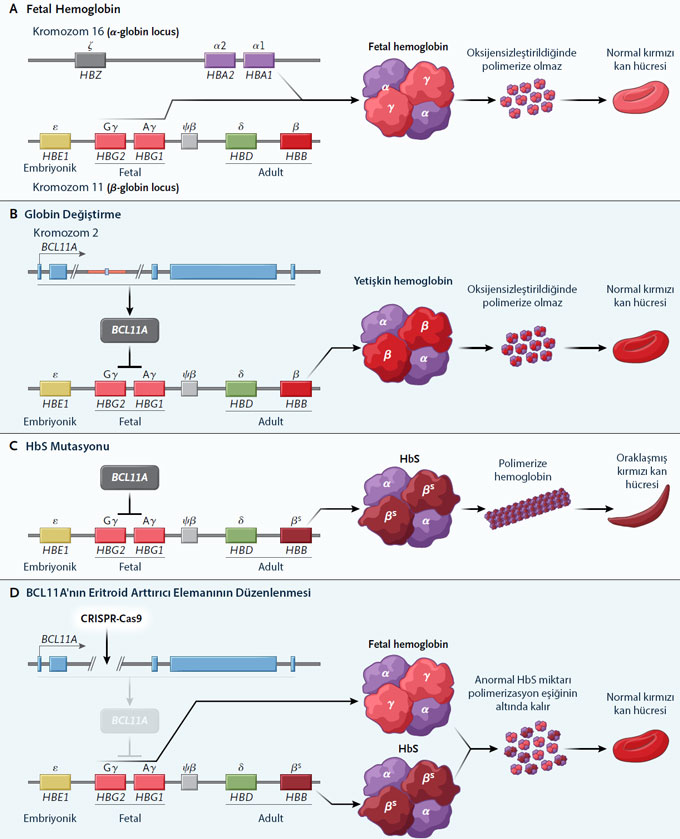
Diagram Explanation: Hemoglobin is a tetramer containing two alpha (α) subunits expressed from a gene cluster on chromosome 16 and two subunits from a β-globin gene cluster comprising embryonic (ε), fetal (γ), and adult (β) genes.
- Panel A: Fetal Hemoglobin
- The γ gene is predominantly expressed during most of fetal development.
- Panel B: Globin Switching
- Expression of BCL11A, located on chromosome 2, reduces expression of the two γ-globin genes and increases β-globin expression.
- If the β subunit carries the HbS mutation, the abnormal hemoglobin tends to polymerize, causing pathological sickling of red cells.
- Panel C: The HbS Mutation
- The amount of abnormal HbS remains below the polymerization threshold.
- Exa-cel uses a guide RNA-directed CRISPR-Cas9 complex to cut and disrupt an enhancer within BCL11A.
- This enhancer is critical for BCL11A expression in the erythroid lineage.
- Removing BCL11A-mediated repression reactivates γ-globin expression, replacing abnormal HbS and diluting it below the polymerization threshold in red cells, thereby eliminating sickling.
Challenges Hidden in the Details
Although this success deserves celebration, challenges remain. Exa-cel requires gene editing in the context of autologous bone marrow transplantation, involving stem cell collection, ex vivo gene transfer, and a specialized transplantation procedure requiring intensive-care-level support that not all United States hospitals can provide.
Transplantation centers are rare in low-resource regions, including sub-Saharan Africa, where millions of people have SCD. Exa-cel is also extremely expensive, priced at 2.2 million dollars per treatment . Although a single treatment may provide a functional cure, the risk of infertility creates another barrier to widespread acceptance. The organizing committee's statement from the Third International Summit on Human Genome Editing, held in March 2023, emphasized the imperative of equitable access to these potentially curative genetic therapies and ongoing research into ways to democratize treatment.
Drugs are more scalable than gene therapies. The recently approved compound voxelotor (Oxbryta, Pfizer) is approved as an antisickling treatment for SCD, but is not a cure. Developing a pill that can induce HbF expression is a high priority. Further innovations in CRISPR-based gene editing include base editing and prime editing, which could rewrite the HbS mutation. Prime editing can replace a mutated base with the base carried by healthy people.
An Equitable and Accessible Future
Ultimately, a more accessible and cost-effective treatment could eliminate the need for autologous marrow collection, laboratory gene editing, and bone marrow transplantation. Instead, targeted stem cells could be edited directly through intravenous or intramuscular injection of tiny gene-repair machines containing CRISPR technology. A simple, one-time, vaccine-like treatment is one of genetic medicine's greatest goals and would improve global health equity. Given rapid technological progress and recent successes, I believe these approaches will move from the laboratory into clinical practice and ultimately become accessible to everyone.
Gene-Editing Alternatives Are Also Expanding
As the first approved gene-editing medicine, exa-cel will profoundly affect patients able to receive it. It is only one of several potentially curative treatments now available. Bone marrow transplantation from an HLA-matched sibling remains the standard of care, while new protocols using haploidentical donors have produced impressive results. Lentiviral vector replacement of β-globin (lovotibeglogene autotemcel [Lyfgenia, Bluebird Bio]) was approved on the same day as exa-cel. Choosing among these treatments will be difficult because the safest and most effective approach is not yet fully defined. The demanding work of both basic and clinical translational research must continue.
Effective delivery of gene editing through intravenous or intramuscular injections aims to make it equitable and accessible to everyone. This goal, an initiative launched by the Cure Sickle Cell Initiative in 2018 and cofunded by the Bill and Melinda Gates Foundation, was identified as a priority by McCune and Kiem in an editorial in NEJM. The feasibility of intravenous delivery of prime editing targeting bone marrow stem cells has been demonstrated in a mouse model of SCD. However, the method needs further development before clinical trials. Given the pace of technological innovation and momentum from recent successes, I believe effective in vivo delivery of gene editing will inevitably move from laboratory research to clinical practice, making gene editing an equitable and accessible treatment.
Sources
Was this article helpful?
Your feedback helps us improve our content.




Reader comments
Share your comment
Your name and comment are published only after administrator approval. Your email address is never shown to visitors.
Be the first to comment.