
The Latest Position of Artificial Intelligence in Cancer Research, Diagnosis and Treatment

In this article
Artificial intelligence (AI), machine learning and deep learning, terms we often hear, are also finding a place in biomedical research and healthcare in oncology, where their potential applications are wide-ranging and important. AI work in oncology covers many areas, including cancer diagnosis, identification of cancer subtypes, optimization of cancer treatments, and identification of new candidate drugs in drug discovery. The large medical datasets needed by machine-learning models already exist, but important obstacles must be overcome to realize AI’s full power and take advantage of this opportunity in both cancer research and clinical practice.
So, how can we begin applying artificial intelligence to improve cancer diagnosis, prognosis and treatment, and guide new drug discoveries?
Four experts answered questions on this subject: Olivier Elemento, Professor of Physiology and Biophysics at Cornell University; Christina Leslie, Professor of Physiology, Biophysics and Systems Biology at Memorial Sloan Kettering Cancer Center; Johan Lundin, Professor of Medical Technology at the University of Helsinki in Finland and Karolinska Institute in Sweden; and Georgia Tourassi, Professor of Radiology at Duke University and Knoxville Tennese University.
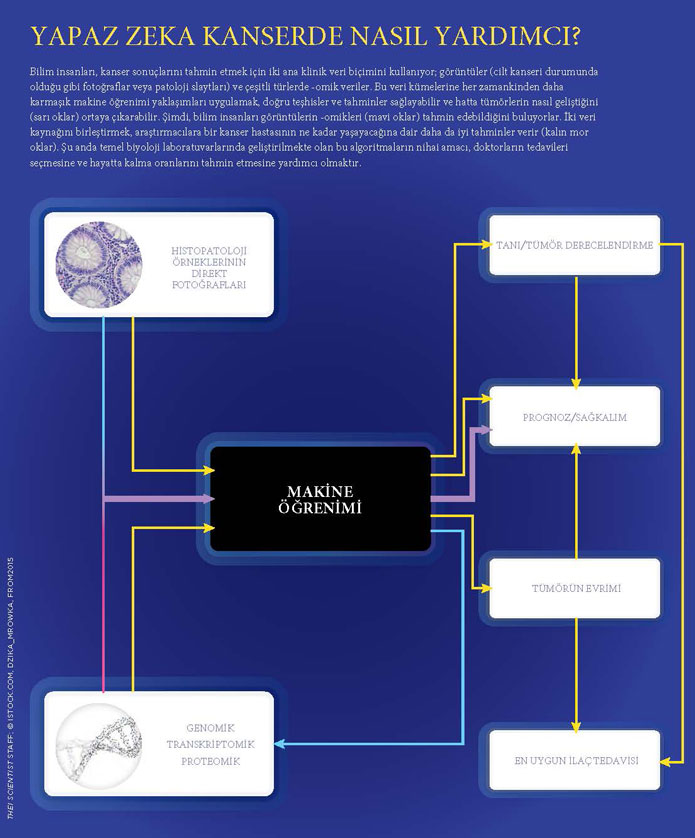
Before going into detail, let us summarize artificial intelligence, machine learning and deep learning in the infographic below:

Promising Studies for Cancer Diagnosis and Treatment
The experts say studies focusing on imaging methods in artificial intelligence and deep learning are undoubtedly promising. The last decade has seen major advances in applying AI to cancer research, including deep learning and increased computing power. Moving the data pathologists use in cancer diagnosis into digital environments, a process that continues, is also among these advances. Just as AlphaGo22, a neural-network algorithm, learned to play Go based on game results and proved its accuracy by beating all Go champions, these visual data, which can be stored in a cloud, can be analyzed in oncology using artificial intelligence (AI) algorithms in a trained neural network.
A deep-learning model can also assess tumor homogeneity/heterogeneity. Many examples have emerged rapidly in this field, suggesting that AI may also be used to analyze colonoscopy videos.
Besides tumor detection, promising research areas include computer-assisted treatment selection, planning and prognosis prediction using clinical data, new drug development and population cancer screening.
With the increasing number and variety of drugs and the introduction of combination therapies, treatment selection in oncology has become increasingly complex. Advances in artificial intelligence could address these problems and predict which drug combinations might be more effective for a patient. Individualized treatments based on patients’ genetic and epigenetic variability would thereby find their place in oncology.
Deep-learning models that predict a protein’s 3D structure from its primary amino-acid sequence are another new engineering breakthrough. Using AI to do this, with results accurate enough to replace experimental data, could also support the production of new scientific knowledge.
The Biggest Challenge in Using Artificial Intelligence in Clinical Practice
There is a large gap between the biomedical research literature and AI models used in clinical practice. Most AI models cannot be applied in the clinic. One reason is rapidly changing approval processes. Another is the need to integrate AI into clinical workflows and train staff for the updated workflow, a process requiring substantial time and investment.
The most fundamental problem is that AI models often fluctuate in clinical practice because of variations in inputs, such as data quality, differences between people entering and analyzing data, and patient characteristics. AI models have either not been tested against these fluctuations or test results have clearly shown deteriorating performance. Realistic performance evaluations of existing AI models are essential for clinical success.
Digitization is another prerequisite for applying AI in clinical settings. The digital transformation has already occurred in radiology, but the situation is not the same in pathology. Tools for digitizing pathology data have existed for more than 20 years, but progress is slow. More innovation is needed to simplify this technology, lower costs and use it in settings with limited resources.
Communication is also important. It is still unclear how AI reports will reach doctors, what those reports will look like, and how doctors will use the information in a patient’s clinical management.
Finally, people working collaboratively with AI technology may come to rely on it excessively, leading to errors. It is also important for users to remain alert to possible errors and receive training in this.
The Importance of Transparency, Reproducibility and Validation in AI
Greater transparency, reproducibility and validation are highly important for trust in AI models in clinical practice and research.
If transparency means being able to read an algorithm’s parameters and understand what it does, however, this will not be possible for most AI algorithms in the future. AlphaZero taught itself to play chess, shogi and Go so well that it beat even the best masters. But there is no necessary reason to believe we can, or even should, understand the rules by which it learned to play.
If reproducibility means obtaining the same result when retraining an algorithm on the same dataset, the trained algorithm must have model stability. Trained AI algorithms must then be tested and validated. All algorithms are tested on a “test set” after training on a “training set.” These steps, however, do not address generalizability. A validation dataset is needed for that.
In summary, to ensure transparency, reproducibility and validation in AI, we may need to consider a multifaceted approach throughout the AI lifecycle, from data collection and AI development to clinical deployment and ongoing quality control.
The Short- and Long-Term Future of AI in Oncology
Depending on the growth and breadth of AI models and the availability of data and computing resources, we will see increasing applications to important cancer problems over the next few years. As pathology digitization grows exponentially and data for training AI models become increasingly accessible, models predicting responses to specific treatments will reach sufficient maturity and performance for clinical use. AI models will also be trained on prognostic outcomes to provide individualized predictions for patients and disease-specific outcomes.
Sequence models predicting critical biological markers, such as epigenomic signals and 3D chromatin contacts, will also be used to evaluate systematically the function of noncoding somatic variation in cancer genomes. Similar predictive splicing and alternative polyadenylation models will be used to screen patients for mutations that alter RNA processing.
Conclusion
In the long term, AI algorithms will aim to improve diagnosis, help select optimal individual patient treatments, improve outcomes and reduce healthcare costs. They could be used to understand better the biological mechanisms underlying cancer, determine combination treatments and dosages, and develop new anticancer drugs with lower toxicity. Work will even focus on improving current imaging methods such as mammography to develop models that predict cancer risk and help prevent cancer.
Sources
Was this article helpful?
Your feedback helps us improve our content.




Reader comments
Share your comment
Your name and comment are published only after administrator approval. Your email address is never shown to visitors.
Be the first to comment.