
Tissue vs Liquid Biopsy in Cancer: Competitors or Complementary Partners?

In this article
Survival Improves When Tissue and Liquid Biopsy Are Used Together (ROME Trial)
Is a Single Biopsy Enough?
In modern oncology, we usually base treatment decisions on a small piece of tissue taken from a tumor (a conventional biopsy). But cancer is not static; it is a constantly changing, evolving enemy that can display different characteristics in different parts of the body (heterogeneity). While tissue biopsy takes a “snapshot” of the tumor at one moment and in one location, liquid biopsy, which analyzes tumor DNA circulating in the blood, allows us to watch a “video” of the disease.
So can combining these two methods change a patient’s fate?
On January 6, 2026, Clinical Cancer Research published the large study involving approximately 1800 patients, the ROME Trial, which provides a clear answer to this question: Yes. When we detect the same target (mutation) in both tissue and liquid biopsy and give the corresponding targeted drug, patients’ survival and treatment success improve dramatically. This article details this new “gold standard” in oncology and its implications for clinical practice.
ROME Trial: Design and Scope
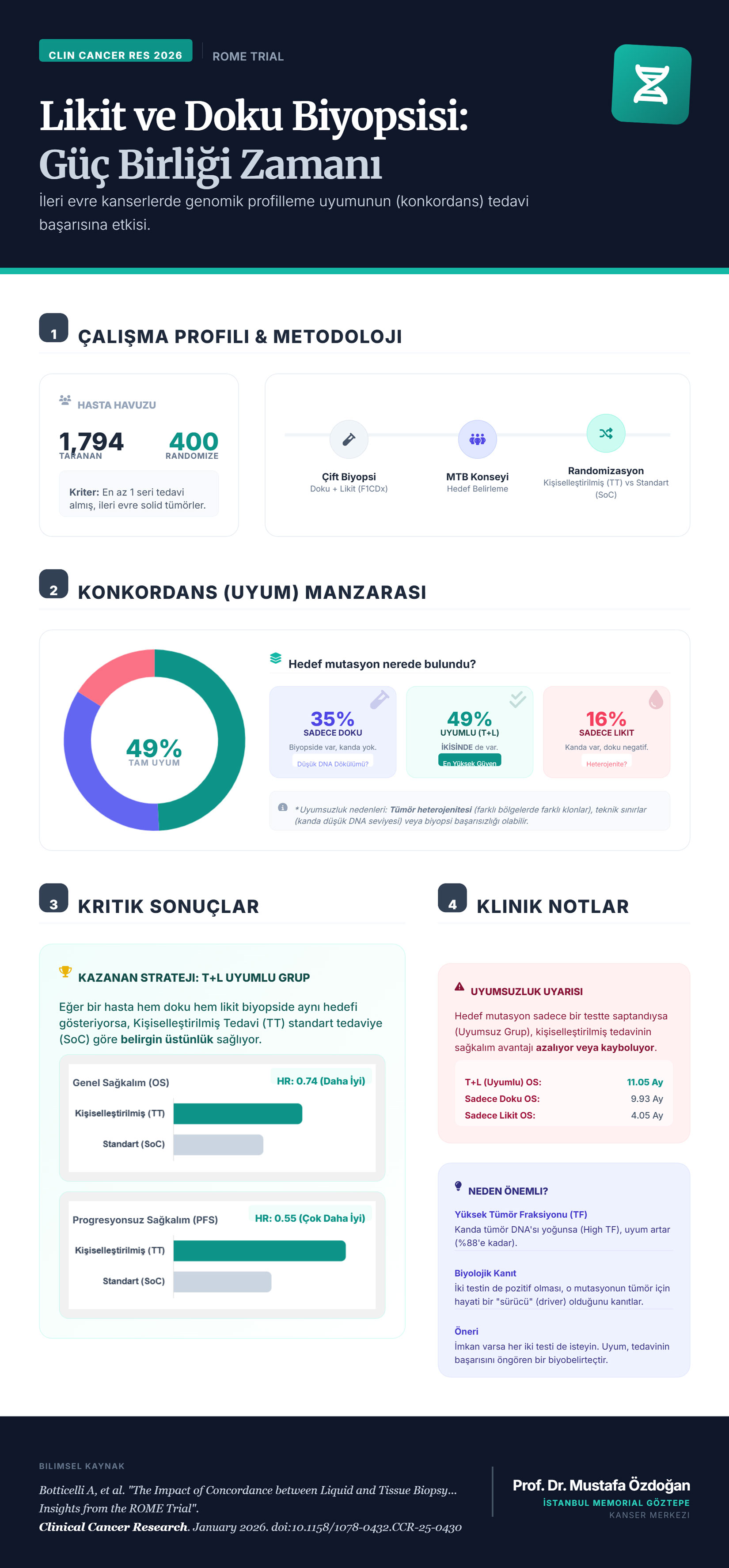
This Phase 2, multicenter trial was designed to test the power of “personalized treatment” (Tailored Therapy - TT) in advanced cancer patients who had exhausted standard treatments (2nd or 3rd line).
- Patient Numbers: 1,794 patients were screened and 400 were randomized.
- Method: Every patient underwent both tissue (FoundationOne CDx) and liquid (FoundationOne Liquid CDx) biopsy.
- Decision-Making Process: Results were reviewed by the Molecular Tumor Board (MTB).
- Groups:
- Tailored Therapy (TT): Patients who received a drug directed at the genetic target.
- Standard of Care (SoC): Patients who received conventional chemotherapy selected by the physician.
Results: “Double Confirmation” Saves Lives
The trial’s most striking finding was the enormous survival difference in patients whose two tests confirmed each other (concordant).
Group 1: Concordant (T+L)
The same mutation was detected in both tissue and blood.
Best Outcome!
Group 2: Tissue Only
The mutation was found only in tissue, not in blood.
Intermediate Success
Group 3: Liquid Only
The mutation was found only in blood, not in tissue.
Weakest Response
Statistical Strength:
In the concordant group (T+L), receiving tailored therapy (TT) rather than standard of care (SoC) reduced the risk of death by 26% (HR: 0.74) and the risk of disease progression by 45% (HR: 0.55). This is highly statistically significant.
Why Is “Double Positivity” Better? (Scientific Interpretation)
The study authors explain this through several factors:
- Biological Dominance: If a mutation can be detected in both tissue and blood, it is probably the tumor’s “main driver” (driver mutation). In other words, tumor growth depends on this mutation, and the tumor collapses when we give the drug.
- Tumor Burden and Heterogeneity: Mutations detected only in blood (L-Only) are generally seen in patients with very advanced disease, a very high tumor burden and a highly complex genetic structure (polyclonal). Achieving success with a single drug is difficult in these patients.
- Reliability: Having the same result from two tests reassures the Molecular Tumor Board (MTB) that it has selected the right drug. The possibility of a “false positive” is eliminated.
Implications for Clinical Practice: What Should We Do?
The ROME trial is changing the concept of “biopsy” in oncology practice.
| Situation | Recommendation |
|---|---|
| Ideal Scenario | Whenever possible, every patient should undergo both tissue and liquid biopsy, and the results should be compared. |
| Concordant (Matching) Result | These patients are the best candidates for targeted drugs. Targeted therapy (TT) should be prioritized over standard chemotherapy. |
| Discordant (Nonmatching) Result | If a mutation is present in only one test, targeted therapy is less successful. Standard treatments or clinical trials may be more appropriate for these patients. |
| Brain Tumors | The study showed that liquid biopsy (from blood) has low success in brain tumors (Glioblastoma, etc.), making tissue biopsy or CSF (cerebrospinal fluid) analysis more reliable. |
Scientific References
- Botticelli A, Cremolini C, Scagnoli S, et al. The Impact of Concordance between Liquid and Tissue Biopsy for Actionable Mutations: Insights from the ROME Trial. Clinical Cancer Research. 2026 Jan 6;32(1):45–55. doi:10.1158/1078-0432.CCR-25-0430
- Saldanha O, Siu LL. On the Road to ROME: Defining Tissue–Liquid Concordance in Precision Oncology. Clinical Cancer Research. 2026;32(1):7.
- Pascual J, et al. ESMO recommendations on the use of circulating tumour DNA assays for patients with cancer: a report from the ESMO Precision Medicine Working Group. Annals of Oncology. 2022.
Was this article helpful?
Your feedback helps us improve our content.




Reader comments
Share your comment
Your name and comment are published only after administrator approval. Your email address is never shown to visitors.
Be the first to comment.