
What Are Gene Mapping and DNA Sequencing? Analyzing Results and Types of Genetic Variants

In this article
Cancer treatment is changing fundamentally thanks to extraordinary advances in genetics in recent years. Gene mapping and DNA sequencing technologies enable personalized treatments by identifying genetic changes specific to each patient's cancer. How do these technologies work, and why are they so important in cancer treatment? Let us explore these questions in detail.
Understanding Gene Mapping and DNA Sequencing
Gene mapping and DNA sequencing are different concepts. They can be summarized as follows:
-
Gene Mapping: Determines the locations of genes on a chromosome and the distances between them. It provides a broader map and helps identify gene regions associated with diseases.
-
DNA Sequencing: Determines the exact order of base pairs (A, T, C, G) in genetic material. It is more detailed than gene mapping and allows gene structures, mutations and variations to be identified.
To explain with an example: Gene mapping is like understanding the order of chapters in a book; DNA sequencing is like reading every word and sentence in that book.
What Is DNA Sequencing?
DNA sequencing is the process of determining the order of base pairs in an organism's genetic material. It is a critical tool for understanding the genetic basis of complex diseases such as cancer. Unlike healthy cells, cancer cells contain genetic mutations . Identifying these mutations is important for determining appropriate treatment strategies.
Steps in the DNA Sequencing Process
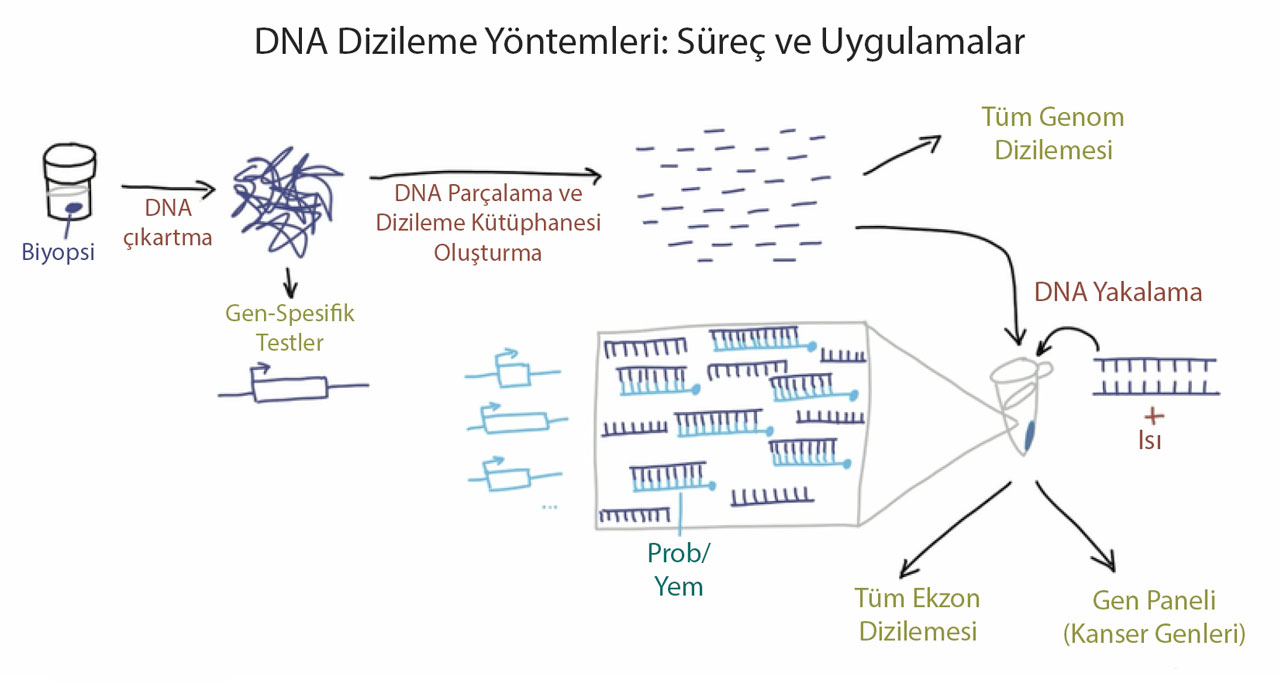
- DNA Extraction: The first step is purifying DNA from cancer cells. This begins by breaking open cells and isolating the genetic material.
- DNA Fragmentation: Long DNA strands are broken into short fragments, making sequencing easier.
- Sequencing Library Preparation: Special adapters are added to the ends of DNA fragments, preparing them for processing in the sequencing instrument.
- Sequencing: Sequencing instruments read the base pairs in these fragments in order, generating millions of short reads.
- Alignment and Analysis: Short read sequences are compared with a reference genome. Genetic variations (mutations) and their biological significance are identified at this stage.
What Is NGS (Next-Generation Sequencing) and Why Is It Important?
NGS, or next-generation sequencing, is an advanced DNA sequencing method that enables genomic data to be obtained rapidly and comprehensively. Compared with traditional Sanger sequencing, it offers a much faster, higher-capacity and lower-cost solution. The revolutionary differences NGS makes in cancer research can be summarized as follows:
1. Speed and Scope
NGS can sequence millions of DNA fragments in parallel at the same time. This greatly reduces the time needed to analyze an individual's entire genome. Whereas Sanger sequencing can examine only a particular gene, NGS can examine the whole genome or specific gene panels simultaneously.
2. Depth and Sensitivity
NGS can detect genetic variants present even in very small amounts. This is critical in heterogeneous diseases such as cancer. For example, mutations present in a minority of tumor cells that cannot be detected by traditional methods can readily be identified with NGS.
NOTE: A genetic variant refers to a DNA sequence difference that represents a gene's natural genetic diversity and is generally harmless. A mutation , by contrast, refers to a permanent change in genetic material that may often cause disease; all mutations are variants, but not all variants are mutations.
How NGS Has Transformed Cancer Treatment
NGS is considered a groundbreaking technology in cancer treatment because it examines the genetic foundations of disease, making it possible to achieve results through individualized approaches rather than general treatments alone. This enables the development of targeted therapies or immunotherapies that are more effective and have fewer side effects than traditional chemotherapy.
NGS has also begun to play a major role in the diagnosis and treatment of diseases beyond cancer, such as rare genetic and infectious diseases.
Whole-Genome Sequencing and Other Approaches
Whole-genome sequencing analyzes all of an organism's genetic material. Although frequently used in cancer research, it is not always the most appropriate option in clinical practice because it generates a great deal of information, some of which has no clinical significance.
More Focused Approaches
- Gene Panels: Used to analyze only particular genes associated with cancer.
- Whole-Exome Sequencing: Targets protein-coding gene regions (exons). This method provides lower-cost information that is more applicable to clinical practice.
- DNA Capture Technologies: Used to isolate genes of interest. This method enables highly accurate analysis of targeted genetic regions.
The Role of Gene Sequencing in Cancer Treatment
1. Developing Targeted Therapies
Gene sequencing can identify specific mutations in cancer cells. For example, lung cancer patients with an EGFR mutation may achieve better outcomes with treatments that target that mutation.
2. Selecting Combination Treatments
A patient's tumor may contain multiple genetic changes. Sequencing helps guide which mutations should be prioritized for treatment.
3. Understanding Treatment Resistance
In patients who develop resistance to cancer treatment, sequencing can identify new mutations and guide updates to treatment strategies.
4. Early Diagnosis and Risk Prediction
In people carrying inherited genetic mutations (such as mutations in the BRCA1 and BRCA2 genes), gene sequencing plays a vital role in determining cancer risk and implementing preventive measures.
Challenges of DNA Sequencing Technologies
- Data Volume: Whole-genome sequencing generates a large amount of data that must be analyzed.
- Cost: Despite technological advances, DNA sequencing remains expensive.
- Bioinformatics Analysis: Powerful software and experts are needed to interpret the data generated.
- Ethical Issues: Protecting privacy is important when storing and sharing genetic information.
Recent Developments and Future Prospects
DNA sequencing technologies are continually advancing. In particular, the development of faster, lower-cost sequencing instruments is making this technology more accessible. Genetic information is expected to be used more comprehensively and routinely in cancer treatment in the future.
Notable Innovations
- Liquid Biopsies: Offer noninvasive diagnosis and monitoring by analyzing tumor DNA circulating in the blood.
- CRISPR Technology: Gene-editing tools are being used in efforts to develop patient-specific treatment strategies.
- AI-Assisted Analyses: Offer more effective solutions for interpreting large datasets.
Analyzing Sequencing Results and Detecting Variants
DNA sequencing not only determines the order of genetic material but also enables us to understand the genetic basis of diseases by detecting changes in these sequences. Post-sequencing analysis is critical for identifying genetic variations (mutations) and interpreting their biological significance. This section explains how sequencing results are analyzed and how the most common types of variants are detected.

The image above shows the DNA sequencing analysis process and types of genetic variation. It details how different types of variation, such as single nucleotide variants (SNVs), copy number variants (CNVs) and rearrangements, are detected, from the sequencing library through to variant detection. The image illustrates the alignment of genetic data and the analysis of average coverage and variant frequencies.
Initial Processing of Sequencing Results: Reading and Alignment
Sequencing instruments generate millions of reads consisting of short DNA fragments. These reads are aligned to a reference genome, enabling genetic variations to be detected. The initial steps include:
- Alignment: Each read is placed at the appropriate position in the reference genome.
- Coverage: The number of times each base pair in the genetic region of interest has been sequenced. Higher coverage provides more reliable analyses.
- Filtering: Low-quality reads are removed, so the analysis is based only on high-quality data.
Types of Genetic Variants
1. Single Nucleotide Variants (SNVs)
SNVs are changes in which one base pair is replaced by another, much like changing a single letter in a sentence. For example, where the reference genome has a "C," the analyzed sequence may have a "G" at the same position. The following factors are assessed when detecting SNVs:
- Variant Allele Frequency (VAF): The percentage of all reads that contain a particular variant.
- For example, if there are 10 reads in a region and 4 contain the variant, the VAF is 40%.
- The Importance of VAF:
- Low VAF may indicate somatic mutations (for example, mutations in cancer cells).
- High VAF may indicate inherited mutations or homozygous variants.
2. Copy Number Variants (CNVs)
Copy number variants are increases or decreases in the number of copies of particular regions of genetic material. Frequently seen in cancer cells, these variants are associated with changes in genes that affect the rate of cell growth and division.
- Amplification: The presence of extra copies of a particular gene region. For example, amplification of the HER2 gene is associated with an aggressive course in some breast cancers and with suitability for targeted drugs.
- Deletions: Loss of a particular region of the genome may result in the inactivation of tumor suppressor genes.
3. Rearrangements
Rearrangements occur when DNA fragments from different parts of the genome are joined. They may include inversions, translocations or more complex rearrangements of chromosomal segments.
- Example: Gene Fusions
- The EML4-ALK fusion is a rearrangement frequently observed in certain lung cancers. It is an example of an oncogene (a cancer-causing gene) formed by joining two genes.
- Detection Method:
- Rearrangements are detected when sequencing reads do not align to their expected positions in the reference genome.
- For example, if one end of a read aligns to one gene and the other end to another, this may indicate a fusion between the two genes.
Clinical Significance of Variants
Each variant detected after sequencing is assessed for its effects on disease processes and treatment decisions. For example:
- Targeted Therapies: Specific mutations, such as those in EGFR, KRAS or BRAF, determine treatment options that target these mutations.
- Prognostic Value: CNVs and gene fusions provide clues about cancer aggressiveness and response to treatment.
- Treatment Resistance: New SNVs or CNVs that emerge during treatment play a critical role in understanding mechanisms of drug resistance.
Conclusion
Gene mapping and DNA sequencing are revolutionizing cancer treatment. By identifying genetic characteristics specific to each patient's cancer, these technologies offer more effective and personalized treatment strategies. However, stronger bioinformatics infrastructure and lower costs are needed for them to be used effectively. The future points to an era in which genetics will push the boundaries of cancer treatment even further.
Was this article helpful?
Your feedback helps us improve our content.




Reader comments
Share your comment
Your name and comment are published only after administrator approval. Your email address is never shown to visitors.
Be the first to comment.