
What Is Mesothelioma? Its History and the Latest Developments in Treatment

In this article
Mesothelioma is a rare cancer that went undiagnosed or misdiagnosed for many years. Around 3,000 people in the USA and approximately 500 in Turkey are diagnosed with mesothelioma each year. Although there is still no curative treatment for mesothelioma, which is often diagnosed at an advanced stage, innovations in chemotherapy, targeted therapies, immunotherapies and electrotherapy are producing promising results.
What Is Mesothelioma?
Cancer of the membranes covering the lungs, heart and abdominal organs is called malignant mesothelioma or simply mesothelioma. Our lungs are covered by a two-layer membrane called the pleura. A small amount of fluid between the pleural layers is produced by mesothelial cells. Tissues similar in structure to the lung's pleural membrane are found elsewhere in the body: the peritoneum around the abdomen and the pericardium around the heart. Malignant mesothelioma is the name of cancer arising from these membranes. Malignant mesothelioma originating in the pleura accounts for 80% of patients with malignant mesothelioma.
Because cases are few, the known history of mesothelioma is limited. Joseph Lieutaud recorded the earliest tumor of the lung lining (pleura) in 1767. The term "mesothelioma" was used to classify this rare cancer in 1920. In the 1940s, mesothelioma was found to be associated with asbestos exposure. Because mesothelioma is so rare, patients are thought to have been misdiagnosed for decades. After the 1940s, physicians began investigating mesothelioma and its link to asbestos in depth. Cancer can take 15 to 70 years to develop after a person's first asbestos exposure. Research to date has not achieved major advances in early diagnosis of mesothelioma. It is therefore typically diagnosed at advanced stages, when it is harder to treat.
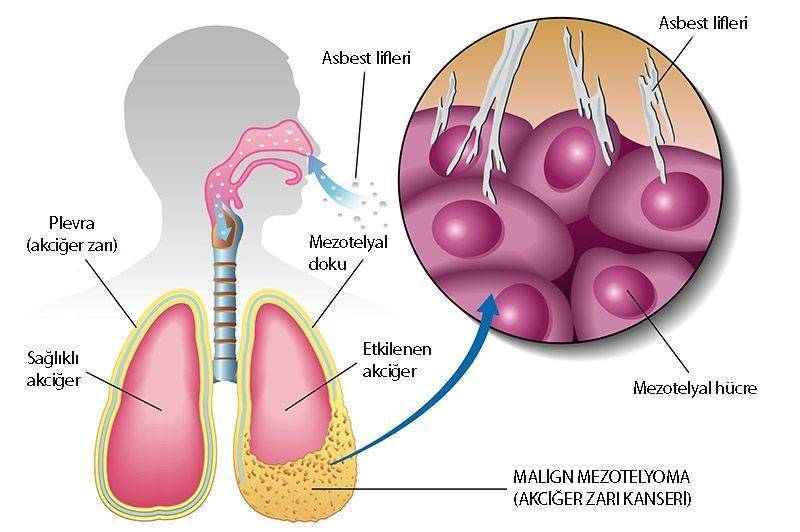
Although current treatments enable longer and better-quality lives for patients diagnosed with advanced mesothelioma, this cancer is still considered incurable. Only 15% to 20% of patients diagnosed with pleural mesothelioma have early-stage disease and are suitable for surgery.
What Is Asbestos, and How Does It Cause Cancer?
Asbestos is a natural material formerly used to insulate buildings. Consisting of very small fibers and favored for its resistance to burning, it can cause mesothelioma and lung, laryngeal (voice box) and ovarian cancers when inhaled.
There are three types of asbestos: amosite (brown asbestos), crocidolite (blue asbestos) and chrysotile (white asbestos). All three are harmful to health, but brown and blue asbestos are more harmful because their fibers are shorter and sharper and are more difficult for the body to break down.

Although the World Health Organization has banned the use of all asbestos worldwide since the 1980s, people who previously worked with asbestos or live in asbestos-containing buildings remain at risk.
When Was Mesothelioma Discovered? A Brief HISTORY
This tumor arising from the pleura (the lung lining) was first described in 1767 by Joseph Lieutaud, the founder of pathological anatomy in France. In a publication detailing his study of around 3,000 autopsies, Lieutaud mentioned two "pleural tumor" cases, probably the first recorded cases of pleural mesothelioma.
René-Théophile-Hyacinthe Laennec, the French physician who invented the stethoscope in 1819, suggested that cancer could arise from the pleura, based on his understanding of the nature of pleural cells.
However, Karl Freiherr von Rokitansky, professor of pathological anatomy at the University of Vienna in 1843, opposed this idea. He argued that cancers found in the pleura could not originate there, but were metastases from cancers originating in other organs.
Despite the absence of compelling evidence, this was the theory accepted by the medical establishment for years. Ironically, von Rokitansky later described primary tumors of the peritoneum (the abdominal lining), probably the first recorded cases of peritoneal mesothelioma.
In the early 1900s, the medical community finally began accepting that pleural cancer could arise in the pleura itself, as well as spread from a primary cancer elsewhere in the body.

Wittenoom's Lost Generation: The Tragic Consequences of Asbestos Playgrounds
A photograph from 1953 shows four-year-old neighbors playing in an asbestos sandbox in the backyard of a residential property in Wittenoom, Australia. Residents commonly used asbestos sandboxes for their children to play in.
Philip Noble (left) grew up to become a footballer before dying of mesothelioma at 36. Ross Munroe (right) became a high school principal and died of mesothelioma at 38.

Historical Studies of Mesothelioma and Asbestos Exposure
After years of research, speculation and debate, medical establishments worldwide definitively accepted two important facts about mesothelioma: its pleural origin and its clear link with asbestos exposure.
Groundbreaking German study
In 1943, Dr. H.W. Wedler became the first to report a link between asbestosis and pleural cancer among German asbestos workers. Cancer was found in approximately 20% of asbestos workers, with lung cancer more common than mesothelioma in these patients.
Wedler's work was well received in Germany, but the political climate at the time led the rest of the world to disregard research from Nazi Germany.
South African study
Perhaps the most important study documenting the clear link between asbestos exposure and cancer was presented by medical researcher JC Wagner and physician Chris Sleggs.
In their paper published by the British Journal of Medicine in 1960, Sleggs and Wagner detailed 33 cases of mesothelioma identified in northwestern South Africa, where crocidolite asbestos was mined.
American study
American physician Dr. Irving J. Selikoff presented his findings at the 1964 Biological Effects of Asbestos conference sponsored by the New York Academy of Sciences.
For more than a year, Selikoff examined over 1000 workers from the Union Asbestos & Rubber Company factory in Patterson, New Jersey.
Selikoff found mortality among these workers to be 25% higher than statistically expected. He revealed that the workers had died from various diseases, including asbestos, asbestos-related lung cancer and other lung, stomach and colorectal cancers.
British study
Another study by British physician Molly Newhouse found mesothelioma cases among people living near an asbestos factory in London who were not employed there.
In 1968, the British Medical Journal asserted that asbestos was the direct cause of most mesothelioma cases. Debate continued over which types of asbestos were more carcinogenic.
The History of Mesothelioma Treatments
Despite decades of research, there is still no definitive treatment for advanced mesothelioma. However, more precise surgical procedures, improved chemotherapy regimens and immunotherapy and similar newly emerging treatments have helped patients to survive for longer than ever before.
Surgery
Surgical treatment of mesothelioma began in the 1940s with pneumonectomy (complete removal of one half of the lung) and pleurectomy (stripping the lung lining).
In the 1960s, pleurectomy and decortication was introduced, a procedure still widely used today.
In the 1970s, physicians tried another operation, extrapleural pneumonectomy, which was also initially used to treat tuberculous empyema. Surgical mortality at the time was as high as 31%. Today, it is around 4% at leading cancer centers.
Chemotherapy
From the 1970s to the 1990s, various chemotherapy drugs, including doxorubicin and cisplatin, were used to treat mesothelioma, with response rates ranging from 20% to 40%.
In 2003, a phase III trial of cisplatin and pemetrexed for mesothelioma reported the best response rate to date, at 41.3%. Following this trial, in 2004 the US Food and Drug Administration (FDA) approved cisplatin plus pemetrexed as the new standard treatment for mesothelioma.
Radiation therapy
Physicians began trying radiation therapy for mesothelioma in the 1950s using intrapleural instillation of radioactive colloidal gold.
A 2001 phase II clinical trial changed this perspective when it reported a low local recurrence rate of 13 percent after radiation therapy following EPP surgery. Today, advanced techniques such as intensity-modulated radiation therapy are used to reduce radiation exposure to vital organs.
New treatments
The combination of two immunotherapy drugs, nivolumab (Opdivo) and ipilimumab (Yervoy), produced highly successful results in mesothelioma clinical trials and received FDA approval in October 2020. We thus gained an approved chemotherapy-free treatment option for mesothelioma regardless of subtype.
Was this article helpful?
Your feedback helps us improve our content.




Reader comments
Share your comment
Your name and comment are published only after administrator approval. Your email address is never shown to visitors.
Be the first to comment.