
What Is the Ideal Postoperative Treatment for Stage 3 BRAF Mutation-Positive Melanoma?

Malignant melanoma, accounts for approximately %5 of skin cancers and has very aggressive cancer biology. However, melanoma treatment and its outlook changed completely after 2011. Previously, treatment options were very limited and chemotherapy was weak; in 2011, the BRAF-targeted vemurafenib (Zelboraf) and immune checkpoint inhibitor immunotherapy ipilimumab (Yervoy), FDA approval received, and subsequent new medicine approvals significantly extended patients' lives. Genetic research showed that melanomas fall into BRAF mutation -positive and -negative main groups.
For early-stage (1 and 2) melanoma, the main treatment is extensive surgery. At locally advanced stage 3, surgery is again the main treatment, and the role of postoperative adjuvant treatment (reducing recurrence risk) is debated. For unresectable or stage 4 melanoma, systemic treatment with immunotherapy and targeted medicines is now established: in stage 4 melanoma, BRAF mutation-positive disease starts with BRAF-targeted medicines, while immunotherapies are considered first for negative disease. However, debate continues over "the best postoperative protective treatment in stage 3 melanoma".
Details of COMBI-AD, Evaluating Postoperative BRAF-Targeted Medicines in Stage 3 Melanoma
Journal of Clinical Oncologypublished long-term results on 22 October 2018 of this phase-3 clinical trial, which enrolled patients with previously operated BRAF V600 mutation-positive stage 3 melanoma, totaling 870 patients. They were randomly assigned to 2 groups; in the treatment arm, 438 received dabrafenib (brand name Tafinlar) plus trametinib (Mekinist), while the control arm received placebo .
Treatment efficacy was primarily evaluated by relapse-free survival duration (relapse free survival) and distant metastasis-free survival. Relapse-free survivalwas defined as the time from treatment initiation to disease relapse (local, regional or distant metastasis), a new primary melanoma, or death from any cause.
Note: For postoperative treatment of stage 3, high-risk because of positive lymph nodes, BRAF mutation-positive melanoma, adjuvant dabrafenib plus trametinib had previously, based on early COMBI-AD findings, received FDA approval on 30 April 2018 . These data, however, are the same clinical study's long-term results.
Study Results
- During a median follow-up of 44 months, at 3 and 4 years, relapse-free survival rates were % 59 and % 54 in the dabrafenib plus trametinib arm, versus % 40 and % 38 in the placebo arm.
- After surgery, the main treatment, using dabrafenib plus trametinib reduced distant metastasis risk by % 47.
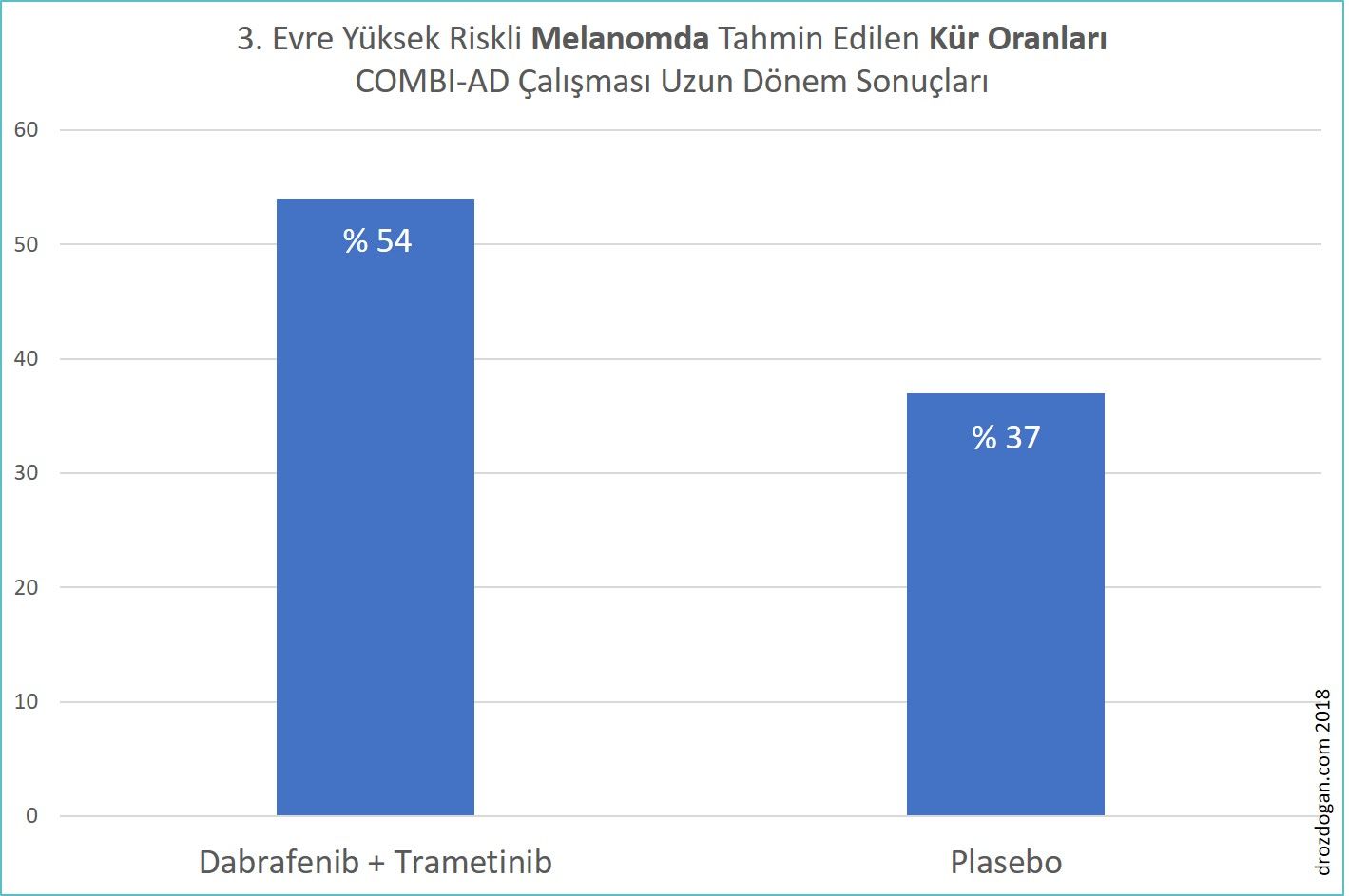
- The study's most striking result was the estimated cure (complete recovery) rate, which was % 54 in the dabrafenib plus trametinib arm and % 37 in the placebo arm.
Conclusion Longer follow-up confirmed the benefit of dabrafenib plus trametinib in stage 3 melanoma. Subgroup analyses also suggest that this treatment benefits patients independently of other baseline factors. This study allows us to say that, following stage 4 melanoma, clinical practice for stage 3 melanoma has also changed completely.
Sources
Longer Follow-Up Confirms Relapse-Free Survival Benefit With Adjuvant Dabrafenib Plus Trametinib in Patients With Resected BRAF V600–Mutant Stage III Melanoma.
Journal of Clinical Oncology, 22 October 2018.
Was this article helpful?
Your feedback helps us improve our content.




Reader comments
Share your comment
Your name and comment are published only after administrator approval. Your email address is never shown to visitors.
Be the first to comment.