A Gene Misjudged: p53 and Its Tumour Suppressor Identity, 1989
In this article
A Gene Misjudged: p53 and Its Tumour Suppressor Identity, 1989
On Day 179 we saw loss of 17p reach 75 percent of carcinomas, and I left open which gene's loss that was. Today it is that gene: p53, which began in 1979 as a band on a gel and was counted as an oncogene in 1984 (Day 165). In this article I keep the promise I made on Day 165: which clone proved wrong and why, how the turn of 1989 came by two separate routes, and who showed what on which date, as far as I could verify.
A mutation inside an assumption
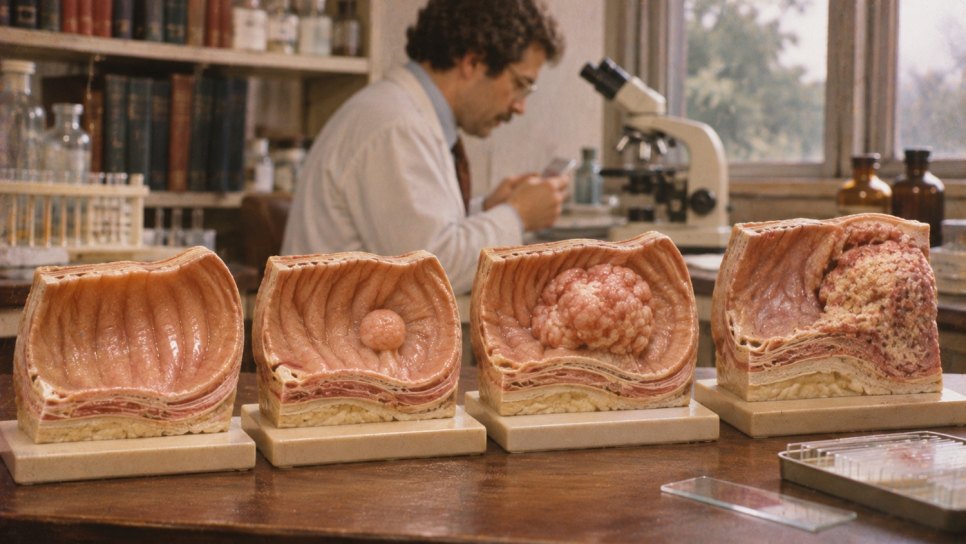
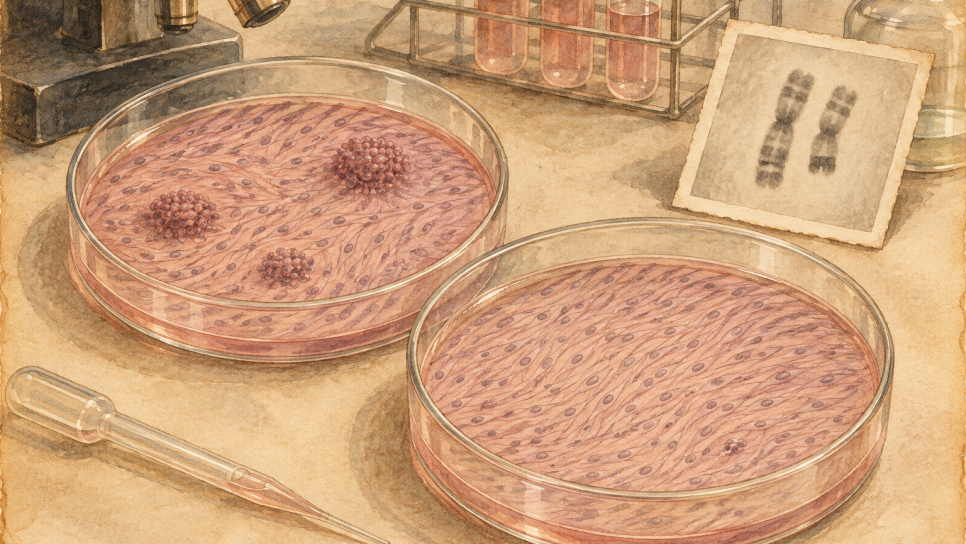
Fibroblasts taken from a rat embryo form a thin layer in a culture dish. Give the cells one oncogene, ras, and a second one, say p53, and heaps of cells appear on the layer: foci, the visible sign of transformation. After 1984 this experiment was the basis for counting p53 as an oncogene (Day 165). The experiment had a silent assumption: that the p53 clone put into the dish was the normal p53 gene.
The discussion of the 1989 paper by Finlay, Hinds and Levine says this assumption did not hold. According to the text, which I read through a summarizing tool, several independently derived p53 cDNAs and at least one genomic clone carried mutations that "activate" p53 for cooperation with ras; the changes were one or two single nucleotides between amino acids 130 and 234. The paper bases this on Finlay (1988), Eliyahu (1988) and Hinds (1989); I did not read those. Soussi's 2010 historical article, for its part, names Levine's team as the one that first cloned a non-mutant mouse cDNA and showed it lacked oncogenic activity (that is Soussi's wording; I make no ruling on priority).
The bitter part of the story is that the 1984 experiments were consistent in themselves: with those clones the experiment really did give "p53 transforms". What was wrong was what the clone was.
Wild-type p53 suppressed transformation
Finlay, Hinds and Levine, "The p53 proto-oncogene can act as a suppressor of transformation", Cell 57:1083-1093
The paper was received on 27 December 1988, revised on 14 April 1989 and appeared in the Cell issue of 30 June 1989. The experiments used primary rat embryo fibroblasts. Wild-type mouse p53 almost completely abolished focus formation when ras and an activating mutant p53 were present together; with ras and E1A it reduced foci by about two-thirds to 80 percent on average. A control construct that makes no protein had no effect. Most of the surviving transformed colonies carried p53 DNA but did not make the protein; those that did made mutant forms. Adding mutant p53 increased the number of foci. In the Discussion the authors write that p53 would be more appropriately classified as a "recessive oncogene", and a note added in proof reports that Oren and colleagues obtained similar experiments and results.
Wild-type and mutant: one name, two roles
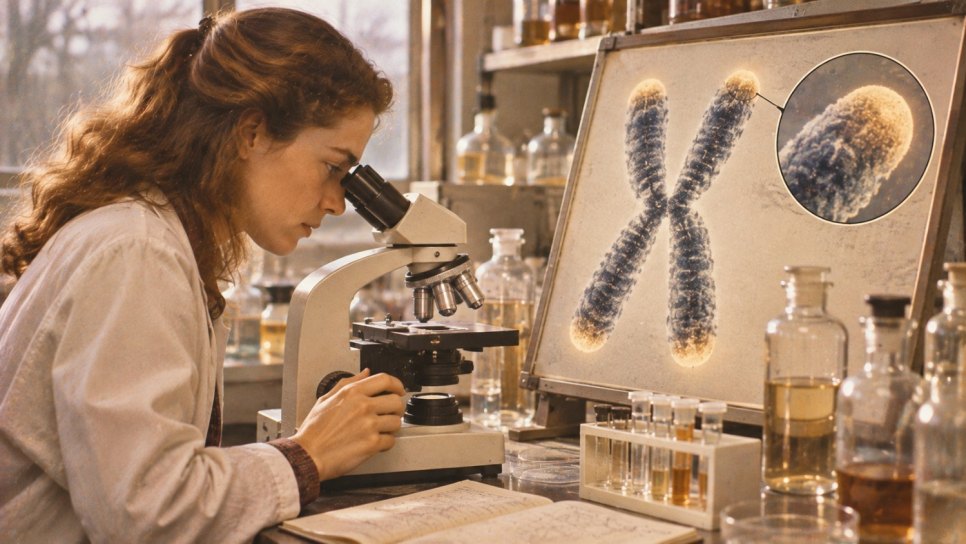
"Wild-type" means the normal form of a gene, "mutant" the altered form. The same gene name can carry two behaviours: normal p53 suppresses transformation; mutant p53 cannot do so and, according to a suggestion by Finlay and colleagues, can interfere with the normal copy and disable it (a trans-dominant effect). Because a cell has two copies, one mutant copy may leave the sound copy useless as well.
A mutation and the loss of the other copy
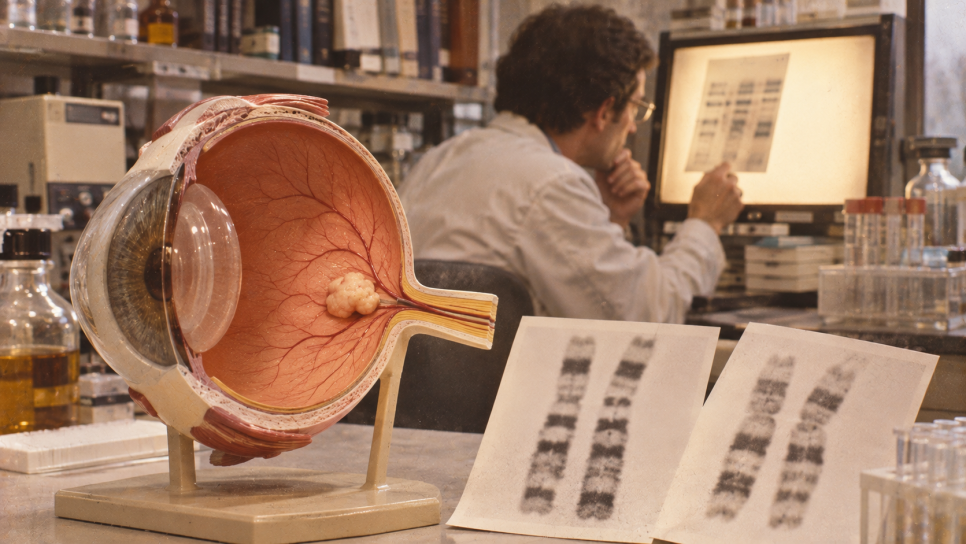
In the first half of the same year another route opened. The Science paper of 14 April 1989 by Baker and colleagues reported chromosome 17 deletions and p53 gene mutations in colorectal carcinomas (Science 244:217-221). I could not reach the abstract of that paper in this session; I infer its content only from the abstract of Nigro and colleagues, which says that the 17p region containing p53 is often deleted in colorectal cancers and that in two tumours the remaining p53 allele carried mutations.
The Nature paper of Nigro and colleagues (7 December 1989; 342:705-708) tried to generalise this finding. According to the abstract, most tumours with a 17p deletion had also disabled the remaining copy of p53 through point mutations that change an amino acid; some tumours that kept both copies of 17p also carried mutations; and the mutations clustered in four "hot spots" of the gene which coincided with its four most conserved regions. The authors proposed that p53 mutations contribute to many common human cancers. According to Soussi's article, Takahashi and colleagues reported in the same year that p53 is a frequent target in lung cancer (Science 246:491-494); of that paper I verified only the citation.
The link to Day 179 is direct: the 17p loss seen in 75 percent of carcinomas in the 1988 NEJM study was the loss of one copy of a gene, and the remaining copy was often mutated. A mutation in one copy, loss of the other: Knudson's two-hit logic (Day 151; Day 177 for RB) is now at work in a colorectal carcinoma through p53. I am making that link; the Nigro abstract does not use the term.
Oncogene or anti-oncogene?
Two separate sources reached the same conclusion: in the culture dish wild-type p53 suppressed transformation; in human tumours the gene had been deleted or mutated. The 1990 article by Lane and Benchimol, "p53: oncogene or anti-oncogene?", discussed this accumulation (Genes Dev 4:1-8; according to Soussi; I verified only the citation). In November 1990 Malkin and colleagues reported germline p53 mutations in the Li-Fraumeni families we met on Day 148 (treated on Day 165).
Soussi's thesis is that the field got stuck in a paradigm. According to the same article, Maltzman and Czyzyk showed in 1984 that UV light raised nuclear p53 in cells, but the finding was not interpreted correctly at the time. This may be a case of a "rejected pioneer"; it comes from a single secondary source and I could not verify it independently.
The name changed too: Finlay and colleagues said "recessive oncogene", and in the following years the gene came to be called a "tumour suppressor". The name describes the behaviour: one copy may not be enough, and the brake loosens when both copies are disabled or when the mutant protein affects the sound copy.
Price and limits
First, I do not generalise a laboratory finding to humans: the results of Finlay and colleagues are in rat embryo fibroblasts; the suppression is partial (two-thirds to 80 percent) and varies with the cell line (in Rat-1 cells the effect of wild-type p53 was modest). Second, the human data were a small beginning: I could report the finding of Baker 1989 only from a secondary abstract ("two tumours"); I did not read the sample numbers of Nigro 1989. Third, "mutation = loss" is a simplification: Finlay and colleagues point to the possibility that the mutant gains a new function, and I did not go further on that. Fourth, priority: in the same year the Oren team published similar results (PNAS 1989; only the citation was read) and a note in the Finlay paper acknowledges this; I make no ruling on who was "first". Fifth, "TP53 mutation" on a report carries no conclusion by itself; its meaning is discussed with a physician within the patient's situation.
Two routes in 1989: in cell culture wild-type p53 suppressed transformation (blue), and in human tumours p53 deletions and mutations were found (orange). Dates: the Finlay paper was received on 27 December 1988 and published on 30 June 1989; Baker 14 April 1989; Nigro 7 December 1989. Eliyahu (PNAS) and Takahashi (Science) were also published in 1989; their months were not verified, so they are not drawn. The positions of the dots are day counts I calculated from the dates (my drawing).
Inherited TP53 and a small study from Turkey
Today's colorectal data describe p53 changes acquired later in the tumour (somatic). Inherited (germline) TP53 is a different subject: the Li-Fraumeni of Day 148. An example from Turkey: at İzmir Tepecik Training and Research Hospital, in 100 patients with BRCA-negative breast cancer diagnosed at 50 years or younger, tested in 2016-2017, targeted next-generation sequencing was used, with Sanger sequencing for confirmation; a variant was found in 5 patients (5 percent), a pathogenic or likely pathogenic variant in 4 (4 percent), and one was a variant of uncertain significance. The mean age at diagnosis was 39.1 (24-48); in the four carriers, 30.2 (24-38). Deletion/duplication analysis (MLPA) showed no deletion. My reservations: only 100 patients; a single centre and retrospective; no comparison group; the patients were selected as BRCA-negative and young, so I do not generalise the 5 percent to the general population or to all breast cancers; four carriers is a very small number. The page gave author names only as initials; the journal and year are inferred from the DOI prefix (Turkish Journal of Oncology, 2020).
From 1979 to 1990
What was verified, what remains uncertain
- Finlay, Hinds, Levine 1989: the PDF was read twice through a summarizing tool (Cell 57:1083-1093; 30 June 1989). The dates of receipt (27 December 1988) and revision (14 April 1989), the phrase "recessive oncogene" appearing in the Discussion, and the "two-thirds to 80 percent" range come from that reading. The paper does not name the clones used in 1984; I could not verify here the "Pennica clone" detail mentioned on Day 165.
- Soussi 2010: read through a summarizing tool (EMBO Rep 11(11):822-826). The wording "first to clone a non-mutant mouse cDNA" is Soussi's; the citations of Baker, Takahashi, Lane-Benchimol and Maltzman-Czyzyk were taken through him and not independently verified. Soussi writes a critique of paradigms; I reported his thesis, I did not adopt it.
- Baker 1989: the citation (authors, Science 244(4901):217-221, 14 April 1989, DOI 10.1126/science.2649981) was verified from two record pages; the abstract could not be read (PubMed and Europe PMC rate limits, reCAPTCHA). On Day 165 I wrote that the Baker abstract had been read; I could not reach it in this session and could not re-verify that statement. Today's content I took only from the Nigro abstract and I gave no numbers.
- Nigro 1989: citation and abstract from a publisher page, through a summarizing tool (Nature 342(6250):705-708; received 30 August, accepted 30 October, published 7 December 1989). The sample numbers were not read in the abstract. "Four hot spots" and "four most conserved regions" are from the abstract.
- Eliyahu 1989 (PNAS 86(22):8763): only title and citation, from a record page; abstract and month not read. Takahashi 1989 (Science 246:491-494) only through Soussi; not read. Lane and Benchimol 1990 citation only (through Soussi).
- Turkey: the study was read from a record page through a summarizing tool (DOI 10.5505/tjo.2020.2107). Author names were incomplete; the journal and year are inferred from the DOI prefix. Patients were tested in 2016-2017; single centre, retrospective, no comparison.
- Readings and calculations are mine: the two-hit link (Knudson, RB, NEJM 1988) is my interpretation; the Nigro abstract does not use the term. The positions in the figure are day counts I calculated from the dates. "17p is the region containing p53" is from the Nigro abstract. I made no ruling on the priority question (Finlay and Oren in the same year).
A Second Gene on One Chromosome: Mary-Claire King and the Trace of BRCA1, 1990
Today we found p53 on the short arm of chromosome 17. Tomorrow we move to the long arm of the same chromosome: to 1990, when a trace was sought for the gene of early-onset familial breast cancer, and to Mary-Claire King. Before writing I will verify the citation of the paper, its date, how many families it rested on, which region of the chromosome the signal fell in, and when King began this search.
Author's note: In this article I paid attention to both sides of the sentence "p53 was misjudged": the 1984 experiments were consistent under their own conditions, and what was wrong was what the clone was; the turn of 1989 belongs neither to a single paper nor to a single laboratory. Because I could not read the Baker 1989 abstract, there is a gap in that link, and I have noted it in the fact-check box.
Sources and Further Reading
- Finlay CA, Hinds PW, Levine AJ. The p53 proto-oncogene can act as a suppressor of transformation. Cell 1989;57:1083-1093 (full text; read through a summarizing tool).
- Baker SJ, Fearon ER, Nigro JM, Hamilton SR, Preisinger AC, Jessup JM, vanTuinen P, Ledbetter DH, Barker DF, Nakamura Y, White R, Vogelstein B. Chromosome 17 deletions and p53 gene mutations in colorectal carcinomas. Science 1989;244(4901):217-221; DOI 10.1126/science.2649981 (bibliographic details only; content not readable).
- Nigro JM, Baker SJ, Preisinger AC, et al., Vogelstein B. Mutations in the p53 gene occur in diverse human tumour types. Nature 1989;342(6250):705-708; DOI 10.1038/342705a0 (from the abstract).
- Eliyahu D, Michalovitz D, Eliyahu S, Pinhasi-Kimhi O, Oren M. Wild-type p53 can inhibit oncogene-mediated focus formation. Proc Natl Acad Sci U S A 1989;86(22):8763; DOI 10.1073/pnas.86.22.8763 (bibliographic details only; content not readable).
- Takahashi T, et al. p53: a frequent target for genetic abnormalities in lung cancer. Science 1989;246:491-494 (bibliographic details only; content not readable).
- Soussi T. The history of p53: a perfect example of the drawbacks of scientific paradigms. EMBO Rep 2010;11(11):822-826; DOI 10.1038/embor.2010.159 (full text; read through a summarizing tool).
- Lane DP, Benchimol S. p53: oncogene or anti-oncogene? Genes Dev 1990;4:1-8 (bibliographic details only; content not readable).
- The frequency and management of TP53 mutation carriers in Turkish patients with BRCA-negative breast cancer under 50 years of age; DOI 10.5505/tjo.2020.2107 (secondary; read through a summarizing tool).
- Mukherjee S. The Emperor of All Maladies: A Biography of Cancer. New York: Scribner; 2010 (general context; relevant pages not re-read for this article).
This article is Day 180 of the "365 Days of Cancer History" series. It is historical-popular content; it is not a recommendation for diagnosis, genetic testing, screening or treatment. For questions about TP53 and hereditary cancer syndromes, consult your physician or a genetic counselling service. Sources have been verified; details resting on a single secondary source, on a record read through a summarizing tool or on an unreadable text are marked in the fact-check notes.
Plan your visit
Share your preferred date. Our team will contact you to arrange the appointment.
Was this article helpful?
Your feedback helps us improve our content.