A Tumour, Step by Step: Vogelstein and Colorectal Carcinogenesis, 1988
In this article
A Tumour, Step by Step: Vogelstein and Colorectal Carcinogenesis, 1988
On Day 178 we read the trace that an outside agent, iodine-131, left in children's thyroids, through dose and years. Today the question comes from the inside: through which genetic steps does a colon tumour pass, from one cell to a disease? On Day 177 we saw both copies of the RB gene lost; today the same logic leaves a single gene and spreads across the whole story of an organ. An NEJM paper of 1 September 1988 is one of the studies that put this sequence, from polyp to carcinoma, into numbers.
Before genes, the microscope
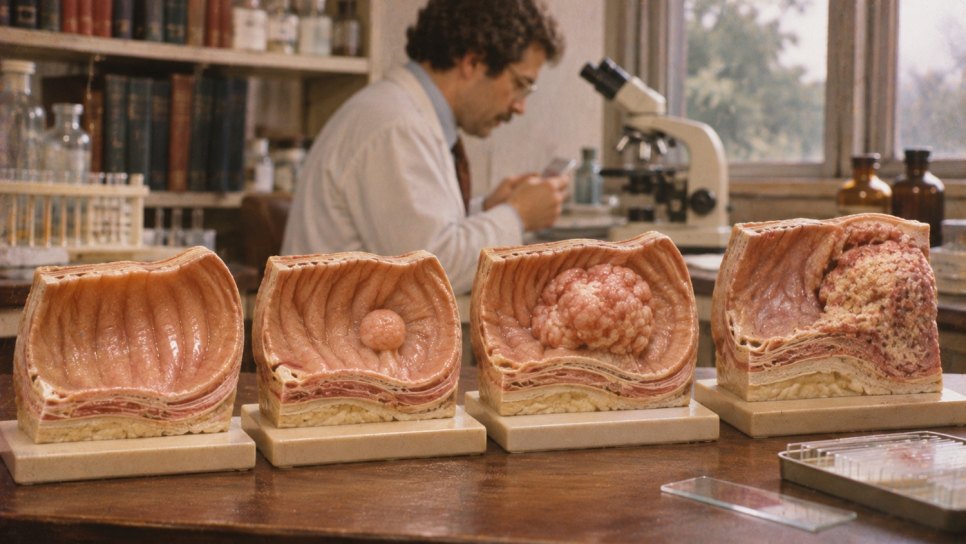
Picture a colonoscopy room; not a particular patient, a general scene. A small protrusion of the bowel wall, a polyp, is removed and sent to the pathologist. On the glass slide the pathologist looks at how the cells are arranged: are the glands orderly, how atypical are the nuclei? Long before genes were known, these two looks tried to weigh how dangerous a polyp was. The 1975 article by Muto, Bussey and Morson in Cancer, "The evolution of cancer of the colon and rectum", is one of the classic examples of that look (Cancer 36:2251-2270). According to the summary I could read, the authors describe how the malignant potential of adenomatous polyps depends on size, histological type and the degree of epithelial atypia: the risk is low in small adenomatous polyps and the cancer rate is much higher in large villous tumours.
The same summary says two more things, and both draw the limits of today's story. First, it presents evidence that most colorectal cancers develop through the polyp-cancer sequence. Second, most adenomas never turn into cancer within an adult lifespan, and progression is slow. So by 1988 there was a sequence, but the genetic steps beneath it were undefined. The question was: what change in genes lies under each step seen in the microscope? I am not saying that Muto and colleagues were the only source or the pioneers of this idea; I did not research who first proposed the polyp-cancer sequence.
A sequence put into numbers
Vogelstein, Fearon, Hamilton, Kern et al., "Genetic alterations during colorectal-tumor development", N Engl J Med 319(9):525-532
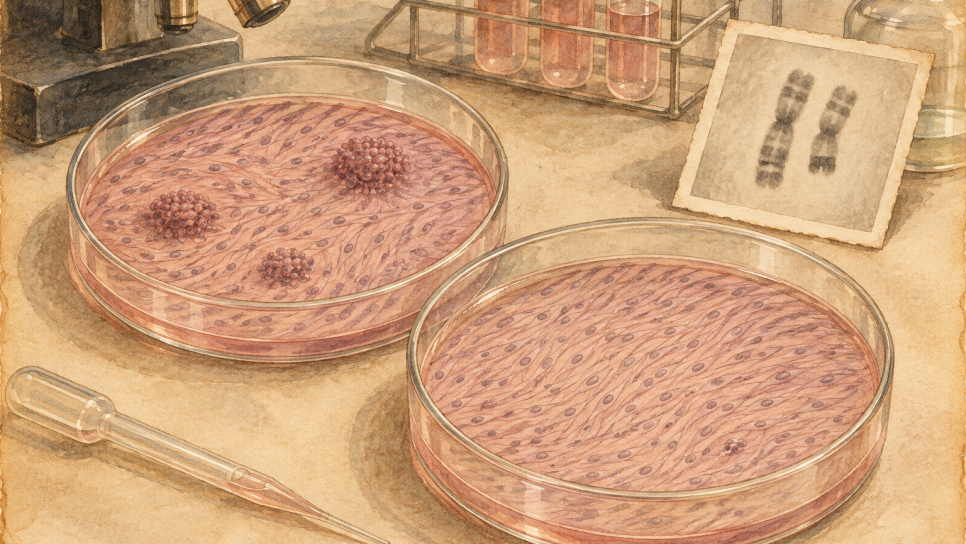
The Molecular Genetics Laboratory of Bert Vogelstein at the Johns Hopkins Oncology Center in Baltimore published a study in the NEJM issue of 1 September 1988. According to the abstract, 172 tumour specimens were examined: 40 adenomas from seven patients with familial adenomatous polyposis (FAP); 40 adenomas from 33 patients without FAP (19 without carcinoma, 21 with an associated carcinoma); and 92 carcinomas from 89 patients. Four alterations were sought: mutations in the ras gene and allelic deletions, that is loss of a chromosome region, on chromosomes 5, 17 and 18.
Allelic deletion: loss of the second copy
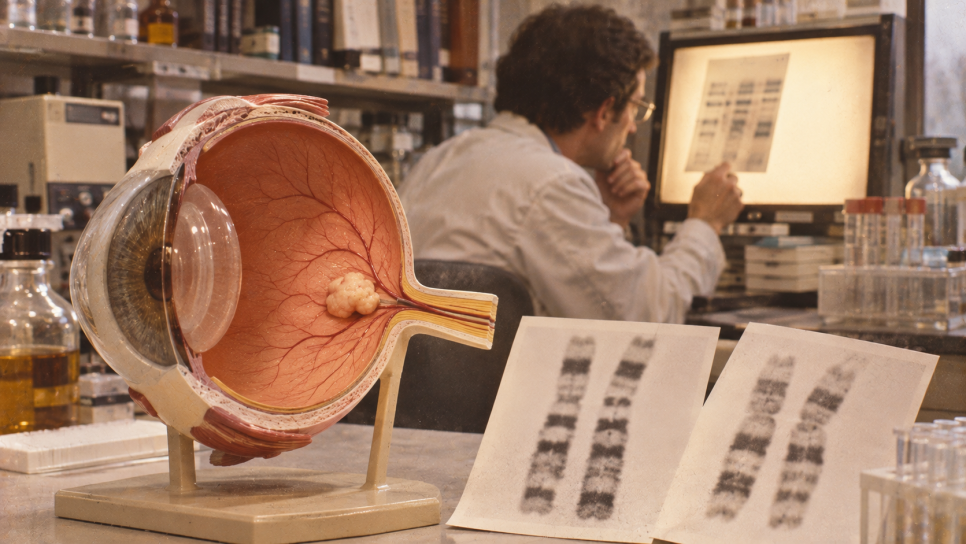
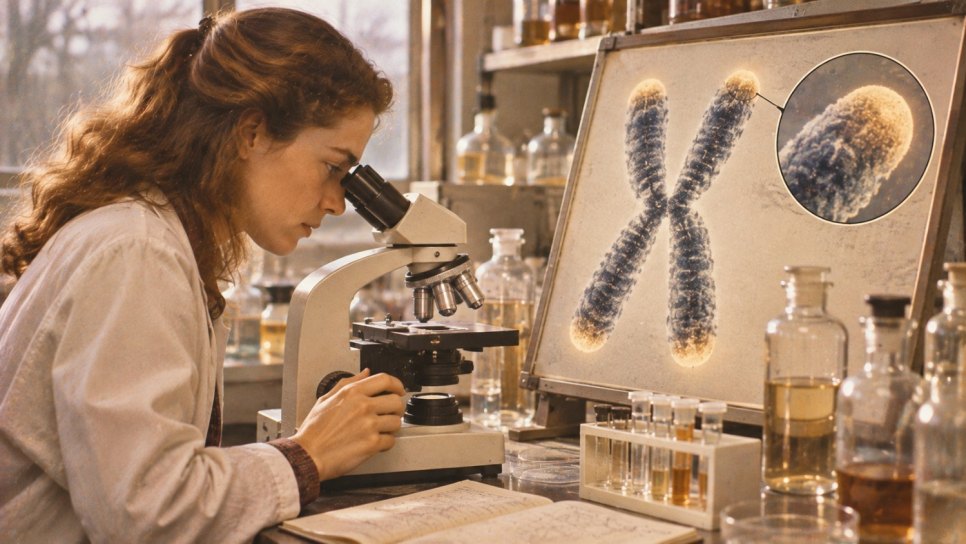
Every gene is carried in two copies. Loss of a chromosome region can remove the remaining copy of the gene there; for a suppressor gene, the brake is then switched off entirely. This is the logic we saw in Knudson's two-hit idea on Day 151 and in the RB gene on Day 177 (I am making that link). In an oncogene such as ras, by contrast, a single mutation is enough: the accelerator stays pressed. The structure the abstract arrives at is the activation of an oncogene by mutation combined with the loss of several suppressor genes.
Changes that rise as the tumour grows
The results are in the figure: a ras mutation was found in 9 percent of adenomas smaller than one centimetre, 58 percent of larger adenomas and 47 percent of carcinomas. Loss of a specific region of chromosome 18 was present in 11-13 percent of early-stage adenomas, 47 percent of advanced adenomas and 73 percent of carcinomas. Loss of 17p was usually seen only in carcinomas (75 percent). The abstract states that the four alterations accumulated along with clinical tumour progression.
Chromosome 5 says something different. In the adenomas of FAP patients this region was not lost; in patients without FAP it was lost in 29 percent of adenomas and 35 percent of carcinomas. The four markers do not all rise at the same pace or in the same patients; the model was trying to fit exactly this irregularity into a structure.
According to the assessment quoted on The Scientist's "Hot Papers" page, Vogelstein says it is widely believed that cancer results from a series of genetic alterations, that this study strongly supports that belief for one of the most common tumour types, and that the model may also apply to other tumours that are harder to study. This is his view; I am only reporting it.
One point needs careful reading here. The study placed side by side specimens at different stages from different patients; it did not follow the same tumour for years (this is my reading of the sample description; the abstract mentions no such follow-up). The order, first ras, then 18, then 17p, is an inference: frequencies that rise with growth support the existence of steps, but they do not prove that each individual tumour follows that order.
The Fearon-Vogelstein model and its disputed side
Two years later these findings became a model in the article by Fearon and Vogelstein in Cell, "A genetic model for colorectal tumorigenesis" (Cell 61:759-767, 1990). I could not reach the abstract of that article; I verified only the citation. I report the content of the model from secondary sources.
The 2019 review by Nguyen, Goel and Chung calls it a multi-hit genetic model and places genes on the steps. APC is the earliest event; its loss activates Wnt signalling. Activating KRAS mutations often come after APC and are found in about 40 percent of colorectal tumours. Loss of 18q (DCC, SMAD2, SMAD4) is seen in more than 70 percent of advanced tumours. Loss of TP53 function is more frequent in invasive cancers than in benign adenomas; that is, late. Ilyas and Tomlinson (1996) describe tumour development as Darwinian selection of advantageous somatic mutations; they write that the model's emphasis on APC and TP53 has remained largely valid, and that alternative or additional mutations have been found at other loci.
On the importance of order, the sources I read stress different things. Nguyen and colleagues regard the accumulation of specific mutations in a particular order as necessary; I could not verify, from the primary text, the common account that the model stresses the total accumulation more than the order. So I make no judgement on this point.
Price and limits
First, the model is not the only route: Ilyas and Tomlinson conclude that not all colorectal cancers follow the same genetic pathway; Nguyen and colleagues write that 65-70 percent of sporadic tumours follow chromosomal instability and about 15 percent microsatellite instability (a mismatch-repair defect), that there is also a serrated route starting with BRAF V600E, and that colorectal cancer is no longer considered a single disease. Second, the speeds differ: the same review says chromosomal-instability tumours can take ten years or more, microsatellite-instability tumours a few years. Third, the candidate genes on 18q are rarely disabled by mutation and their deletion in mice has not been linked to tumours; the 73 percent of 1988 is a region, not a gene. Fourth, Chan and Buczacki (2021) write that multiregion sequencing found heterogeneity inside tumours, that linear accumulation of drivers describes the process incompletely, and that premalignant lesions can carry driver mutations without becoming malignant. Fifth, most adenomas never become cancer (Muto): reading the model as "every polyp becomes cancer" is wrong. Sixth, frequencies cannot be compared across studies: ras in 47 percent of carcinomas in 1988, KRAS in about 40 percent in the 2019 review, 46.6 percent in the Turkish data; specimens, methods, genes and stages differ, and I have not reconciled them. For personal risk and surveillance, a physician should be consulted.
Frequencies of genetic alterations by stage (from the 1988 NEJM abstract, percent). These are proportions in specimens from different groups of patients; the same tumours were not followed. The early-adenoma value for chromosome 18 is a range of 11-13 percent; the bar is drawn at the midpoint, 12 percent (the scaling is mine). Bar lengths show the percentage directly. No adenoma value for 17p was given in the abstract.
KRAS and NRAS in metastatic disease
Kavgaci, Akiva, Ozon, Berkil, Karadayi, Dizdar and Yalcin reported in Molecular Oncology (May 2025; 19(10):2967-2977) the KRAS and NRAS results of 10,754 patients with metastatic colorectal cancer, from several centres in Turkey between January 2015 and June 2023, all tested in one laboratory. Of 10,681 conclusive KRAS results, 4,982 were mutant (46.6 percent); the most common were G12D (30.3 percent of mutants), G12V (20.1), G13D (18.4) and G12C (7.0). NRAS was examined only in the 5,699 KRAS wild-type patients; 480 were mutant (about 8.4 percent; about 4.5 percent of the whole cohort). The combined rate was about 51.1 percent; G12C was 3.4 percent of the whole cohort. The authors find the rates broadly consistent with international databases. For the cloning of RAS see Day 170. My reservations: the method is PCR (not next-generation sequencing), there are no clinical or stage data, only metastatic patients are included, NRAS was tested only in KRAS wild-type cases, the study was sponsored by Amgen and some authors are linked to the testing companies, and there are small numerical inconsistencies in the text (an observation of the summarizing tool). For that reason I do not set 46.6 percent beside the 47 percent of 1988; the similarity may be coincidence (this is my inference).
From 1975 to 2025
What was verified, what remains uncertain
- NEJM 1988: the citation and all numbers come from the PubMed abstract, read through a summarizing tool (N Engl J Med 1988 Sep 1;319(9):525-532). The abstract page had no author list; I took the names Vogelstein, Fearon, Hamilton and Kern from The Scientist page and wrote "et al." The abstract does not say which member of the ras family is meant; I did not write KRAS in the text. For chromosome 18 it speaks of "a specific region"; I did not name a gene.
- Cell 1990: only the citation was verified (Cell 61(5):759-767; DOI 10.1016/0092-8674(90)90186-I); neither abstract nor full text could be read. The content of the model was reported from secondary sources (Ilyas and Tomlinson; Nguyen et al.). I did not write details that belong to the primary text, such as a "four features" list.
- Order or total: Nguyen et al. write that accumulation of specific mutations in a particular order is necessary; I could not verify the common account that the model stresses total accumulation. I have not reconciled the two emphases.
- Muto 1975: citation and abstract come from a record page, read through a summarizing tool (Cancer 36(6):2251-2270; DOI 10.1002/cncr.2820360944). The page named only the first author, Muto; the names of the second and third authors (Bussey HJR, Morson BC) matched the citation found in search but were not confirmed on the page. I did not research whether they were the first to propose the polyp-cancer sequence.
- Ilyas and Tomlinson 1996: citation and abstract from a record page, through a summarizing tool (Histopathology 28(5):389-399). Nguyen et al. 2019: full text, through a summarizing tool, only the first 100,000 characters read; the 40, 65-70 and 15 percent figures, "more than 70" and "ten years or more" come from there; this is a secondary account. Chan and Buczacki 2021: Oncogenesis 10(7):53, first 100,000 characters, through a summarizing tool.
- Turkey: the citation and numbers of Kavgaci et al. come from a page read through a summarizing tool (Mol Oncol 2025;19(10):2967-2977; DOI 10.1002/1878-0261.70042). Samples were from 1 January 2015 to 30 June 2023; the number of centres is not stated. Numbers in the text are inconsistent: the NRAS wild-type rate is 91.5 percent in the abstract and 90.5 percent in the results. The Amgen sponsorship and author links are the summarizing tool's report.
- Calculations and readings are mine: bar lengths show the percentage directly; the early-adenoma value for chromosome 18 is drawn at the midpoint of the range (12). The "cross-sectional sampling" reading is an inference from the sample description. The links to Days 170, 177 and 151 are my interpretation. The location of tomorrow's gene on 17p is general knowledge; it will be verified tomorrow.
A Gene Misjudged: p53 and Its Suppressor Identity, 1989
Today we saw loss of 17p reach 75 percent in carcinomas. Tomorrow we turn to the best-known resident of that arm: p53, discovered in 1979 (Day 165), why was it first thought to be an oncogene, and what was shown in 1989 that gave it its suppressor identity? I will verify who showed what and when, and the share of the colon data.
Author's note: In this article I avoided two shortcuts: the single-route story "one polyp, four genes, one cancer", and the quick verdict "the model turned out wrong". The model did not turn out wrong, it turned out incomplete; I tried to separate what remains from what is disputed. I could not read the Fearon-Vogelstein 1990 text; that is a gap.
Sources and Further Reading
- Vogelstein B, Fearon ER, Hamilton SR, Kern SE, et al. Genetic alterations during colorectal-tumor development. N Engl J Med 1988;319(9):525-532; DOI 10.1056/NEJM198809013190901 (from the abstract).
- Fearon ER, Vogelstein B. A genetic model for colorectal tumorigenesis. Cell 1990;61(5):759-767; DOI 10.1016/0092-8674(90)90186-I (bibliographic details only; content not readable).
- Muto T, Bussey HJR, Morson BC. The evolution of cancer of the colon and rectum. Cancer 1975;36(6):2251-2270; DOI 10.1002/cncr.2820360944 (secondary; read through a summarizing tool).
- Ilyas M, Tomlinson IP. Genetic pathways in colorectal cancer. Histopathology 1996;28(5):389-399 (from the abstract).
- Nguyen LH, Goel A, Chung DC. Pathways of colorectal carcinogenesis. Gastroenterology 2019;158(2):291-302 (full text; read through a summarizing tool).
- Chan DKH, Buczacki SJA. Tumour heterogeneity and evolutionary dynamics in colorectal cancer. Oncogenesis 2021;10(7):53 (full text; read through a summarizing tool).
- Kavgaci G, Akiva I, Ozon YH, Berkil H, Karadayi H, Dizdar O, Yalcin S. Evaluation of KRAS and NRAS mutations in metastatic colorectal cancer: an 8-year study of 10,754 patients in Turkey. Mol Oncol 2025;19(10):2967-2977; DOI 10.1002/1878-0261.70042 (secondary; read through a summarizing tool).
- The Scientist, Hot Papers entry on the 1988 NEJM paper (December 1989 issue) (secondary; read through a summarizing tool).
- Mukherjee S. The Emperor of All Maladies: A Biography of Cancer. New York: Scribner; 2010 (general context; relevant pages not re-read for this article).
This article is Day 179 of the "365 Days of Cancer History" series. It is historical-popular content; it is not a recommendation for diagnosis, screening, colonoscopy, genetic testing or treatment. Consult your physician on polyps, colon health and surveillance. Sources have been verified; details resting on a single secondary source, on a record read through a summarizing tool or on an unreadable text are marked in the fact-check notes.
Plan your visit
Share your preferred date. Our team will contact you to arrange the appointment.
Was this article helpful?
Your feedback helps us improve our content.