The Clock at the End of the Chromosome: Greider, Blackburn and Telomerase, 1985
In this article
The Clock at the End of the Chromosome: Greider, Blackburn and Telomerase, 1985
On Day 175 we looked at the effort to direct immune cells at cancer. In the same year, 1985, a seemingly unrelated question was being asked behind another door: what is at the ends of chromosomes, and why do those ends shorten as cells divide? The role of chromosomes in cancer is familiar to us from Day 98 (Boveri); this article is the link in that story that concerns not the chromosome itself but its tip.
The chromosome ends of a single-celled organism
According to her Nobel Foundation biography, Elizabeth Blackburn was born in Hobart, Tasmania, in 1948; from early 1975 to the end of 1977 she worked as a postdoctoral researcher in Joseph Gall's laboratory at Yale. There she studied the ends of the rDNA minichromosomes of the single-celled organism Tetrahymena and found that the DNA at the tip consisted of CCCCAA repeats.
The question, in general terms, was this: how is the end of a linear chromosome copied completely each time a cell divides, and how is that end protected? I mention this framing (the tendency of ends to shorten with division) as general knowledge; I did not verify its source one by one for this article. Why the single-celled Tetrahymena was considered suitable for this question I also did not verify in my sources; all we know is that Blackburn studied the ends of its rDNA minichromosomes.
According to the Nobel press release, in 1982 Blackburn and Jack Szostak showed that this Tetrahymena telomere sequence, when introduced into yeast cells, protected minichromosomes from degradation. That was a step showing that the telomere is an "end protector"; but how the sequence gets longer was still a question.
Christmas Day and the Cell paper
Greider and Blackburn, Cell 43(2 Pt 1):405-413
According to the Nobel press release, on 25 December 1984 Carol Greider saw signs of enzymatic activity in a cell extract. The title of the paper means "Identification of a specific telomere terminal transferase activity in Tetrahymena extracts". According to the abstract, an activity was found in the extract that added TTGGGG repeats one after another to synthetic telomere primers: primers carrying Tetrahymena or yeast telomere sequences worked, non-telomeric sequences did not; primer, dGTP and dTTP alone were enough for repeat synthesis. The activity was destroyed by heat and by proteinase K, did not depend on the cell's own DNA or on an alpha-type DNA polymerase, and was stronger during macronuclear development than during vegetative growth. The authors proposed that this telomere terminal transferase adds the telomere repeats needed for the replication of chromosome ends in eukaryotes.
Telomere and telomerase
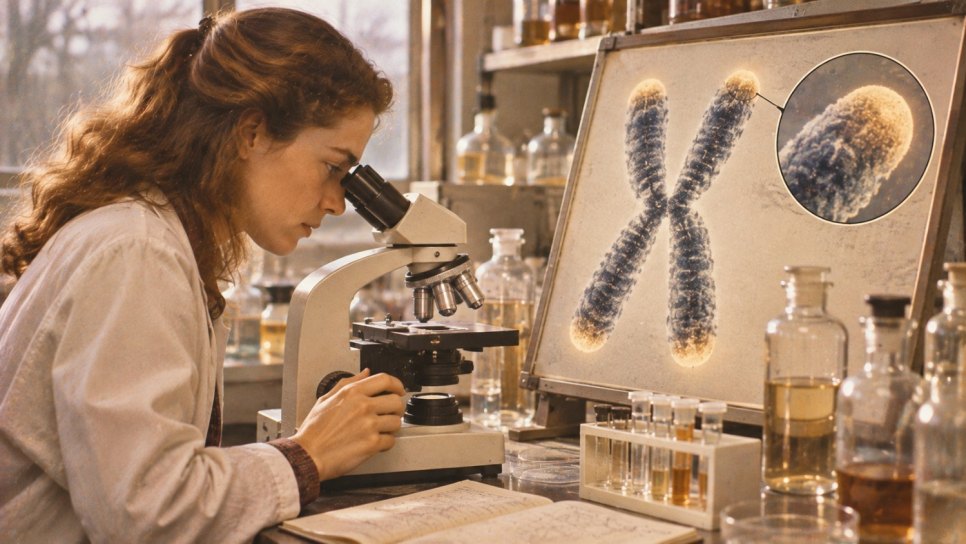
A telomere is the protective end of a chromosome, made of a repeated DNA sequence and the proteins bound to it. Telomerase is the enzyme that adds these repeats to the chromosome end. According to the Nobel press release, Greider and Blackburn named the enzyme telomerase and showed that it contains both RNA and protein, the RNA carrying the telomere sequence. If telomerase does not work, the ends shorten with every division; if it works, the ends are maintained and the cell can divide without limit.
Shortening ends, a working enzyme
In 1990 Harley, Futcher and Greider reported that telomeric DNA in human fibroblasts decreased with serial passage in the laboratory and perhaps could also decrease in the living body (Nature 345:458-460). The abstract itself says it is not known whether this loss causes ageing (senescence); that is, the observation is not a causal claim.
The turning point came in 1994: Kim and colleagues developed a sensitive telomerase assay (Science 266:2011-2015). According to the abstract, telomerase was found in 98 of 100 cell populations capable of unlimited division, drawn from 18 tissues, and in none of 22 populations with a limited lifespan; it was found in 90 of 101 tumour biopsies of 12 tumour types, and in none of 50 normal somatic tissue samples. That is, about 89 percent (90/101) in tumours and 0 percent (0/50) in normal somatic tissues. The same abstract also reports that normal ovary and testis tissue were positive and that benign tumours such as uterine fibroids were negative. The authors concluded that telomerase is tightly repressed in normal human somatic tissues and reactivated in cancer.
In 1997 Meyerson and colleagues cloned the putative gene for the catalytic subunit of telomerase (hEST2); the gene was expressed at high levels in tumour cells, cancer cell lines and telomerase-positive tissues and at low levels in telomerase-negative cells and tissues, and as cells acquired the ability to divide without limit its mRNA rose together with telomerase activity (Cell 90(4):785-795). The authors proposed that hEST2 expression might be required for telomerase activation during immortalization and tumour progression.
Read together, the three steps give this picture: 1985 brought the existence of the enzyme, 1994 a widespread pattern in many human samples, 1997 the gene itself. None of them alone said "if we switch off telomerase, cancer stops"; that sentence was a hypothesis, and in the 2009 press release it still stood as a proposal. How the cell's division counter is re-established in a tumour has therefore remained an open research area to this day.
A Nobel Prize and a narrow indication
On 5 October 2009 the Nobel Prize in Physiology or Medicine was awarded to Elizabeth Blackburn, Carol Greider and Jack Szostak "for the discovery of how chromosomes are protected by telomeres and the enzyme telomerase". The press release writes that cancer cells can divide again and again by maintaining their telomeres and can be considered to have "eternal life"; it says that, because telomerase activity is often high in cancer cells, the proposal arose to treat cancer by eliminating telomerase, and that various studies, including vaccine trials, are under way. On ageing, the same press release cautions against the speculation that telomere shortening may cause ageing of the whole organism, saying that the process is complex and that the telomere is only one factor.
FDA approval of a drug that targets telomerase came in 2024: on 6 June 2024 the FDA approved imetelstat (Rytelo), an oligonucleotide telomerase inhibitor; the indication is transfusion-dependent anemia in low- or intermediate-1 risk myelodysplastic syndromes (MDS) in patients with no response, loss of response or ineligibility for erythropoiesis-stimulating agents. In the IMerge trial (178 patients, 2:1 randomization, double-blind, placebo-controlled), independence from red-cell transfusion for at least 8 weeks was 39.8 percent with imetelstat and 15 percent with placebo; for at least 24 weeks it was 28 percent and 3.3 percent. Among the main adverse reactions were low platelet and neutrophil counts, fatigue and joint or muscle pain.
Price and limits
First, the 1985 data came from single-celled Tetrahymena; generalizing to human cells and human cancer required separate studies, and those took years. Second, the link between telomerase and cancer is an association: in 1994 about 89 percent of the tumours were positive, which means 11 of 101 tumours (about one in nine) were negative; moreover, a review writes that 10 to 15 percent of cancers use not telomerase but a telomerase-independent route called "alternative lengthening of telomeres" (ALT). Third, normal ovary and testis tissue were also positive; telomerase is not specific to cancer alone. Fourth, the 2009 press release presented telomerase-targeted therapy as a proposal and ongoing research; the 2024 approval is not for a solid tumour but for transfusion independence in low-risk MDS, and it carries marked haematological side effects. Fifth, the "eternal life" image describes cells; it has not been proven that telomerase explains ageing of the whole organism.
Where telomerase was found in 1994. Bar length shows the percentage of telomerase-positive samples; the full length is 100 percent. The amber bars are the finding of Kim and colleagues: 98/100 in cell populations capable of unlimited division, 90/101 in human tumour biopsies (about 89 percent); the blue bars are groups in which telomerase was not found: cell populations with a limited lifespan 0/22, normal somatic tissue 0/50 (no bar drawn). The green bar comes from a different source: 10 to 15 percent of cancers use the ALT route (midpoint, about 12.5, chosen for drawing). Two different studies are shown on the same scale; the ALT proportion is not the converse of the telomerase proportion.
I found no verified local link
I found no verified source on telomerase research or the use of imetelstat in Turkey, so I do not build a local link. General inference: measuring telomere length or telomerase is not a routine cancer test today; on its own it is not used for a screening or treatment decision.
From 1975 to 2024
What was verified, what remains uncertain
- Cell 1985: citation (Cell, December 1985, 43(2 Pt 1):405-413) and abstract from a PubMed record via a summarizer tool; I read the main points of the abstract, not the full text. The page did not list author names; I took the authors from the Nobel press release (Greider and Blackburn). The "December 1985" period is from the record; no day was given.
- 25 December 1984: only in the Nobel press release; the paper itself does not carry this date, and it was not verified with an independent second source. I did not verify, and did not write, what position Greider held at the time.
- Nobel 2009: the press release and the announcement date (5 October 2009) from the Nobel Foundation page, via a summarizer tool. The 1982 experiment and the cancer and ageing passages come from there.
- Blackburn biography: from the Nobel Foundation page, via a summarizer tool (born 1948 in Hobart, in Gall's laboratory 1975-1977, CCCCAA repeats). The 1982 work with Szostak is from the press release only; I did not verify the citation of the 1982 paper and did not write it. The reason Tetrahymena was chosen and the framing of "the tendency of ends to shorten" are general knowledge, not verified with a source for this article.
- Harley 1990: citation and abstract from an institutional archive record, via a summarizer tool. "May 1990" is from this record. The abstract did not give the number of fibroblast lines or the loss per doubling; I did not write them.
- Kim 1994: the numbers (98/100, 0/22, 90/101, 0/50, 18 tissues, 12 tumour types) come from a PubMed abstract read via a summarizer tool; the page had no author, journal or page information. The citation (Science 266:2011-2015) and the author list come from a second source; in the text I shortened it to "Kim and colleagues". About 89 percent is my own calculation from 90/101.
- Meyerson 1997: citation and abstract from an institutional record, via a summarizer tool; I did not separately explain in this article that hEST2 is the same gene as hTERT. I did not verify the second group's 1997 study (Nakamura) and did not write it.
- ALT 10 to 15 percent: from the abstract of the review by Cesare and Reddel, Nat Rev Genet 2010;11:319-330 (via a summarizer tool); an inference of roughly 85 to 90 percent for telomerase is not in the review and I did not write it. The 12.5 in the chart is only a midpoint.
- Imetelstat: the FDA announcement (6 June 2024) was read via a summarizer tool; the numbers are for IMerge (NCT02598661, 178 patients). The adverse reactions are from the FDA's "common" list; the full label was not read.
- "First" claims: I did not write a claim such as "the first telomerase inhibitor"; I only reported that this label is dated 6 June 2024. Background such as the Hayflick limit and who coined the word telomere was not included in this article.
One gene, two hits: the cloning of the RB gene, 1986
Today we looked at the cell's division counter; tomorrow we move to how the gene of retinoblastoma, which we described on Day 151 with Knudson's "two-hit" theory, was captured in the laboratory.
Author's note: I watched two things in this article. First, showing the length of the road from an enzyme seen in a single-celled organism to its role in human cancer, in years and steps. Second, not presenting telomerase as "the secret of cancer": the 89 percent finding and the 10 to 15 percent of ALT are told together, and it is stated plainly that the only approved telomerase inhibitor is for a blood disease.
Sources and Further Reading
- Greider CW, Blackburn EH. Identification of a specific telomere terminal transferase activity in Tetrahymena extracts. Cell 1985;43(2 Pt 1):405-413 (from the abstract of the PubMed record).
- Nobel Foundation. The Nobel Prize in Physiology or Medicine 2009, press release, nobelprize.org.
- Nobel Foundation. Elizabeth H. Blackburn, biography, nobelprize.org.
- Harley CB, Futcher AB, Greider CW. Telomeres shorten during ageing of human fibroblasts. Nature 1990;345(6274):458-460 (from the record abstract).
- Kim NW, Piatyszek MA, Prowse KR et al. Specific association of human telomerase activity with immortal cells and cancer. Science 1994;266:2011-2015 (from the PubMed abstract; citation from a second source).
- Meyerson M, Counter CM, Eaton EN et al. hEST2, the putative human telomerase catalytic subunit gene, is up-regulated in tumor cells and during immortalization. Cell 1997;90(4):785-795 (from the record abstract).
- Cesare AJ, Reddel RR. Alternative lengthening of telomeres: models, mechanisms and implications. Nat Rev Genet 2010;11:319-330 (from the abstract).
- U.S. Food and Drug Administration. FDA approves imetelstat for low- to intermediate-1 risk myelodysplastic syndromes with transfusion-dependent anemia, 6 June 2024, fda.gov.
- Mukherjee S. The Emperor of All Maladies: A Biography of Cancer. New York: Scribner; 2010 (general context; relevant pages were not re-read for this article).
This article is Day 176 of the "365 Days of Cancer History" series and presents the history of the discovery of telomerase as a historical reading. It is popular historical content; it is not a recommendation for diagnosis, screening or treatment. Please consult your physician about treatment options. Sources have been verified; details that rest on a single secondary source, on a record read via a summarizer tool or on an unreadable text are marked in the fact-check notes.
Plan your visit
Share your preferred date. Our team will contact you to arrange the appointment.
Was this article helpful?
Your feedback helps us improve our content.