One Gene, Two Hits: The Cloning of the RB Gene, 1986-1987
In this article
One Gene, Two Hits: The Cloning of the RB Gene, 1986-1987
On Day 176 we looked at the cell's division counter. Today we return to the question we left on Day 151 with Knudson's four-page calculation: where do the two hits actually fall? In 1971 that was only a statistic. Fifteen years later it became a piece of DNA, and a year after that, a gene.
The trace of the lost copy
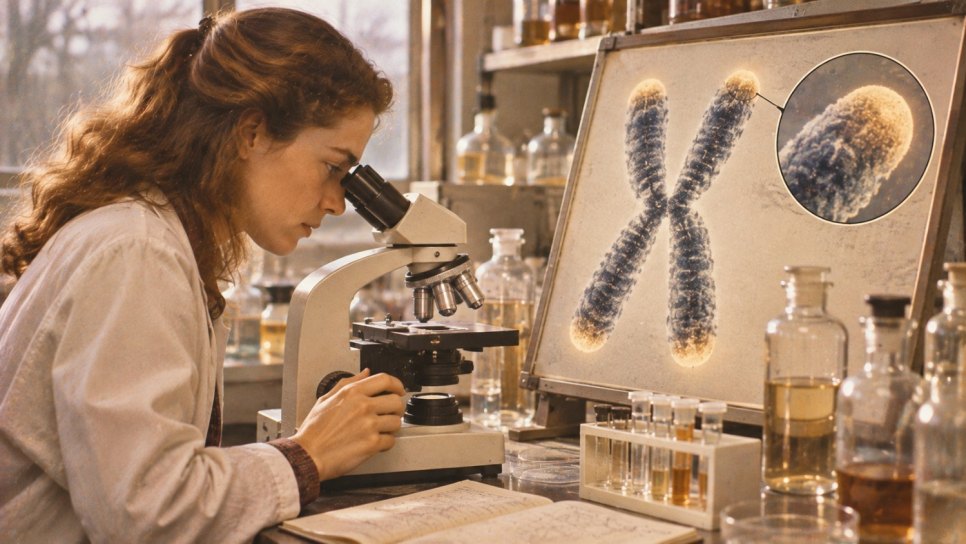
The 1983 Nature paper by Webster Cavenee and colleagues (vol. 305, pp. 779-784) was the first step from calculation to chromosome. According to the abstract, the team used cloned DNA segments from chromosome 13 that differ between people, and compared the same patient's normal tissue with the tumour. The finding: tumour formation could involve becoming homozygous for the damaged Rb-1 allele, arising either from loss of the normal homologous chromosome at cell division or from mitotic recombination. That is, in some cases the "second hit" was loss of the healthy copy.
This was not yet a gene; it was the trace of a region, 13q14. To catch the gene, a piece from that region was needed.
A DNA segment "with properties of the gene"
Friend and colleagues, Nature 323(6089):643-646
By the date of the journal issue, the paper appeared on 16-22 October 1986. The authors were Friend, Bernards, Rogelj, Weinberg, Rapaport, Albert and Dryja. The title was chosen carefully: "a human DNA segment with properties of the gene that predisposes to retinoblastoma and osteosarcoma". It did not say gene; it said a segment with gene properties. Quoting from the abstract: some tumour-predisposing mutations act recessively, that is, a normal copy suppresses them; retinoblastoma is a prototype model for such recessive "oncogenes". The authors describe a model in which tumour formation requires loss of both copies of a single locus, Rb at 13q14; those who inherit one copy have a high rate of later non-ocular tumours, especially osteosarcoma. What was reported was a complementary DNA (cDNA) fragment: the gene was expressed in many tumour types, but no RNA transcript was found in retinoblastomas or osteosarcomas; the fragment detected a region of at least 70 kilobases, and this region was often partly or wholly deleted in the two cancers.
The recessive oncogene
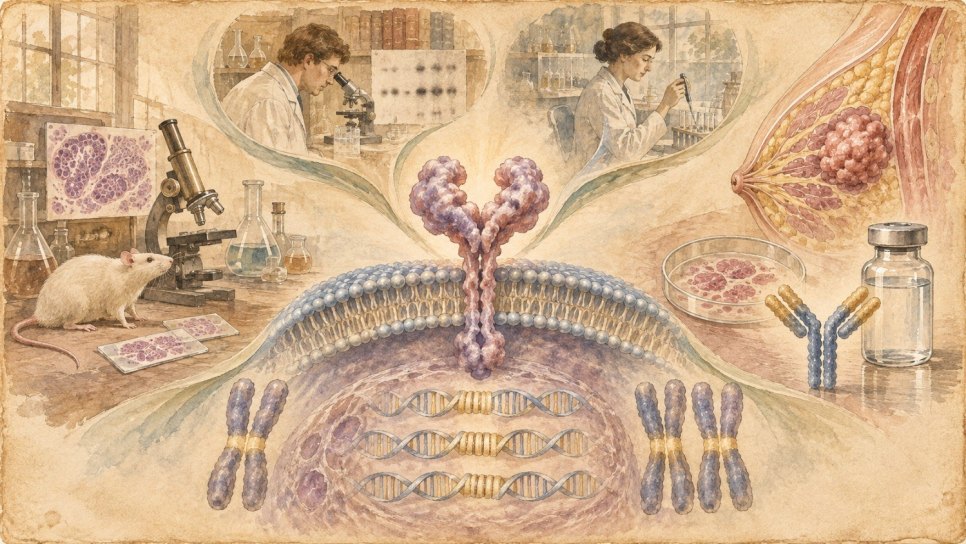
In a normal cell every gene exists in two copies. For a recessive predisposition gene one damaged copy is not enough; the healthy copy keeps suppressing. Friend and colleagues call this a "recessive oncogene". Knudson had later proposed calling it an "anti-oncogene" (Day 151); today it is called a tumour suppressor gene. The idea common to these terms is this: some cancers begin not with something being switched on but with something being lost.
Cloning, sequence and structure
In 1987 two teams published the gene. According to the Nature "Milestones in Cancer" page, Wen-Hwa Lee's team published first and Yuen-Kai Fung's team followed, and both reached a cDNA fragment by chromosome walking; this order and method rest on that single secondary source alone.
The paper by Lee and colleagues (Science, vol. 235, no. 4794, pp. 1394-1399) reported, in its title, "cloning, identification, and sequence". According to the abstract the RB gene encoded an mRNA of about 4.6 kilobases. In all six retinoblastomas examined the RB transcript was abnormal: two had no detectable mRNA, four had a shorter transcript of about 4.0 kb. Full-length RB mRNA was seen in normal fetal retina, in placenta and in some other tumours. The gene had at least 12 exons and exceeded 100 kilobases; the cDNA predicted a protein of 816 amino acids with no close match in the protein databases.
The paper by Fung and colleagues appeared in the issue of 26 June 1987 (Science, vol. 236, pp. 1657-1661). According to the abstract the team examined 40 retinoblastomas; in 16 they found structural changes, some of them homozygous internal deletions producing truncated transcripts. An osteosarcoma carried a similar deletion. In tumours without structural change the transcript was either absent or abnormally expressed. In some patients the comparison of tumour with fibroblasts supported Knudson's two-hit hypothesis at the molecular level; germline deletions found in fibroblasts of patients with bilateral disease suggested that the cloned gene could be used in diagnosis.
In 1988 Huang and colleagues reported that when a healthy RB gene was put back into RB-mutant retinoblastoma cells, the tumour features were suppressed (Science 242:1563-1566; again known only from the Nature page). Thus the idea was also tested by an experiment in the direction that loss of the gene leads to the tumour features.
A protein held by a virus
Once the gene was cloned, the protein could be sought. The 1989 paper by Dyson, Howley, Munger and Harlow (Science 243:934-937, February 1989) reported this: the product of the RB gene (p105-RB) formed stable complexes with the oncoproteins of two DNA tumour viruses, adenovirus E1A and the SV40 large T antigen. The E7 oncoprotein of human papillomavirus type 16 also, according to the abstract, formed similar complexes in the laboratory setting. The same abstract writes that HPV-16 is associated with about half of cervical carcinomas and proposes that these three viruses may share transformation mechanisms and that RB binding may be a step in HPV-associated carcinogenesis.
This finding ties three old threads together. On Day 161 we told zur Hausen's HPV trail, on Day 172 the cloning of HPV-16 and HPV-18 from tumours, and on Day 165 the first appearance of p53 as a band beside the SV40 large T antigen. Now there was a second cell protein held by the viral proteins, and its gene was known from retinoblastoma. HPV, in the "cause" front of cervical cancer, was joining the same story as one of the cell's own suppressor genes. In 1989 this was a proposal; it was a binding in the laboratory setting, not proof of a mechanism in the patient.
Price and limits
First, the 1986 title of Friend and colleagues did not say gene; gene identity was given by the sequence and structure studies of 1987. Second, the samples were small: six retinoblastomas in Lee and colleagues, forty in Fung and colleagues; only sixteen of the forty showed a structural change, the rest were described by transcript loss or abnormal expression, so it cannot be said that the gene is disrupted in the same way in every tumour. Third, figures such as 100 percent and 40 percent are numbers from small series, not population proportions. Fourth, the 1989 RB-E7 binding was shown in the laboratory setting and was only at the level of a proposal. Fifth, the price of the hereditary form continues: the abstract of Friend and colleagues says carriers are at high risk of second tumours, especially osteosarcoma; cloning the gene did not reduce this risk, it only made it possible to describe it at the molecular level. Sixth, I could not verify a ranking claim such as "the first tumour suppressor gene cloned" and I do not write it.
What was found in retinoblastoma in 1987. Bar length shows the percentage; the full length is 100 percent. The amber bar is the main finding of Lee and colleagues: in 6 of the 6 retinoblastomas examined the RB transcript was abnormal. The blue bars are its components: 2/6 with no detectable mRNA (about 33.3 percent) and 4/6 with a shorter transcript (about 66.7 percent). The green bars are from a separate study by Fung and colleagues: structural change in 16 of 40 retinoblastomas (40 percent), none seen in 24 (60 percent; in these the transcript was absent or abnormal). The percentages are my calculation. Two separate studies and a very small series are shown on one scale; they are not a population proportion.
A series from Cerrahpaşa
The 2006 study by Ozkan, Pazarli, Celkan, Karaman, Apak, Kaner, Uzel and Yildiz (Pediatrics International 48(4):369-373) examined 141 children (177 eyes) with retinoblastoma followed at Cerrahpaşa Medical Faculty in Istanbul between 1981 and 2004. 105 were unilateral (74.5 percent) and 36 bilateral (25.5 percent); the mean age at diagnosis was 25 months, and 16 months in the bilateral cases. A family history was present in 16 patients (11 percent). Three-year cumulative survival was reported as 89.69 percent; the authors found this similar to developed countries and attributed it to a multidisciplinary team approach and to government-sponsored health insurance covering all patients (the authors' interpretation). The abstract does not mention RB1 testing; I do not present this series as a consequence of the cloning of the gene. My inference: the clinical counterpart of Knudson's two hits is that bilateral disease and early age bring hereditary disease to mind; on Day 151 I had also reported another Istanbul series.
From 1971 to 1989
What was verified, what remains uncertain
- Friend 1986: citation (Nature 1986 Oct 16-22; 323(6089):643-6; PMID 2877398), author list and abstract were read from a university bibliography page via a summarizer tool; the full text was not opened. Gene or segment: the title itself says "properties of the gene". How the cDNA fragment was isolated and the authors' institutions were not in the abstract; I did not write them.
- Lee 1987: citation (Science 235(4794):1394-1399, DOI 10.1126/science.3823889) and abstract from a library catalogue record via a summarizer tool. The publication day was not in the record; "March 1987" is my inference: since Fung's issue no. 4809 is 26 June 1987, issue no. 4794 should be 15 weeks earlier, around 13 March. The date was rounded to "March 1987" in the text and not verified directly from a source.
- Fung 1987: citation (Science 236(4809):1657-1661, 26 June 1987; PMID 2885916) and abstract from a bibliography page via a summarizer tool. The numbers 40 and 16 are from the abstract; 24 and 60 percent are my inference (the rest, according to the abstract, "either lack the transcript or express it abnormally"; the abstract does not say outright that abnormality was found in all 24).
- Cavenee 1983: citation and abstract from a Europe PMC record via a summarizer tool (Nature 305(5937):779-784; first published 1 October 1983, issue dated 27 October-2 November 1983). The method of "walking", the number of patients and the institutions were not taken into this article.
- Order and method: "first Lee, then Fung", "chromosome walking" and the 1988 Huang gene-replacement experiment come only from the Nature "Milestones in Cancer" page, read via a summarizer tool; I did not reach the Huang paper itself. I marked these three details as single-source.
- Dyson 1989: citation and abstract from the Cold Spring Harbor repository via a summarizer tool (Science 243(4893):934-937, February 1989). The phrase "about half of cervical carcinomas" is from the abstract. I did not separately verify the 1988 SV40 and E1A studies of DeCaprio and Whyte; in the text I relied only on the account in the Dyson abstract.
- Knudson 1971: citation and abstract from a university article page (SciSpace) via a summarizer tool; treated in detail on Day 151. The name "anti-oncogene" and the 1982 date had been taken on Day 151 from an award page; here I only refer to that day.
- Turkey: citation and figures from the abstract on a university archive page, via a summarizer tool; the full text was not read. "Similar to developed countries" and the reasons are the authors' interpretation. As the abstract does not mention RB1 testing, I wrote nothing about testing.
- Calculations and naming: 33.3, 66.7, 40 and 60 percent are my calculations. The spelling "Rb", "RB" and "RB1" differs among sources; in the text I used Rb/RB as in the 1986-87 sources and RB after 1989. I referred to the stories of earlier days (Knudson 151, HPV 161 and 172, p53 165) by day number only.
The Shadow of a Reactor: Chernobyl and Thyroid Cancer, 1986
Today we looked at the laboratory scene of the year; tomorrow we move to another scene of the same year: I will verify how the accident at the Chernobyl reactor in Ukraine in April 1986 was linked, years later, to an increase in thyroid cancer in children, which doses and which delay are involved, and what remained uncertain.
Author's note: I watched two things in this article. First, not erasing the difference between a piece of DNA in 1986 and a gene in 1987: the "properties of the gene" in the title was chosen on purpose. Second, not presenting the viral binding of 1989 as proof of causation. The sixteen years between Knudson's calculation and the gene show that testing an idea against the molecule is slow, step-by-step work.
Sources and Further Reading
- Knudson AG. Mutation and cancer: statistical study of retinoblastoma. Proc Natl Acad Sci USA 1971;68(4):820-823 (from the abstract).
- Cavenee WK, Dryja TP, Phillips RA et al. Expression of recessive alleles by chromosomal mechanisms in retinoblastoma. Nature 1983;305(5937):779-784 (from the abstract).
- Friend SH, Bernards R, Rogelj S, Weinberg RA, Rapaport JM, Albert DM, Dryja TP. A human DNA segment with properties of the gene that predisposes to retinoblastoma and osteosarcoma. Nature 1986;323(6089):643-646 (from the abstract).
- Lee WH, Bookstein R, Hong F, Young LJ, Shew JY, Lee EY. Human retinoblastoma susceptibility gene: cloning, identification, and sequence. Science 1987;235(4794):1394-1399 (from the abstract).
- Fung YK, Murphree AL, T'Ang A, Qian J, Hinrichs SH, Benedict WF. Structural evidence for the authenticity of the human retinoblastoma gene. Science 1987;236(4809):1657-1661 (from the abstract).
- Dyson N, Howley PM, Munger K, Harlow E. The human papilloma virus-16 E7 oncoprotein is able to bind to the retinoblastoma gene product. Science 1989;243(4893):934-937 (from the abstract).
- Ozkan A, Pazarli H, Celkan T, Karaman S, Apak H, Kaner G, Uzel O, Yildiz I. Retinoblastoma in Turkey: survival and clinical characteristics 1981-2004. Pediatr Int 2006;48(4):369-373 (from the abstract).
- Nature Milestones in Cancer. Retinoblastoma gene milestone, nature.com/articles/milecancer11 (single secondary source; read via a summarizer tool).
- Mukherjee S. The Emperor of All Maladies: A Biography of Cancer. New York: Scribner; 2010 (general context; relevant pages were not re-read for this article).
This article is Day 177 of the "365 Days of Cancer History" series and presents the history of the cloning of the RB gene as a historical reading. It is popular historical content; it is not a recommendation for diagnosis, screening, genetic testing or treatment. For family history and genetic counselling, please consult your physician. Sources have been verified; details that rest on a single secondary source, on a record read via a summarizer tool or on an unreadable text are marked in the fact-check notes.
Plan your visit
Share your preferred date. Our team will contact you to arrange the appointment.
Was this article helpful?
Your feedback helps us improve our content.