A Salon, an Advisory Council and the First Appropriation: Mary Lasker, Congress and the NCI Drug Program (1952-1955)
In this article
A Salon, an Advisory Council and the First Appropriation: Mary Lasker, Congress and the NCI Drug Program (1952-1955)
Yesterday we asked who owns the double helix (Day 129). Today's question is more material: who found the money for the laboratories, the hospitals and the drug trials? We saw Farber obtain temporary remissions in children with aminopterin (Day 122) and the Jimmy Fund raise donations for that work (Day 123). But those drugs were still found one at a time, by chance and with private gifts. In the mid-1950s the United States set up a program that searched for cancer drugs systematically, with public money. This article tells the story of that program and the person behind it, and says at the outset what the sources I have show and what they do not.
A society that set aside nothing for research
Mary Lasker was born on 30 November 1900 in Watertown, Wisconsin. She met Albert Lasker in April 1939 and married him on 22 June 1940. Albert (1880-1952) owned the Lord & Thomas advertising agency in Chicago and sold it in 1942. That same year the couple founded the Albert and Mary Lasker Foundation; today's Lasker Awards come from that foundation (NLM). Mary Lasker's first project was to reorganize the American Cancer Society: they tied it to large-scale fundraising, public relations work and a relationship with Congress.
The starting point was low. The American Society for the Control of Cancer, founded in 1914, had about a thousand members and a budget of 102,000 dollars, none of which went to research. In 1943 Lasker met Clarence Cook Little of the society; the couple took over its board and in 1944 it became the American Cancer Society. On the board, physicians were largely replaced by lay people who knew fundraising and advertising methods (ASCO Post). In 1948 the society raised 14 million dollars, and about a quarter of it went to research grants (NLM). On the public side the picture was changing too: the NCI appropriation was 1.75 million dollars in fiscal 1946 and passed 14 million in 1947.
Two figures for scale: the NIH budget grew 150-fold between 1945 and 1961, to 460 million dollars, and the NCI appropriation for 1961 was 110 million dollars (NLM). The first CCNSC appropriation of 5 million dollars was roughly one twenty-second of that 1961 figure (my own arithmetic; a rough comparison across different years). So the step of 1955 was small in money terms. Its importance was that drug searching became a continuing line in the public budget and stayed one until 1976; that last judgment is my own reading.
"Knowledge inadequate" had been the verdict; within three years the appropriation came
In December 1952 the National Advisory Cancer Council concluded that knowledge was inadequate to justify a chemotherapy discovery program (NCI Developmental Therapeutics Program page). In 1955 Congress approved the Cancer Chemotherapy National Service Center (CCNSC) with 5 million dollars: 4.2 million for cancer research grants and 800,000 dollars for acquiring and evaluating test compounds; four screening centers were set up. NLM's timeline, however, says "in 1954 Congress directed 3 million dollars toward chemotherapy." The two figures do not match; details are in the fact-check box. Whichever is right, the picture is the same: a field judged "premature" in 1952 had become a publicly funded program two or three years later.
What was Lasker's share in this change? An NLM essay says that in the mid-1950s Lasker "precipitated" the establishment of a research and testing program in cancer chemotherapy at the NCI (conceptual summary). From 1950 she sat on the National Cancer Advisory Council for twenty years, with short interruptions; together with her friend Florence Mahoney she used those seats to steer NIH toward new fields such as chemotherapy (an undated account). Farber, in the NLM catalog, is one of her leading "citizen witnesses," and his letter of 19 August 1955 is described as a strong endorsement of the chemotherapy program; I have not read the letter's text.
The citizen witness and empirical screening
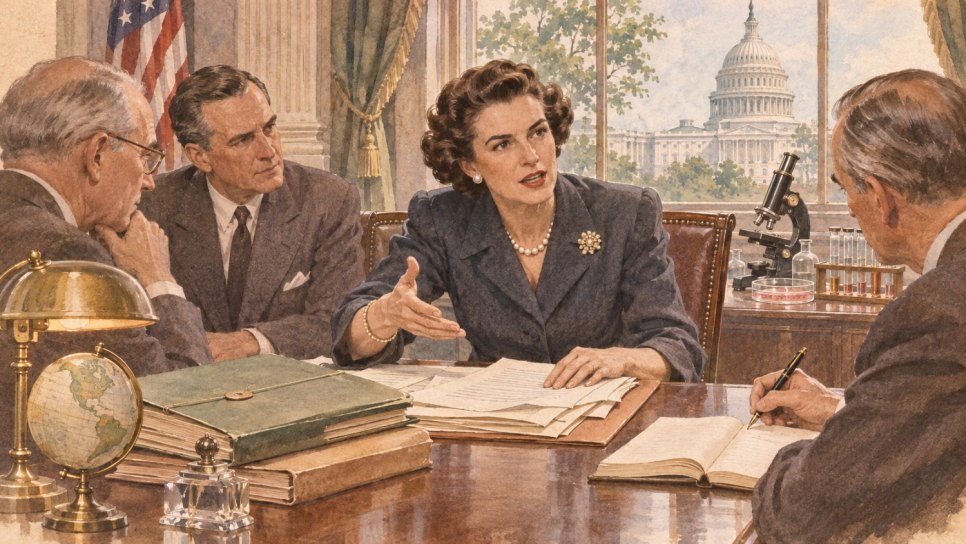
Two concepts carry this story. The first is the "citizen witness": for budget hearings Lasker brought experts, most of them Lasker Award winners (heart surgeon Michael DeBakey, Sidney Farber, psychiatrist Karl Menninger), before Congress, and she took the committees figures on the disability and lost income that disease caused. She put the journalist Mike Gorman at the head of her Washington lobby, and Florence Mahoney hosted the health lobby in her Georgetown home. Lasker's observation was this (conceptual summary): doctors are not used to selling anything, and they must be taught that Congress expects them to ask for large increases every year. The second is "empirical screening": compounds are first tried in transplantable mouse tumors and leukemias, and the mechanism is asked about afterwards. The L1210 mouse leukemia model worked from 1955 to 1975 and supported 21 small molecules approved by the FDA, mostly drugs for leukemias and lymphomas; its limits were clear in solid tumors (NCI DCTD).
Cost and limit: what was being funded
The first cost is where the budget went. In the late 1950s thousands of chemicals were screened, and in 1957 almost half of the NCI budget went to these tests (NLM). The first review, after roughly 11,000 compounds had been screened, asked that screening predict usefulness in human tumors more accurately; it also noted that suppliers often presented what the screening data showed as larger than it was (NCI). Critics said too little was set aside for prevention and early detection.
The second cost is the weight of language and expectation. NIH director James Shannon criticized science policy being shaped by advertising and public relations experts, and some scientists saw the effort as Lasker's personal project. In the early 1970s Sol Spiegelman said an all-out effort aimed at a cure was premature, like going to the moon without understanding gravity (all criticisms as reported by NLM, conceptual summary). A concrete example comes from outside cancer: at Lasker's urging, Senator Lister Hill added 5 million dollars to the 1968 NIH budget for a clofibrate trial; NIH scientists said it was premature, and that a conclusive trial would need ten years and more than 50 million dollars; by 1980 the drug was found to have serious side effects and to benefit only a small number of patients (NLM).
Third, the other side's reasoning is on record too: Lasker argued that researchers should pay more attention to helping the people who pay for research. Her influence declined in the 1970s. Reading the two sides together gives a useful frame, even today, for asking whose voice shapes a research budget.
What remains
- The idea of a publicly funded, central drug screening program; the CCNSC joined NCI's Developmental Therapeutics Program in 1976 and the program continues
- The role of advocacy and citizen testimony in budget decisions
- The leukemia and lymphoma drugs of the L1210 era
What fell or was limited
- The assumption that the mouse model predicts human tumors well enough, especially in solid tumors
- The expectation that supplier data could be read as given
- Promises of a quick cure and large trials started early
The public chemotherapy program, 1952 to 1976. The axis runs from 1952 to 1977. The Council's conclusion in December 1952, the 5-million-dollar CCNSC approval of 1955, the L1210 era of 1955-1975 and the 1976 merger rest on NCI pages; the 3 million dollars of 1954 rests on NLM. Because only the year is known for these events (December 1952 aside), they are drawn at mid-year.
I did not look for a local link in this article
I found no verified source on a Turkish name in this story or on a comparable Turkish initiative, and I invented no link. A general inference (not from a source): the question of how a research budget is divided among disease headings exists in every country's health system; the two faces seen in this story, advocacy that can bring in resources but can also narrow the agenda, may give a frame for reading debates elsewhere too.
From 1914 to today
What was verified, what conflicts
- 1954 or 1955? NCI pages say the CCNSC was approved in 1955 with 5 million dollars (4.2 + 0.8) (DTP and DCTD). NLM's timeline writes that in 1954 3 million dollars were directed to chemotherapy. I could not reconcile the two figures; they may be the same appropriation or a separate intermediate step. For that reason the 1954 date in the "tomorrow" box of Day 129 appears here as 1954-55.
- The link between Lasker and the appropriation: NLM says "precipitated" and counts Farber a "citizen witness." The NCI pages do not say who advocated for the appropriation. I read no record showing in which committee, on whose motion, the appropriation passed.
- Fogarty and Hill: NLM mentions John Fogarty of Rhode Island as chair of the House health appropriations subcommittee and Lister Hill of Alabama as chair of the corresponding Senate committee. I read no record of these two names' role in the 1955 appropriation and did not link them to it.
- December 1952 conclusion: from the DTP page; the page does not explain what changed between the "inadequate" view of 1952 and the approval of 1955.
- Starting budgets: for NIH's 1945 budget one source gives 2 million dollars and another "a little over 3 million"; the 150-fold growth to 460 million dollars in 1961 is also from an NLM page. I did not use the starting figure.
- Lasker's Council membership: twenty years from 1950, with short interruptions (NLM). The effort with Mahoney to "steer chemotherapy" is undated; I did not tie it to 1955.
- Farber's letter: only the catalog record was read (19 August 1955, 3 pages, Lasker Papers, Columbia). The record praises the program in very large terms; I did not use that language here.
- Criticisms: Shannon, Spiegelman and the "personal project" label are NLM's reporting; I have not seen the original sources. Spiegelman's remark belongs to the 1970s, not the 1950s.
- Clofibrate: per NLM, 5 million dollars, the 1968 budget, side effects by 1980. It is not a cancer drug; it is used here only as an example.
- 11,000 compounds: the DTP page gives "late 1950s"; there is no exact year. The same page gives today's budget as about ten times the first appropriation; the page is undated and I did not use the figure.
- Two further sources: a review article I read and a history interview neither confirmed nor refuted this link; they were not used as sources. I have not read the Senate hearing records or the Lasker oral history at Columbia.
A design beside random screening
Was trying thousands of compounds in mouse tumors the only way to look for a drug? Was anyone looking at what a cell needs and trying to build the drug to fit? Charles Heidelberger and the fluorinated pyrimidines tomorrow: I will tell it after verifying the date of the first paper, the observation of Rutman and colleagues, and why this drug is still in use.
Author's note: The easy way to write this article was to say "one woman persuaded Congress." My sources say Lasker precipitated the chemotherapy program; they do not show in which committee, on whose motion, the appropriation passed. I did not fill that gap. I also put the criticisms aimed at Lasker, as NLM reports them, into the same article.
Sources and Further Reading
- NCI Developmental Therapeutics Program. Milestone page on the Cancer Chemotherapy National Service Center (dtp.cancer.gov, M3_CCNSC; read; institutional page, undated).
- National Library of Medicine. "Cancer Wars," Mary Lasker digital collection (profiles.nlm.nih.gov; read; secondary).
- National Library of Medicine. "Mary Lasker and the Growth of the National Institutes of Health" (read; secondary).
- National Library of Medicine. "From Bench to Bedside: Mary Lasker and the Drive for Payoff from Medical Research" (read; secondary).
- National Library of Medicine. Mary Lasker, biographical overview (read; secondary).
- National Library of Medicine. "Letter from Sidney Farber to Mary Lasker," 19 August 1955 (only the catalog record was read; the letter's text was not read).
- NCI Division of Cancer Treatment and Diagnosis. The institution's history page (read; institutional page; title not verified).
- The ASCO Post. Article on Mary Lasker, 10 October 2020 (ascopost.com; read; secondary; title not verified).
- Mukherjee S. The Emperor of All Maladies: A Biography of Cancer. New York: Scribner, 2010. (Not separately verified for this article.)
This article is Day 130 of the "365 Days of Cancer History" series and tells the founding of the publicly funded cancer drug program in the United States in the mid-1950s as a historical event. It is historical-popular content; it is not a diagnosis or treatment recommendation. Consult your physician for decisions about your health. Sources have been verified; details that rest only on a secondary source are noted in the fact-check notes.
Was this article helpful?
Your feedback helps us improve our content.