
Blade, Fire and Gold: Avicenna's Surgical Manifesto

In this article
Day 30 (Cancer History in 365 Days Series)
In an age without anesthesia, when infection was everywhere: the thin, deadly line between "uprooting" a tumor and "never touching it."
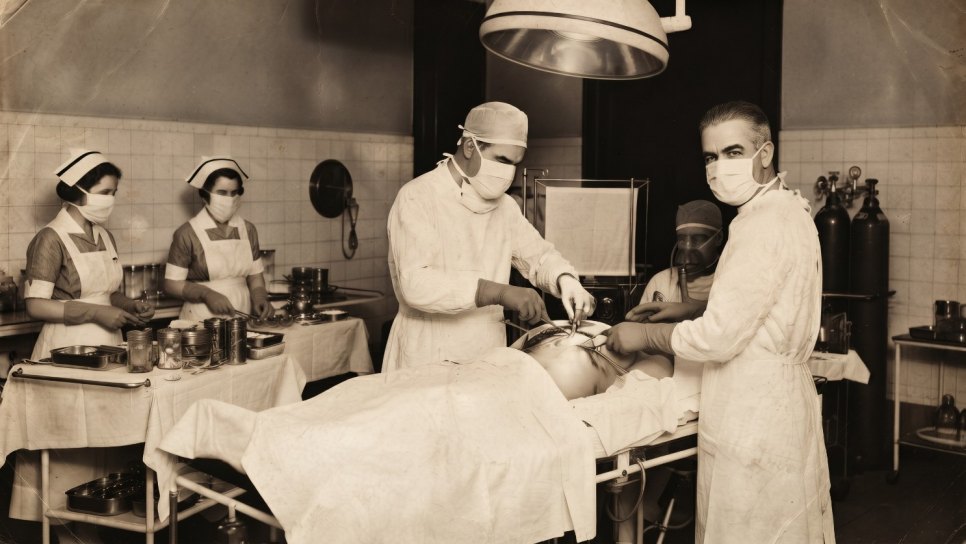
We are in one of the most tense scenes in medical history. In the Middle Ages, a surgeon had only a sharp blade, a blazing fire and the patient's screams. After understanding cancer as an accumulation of "Black Bile" invading the body, Avicenna placed a terrible dilemma before physicians: either dance with death to tear this evil out of the body, or sheathe your blade and accept fate.
In that era, being a "good surgeon" meant not only cutting well, but also knowing when not to cut . In answering this question in the fourth book of the Canon, Avicenna also wrote the constitution of today's surgical oncology: radical excision and inoperability. This was a philosophy, not merely a technique.
"All or Nothing": Radical Excision
Avicenna's surgical philosophy is clear: "A job half done is worse than one not done at all." If a tumor is to be operated on, it must not be a routine cutting-out procedure. He sensed that a tumor had "invisible roots" and formulated modern medicine's "Clear Surgical Margin" (Clean Margin) principle a thousand years ago as follows:
Remove not only the tumor, but also a wide area of the apparently healthy surrounding tissue, as if performing an "amputation."
Cut and tie off the vessels feeding the tumor at their roots. Do not let "contaminated blood" (tumor cells) escape.
Drain all remaining blood from the area, as this blood may carry the seeds of the disease (prevention of local recurrence).
A Sacred Warning: "Noli Me Tangere"
Perhaps Avicenna's greatest contribution was to curb surgical arrogance. He recognized that using a blade on advanced cancers that had spread and adhered to deep tissues meant "waking a sleeping monster." Yet the concept he used to express this warning became part of one of the most intriguing cultural transfers in medical history.
"If the tumor is large, hardened and deeply rooted, do not touch it! Surgical intervention provokes the disease, aggravates the tumor and shortens the patient's life."
Medical Observation
"It is better not to treat hidden (internal) cancers. Those who are treated die quickly; those left untouched live longer." (Aphorisms, 38)
Hippocrates said this purely as a medical observation: inadequate surgery accelerated infection and death.
Sacred Untouchability
After his resurrection, Jesus appears to Mary Magdalene and says: "Noli me tangere" (Do not touch me / Do not hold on to me), because I have not yet ascended to the Father.
In the Middle Ages, this expression was applied to cancer. Cancer was declared "untouchable," as if it were something sacred or cursed. Avicenna adopted this concept and gave it a biological basis (the risk of metastasis).
Purification by Fire: Why Gold?
The most important and most frightening weapon in medieval surgery was "cauterization." Avicenna required the wound to be cauterized after tumor removal. There were three reasons: stopping bleeding, burning remaining cancer cells and preventing infection.
THE NOBILITY OF GOLD
While his contemporaries used iron instruments, Avicenna insisted on recommending a "Gold-Tipped Cautery" . As a noble metal, gold does not rust, adheres less to tissue and allows cleaner wound healing. This detail demonstrates how Avicenna combined materials science with medicine and considered patient comfort, even under those conditions.
Commentary by Prof. Dr. Mustafa Özdoğan
"When we read Avicenna, we see not just a physician but a 'risk manager.' The principle that 'not every cancer should be cut' remains a golden rule of oncological surgery even today. In an age without radiology or PET scans, his ability to determine solely with his fingertips whether a tumor was 'adherent' (invasive), and thus protect a patient from an unnecessary, painful operation, shows not only a great physician but also a great conscience. The Canon proves that medicine is not only science, but also an 'art of stopping.'"
- Report on Physicians in Islamic History, Part 2: The Surgeon's Dilemma.
- Avicenna's Canon of Medicine, Book IV (Surgical Treatment of Cancer).
- Contributions of Avicenna to Surgery and Anesthesiology - ResearchGate.
- The Art of Healing with Heat: Cauterization in Unani Medicine.
Was this article helpful?
Your feedback helps us improve our content.


Reader comments
Share your comment
Your name and comment are published only after administrator approval. Your email address is never shown to visitors.
Be the first to comment.