Entering the Forbidden Zone: Evarts Graham and the First Pneumonectomy
In this article
Entering the Forbidden Zone: Evarts Graham and the First Pneumonectomy
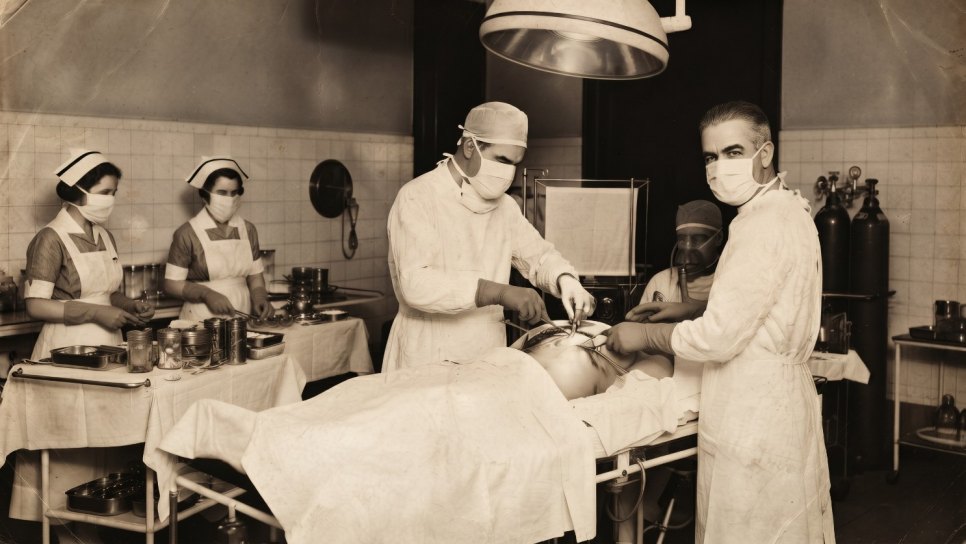
On day 106, Shope's rabbits taught us that cancer can also begin with a transmissible agent. Now we return to the surgical thread of the series. On day 104, Patey showed that "cutting less" could be safe. But the history of surgery is not a one-way road: in some diseases, the safe course is, on the contrary, to remove far more. In 1933 in St. Louis, Evarts Graham performed the first successful pneumonectomy on record, the removal of an entire lung, for lung cancer. The patient left the hospital and lived about thirty more years. The operation shook, for the first time, the belief that the chest was a "forbidden zone." On day 107 we also tell the other side: it was not merely a "success" story but a step with a high cost and uncertain consequences.
The rules of the chest
Opening the abdomen took courage at the turn of the century; opening the chest was often considered beyond courage. The lung shares one cage with the heart and the great vessels; open one side and the lung collapses, upsetting the pressure balance inside the chest. Removing a lung entirely for cancer meant not just taking out a tumor but rebuilding that balance from scratch.
In the introduction to their paper, Graham and Singer write that cancer arising from the bronchi accounts for roughly 5-10% of all carcinomas and is about as common as cancer of the colon (a conceptual summary; this is a 1933 estimate, not today's figure). The disease, then, was not "a rare curiosity"; but its treatment was squeezed into a single path, surgical removal.
There had been attempts, and most ended badly. According to the sources, in 1895 Macewen performed a staged pneumonectomy (for a tuberculous collection of pus, not for cancer). In 1910 Kümmell clamped the root of the lung in a lung cancer patient and left the clamps in place; the patient lost his life on the sixth day. In 1922 Hinz tied the structures of the lung root one by one; the patient lost his life on the third day. In Berlin, Rudolf Nissen performed a two-stage left pneumonectomy in 1930-31, for a disease other than cancer, achieving the first successful case in Europe. For cancer, there was no recorded success.
Evarts Ambrose Graham was born in Chicago in 1883 and was a surgeon at Washington University and Barnes Hospital in St. Louis. He had earlier become known for treating pus in the chest cavity (empyema) and for a method that images the gallbladder (cholecystography). He was a surgeon who knew the physics of the chest well and saw it as a product, not a rule.
A gynecologist's lung
The patient was a 48-year-old obstetrician-gynecologist from Pittsburgh: James Lee Gilmore. Popular accounts report that he first thought he had a lung abscess, but a cancer was found in the upper lobe of the left lung. The operation took place on 4 or 5 April 1933 (sources differ on the date).
The moment of decision is also told differently. In one account Graham was planning a lobectomy, that is, removal of a single lobe; during the operation he saw that the tumor had spread from the bronchus and took the whole lung. In another, he deliberately chose pneumonectomy over lobectomy, and one of the onlookers questioned the decision. What both share is the result: the entire left lung was removed in a single operation. Popular accounts add that the root of the lung was tied tightly with a rubber catheter, after which the surgeon worked with clamps and an electric knife, and that the operation lasted under two hours.
Recovery was hard. Gilmore needed two further operations for an abscess; he could leave hospital only after 75 days. According to one source, radon seeds were placed in the bronchial stump, followed by a rib operation (thoracoplasty). Graham and his colleague J. J. Singer published the case in JAMA on 28 October 1933 under the title "Successful removal of an entire lung for carcinoma of the bronchus."
The relationship between Gilmore and Graham did not end with the operation. According to an institutional archive, Graham remained his friend and invited him to surgical meetings as a "willing, living exhibit" of this milestone. It is also reported that no recurrence was seen in Gilmore's remaining lung.
WHY WAS IT SO IMPORTANT? —
An organ could be removed entirely, and the patient could live. Gilmore lived about thirty years; according to a popular source, he went on practicing medicine for twenty-four of them. Graham invited him to surgical meetings as "living proof."
Surgery was the only treatment. The introduction of the JAMA paper states that surgical removal was regarded as the only effective treatment in lung cancer, and that in the literature the authors could find there was no verified case that had been followed free of disease for five years after radiotherapy (a conceptual summary). In other words, Graham's operation was done on ground where no proven alternative existed.
The limit of surgery moved. From then on, thoracic surgery had to address, systematically, how to tie the vessels and bronchus of the lung root separately, how to preserve the function of the remaining lung, and the question of "who can be operated on."
COST AND LIMITS —
A single success does not make an operation safe. According to one review, after Gilmore, 19 consecutive pneumonectomy patients of Graham's lost their lives in the postoperative period; he nevertheless performed 70 more pneumonectomies over the next five years. These figures come from a single source and should be read with care; but the direction is clear: the first success was built on a high cost.
Gilmore was a particular patient. By today's classification the tumor was early-to-intermediate stage (one review interprets it as stage II by the current AJCC staging). It cannot be generalized to every lung cancer patient.
More is not always better. On day 104, Patey's principle was "remove what is needed." Graham's operation is not its contradiction but another face of it: the right course is to remove as much as the disease requires; sometimes that is far more than a lobe, sometimes far less.
A distinction is needed here: one patient's survival shows that an operation is possible; not that it works. Graham's 1933 paper is a case report, not a comparison. The later steps of evidence, that is, series, results across centers, and studies comparing the operation with other options, were built over decades by other people. Graham's share was making the question askable.
Five attempts, one leap. Before pneumonectomy for cancer there were a few scattered attempts; the first successful one-stage left pneumonectomy for cancer belongs to Graham and Singer in 1933. The diagram is simplified from the sources listed in the fact-check box below.
What remains
- Controlled tying of the structures in the lung root
- The idea that surgery can be curative in lung cancer
- The value of operating in a selected patient at an early stage
What falls
- The belief that "the chest is a forbidden zone"
- The assumption that "if you remove a lung, the patient cannot live"
- The idea that surgery has no chance in lung cancer
Smoking and Graham's own story
Graham was not only a surgeon but also a researcher who looked for the cause of lung cancer. In 1950, together with Ernest Wynder, he published in JAMA a study of the smoking history of 684 proven lung cancer cases. The study is remembered as one of the first large attempts to examine systematically the role of smoking in lung cancer. We will tell that story separately when we reach smoking and lung cancer.
The same popular source reports that Gilmore kept smoking after the operation; this is a note worth keeping because it shows that in 1933 the role of smoking was not yet known. According to one review, Graham smoked for many years and quit in 1951; he retired in 1956. The same year he was diagnosed with lung cancer, and on 4 March 1957, with disease spread to bone and brain, he lost his life. That a surgeon who had successfully operated on a lung cancer and tried to establish one of its causes lost his life to the same disease is the quiet and painful close of this story.
Even the story of a single operation shows that progress always carries a cost and a question.
Graham's trace in today's thoracic surgery
We could not find a local Turkish story linked to this account, and we do not want to invent one. The general inference is this: lung cancer surgery today is a spectrum that varies with the stage of the disease and the location of the tumor. In many early-stage patients only one lobe or a smaller part of the lung is removed; taking the whole lung is a less frequently used option reserved for certain situations. The path Graham opened teaches us to ask again, for each patient, "how much should be removed?"
As a patient or relative, the practical meaning is this: the decision to operate depends not only on the question "where is the tumor?" but on the remaining function of the lung, general health, and the stage of the disease. Discussing these questions with the thoracic surgery and oncology team before surgery bases the answer on far more criteria than were available in Graham's day.
THE JOURNEY OF AN OPERATION
INFORMATION VERIFIED AND CONFLICTING IN THIS ARTICLE
- Evarts Ambrose Graham (19 March 1883 - 4 March 1957): born in Chicago; Washington University and Barnes Hospital in St. Louis.
- Publication: Graham EA, Singer JJ. Successful removal of an entire lung for carcinoma of the bronchus. JAMA 1933;101(18):1371-1374 (28 October 1933). Only the introduction was readable on the source page; details of the case were taken from secondary sources.
- Conflict on the date of the operation: Pai and Kumar (2017) give 4 April 1933; a popular source says 5 April. Hence "4 or 5 April" was written.
- Patient: James Lee Gilmore, a 48-year-old obstetrician-gynecologist, Pittsburgh. He lived about thirty years; two sources report that he lost his life in 1963, at age 78.
- Conflict on tumor size: One source describes the tumor as "pea-sized," another as 4 cm and stage II; in the text we gave only the stage interpretation and its source.
- Conflict on the moment of decision: The account in which a lobectomy was planned and converted to pneumonectomy during the operation differs from the account in which he chose pneumonectomy from the start. We reported both.
- Technical details (rubber catheter, electric knife, under two hours): from a popular source; radon seeds and thoracoplasty: from Pai and Kumar. Not verified in the primary paper.
- "19 consecutive, then 70": appears only in Pai and Kumar; not confirmed by another source.
- Earlier attempts: Macewen 1895, Kümmell 1910, Hinz 1922, Nissen 1930, Overholt 1935 were taken from a single review (Shanghai Chest); because Nissen's date appears as 1931 in some sources, "1930-31" was written.
- Smoking and Graham: Wynder EL, Graham EA. JAMA 1950;143:329-336 (684 cases). His quitting in 1951 and his loss of life on 4 March 1957 come from the review by Pai and Kumar. The "retired in 1956" detail is from a popular source.
- The "living proof" wording: Graham's inviting Gilmore to meetings was taken from an American College of Surgeons archive page.
The Agent in the Milk: Bittner and the Mouse Mammary Tumor Virus
Graham showed us how the limits of surgery could widen; now we return to the virus thread, to where Shope left off. In 1936, John Bittner showed that mammary tumors in mice were linked to an agent that could pass from mother to pup through milk. The argument between those who thought cancer was hereditary and those who thought it was contagious was finding a new answer inside a mouse cage. On day 108 we will tell the story of the "milk factor."
Author's note: This article continues the surgical thread of the series: on day 104 there was "cutting less," here there is "taking an entire organ." The question common to both is "how much?" Sources on the date of the operation, the patient's details and the surgical technique differ at some points; these differences are marked in the fact-check box. The story of smoking and lung cancer will be covered separately in later days of the series.
Sources and Further Reading
- Graham EA, Singer JJ. Successful removal of an entire lung for carcinoma of the bronchus. JAMA 1933;101(18):1371-1374. doi:10.1001/jama.1933.02740430017005.
- Horn L, Johnson DH. Evarts A. Graham and the first pneumonectomy for lung cancer. Journal of Clinical Oncology 2008;26(19):3268-3275.
- Pai E, Kumar T. Evarts Ambrose Graham and the first successful pneumonectomy: a brief account. Indian Journal of Surgery 2017;79(5):480-481. doi:10.1007/s12262-017-1646-7.
- Wynder EL, Graham EA. Tobacco smoking as a possible etiologic factor in bronchogenic carcinoma: a study of 684 proven cases. JAMA 1950;143:329-336.
- The role of pneumonectomy in thoracic surgery in the third millennium. (History of pneumonectomy; shc.amegroups.org.)
- Mukherjee S. The Emperor of All Maladies: A Biography of Cancer. New York: Scribner, 2010. (History of surgery; Turkish edition: İmparatorluğun Kralı, Domingo Yayınevi.)
This article is day 107 of the 365 Days of Cancer History series. In St. Louis, the surgeon Evarts Graham and J. J. Singer performed a one-stage left pneumonectomy in April 1933 on a patient with lung cancer and published the case the same year in JAMA; the patient lived about thirty years. Accounts of the date of the operation, the size of the tumor and the moment of decision differ between sources; these differences are marked in the fact-check box. This article has been prepared from a historical-popular perspective; it contains no diagnostic or treatment guidance. The dates, names and data in the article have been verified against sources such as Graham-Singer 1933, Pai-Kumar 2017, Wynder-Graham 1950 and the relevant academic literature; details based on popular sources are indicated in the fact-check box.
Was this article helpful?
Your feedback helps us improve our content.