The Rabbit’s Horns: Richard Shope and the Discovery of the Papillomavirus
In this article
The Rabbit's Horns: Richard Shope and the Discovery of the Papillomavirus
On day 105, Antoine Lacassagne gave a hormone to his mice and saw tumors appear in the animals: that cause lay in the dose and duration of a single molecule. In the same years, in New Jersey, a completely different clue to cause sat on the forehead of a wild rabbit. It was neither a chemical nor a hormone: it was a virus. Peyton Rous's 1911 chicken sarcoma (day 97) had to wait until 1966 for its Nobel Prize; for that long, the link between viruses and cancer had resisted testing. Richard Shope's 1933 rabbit study made this link testable in a mammal. On day 103 we said that the "cause" link in the cervical cancer chain was missing; the first link of that chain comes from a rabbit that had nothing to do with any human patient.
A rabbit story in Princeton
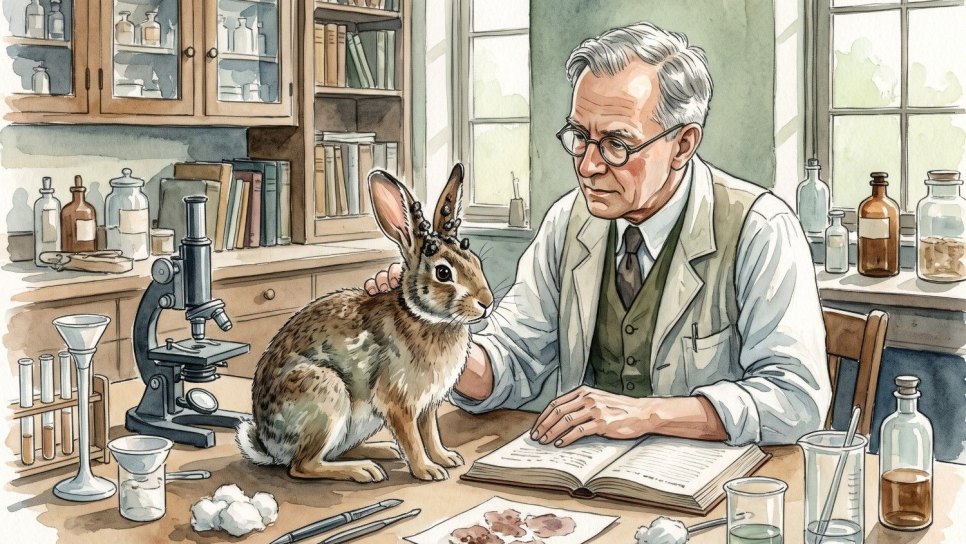
In the early 1930s, in the animal pathology unit of the Rockefeller Institute at Princeton, there were rabbits on Richard Shope's workbench. In 1931 Shope, together with Paul Lewis, had described the swine influenza virus, and in 1932 he had published a transmissible fibroma in rabbits, a tumor-like swelling carried by a virus. According to an account drawn from his own notes, while the experiments were under way a visitor came through the laboratory one day: the father of a colleague's wife, an elderly man from Iowa who had hunted all his life. He looked at the fibroma with disdain and said that in Iowa he had seen things far beyond this: rabbits with growths sticking out like horns from the sides of their heads or from the tops of their noses.
The details vary from source to source. According to Michael Branch, a man from Cherokee, Iowa, told Shope that such rabbits were not rare in the state; Shope went to Iowa with him and spent several days looking for horned rabbits; then a shipment of wild rabbits arrived from Kansas, and in the end seventy-five cottontail rabbits were collected from the Midwest. These animals were popularly called "horned" or "warty" rabbits.
Shope's reasoning was simple. If the horns were the product of an infection, the tissue could be ground into a suspension and rubbed onto the lightly scratched skin of a healthy rabbit. According to secondary accounts, the mixture was passed through a porcelain filter that holds back bacteria. Warts appeared on the healthy rabbits. The horn was a growth carried by a virus.
Shope and Hurst: "Infectious papillomatosis of rabbits"
Shope and E. Weston Hurst published the detailed description in volume 58 (issue 5) of the journal; the title of the paper also mentions a note on the histopathology. The abstract said that the papilloma of wild cottontail rabbits can be transmitted to both wild and domestic rabbits; rabbits carrying experimentally produced papillomas are partly or completely immune to reinfection, and their sera neutralize the virus. The disease can be passed in series through wild rabbits but not through domestic rabbits. The virus was immunologically distinct from the rabbit fibroma and myxoma viruses studied in the same laboratory.
THE TWO-HOST PUZZLE —
In the domestic rabbit a wart appears, but that wart does not pass the virus on to another domestic rabbit. In later years John Kidd (1939) showed that the virus can be "masked" in large, fissured papillomas by the host's own antibody, while in domestic rabbit papillomas something other than antibody causes the masking. Friedewald and Kidd (1944) also reported that far less infectious virus is present in the papillomas of domestic rabbits than in those of cottontails. A tumor that carries traces of a virus but little infectious virus: this logic can be seen as a relative of the logic of looking for papillomavirus DNA in human tumors, decades later. That link is an interpretation; in the sources I examined there is no statement that zur Hausen drew inspiration from Shope.
Shope showed the wart, Rous showed the cancer
Popular accounts erase a distinction here. In 1933 Shope described a papilloma, that is, a benign, wart-like growth; he made no claim about cancer. The cancer link came from Peyton Rous and J. W. Beard of the same institute. In three papers in 1934 they argued that this papilloma had the defining characters of tumors, but that its incidence was that of an infectious process and that its cause had been demonstrated.
The decisive step came in 1935. With virus taken from cottontail rabbits they produced papillomas in domestic rabbits. Of ten animals that carried papillomas and were followed for more than 200 days, seven developed cancer; in an eighth a tumor of uncertain malignancy arose. In ten wild cottontails that carried warts for much longer, no cancer was seen. Rous and Beard concluded that the virus must be regarded as the primary cause of these cancers. Kidd and Rous later reported that in natural conditions the papillomas of western cottontails only occasionally turn malignant, while in jackrabbits and snowshoe hares they do so far more often.
In 1938 Rous and Kidd obtained an even more interesting result: when the virus reached tarred rabbit skin through the bloodstream, carcinomas appeared at once, alongside papillomas. Causes did not exclude each other. Yamagiwa's tar (day 99) and Shope's virus had met on the same skin; together with the hormone story (day 105), the idea gained weight that cancer may be the intersection of several factors rather than a "single cause".
LIMIT: NO EXTRAPOLATION FROM RABBIT TO HUMAN —
These experiments were done in rabbits. According to an expert quoted in the press, Shope papillomavirus passes from rabbit to rabbit but not to humans or pets. In nature most cottontails live with warts; cancer is rare, and the high rates were seen experimentally in hosts for which the virus is foreign, such as the domestic rabbit. Most cancers have no link to a virus (day 97). For human cervical cancer the evidence came not from the rabbit but from the search for papillomavirus in human tumors between 1976 and 1984. The rabbit model helped in understanding the papillomavirus-cancer relationship; it does not replace human data.
Shown (1933-1938)
- The papilloma is transmitted by a filterable virus
- Different behavior depending on the host: wild and domestic rabbit
- The progression from papilloma to carcinoma can be followed experimentally
- A virus and a chemical agent can work together
Not shown
- That it causes cancer in humans
- That every papilloma progresses to cancer
- That cancer depends on the virus alone
- That a virus is the cause of all cancers
The same virus, two hosts. In the 1935 experiment of Rous and Beard, cancer was frequent in the domestic rabbit, for which the virus is foreign, and was not seen in the cottontail, its natural host.
Legend, hoax and virus
The jackalope is the story of a half-rabbit, half-antelope animal in the American West. According to the account, the brothers Douglas and Ralph Herrick of Douglas, Wyoming, fitted antlers to a taxidermy rabbit and sold it to a hotel owner; Ralph said this happened in 1932. In the same year Shope was on the trail of horned rabbits, but no link between the two is known. Horned-rabbit tales also exist in the folklore of Europe, Asia and Africa; some researchers think that part of them may have arisen from rabbits infected with papillomavirus. That is a possibility, not an established origin.
The virus had been around long before Shope. In a rabbit specimen from the natural history museum of the University of Kansas, collected in 1915 in Cherokee County, Kansas, Shope virus was confirmed by molecular methods: according to a 2015 study, the oldest laboratory-confirmed case. Shope's contribution was not to be the first to see the virus, but to show what it was, how it spread, and how it behaved depending on the host.
Forty years from rabbit to human
In 1933 Shope's rabbit said nothing about humans. In 1976 Harald zur Hausen put forward the hypothesis that human papillomaviruses could cause cervical cancer; in the words of the Nobel announcement, against the prevailing view of the 1970s. In 1983 he showed a new tumor-causing type in tumor biopsies, HPV16; in 1984 he cloned HPV16 and HPV18. These two types were found in about 70 percent of cervical cancer biopsies around the world. In 2008 he received half of the Nobel Prize in Physiology or Medicine.
Meanwhile the rabbit model went on working. In 1985 Giri, Danos and Yaniv sequenced the genome of the Shope virus. In 1995 Breitburd and colleagues showed that domestic rabbits vaccinated with virus-like particles made from the L1 capsid protein were protected against Shope virus warts; the protection was antibody-mediated and type-specific. Cottontail rabbit papillomavirus became one of the models used in developing protective vaccines against papillomaviruses. The four fronts of cervical cancer are thus coming together: treatment (day 93), early diagnosis (day 103), cause (begun today) and prevention (later in the series).
Papillomavirus in today's screening program
According to Ministry of Health data, Türkiye's national cervical cancer screening is carried out with a free HPV-DNA test every five years for women aged 30-65; according to press sources the program moved in 2014 from a Pap-based to an HPV-DNA-based structure, and in 2024 about 3.5 million cervical screenings were performed. When a woman has an HPV-DNA test at a KETEM (cancer early detection, screening and training center), what is being looked for rests on the knowledge of the chain that began with Shope's rabbit, that is, the papillomavirus-cancer relationship.
On the prevention front the situation is different: a statement by the Turkish Medical Association and news reports from August 2026 say that the HPV vaccine is not yet part of the national immunization program. This information should be re-verified before publication.
FROM A RABBIT WART TO THE HPV VACCINE
INFORMATION VERIFIED IN THIS ARTICLE AND WHAT REMAINS OPEN
- Publication: Shope RE, Hurst EW. J Exp Med 1933;58(5):607-624 (31 October 1933; doi:10.1084/jem.58.5.607). The preceding fibroma paper: Shope RE, J Exp Med 1932;56:793-802. Some sources give the discovery as "1932"; the year Shope heard of the rabbits was 1932, the descriptive publication is from 1933.
- "First" claims: A 2015 literature survey presents Shope's 1933 paper as the "first description of a papillomavirus"; the "first confirmation of a virus causing cancer in a mammal" is attributed to Rous and Beard 1935. Shope's 1932 fibroma is an earlier example of a tumor-like virus, so the "first" statements have been hedged.
- The visitor account: The version drawn from Shope's own notes (the father-in-law of a colleague, an Iowa hunter) does not match one-to-one the Iowa man from Cherokee and the trip to Iowa in Branch's account; which visit is which could not be resolved, so no name or date is given. The filter detail comes from secondary sources; it is not in the Shope-Hurst abstract.
- Rous-Beard 1935: cancer in seven of ten domestic rabbits with papillomas lasting over 200 days; a tumor of uncertain malignancy in an eighth; no cancer in ten wild rabbits. Kidd and Rous: occasional malignant change in western cottontails under natural conditions.
- The museum specimen: The oldest confirmed case is Cherokee County, Kansas, 1915 (Escudero Duch et al., PLoS ONE 2015); do not confuse it with the town of Cherokee in Iowa.
- Jackalope: That papillomavirus may have inspired the legend is a possibility; there is no evidence that the Herrick brothers knew of it.
- Not passing to humans: This is a statement made by a veterinary expert in the press.
- zur Hausen: the 1976 hypothesis according to Ärzteblatt; HPV16 in 1983, cloning of HPV16/18 in 1984, "about 70 percent" from the Nobel announcement. The Shope genome: Giri, Danos, Yaniv, PNAS 1985;82:1580-1584.
- Türkiye: the 2014 transition and the 2024 figure come from press sources; the vaccine status rests on August 2026 news reports and must be confirmed with a Ministry source before publication.
Entering Forbidden Territory: Evarts Graham and the First Pneumonectomy
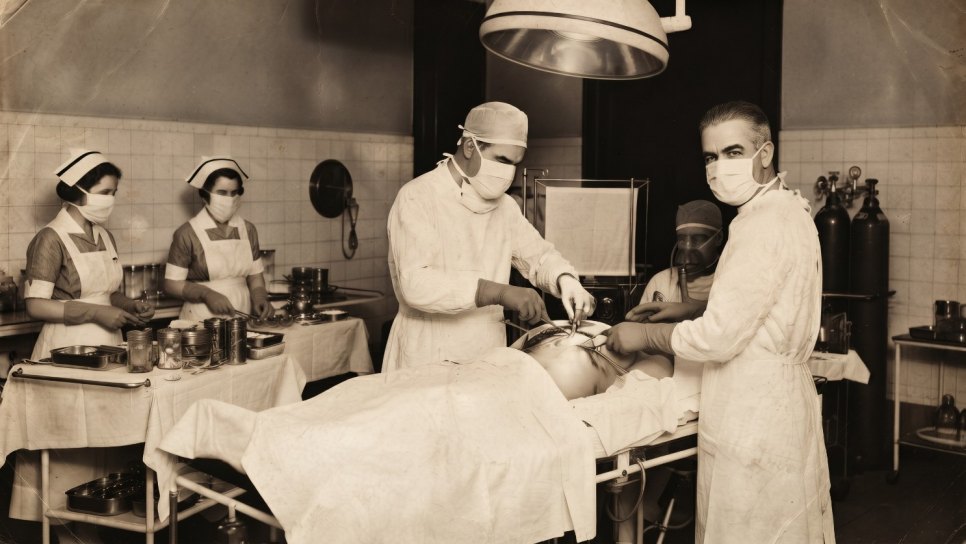
In 1933, the year Shope's rabbit was searching for the cause of cancer, a surgeon elsewhere was wrestling with a very different question: could a lung cancer be treated by removing an entire lung? The inside of the chest had long been territory that surgeons did not enter. On day 107 we will look at how that door was opened, and at the role the same surgeon played years later in the study of the relationship between smoking and lung cancer.
Author's note: This article continues the "cause" thread: Rous's virus (97), Yamagiwa's tar (99), Lacassagne's hormone (105) and, today, Shope's papillomavirus. The attribution was made deliberately: Shope showed the wart, Rous and Beard showed the cancer. Rabbit studies are not direct evidence about human cancer; the human link will be completed in later days of the series with zur Hausen and the vaccine story.
Sources and Further Reading
- Shope RE, Hurst EW. Infectious papillomatosis of rabbits; with a note on the histopathology. Journal of Experimental Medicine 1933;58(5):607-624.
- Rous P, Beard JW. The progression to carcinoma of virus-induced rabbit papillomas (Shope). Journal of Experimental Medicine 1935;62(4):523-548.
- Rous P, Kidd JG. The carcinogenic effect of a papilloma virus on the tarred skin of rabbits. I. Journal of Experimental Medicine 1938;67(3):399-428.
- Breitburd F, Kirnbauer R, Hubbert NL, et al. Immunization with viruslike particles from cottontail rabbit papillomavirus (CRPV) can protect against experimental CRPV infection. Journal of Virology 1995;69(6):3959-3963.
- Escudero Duch C, et al. A century of Shope papillomavirus in museum rabbit specimens. PLoS ONE 2015;10(7):e0132172.
- Nobel Prize Outreach. Press release: The Nobel Prize in Physiology or Medicine 2008, 6 October 2008. nobelprize.org.
- Branch MP. Book excerpt from On the Trail of the Jackalope. The Scientist.
- Mukherjee S. The Emperor of All Maladies: A Biography of Cancer. New York: Scribner, 2010. (General framework for the discussion of viruses and cancer.)
This article is day 106 of the History of Cancer in 365 Days series. Richard Shope, working at the Rockefeller Institute in Princeton, published with Hurst in 1933 that the warts of "horned" wild cottontail rabbits from Iowa and Kansas were caused by a filterable virus. The progression from wart to cancer was shown in domestic rabbits in 1935 by Peyton Rous and J. W. Beard. These findings are rabbit experiments; they contain no direct conclusion for human health and are not guidance on diagnosis or treatment. The article has been prepared from a historical-popular perspective. The dates, names and data have been verified against sources such as Shope-Hurst 1933, Rous-Beard 1935, Rous-Kidd 1938, Breitburd et al. 1995 and the 2008 Nobel announcement.
Was this article helpful?
Your feedback helps us improve our content.