
Can Masks Be Disinfected and Reused?

In this article
Healthcare workers worldwide report shortages of Personal Protective Equipment (PPE), such as gloves, protective gowns, goggles and masks. This has prompted discussion about whether used equipment, especially masks, can be reused. The three-layer respiratory-isolation masks used by healthcare workers that contain N95 material are called N95 masks. An N95-level face mask is personal protective equipment recommended for close contact with the novel coronavirus (SARS-CoV-2) by the United States Centers for Disease Control and Prevention (CDC). Although the appropriateness of using the same N95 mask more than once is unknown, some recommendations are available.
Note: In his speech on the evening of 3 April 2020, President of the Republic of Turkey Recep Tayyip Erdoğan stated: "...From tomorrow onward, everyone will be required to wear a mask in all areas where people gather, such as marketplaces and supermarkets..."
Related topics:
- Types of Medical Masks – Are Masks Effective against the Coronavirus? Which Should Be Chosen?
- Everyone Should Wear a Mask against the Coronavirus in Daily Life
1. Can Masks Be Disinfected?
First, it is useful to correct this misunderstanding: using household ovens at 70 degrees to disinfect masks and other equipment is inappropriate. None of us should take contaminated materials home or keep them near food or drinking water, as they may pose a risk to our families and loved ones. Many disinfection methods are being tested. One device that stands out is a small battery-powered ultraviolet lamp with a wavelength of 254 nm (UV), commonly used to sterilize CPAP equipment used by sleep apnea patients.
IMPORTANT WARNING

For contaminated equipment, do not use anything in your home to disinfect it. Never heat your masks in a household oven! According to Stanford infection-control experts, the following four simple precautions may help reduce the risk of infecting household members:
- Wash your hands before leaving work.
- Wash your hands when you arrive home.
- Wear different shoes at home and at work, or wash your hands immediately after taking off your shoes.
- Disinfect frequently touched shared surfaces in your home and car once a day.
Note: Do not disinfect cutting boards or any item that comes into contact with food.
Materials science studies have identified 2 disinfection methods that do not reduce the filtering efficiency of the mask layers:
- Method 1: 75 °C Hot Air (30 minutes), maximum 20 cycles
- Method 2: UV treatment (254 nm, 8W, 30 minutes), maximum 10 cycles
Hot-air treatment does partially reduce filtering efficiency: for example, efficiency falls to around 85% after 5 cycles and around 80% after 10 cycles. Furthermore, because 75 °C hospital ovens were available in hospitals in the study area, the heating treatment at 70 °C was updated.
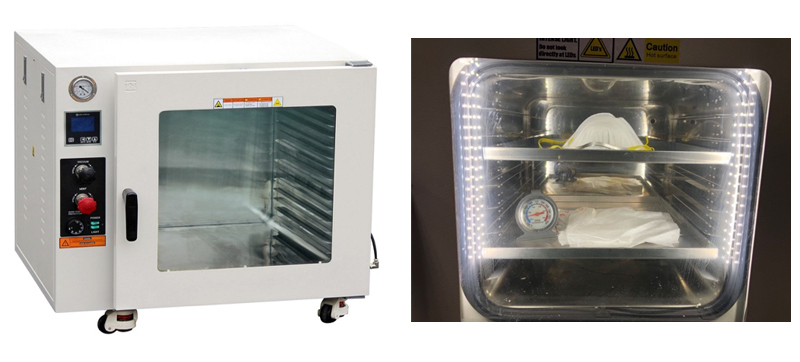
Above: AI 14 Rack Max 5 Cu Ft 480 ° F 5-Sided Heating Vacuum Oven, Across International LLC.
2. Can Disinfected Masks Be Reused? How Many Times?
The novel coronavirus that causes COVID-19 is thought to be transmitted primarily through respiratory droplets. Although respiratory droplets can vary in size, the novel coronavirus is approximately 0.1 μm (micrometers) in size. However, a droplet can shrink in flight as water evaporates. Personal protection, especially face masks, is therefore important for those in close contact with patients infected with COVID-19.
Wearing face masks in crowded settings is also recommended to reduce COVID-19's spread. Mask use will reduce spread by limiting the risk of transmission from people infected with COVID-19 who show no symptoms.
According to the United States National Institute for Occupational Safety and Health (NIOSH), N95 means that an efficiency greater than 95% is achieved for particles approximately 0.3 μm in size. Equivalent N95 standards in other countries are called FFP2 (European Union), KN95 (China), DS / DL2 (Japan) and KF94 (South Korea).
Current N95 masks consist of multiple material layers, the most important being the layer containing melt-blown fibers. The fabric incorporated through the melt-blowing process (100 to 1000 μm thick) consists of polypropylene microfibers ranging from 2-10 μm in diameter. The molten fibers interlock to form a three-dimensional structure with porosity of up to 90%. This allows these fabrics to trap large quantities of particulate matter. For small, harmful particles, the fibers alone are insufficient. Melt-blown fibers are therefore typically electrostatically charged to increase interaction with particles, providing much greater filtering efficiency without increasing air resistance.

Above: An electron microscopy image of microfiber fabric containing melt-blown fibers.
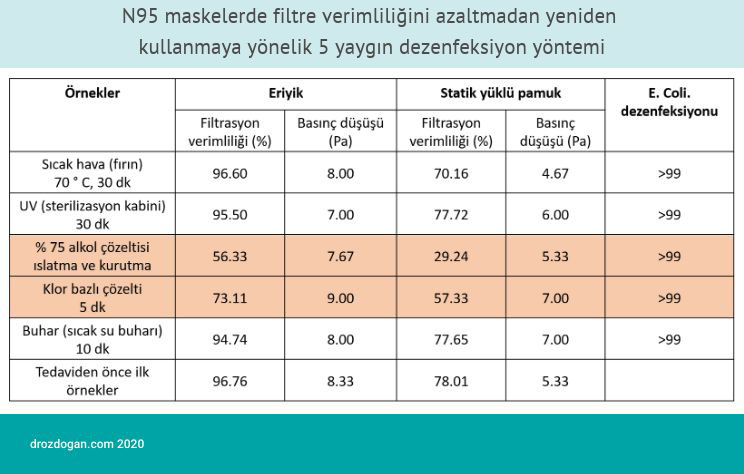
The COVID-19 outbreak has caused a major shortage of face masks, particularly N95-level masks. Five common disinfection methods have been used to reuse N95 masks without reducing filtering efficiency:
- Hot air (oven)
- UV light
- Alcohol solution
- Chlorine-based bleach
- Hot water vapor
The 2 most important factors were evaluated: particle-filtering efficiency and air-pressure drop before and after disinfection. Pressure drop reflects air resistance, and a significant change means the filter material's three-dimensional porous structure has changed. For example, a significant drop in air pressure may mean the melt-blown fibers have been damaged. A decrease in filtering efficiency may also mean reduced static charge on the fibers and/or damage to the fabric.
A 75% alcohol solution and chlorine-based solutions were observed to damage the static charge in our melt-blown fabric and reduce efficiency.
The report focuses on three promising methods:
- Method 1: 75 °C Hot Air (30 minutes)
- Method 2: UV Light (254 nm, 30 minutes)
- Method 3: Hot Water Vapor (10 minutes)
Note: Steam may not be an ideal choice because polypropylene, the component of melt-blown fibers, is hydrophobic (water-repelling). Using steam may saturate the fibers, and water condensation may reduce their static charge. Repeated disinfection may compromise filtering performance. Studies are ongoing to better define temperature limits and treatment times for all proposed disinfection processes.
SUMMARY
- Based on the SARS-CoV-1 (also called the old coronavirus) study, treatment at 75 °C for 30 minutes is sufficient for disinfection; however, remember that this previous study did not evaluate disinfection methods for the novel coronavirus (SARS-CoV-2).
- Exposure to heat treatment does not cause deterioration of masks' physical structure. The elasticity of the ear/face straps is not impaired, and they remain suitable for use.
- The following two methods are sufficient for disinfection:
- Method 1: 75 °C Hot Air (30 minutes), maximum 20 cycles
- Method 2: UV treatment (254 nm, 8W, 30 minutes), maximum 10 cycles

Above: UV Sterilizer Cabinet, CHS-208A, 110V / 60 Hz, 254 nm
*
- ALL OUR CORONAVIRUS ARTICLES *
Sources
stanfordmedicine.app.box.com/v/covid19-PPE-1-2
Was this article helpful?
Your feedback helps us improve our content.


Reader comments
Share your comment
Your name and comment are published only after administrator approval. Your email address is never shown to visitors.
Be the first to comment.