
Types of Medical Masks – Are Masks Effective against the Coronavirus? Which Should Be Chosen?

In this article
COVID-19 disease caused by the novel coronavirus has led to the declaration of a pandemic, and all humanity is on alert over this disease, which affects people of all ages worldwide, particularly older adults.
Who Should Wear a Mask to Protect against the Coronavirus?
The mouth and nose are the first entry points of the respiratory tract, and the use of masks covering them is being discussed as a way to protect against transmission of this virus. Healthcare workers, who have the most frequent contact with patients, need masks to reduce occupational exposure, while patients need them to reduce the likelihood of infecting others. However, the proportion of people positive for the novel coronavirus (SARS-CoV-2) in the community is increasing every day. Since we do not know who is positive for coronavirus infection, wearing masks in shared spaces or when attending hospital may reduce transmission.
Note: In his speech on the evening of 3 April 2020, President of the Republic of Turkey Recep Tayyip Erdoğan stated: "...From tomorrow onward, everyone will be required to wear a mask in all areas where people gather, such as marketplaces and supermarkets..."
- Related topic: Everyone Should Wear a Mask against the Coronavirus in Daily Life
What Is the History of Mask Use in Medicine?
Medical historians regard the beak-shaped mask as the first mask used for medical purposes. It formed part of an outfit, sometimes made of leather and sometimes of waxed canvas, that covered almost the physician's entire body. The idea of protection through this clothing is attributed to Charles de Lorme, who first adopted it in 1619. This outfit was also worn during the plague that killed 145,000 people in Rome and 300,000 in Naples, the Plague of 1656, by plague doctors.
Below is an illustration of the mask and protective clothing used by plague doctors.

Advances in medicine, the expansion of medical practice and technological development have led to changes and improvements in masks, particularly those used by doctors.
At present, the numbers and types of masks used in medicine and other fields have increased considerably, alongside efforts to standardize them.
Simple Medical Masks
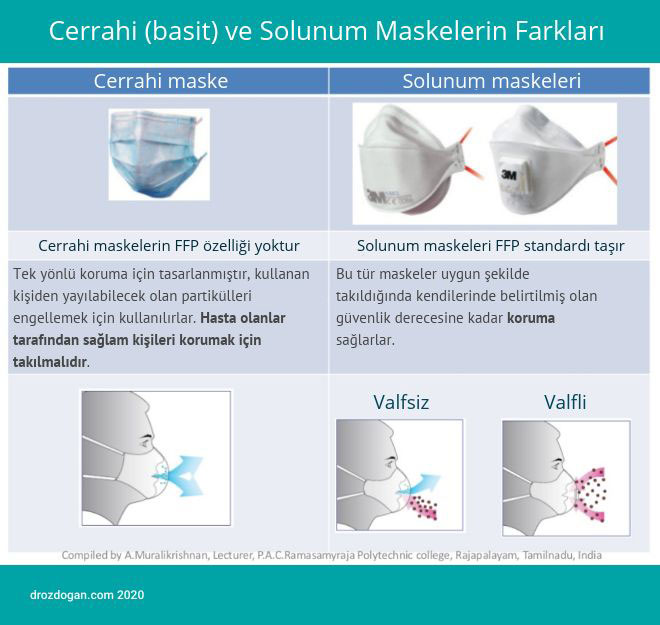
Surgical masks are another name for simple masks:
- Masks fit somewhat loosely and cover the nose and mouth.
- They are designed for one-way protection and are used to block particles that may be released by the wearer.
- They can prevent particles released by the wearer from being transmitted to other people. In other words, these masks should be worn by people who are ill or at risk of transmitting infection to protect healthy people. They do not protect the wearer.
- Most masks of this type have not been assigned any safety rating, such as NIOSH or EN.
Respirators
- Respirators fit the face more closely.
- Valveless respirators provide good two-way protection—for both the wearer and the person opposite—by filtering both incoming and outgoing airflow.
- When properly worn, these masks provide protection up to their stated safety rating.
- They are manufactured as disposable, half-face or full-face masks.
- Valved respirators allow faster exhalation than their valveless counterparts. The valve also reduces moisture trapped inside the mask. However, there is a significant difference in transmission risk because the valve opens during exhalation.
- Unfortunately, valved respirators cannot fully filter particles in the wearer's exhaled breath and may therefore fail to reduce transmission risk if the wearer carries the virus. If the wearer is a carrier or is ill, the valve may allow their breath, cough or sneeze to leave the mask without being fully filtered.
In Summary
- The patient should wear a surgical/simple mask to avoid infecting others.
- Healthcare workers should wear medical masks to protect themselves. Those at high risk of exposure should use respirators such as N95, while those at low risk should use surgical masks (exposure risks are described below). Valved respirators make breathing easier, but if the wearer is ill, they may infect others. Valveless respirators make breathing harder, but can provide both protection and a reduced risk of infecting others.
- Related topic: Can Masks Be Disinfected and Reused?
On 26 March, the Ministry of Health of the Republic of Turkey published two guides titled Evaluation of Healthcare Workers with COVID-19 Exposure and Follow-up of Healthcare Workers with COVID-19 Contact:
What Are the Standards for Respirators?
The United States Centers for Disease Control (CDC) lists the N95 respirator standard as part of the protective equipment recommended in its COVID-19 and SARS guidelines. Europe, meanwhile, has taken the "Filtering facepiece" rating (FFP) from EN standard 149: 2001. This standard is also used as a basis in Turkey.
The properties of well-known respirators are as follows:
- FFP2 filters 94% of its filtering capacity.
- N95 filters 95% of its filtering capacity.
- FFP3 and n99 filter 99% of their filtering capacity.
- N100 filters 99.7% of its filtering capacity.
Note: "Filtering capacity" refers to the percentage of particles 0.3 microns or larger that are filtered.
How Protective Are Respirators against the Coronavirus?
Given that the coronavirus is approximately 0.12 micrometers (12 nanometers) in average size, "could these filters be unable to filter the coronavirus?" is a question that may arise. Microorganisms smaller than 0.3 microns interact with other airborne molecules, such as nitrogen and oxygen, becoming particles that move irregularly and can be filtered by respirators such as N95. For this reason, a filtering capacity for particles of 0.3 microns is considered protective against coronaviruses attached to aerosols in the air.
Note: "aerosol" refers to solid or liquid particles that can remain suspended in the air. Their diameters can range from 0.003 micrometers to 100 micrometers.
*
- ALL OUR CORONAVIRUS ARTICLES
*
Sources
fda.gov - 11 March 2020
Was this article helpful?
Your feedback helps us improve our content.


Reader comments
Share your comment
Your name and comment are published only after administrator approval. Your email address is never shown to visitors.
Be the first to comment.