
Everyone Should Wear a Mask against the Coronavirus in Daily Life

In this article
In his speech on the evening of 3 April 2020, President of the Republic of Turkey Recep Tayyip Erdoğan stated: "...From tomorrow onward, everyone will be required to wear a mask in all areas where people gather, such as marketplaces and supermarkets..."
Given the scenes below that we continue to see in marketplaces in Turkey, we consider this mask rule highly appropriate and necessary.

COVID-19 disease caused by the novel coronavirus cases are increasing every day, and people are trying to obtain simple medical (surgical) masks to protect themselves. Some healthcare professionals approach the issue differently; they have become concerned about mask supplies for themselves: "Only those who need masks should use them!" they say. But are masks really necessary only for certain people, or should everyone outside their home wear a mask? Could everyone wearing masks be one of the most important factors in slowing and controlling the outbreak?
Until now, the World Health Organization (WHO) and the United States Centers for Disease Control and Prevention (CDC) have said that, apart from healthcare workers at risk of exposure to the coronavirus, only people with COVID-19 symptoms and those caring for them should wear masks.
However, some health experts, including the director of the Chinese Center for Disease Control and Prevention, think this is a mistake. Health authorities in parts of Asia have encouraged all citizens to wear masks in public to prevent the virus's spread, regardless of whether they have symptoms. Last week, the Czech Republic took a step toward making nose and mouth coverings mandatory in public spaces and launched an effort to produce large quantities of masks. As a Central European country with a population of 10 million, Czechia (the Czech Republic) seems so far not to have made the mistakes that Italy or Spain made in controlling the outbreak. Czechia's COVID-19 figures are as follows: 3,869 total cases; 46 new deaths; a mortality rate of 1.1%; and 361 cases per million people.
Video description: The primary route of person-to-person coronavirus transmission is through aerosols or small droplets generated by breathing, sneezing or coughing. The extent to which exhaled air spreads during breathing can be effectively reduced by wearing a face mask, as shown in the video. The video above uses a Schlieren imaging technique to visualize the airflow from a person breathing and coughing. Wearing a face mask blocks exhaled airflow and effectively reduces the risk of infection.
Scientists who recommend that the public wear masks say that mask-wearing has a moderate effect against the spread of this outbreak. Many of us also hesitate to encourage mask purchases because of serious shortages in healthcare systems. But public mask-wearing seems more necessary now than at any other time in history. To slow this outbreak, we must do whatever is necessary, including wearing masks alongside staying home, social isolation and following hygiene rules.
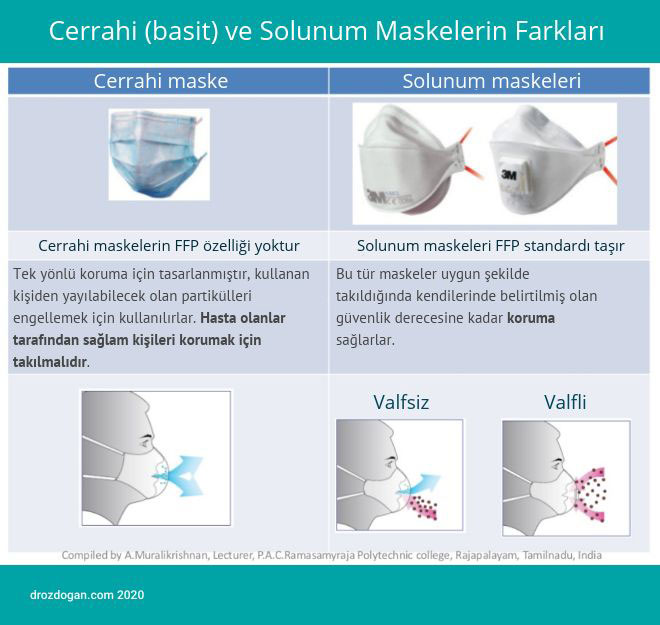
Note: There are two types of medical masks:
- Surgical masks and
- Respirators
RELATED TOPICS
- What Types of Medical Masks Are There? Who Should Choose Which?
- Can Masks Be Disinfected and Reused?
Wearing a Mask May Be an Underappreciated Public Health Intervention
Simple medical masks are normally intended to reduce the risk of transmitting disease to others rather than to protect yourself. However, the proportion of people positive for the novel coronavirus (SARS-CoV-2) in the community is increasing every day. Since we do not know who is positive for coronavirus infection, everyone wearing a mask outside the home may reduce the rate at which COVID-19 spreads.
However, even when wearing masks, people must continue practicing social distancing and staying home to prevent the novel coronavirus's spread. Wearing a mask should not mean that you can go out more easily!
Arnold Monto, an epidemiologist at the University of Michigan in Ann Arbor, says that although there is some evidence that this novel coronavirus, which causes severe acute respiratory syndrome (SARS), is present in aerosols (fine particles suspended in the air), aerosol transmission rarely occurs. It mainly spreads through larger droplets, and "we know that standard surgical face masks will have a modest effect on this type of transmission. However, when you combine masks with other protective approaches, they can make a difference."
The video below contains an experiment showing why the risk of coronavirus transmission is greater in confined, enclosed spaces and demonstrating the importance of wearing a mask:
Randomized controlled trials focusing on other viruses have not demonstrated that public mask-wearing reduces infections, but these studies tend to have small sample sizes, and in many of them participants did not wear masks as often as instructed.
It already makes little sense to think that masks are truly important for healthcare workers but not useful at all for the general public. However, masks may work better when used by healthcare workers because they are trained in how to wear them and practice other important safety measures, such as thorough handwashing. Teaching a member of the public how to wear a mask could therefore provide an advantage against this outbreak.
The Striking Example of Iceland
Because of its small population, Iceland allows anyone who wishes to be tested. Evaluation of the test results showed that approximately half (50%) of individuals with COVID-19 had no symptoms. We must therefore remember that we may carry the disease even without symptoms and use face coverings to avoid spreading the virus. We should also know that infectiousness is greatest during the asymptomatic stage of the disease. We must remember to behave as though we already have the disease and must not pass it on to others.
Iceland and many other countries have launched do-it-yourself movements to produce cloth masks. Cloth masks do not need to be compared with medical masks (simple masks and respirators) in rigorous studies, nor do we need rigorous studies investigating the ideal materials for homemade masks.
Professor Dr. Derya Unutmaz Warns!

A world-renowned immunology expert working in the Department of Genomic Medicine at the Jackson Laboratory in the United States, Professor Dr. Derya Unutmaz, said in a statement to Habertürk, "We need to view everyone as potentially carrying the virus. The findings are very clear. Of those who contract the virus, 30 percent—and according to some data even 50 percent—show no symptoms at all" and clearly stated that people should not go outside without a mask.
My View on Transmission Is Very Clear: Masks Must Definitely Be Worn
"These masks prevent you from transmitting the virus to the person opposite you if you have it. We need to view everyone as potentially carrying the virus. The findings are very clear. Of those who contract the virus, 30 percent—and according to some data even 50 percent—show no symptoms at all. These are the people who actually spread it. They are among us, too. We do not know who has the virus. This virus can be transmitted even while talking. The virus does not remain airborne, but there is face-to-face communication."
Even 10% Is Vital
Unutmaz noted that although they advise handwashing to protect against the outbreak, hands touch the face hundreds of times a day, and said masks would offer protection in this respect as well. Emphasizing that even a 10% protective effect from masks is vital, Unutmaz said: "There is a debate about whether or not we should wear a simple mask. I cannot understand this".
This Is How It Slowed in China
Recalling the countries where the outbreak first appeared, Unutmaz said: "Look at China, the country that has researched this most: you cannot go outside without a mask. The same applies to South Korea and Hong Kong... It is already part of those cultures. It also helped slow transmission at the beginning. Of course it is not 100%, but even 10-20% is an incredible figure".
Sources
Would everyone wearing face masks help us slow the pandemic?
sciencemag.org 28 March 2020
2. Prof. Dr. Derya Unutmaz: Kesinlikle maske takın.
haberturk.com - 3 Nasan 2020
Was this article helpful?
Your feedback helps us improve our content.


Reader comments
Share your comment
Your name and comment are published only after administrator approval. Your email address is never shown to visitors.
Be the first to comment.