
CAR T Cells Delivered in a Special Gel Could Make a Difference in Cancer Treatment

In this article
An exciting scientific development in oncology has attracted attention around the world!
This biotechnology involves collecting a special group of patients' immune cells, T cells, modifying them, and delivering them to the patient as a cancer treatment inside a special gel.
CAR T cells are modified T cells ready to detect and destroy cancer cells. Although they are known to be effective against blood cancers such as leukemia, this method has rarely succeeded in treating solid (organ) tumors. Delivering CAR T-cell therapy in a gel could overcome this problem.
Living Medicine in a Gel
Stanford University engineers developed this new method to increase the “attack power” of genetically engineered immune cells known as chimeric antigen receptor (CAR) T cells. CAR T-cell therapy is also known as living medicine.
The researchers added CAR T cells and specialized signaling proteins to a hydrogel, a water-rich gel sharing properties with biological tissues, and injected this material near the tumor.
On April 8, 2022, Science Advances published the study, which reports that this gel provides a temporary environment where immune cells multiply and become active to fight cancer cells in the body. Over time, the gel continually releases activated CAR T cells to attack the tumor.
Study coauthor Eric Appel, an assistant professor of materials science and engineering at Stanford University, said, “Most work in the CAR-T cell field focuses on making these cells better, but there is very little work on how they can become more effective in the human body. What we are doing is entirely complementary to all the efforts to engineer better cells.”
Currently, intravenous (IV) infusions are the main route for administering CAR T cells. With this method, the cells enter the bloodstream and circulate throughout the body. However, this approach is not ideal for treating solid tumors, which are often dense, located in particular regions, and defend themselves by hiding from immune cells.
The study's lead author, Abigail Grosskopf, says, “The tumor microenvironment, full of terrible things trying to fight T cells, is like a war zone. CAR T cells struggle to infiltrate (invade) these tumors to attack them” .
- Related topic: Tumor-Infiltrating T Cells and Their Importance in Cancer
To activate CAR T cells strongly enough to destroy a tumor, the cells need prolonged exposure to high concentrations of special signaling proteins. These proteins, called cytokines, tell the engineered immune cells to multiply rapidly and prepare to destroy the tumor. However, if given systemically through a vein, the amount of cytokines needed to launch an effective attack would be toxic to other parts of the body. Instead, Grosskopf and colleagues developed a gel that can temporarily host cytokines and CAR T cells near the tumor. The immune cells grow and multiply here rather than in the body. They are also continually released to bombard cancerous growths.
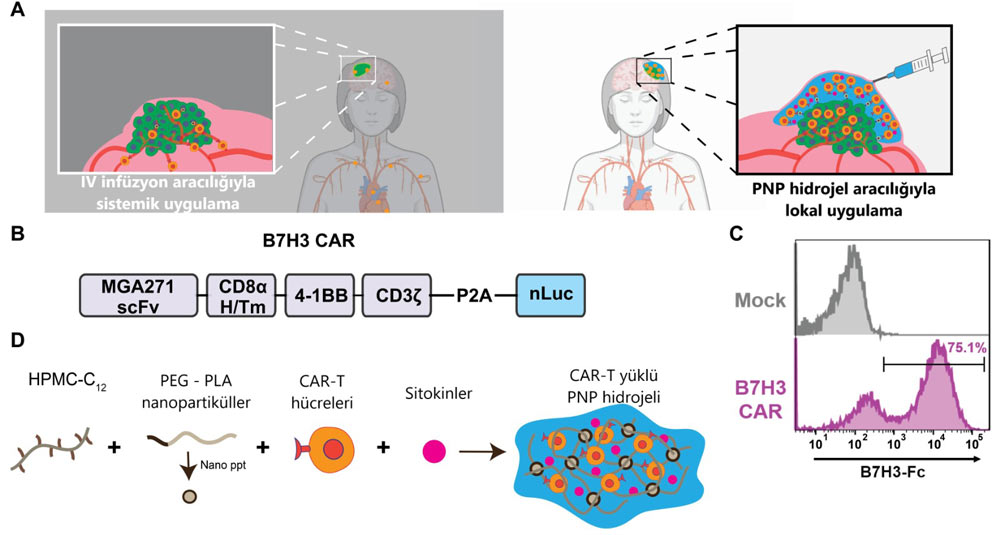
Figure explanation: Injectable hydrogels co-delivering CAR T cells and cytokines for more effective solid tumor treatment. A) Schematic of the method for delivering CAR-T cells to solid tumors (left), compared with the conventional intravenous (IV) approach (left). B) Schematic of the B7H3 CAR structure used in all studies. C) Transduction efficiency of B7H3 CAR-T cells determined by staining with B7H3-Fc, compared with untransduced “Mock” T cells. D) Formation of PNP (Polimet Nanoparticle) hydrogels to co-encapsulate CAR T cells and stimulatory cytokines through self-assembly.
The gel is made from water and two ingredients: a polymer made from cellulose (a material found in plants) and biodegradable nanoparticles. When these two molecules combine, they bind to one another like molecular Velcro—they want to stick together but can easily separate.
Grosskopf said that “this gel material can be injected through small needles”. “Yet after injection, the ‘Velcro’ finds its form again and turns into a strong gel structure.”
The gel's lattice-like shape is woven tightly enough to prevent small cytokines from leaking out. At the same time, the structure's connections are weak enough for CAR T cells to break through them and become free when ready to kill cancer cells.
Successful Results in Animal Experiments
After identifying the best gel formulation for cancer treatment, the research team used mouse models with tumors to test the method.
Grosskopf found that all experimental animals injected with gel containing both CAR T cells and cytokines were cancer-free after 12 days.
Grosskopf and her team also tried delivering only CAR T cells in the gel, but tumors disappeared much more slowly or did not disappear at all in some mice. Treatments delivered through a vein or in saline rather than in the gel were even less effective against tumors. The gel also caused no adverse effects such as inflammatory reactions in the mice and completely degraded in the body within a few weeks.
The team also tested the gel treatment at a site distant from the tumor. Surprisingly, all animals' tumors still disappeared, although the treatment response took approximately twice as long as an injection adjacent to the tumor.
Appel said, “What we are evaluating first are tumors we can inject near. Unfortunately, however, we still cannot do this for all tissues in the human body. Being able to inject at sites distant from tumors would really open the door to treating many solid tumors .” Appel also said his laboratory's next experiment would explore this ability of the gel delivery method to reach distant tumors.
In conclusion, this eye-opening study proposes a relatively simple and effective way to advance promising cancer research. Grosskopf summarized the study as follows: “I think a major advantage of our gels is how easy they are to prepare: you mix two things and inject. We need a little more preclinical work, but I think this treatment is very promising.”
Sources
2. ABIGAIL K. GROSSKOPF, et al. Delivery of CAR-T cells in a transient injectable stimulatory hydrogel niche improves treatment of solid tumors. SCIENCE ADVANCES 8 Apr 2022.
Was this article helpful?
Your feedback helps us improve our content.




Reader comments
Share your comment
Your name and comment are published only after administrator approval. Your email address is never shown to visitors.
Be the first to comment.