
Coronavirus Disease 2019 (COVID-19) TREATMENT and Management – Promising New Research

In this article
Potential Treatments for COVID-19
Novel coronavirus disease COVID-19 is spreading rapidly in Europe and North America. We have limited options for controlling the growing outbreak and treating those who are ill. Preventing the disease is particularly important, and quarantine, isolation, infection control measures and supportive care for people who become ill play a major role in this. What we lack is a disease-specific antiviral drug to treat people infected with the virus and a specific vaccine to reduce transmission.
Note: the scientific name of the novel coronavirus is SARS-CoV-2 , while the disease caused by this virus has been named COVID-19 .
Numerous antiviral agents, immunotherapies and vaccines are being investigated and developed as potential treatment options. Prospective treatment research can be listed as follows:
Antiviral agents being "tested" in the treatment of novel coronavirus disease
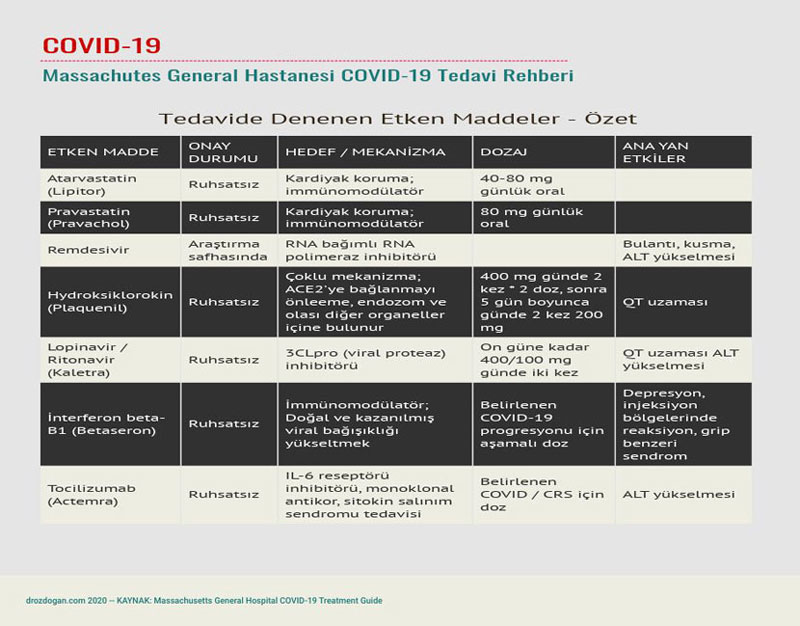
Remdesevir
The broad-spectrum antiviral agent remdesevir is a nucleotide analogue prodrug. It has been shown to inhibit the replication of human coronaviruses in tissue cultures (laboratory conditions), including SARS-CoV-1 in 2003 and MERS-CoV in 2012. Its efficacy in animal models has been demonstrated for SARS-CoV-1 and MERS-CoV. In addition, remdesivir is being evaluated in phase-III clinical trials for Ebola virus infections.
Remdesivir is being evaluated in several phase 3 clinical trials for use in treating COVID-19 in the USA, South Korea and China. A laboratory study showed that the antiviral activity of remdesivir + interferon Beta (IFNb) was superior to that of the lopinavir / ritonavir combination. Preventive and therapeutic use of remdesivir has been reported to improve lung function and reduce severe lung disease in mice.
Lopinavir / Ritonavir
The combination of the HIV protease inhibitors lopinavir and ritonavir (Kaletra) is one of the antiviral drug candidates. Lopinavir, which acts against the 3CL protease, has modest antiviral activity against SARS-CoV-2. Together with ritonavir, which increases its bioavailability, it has been included in clinical trials for MERS treatment. What particularly brings lopinavir + ritonavir to the fore is its wide availability and the fact that it can be prescribed immediately. There are, in fact, several case reports and case series involving its use against COVID-19, but its effectiveness is unclear.
A study in Wuhan, China, the epicentre of the outbreak, tested the effectiveness of lopinavir + ritonavir in patients with COVID-19. The study aimed to obtain data from 160 patients with oxygen saturation of 94% or below, with participants randomly assigned to receive lopinavir + ritonavir. This was truly a heroic effort, as healthcare workers in Hubei Province, the group at highest risk of contracting the disease, were collecting high-quality clinical research data under extremely difficult conditions while caring for patients during an overwhelming outbreak. The team not only succeeded, but also managed to include more patients than intended (199).
Unfortunately, the trial results did not fully deliver what was hoped for. No difference in clinical improvement was observed. However, fewer deaths occurred in the group receiving lopinavir + ritonavir. In addition, lopinavir + ritonavir could not suppress the infectious viral load.
The study faced two important challenges. First, the team had selected a difficult population: the patients enrolled were at a late stage of infection and already had substantial tissue damage. Second, lopinavir was not particularly potent against SARS-CoV-2. Although lopinavir + ritonavir did not appear highly effective in patients with COVID-19, the encouraging message for us is that high-quality randomised clinical trials can be conducted rapidly, even during an outbreak. It is clear that, as research continues, we will have powerful tools at our disposal.
Rintatolimod
The TLR-3 agonist rintatolimod is being tested as a potential treatment for COVID-19 by the National Institute of Infectious Diseases at the University of Tokyo in Japan. It is a broad-spectrum antiviral agent.
Other antivirals
Other antivirals being tested for activity against COVID-19 include azvudine (a nucleoside reverse transcriptase inhibitor), danoprevir (an NS3 / 4A HCV protease inhibitor), plitidepsin (which targets EF1A) and favipiravir (a viral RNA polymerase inhibitor).
Experimental studies from Spain report that plitidepsin targets EF1A, which potentially plays a key role in viral replication and spread.
Preliminary results suggesting moderate antiviral activity of favipiravir against COVID-19 have attracted attention following a study in China, although the company behind the drug has not confirmed its effectiveness. Favipiravir (Avigan) is approved for influenza (flu) in Japan and China and is being investigated for use in COVID-19.
- Related topic: What is favipiravir? According to China, the Japanese flu drug is effective in treating coronavirus (details)
Immunomodulators and other treatment options
Interleukin-6 inhibitors
Interleukin-6 (IL-6) inhibitors may be beneficial in severe lung tissue damage caused by cytokine release (a cytokine storm) in severe COVID-19 infections.
On 16 March 2020, the pharmaceutical companies Sanofi and Regeneron announced the launch of a phase 2/3 trial of the IL-6 inhibitor sarilumab (Kevzara). The US-based component of the research will begin in New York. The multicentre, double-blind, phase 2/3 trial has an adaptive design consisting of two parts, with 400 patients expected to take part. The first part will observe patients with severe COVID-19 infection at approximately 16 US sites and assess the effect of sarilumab on fever and the need for supplemental oxygen. The second, larger part of the study will assess improvement in longer-term outcomes, including preventing deaths and reducing the need for mechanical ventilation, supplemental oxygen and / or hospitalisation.
Genentech, the manufacturer of another IL-6 inhibitor, tocilizumab (Actemra), is working with the FDA to launch a controlled phase III clinical trial. The aim is to conduct the study with approximately 330 patients worldwide in early April 2020.
Hydroxychloroquine and chloroquine (antimalarial drugs)
Hydroxychloroquine and chloroquine are antimalarial drugs with immunomodulatory effects and are therefore widely used to treat autoimmune conditions (e.g. systemic lupus erythematosus and rheumatoid arthritis). As polymerase inhibitors, they are also believed to inhibit pH-dependent steps of viral replication and to have additional antiviral activity through alkalinisation of the phagolysosome.
Wang and colleagues reported that chloroquine effectively inhibits SARS-CoV-2 in vitro. The pharmacological activity of chloroquine and hydroxychloroquine was tested using Vero cells infected with SARS-CoV-2. Physiologically based pharmacokinetic models were constructed for each drug. Hydroxychloroquine was found to be more potent than chloroquine in vitro. Based on these models, the authors recommend hydroxychloroquine 400 mg PO BID, followed by a loading dose of 200 mg BID for 4 days.
Published reports from the worldwide COVID-19 outbreak have assessed the potential usefulness of these drugs in controlling cytokine release syndrome in critically ill patients.
According to the consensus of a multicentre collaborative group in China, chloroquine phosphate tablets at 500 mg (300 mg base) twice daily for 10 days may be considered for patients with COVID-19 pneumonia. Although peer-reviewed treatment outcomes are unavailable, Gao and colleagues claim that 100 patients showed significant improvement with this regimen without documented toxicity. It should be noted that this is 14 times the typical weekly dose of chloroquine used for malaria prophylaxis and 4 times the dose used for treatment. Cardiac toxicity deserves attention, given the prevalence of COVID-19. Chloroquine has also previously been reported to be active against many other viruses in vitro but ineffective in clinical trials.
The French have adopted hydroxychloroquine as a potentially more potent therapy with a good safety profile to treat and prevent the spread of COVID-19. If it is effective, the optimal hydroxychloroquine regimen is unknown, although some experts recommend higher doses such as 600-800 mg daily. A study of hydroxychloroquine for post-exposure prophylaxis in healthcare workers or household contacts is ongoing (a new concept: post-exposure prophylaxis).
A recent study in France evaluated patients treated with hydroxychloroquine against a control group receiving standard care. After 6 patients with missing data were dropped from the analysis, the virus was not detected in nasopharyngeal samples on day 6 in 20 patients receiving hydroxychloroquine (70% clearance [14/20] versus 12.5% [2/16]). This is an unusual approach to reporting outcomes because the clinical correlation of nasopharyngeal clearance on day 6 is unknown, and several patients changed status within days of this endpoint (from negative to positive). The authors did not explain the choice of this endpoint either. However, 4 of the 6 excluded patients had adverse outcomes at that time (ICU admission or death), yet were not counted in the analysis. In addition, patients who did not sign informed consent in the study group were, unusually, included in the control arm.
In its guideline entitled Assessment of Healthcare Workers with COVID-19 Contact, published on 26.03.2020, the Ministry of Health recommended hydroxychloroquine prophylaxis for healthcare workers with high-risk contact, in other words, post-exposure prophylaxis.
Trying drugs such as Plaquenil prophylactically on a mass scale before their effectiveness has been established may cause the virus to undergo mutation much faster than its natural course, develop resistance, and leave us with a new virus and a new outbreak in the near future!
Nearly 100 non-critical mutations have already been identified in this virus. Drugs swallowed like sweets on the assumption that they have no side effects will put pressure on the resistance mechanisms of the virus.
Believing that taking Plaquenil provides protection is another misconception... As the virus spreads, it may undergo more mutations; this process is random and involves, in particular, what we call genetic drift. This is why allowing the virus to evolve and change by spreading it poses a greater risk that will also negatively affect drug discovery. The FDA has not approved Plaquenil for "preventive" use. The FDA has not approved it for COVID-19 treatment either, but it is being tried in Turkey for patients with COVID-19 whose condition is serious enough to require hospitalisation (see below: Ministry of Health Guideline on Adult Patient Management and Treatment for COVID-19).
- Related topic: Could the antimalarial drug Plaquenil be a remedy for coronavirus disease (COVID-19)? (details)
Azithromycin
In the small, open-label French study of hydroxychloroquine, azithromycin was used in 6 patients to reduce the risk of bacterial superinfection. SARS-CoV-2 clearance was reported in all of these patients. Although interesting, these results require further analysis. Patients receiving combination therapy had lower viral loads; however, compared with patients receiving hydroxychloroquine alone, the results were quite similar (6/6 and 7/9). Hydroxychloroquine and azithromycin carry warnings about QT prolongation and may be associated with an increased risk of cardiac death when used in a larger group.
Corticosteroids
A study of 201 cases evaluated the clinical outcomes of patients diagnosed with COVID-19 in Wuhan. Eighty-four patients (41.8%) developed acute respiratory distress syndrome (ARDS), and 44 of them (52.4%) died. Among patients with acute respiratory distress syndrome, methylprednisolone treatment was observed to reduce the risk of death.
Plasma transfusion therapy
The US Food and Drug Administration (FDA) has updated its rules on the use of experimental treatments for the ongoing COVID-19 outbreak. Under these rules, when COVID-19, the disease caused by the novel coronavirus, poses a serious or immediate threat to a patient’s life, "convalescent plasma" may be used only in critically ill patients on an experimental basis. However, it was emphasised that use was permitted only on an individual, case-by-case basis and only in special circumstances. This "permission" does not mean that its use as a COVID-19 treatment has already been approved. The FDA emphasised this distinction. Although it has permitted use in limited circumstances, the FDA believes that convalescent plasma may contribute to research into highly effective treatment.
- Related topic: Plasma transfusion therapy – FDA permits the use of blood from recovered COVID-19 patients for critically ill patients (details)
Nitric oxide
Findings from SARS-CoV infection in 2004 suggest that inhaled nitric oxide may be beneficial as a supportive measure for treating the infection in patients with respiratory distress. Nitric oxide treatment was observed to reduce pulmonary hypertension, improve severe hypoxia and shorten the duration of ventilator support compared with control patients with SARS. A phase 2 study is underway to prevent disease progression in patients with severe respiratory distress syndrome.
Renin–Angiotensin System Blockade
For a virus to enter a cell, the host cell must have an appropriate receptor. The coronavirus attaches to the cell by using Angiotensin-Converting Enzyme-2 (ACE-2) on the target cell.
Early reports proposed using Angiotensin-Converting Enzyme Inhibitors (ACEIs) and Angiotensin Receptor Blockers (ARBs) to target ACE-2 in patients with COVID-19. However, their usefulness as a treatment has been debated. This is because ACE-2 production is thought to increase in patients receiving ACEI and ARB treatment, potentially increasing susceptibility to COVID-19. At the same time, physiologically, ACEI converts angiotensin 2 to angiotensin 1-7, which causes vasodilation and may play a protective role against lung injury. It is therefore unclear whether increased production of ACE-2 receptors increases or reduces the effects of SARS-CoV-2 in human lungs.
There are also conflicting data on whether ACEIs and ARBs increase ACE-2 levels. While some animal studies suggest that ACEIs and ARBs increase ACE-2 production, other studies argue that they do not demonstrate this effect.
Two clinical trials evaluating Losartan use in hospitalised and outpatient patients with COVID-19 are currently ongoing at the University of Minnesota. Losartan is an Angiotensin Receptor Blocker (ARB) drug. The results of these studies will provide information about the potential role of ARBs in treating COVID-19.
*
When will the coronavirus vaccine be ready?
*
Sources
Coronavirus Disease 2019 (COVID-19) Treatment & Management.
emedicine.medscape.com/article/2500114-treatment
Was this article helpful?
Your feedback helps us improve our content.


Reader comments
Share your comment
Your name and comment are published only after administrator approval. Your email address is never shown to visitors.
Be the first to comment.