
Enzyme That Converts Blood Type A to 0 Discovered in the Human Gut

Blood transfusion is one of the medical interventions that save lives. As is known, there are 4 blood types: A, B, AB and O. These blood types are not mutually compatible for transfusions. However, type 0 negative blood can be donated to all other blood types, so it has the characteristic of a universal blood type . However, blood type 0 is rare. In this context, a study published in June 2019 in Nature Microbiologydiscovered a way to convert blood type A to blood type 0. This discovery involves using enzymes from Flavonifractor plautii , a bacterium found in the gut.
Sugar molecules (blood antigens) on the surface of red blood cells distinguish the blood types. Although types A, B and AB have their own antigens, type 0 has no antigen (or has the most basic H antigen). Therefore, type 0 is considered the "universal blood type." Transfusing the wrong blood type causes an immune response. However, because type 0 carries no foreign antigen — or carries the shared H antigen — it can be transfused to every blood type.
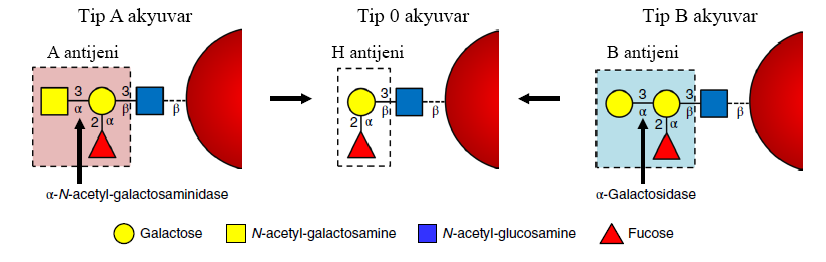
Previous research had shown that certain enzymes could play a role in converting blood types A, B and AB to type 0. It focused on enzymes that break down sugar molecules called glycans on the cell surface. This study discovered that two enzymes found in human gut bacteria could convert blood type A to type 0. When these enzymes were added to type A blood, type A molecules were successfully removed from the blood cell surface, converting the blood to type 0.
The Enzyme's Mechanism of Action Is as Follows:
The enzyme GalNAc deacetylase converts the antigen to an amine. The second enzyme then removes all the amines. In this way, white blood cells (red blood cells) lose their antigens.
What Does This Study Mean for Us?
- An effective method of obtaining the universal blood type 0 has been discovered. Although the idea of using enzymes was proposed in the 1980s, no technique that could work in whole blood had been developed. This method could revolutionize blood transfusions, allowing large amounts of type 0 blood to be obtained.
- It is essential to emphasize that this research is still at the laboratory stage. Preclinical studies are planned to take 2 years, followed by clinical studies in humans. The safety of this method is particularly important. All A antigens need to be removed from red blood cells. Researchers will also examine whether the enzyme causes any changes in those cells.
Sources
An enzymatic pathway in the human gut microbiome that converts A to universal O type blood.
Nature Microbiology, 10 June 2019.
Was this article helpful?
Your feedback helps us improve our content.




Reader comments
Share your comment
Your name and comment are published only after administrator approval. Your email address is never shown to visitors.
Be the first to comment.