Smart Pills and Oral Chemotherapy: Fasted or Fed? A Drug-Food Interaction Table
In this article
Empty Stomach, With Food or Either: A Guide to Food, Acid Reducers and Grapefruit With Oral Cancer Drugs
There is no single rule for oral targeted pills (targeted therapies) and oral chemotherapies: some are taken on an empty stomach, some with food, and for others food makes no difference, because food can increase a drug's absorption, decrease it or leave it unchanged. This updated guide brings together the US label instructions for 31 drugs in one place. At our team's request, fruquintinib (Fruzaqla), trifluridine-tipiracil (Lonsurf), daraxonrasib (Rasonque), lorlatinib, sotorasib, capmatinib, encorafenib and binimetinib have also been added. Medicines that reduce stomach acid, grapefruit and herbal products such as St John's wort can also change the levels of some drugs considerably. This article does not make decisions for you: instructions can vary by drug, formulation and brand. Follow your drug's own patient information leaflet and what your oncology team or pharmacist tells you. We have covered the basics of food and drug interactions in cancer treatment, access to new cancer drugs in Turkey and cancer drugs imported from abroad in separate articles.
- Eight drugs were added: fruquintinib, trifluridine-tipiracil (Lonsurf), daraxonrasib (Rasonque), lorlatinib, sotorasib, capmatinib, encorafenib and binimetinib. The total number of drugs rose from 23 to 31.
- Detailed cards were added for each new drug (how to take it, the effect of food, acid reducers, enzyme interactions, missed doses).
- Illustrations were added showing how food affects absorption, a sample day plan, the effect of acid reducers and the effect of grapefruit and St John's wort on the enzyme, along with new charts on the effects of acid reducers and enzyme inducers.
- The section on missed doses, vomiting and common mistakes was expanded.
- There is no single rule: According to the labels, 10 drugs are taken on an empty stomach and 9 with food; for 12 drugs food does not matter or they should be taken the same way every day. Of the eight newly added drugs, seven are taken with or without food, while Lonsurf is taken with food.
- Why does it matter? Food raises the levels of some drugs several-fold (abiraterone up to 10-fold, lapatinib 3- to 4-fold) and lowers others (afatinib AUC by 39%). Too much exposure can increase side effects; too little can weaken the effect.
- Acid reducers: The sotorasib level falls by 57% with omeprazole; its label says to avoid PPIs and H2 blockers. Gefitinib, erlotinib, dasatinib, neratinib and pazopanib also have special timing rules. No meaningful effect was seen with lorlatinib, fruquintinib, binimetinib or daraxonrasib.
- Grapefruit and herbal products: Grapefruit can raise the levels of some drugs; enzyme inducers such as St John's wort can lower them (with rifampin, lorlatinib fell by 85% and capmatinib by 67%). Do not change your food rule, acid reducer or supplements without talking to your care team.
Why does this matter?
A growing share of cancer treatment now happens at home, with drugs taken by mouth. With intravenous chemotherapy, the dose, timing and conditions of administration are under the hospital team's control; with oral drugs, much of this responsibility shifts to the patient and family. Details that seem small, such as the food rule, the timing of an acid reducer or a glass of grapefruit juice, can change a drug's blood level several-fold.
These effects are not theoretical: food can raise the blood level of abiraterone up to 10-fold; an acid reducer can cut the sotorasib level by more than half; and an enzyme-inducing drug or herbal product can almost cancel out the effect of lorlatinib. That is why, whenever a new oral cancer drug is started, a written, personalized plan covering the food schedule, acid reducers and herbal products is part of successful treatment (supplements taken without evidence).
Should cancer pills be taken on an empty stomach or with food?
There is no single rule for oral cancer drugs. According to the labels, drugs such as abiraterone, erlotinib, lapatinib, nilotinib and pazopanib are taken on an empty stomach; drugs such as imatinib, capecitabine, Lonsurf, regorafenib and alectinib are taken with food; and drugs such as osimertinib, olaparib, lorlatinib, sotorasib, fruquintinib, encorafenib and daraxonrasib are taken with or without food. Follow your drug's own instructions and what your care team tells you.
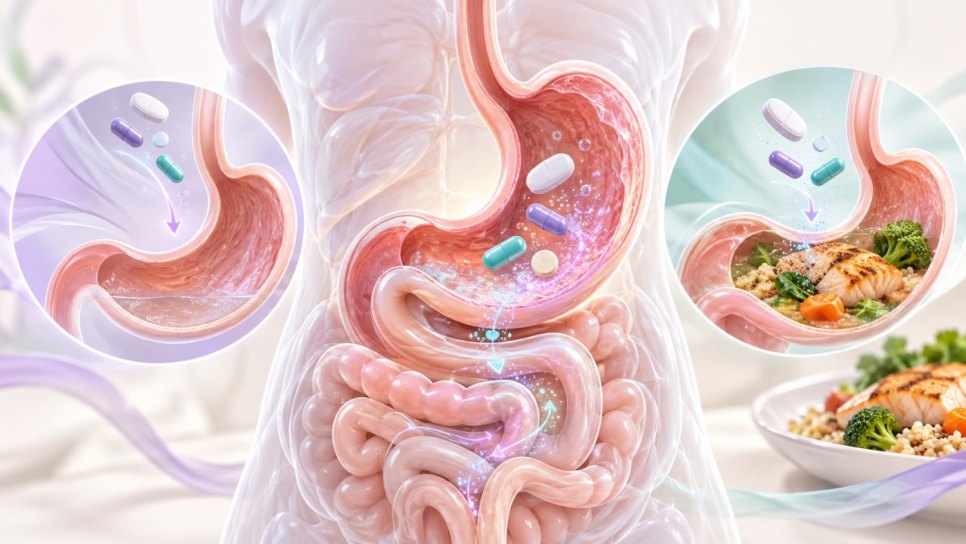
How does food change a drug's effect?
As a drug passes from the stomach and intestine into the blood, food can change that passage. A fatty meal can help some poorly water-soluble drugs dissolve and raise their blood levels; with other drugs, food lowers the level by slowing stomach emptying or binding to the drug. For some, it makes no important difference. The food instructions on a label reflect the conditions under which the drug was tested in clinical trials and how a safe, effective level can be maintained.
Figure 1 · How does food change the way a drug reaches the blood?
Drug in the stomach, intestine and blood: three possible outcomes
| Topic | Details |
|---|---|
| Three groups | Drugs taken on an empty stomach, drugs taken with food, and drugs taken with or without food |
| What does "on an empty stomach" mean? | For most drugs, at least 1 hour before or 2 hours after a meal; it varies by label (for lapatinib, 1 hour before or 1 hour after) |
| What does "with food" mean? | During a meal or right after it; for capecitabine, within 30 minutes after finishing a meal; for regorafenib, after a low-fat meal |
| What does "either way" mean? | It can be taken with or without food, but most labels ask for it to be taken at about the same time every day |
| Other factors | Medicines that reduce stomach acid, antacids, grapefruit and herbal products such as St John's wort |
| Where the rule comes from | The drug's label (prescribing information); instructions can differ between formulations of the same active ingredient, such as capsules and tablets |
The instructions in this article are taken from drug labels published on DailyMed in the US; the brand and patient information leaflet may differ in Turkey.
Figure 2 · Three groups: empty stomach, with food, either way
The main instruction on the labels of 31 drugs
Drug–food interaction table
The three tables below show the food instructions on the labels, along with notes on food, stomach acid and grapefruit. Newly added drugs are marked new. A "—" means that this information could not be found in the relevant label text or was not verified for this article; it does not mean that the information does not exist.
Taken on an empty stomach
| Drug (brand) | When to take it | Effect of food | Stomach acid and grapefruit notes |
|---|---|---|---|
| Abiraterone (Zytiga) | Empty stomach Do not eat for at least 2 hours before and at least 1 hour after the dose | Food raises the level; with a high-fat meal, bioavailability can rise up to 10-fold | — |
| Erlotinib (Tarceva) | Empty stomach At least 1 hour before or 2 hours after a meal | Bioavailability is about 60% on an empty stomach and almost 100% with food | Avoid PPIs if possible; if an antacid is needed, take it several hours apart from the erlotinib dose |
| Afatinib (Gilotrif) | Empty stomach At least 1 hour before or 2 hours after a meal | A high-fat meal lowers Cmax by 50% and AUC by 39% | — |
| Lapatinib (Tykerb) | Empty stomach At least 1 hour before or 1 hour after a meal | AUC rises about 3-fold with a low-fat meal and about 4-fold with a high-fat meal | Grapefruit may raise the level; avoid it |
| Nilotinib (Tasigna) | Empty stomach Do not eat for at least 2 hours before and at least 1 hour after the dose | Taking it with food should be avoided because of the risk of QT prolongation in heart rhythm | A short-acting antacid or an H2 blocker can be used instead of a PPI |
| Pazopanib (Votrient) | Empty stomach At least 1 hour before or 2 hours after a meal | — | Avoid medicines that reduce stomach acid; if this is not possible, take a short-acting antacid several hours apart |
| Sorafenib (Nexavar) | Empty stomach At least 1 hour before or 2 hours after a meal | Bioavailability falls by 29% with a high-fat meal | — |
| Cabozantinib (Cabometyx tablets) | Empty stomach At least 1 hour before or 2 hours after a meal | — | — |
| Dabrafenib (Tafinlar) | Empty stomach At least 1 hour before or 2 hours after a meal | — | — |
| Trametinib (Mekinist tablets) | Empty stomach At least 1 hour before or 2 hours after a meal | — | — |
Oral cancer drugs taken on an empty stomach (label summary).
Taken with food
| Drug (brand) | When to take it | Effect of food | Stomach acid and grapefruit notes |
|---|---|---|---|
| Imatinib (Gleevec) | With food With a meal and a large glass of water | — | — |
| Bosutinib (Bosulif) | With food Once daily, with food | — | A short-acting antacid or an H2 blocker can be used instead of a PPI |
| Capecitabine (Xeloda) | With food Within 30 minutes after the end of a meal (breakfast and dinner), with water | Food reduces the rate and extent of absorption (Cmax by 60%, AUC by 35%); even so, the label says to take it after a meal | Interacts with warfarin; an aluminum and magnesium hydroxide antacid slightly raised the level |
| Trifluridine-tipiracil (Lonsurf) new | With food Twice daily, with the morning and evening meals; on days 1–5 and 8–12 of a 28-day cycle | A high-fat meal lowered the peak level of trifluridine by 40% and the level of tipiracil (Cmax and AUC) by 40%; trifluridine AUC did not change | Not broken down by CYP enzymes; the label has no warning about acid reducers or grapefruit |
| Regorafenib (Stivarga) | With food After a low-fat meal (under 600 calories, under 30% fat); swallowed whole | — | Avoid strong CYP3A4 inhibitors such as grapefruit juice |
| Venetoclax (Venclexta) | With food With a meal and water, at about the same time every day | — | — |
| Alectinib (Alecensa) | With food Twice daily, with food | A high-fat, high-calorie meal raised total exposure (AUC) 3.1-fold | — |
| Neratinib (Nerlynx) | With food At about the same time every day, with food | — | Do not use with PPIs; take it at least 2 hours before or 10 hours after the next H2 blocker dose, and 3 hours after an antacid |
| Darolutamide (Nubeqa) | With food Together with food | Bioavailability rises 2.0- to 2.5-fold with food | — |
Oral cancer drugs taken with food (label summary).
Taken with or without food
| Drug (brand) | When to take it | Effect of food | Stomach acid and grapefruit notes |
|---|---|---|---|
| Dasatinib (Sprycel) | Either way With or without food, in the morning or evening | — | Do not take at the same time as an antacid; avoid using with H2 blockers and PPIs; avoid grapefruit juice |
| Osimertinib (Tagrisso) | Either way With or without food | — | — |
| Gefitinib (Iressa) | Either way With or without food | — | With a PPI, take it 12 hours after the last or 12 hours before the next PPI dose; take it 6 hours after or 6 hours before an H2 blocker or antacid |
| Olaparib (Lynparza) | Either way With or without food | — | — |
| Temozolomide (Temodar capsules) | Be consistent The same way each time; to help with nausea, it can be taken on an empty stomach or at bedtime | A high-fat breakfast lowered Cmax by 32% and AUC by 9% | For nausea, an antiemetic before the drug may be considered |
| Fruquintinib (Fruzaqla) new | Either way Once daily, at about the same time every day; first 21 days of a 28-day cycle; capsules swallowed whole | No meaningful difference with a high-fat meal | No meaningful difference with a PPI (rabeprazole); avoid strong CYP3A inducers |
| Lorlatinib (Lorbrena) new | Either way Once daily; tablets swallowed whole | No meaningful difference with a high-fat meal | No meaningful difference with a PPI; must not be used with strong CYP3A inducers; avoid strong inhibitors |
| Sotorasib (Lumakras) new | Either way Once daily, at the same time every day; patients who cannot swallow may disperse the tablets in water | A high-fat meal raised AUC by 25% (not clinically meaningful) | Avoid PPIs and H2 blockers; if needed, take it 4 hours before or 10 hours after a local antacid |
| Capmatinib (Tabrecta) new | Either way Twice daily; tablets swallowed whole | A high-fat meal raised AUC by 46%; no meaningful difference with a low-fat meal | Rabeprazole lowered AUC by 25%; avoid strong and moderate CYP3A inducers |
| Encorafenib (Braftovi) new | Either way Once daily; together with binimetinib or cetuximab | A high-fat meal lowered Cmax; AUC did not change | Avoid strong and moderate CYP3A4 inhibitors (this may include grapefruit); may reduce the effectiveness of hormonal contraceptives |
| Binimetinib (Mektovi) new | Either way Twice daily, about 12 hours apart | The level did not change with a high-fat meal | The level did not change with rabeprazole; no clinically important drug interactions reported |
| Daraxonrasib (Rasonque) new | Either way Once daily, at the same time every day; tablets swallowed whole | No meaningful difference with a high-fat meal | No meaningful difference with esomeprazole; dose adjustment needed for CYP3A and P-gp interactions |
Oral cancer drugs with a limited relationship to food (label summary). Even in the "either way" group, acid reducers and enzyme interactions can matter.
The table summarizes label texts and does not cover all drugs. Labels are updated; instructions may differ between formulations of the same drug, such as capsules and tablets, or between generic products. This article is not a dosing or timing instruction for you.
What do "on an empty stomach" and "with food" mean in practice?
Labels often describe "on an empty stomach" as a time window. Two wordings describe the same rule: "at least 1 hour before or 2 hours after a meal" and "do not eat for at least 2 hours before and at least 1 hour after the dose" mean the same thing.
Figure 3 · A day plan: three groups, three different timings
A sample day; times vary by person and drug
- Most drugs taken on an empty stomach: Take them at least 2 hours after your last meal, and do not eat for at least 1 hour after the drug (abiraterone, erlotinib, afatinib, pazopanib, sorafenib, cabozantinib, dabrafenib, trametinib, nilotinib).
- Lapatinib is different: It is taken at least 1 hour before or 1 hour after a meal.
- Drugs taken with food: "With food" follows the description on the label: a low-fat meal for regorafenib, within 30 minutes after the end of a meal for capecitabine, and the morning and evening meals for Lonsurf.
- Consistency: Even in the either-way group, keep the same routine every day; the fruquintinib, sotorasib and daraxonrasib labels say to take them at about the same time every day.
- Swallow whole: Lorlatinib, capmatinib and daraxonrasib tablets should not be crushed, chewed or split. Sotorasib is one of the exceptions: it can be dispersed in water for patients who cannot swallow.
The eight newly added drugs: detailed cards
Fruquintinib (Fruzaqla) colorectal cancer
- How is it taken?5 mg once daily for the first 21 days of a 28-day cycle; with or without food, at about the same time every day; capsules swallowed whole.
- Food and acid reducersNo meaningful difference with a high-fat meal or with a PPI (rabeprazole).
- CautionAvoid strong CYP3A inducers (rifampin lowered the level by 65%); avoid moderate inducers if possible. Monitoring blood pressure and protein in the urine is important.
Trifluridine-tipiracil (Lonsurf) colorectal and stomach cancer
- How is it taken?Dose based on body surface area, twice daily with the morning and evening meals; on days 1–5 and 8–12 of a 28-day cycle.
- Effect of foodA high-fat meal lowered the peak level of trifluridine and the level of tipiracil by about 40%; total trifluridine exposure did not change. Even so, the label asks for it to be taken with food (Lonsurf and bevacizumab protocol).
- CautionIt is not broken down by CYP enzymes; enzyme interactions are not expected. Blood counts are monitored regularly; seek care right away if you develop a fever.
Daraxonrasib (Rasonque) pancreatic cancer
- How is it taken?300 mg once daily, at the same time every day, with or without food; tablets swallowed whole. It was approved in August 2026 for previously treated metastatic pancreatic cancer (daraxonrasib at ESMO 2026).
- Food and acid reducersNo meaningful difference with a high-fat meal or with esomeprazole.
- CautionDose adjustment is needed with CYP3A and P-gp inhibitors or inducers; it should not be used with some of them. Leave at least 4 hours between it and drugs carried by P-gp. If a dose is more than 4 hours late, it is skipped; if you vomit, no extra dose is taken. Rash, diarrhea (loperamide) and mouth sores are common (daraxonrasib resistance).
Lorlatinib (Lorbrena) ALK-positive lung cancer
- How is it taken?100 mg once daily, with or without food; tablets swallowed whole (what is lorlatinib).
- Food and acid reducersNo meaningful difference with a high-fat meal or with a PPI.
- CautionIt must not be used with strong CYP3A inducers (rifampin lowered the level by 85%, and a risk of liver injury was reported). Strong inhibitors are avoided; if that is not possible, the dose is reduced. Although grapefruit is not mentioned separately on the label, it is a strong CYP3A inhibitor; ask your care team (ALK-positive lung cancer).
Sotorasib (Lumakras) KRAS G12C lung and colorectal cancer
- How is it taken?960 mg once daily, at the same time every day, with or without food. Patients who cannot swallow can stir the tablets in 120 mL of room-temperature, noncarbonated water for about 3 minutes and drink it within 2 hours; the container is then rinsed with another 120 mL of water, which is also drunk (KRAS G12C targeted therapies).
- Acid reducersAvoid PPIs and H2 blockers: omeprazole lowered the level by 57% and famotidine by 38%. If needed, take it 4 hours before or 10 hours after a local antacid.
- CautionAvoid strong CYP3A4 inducers (rifampin lowered the level by 51%).
Capmatinib (Tabrecta) MET exon 14 lung cancer
- How is it taken?400 mg twice daily, with or without food; tablets swallowed whole.
- Food and acid reducersA high-fat meal raised the level by 46%; a low-fat meal had no effect. Rabeprazole lowered the level by 25%.
- CautionAvoid strong and moderate CYP3A inducers (rifampin lowered the level by 67%); with strong inhibitors, side effects are monitored closely. It can cause sensitivity to light; protect yourself from the sun.
Encorafenib (Braftovi) BRAF V600E melanoma, lung and colorectal cancer
- How is it taken?Once daily, with or without food; with binimetinib in melanoma and lung cancer, and with cetuximab (sometimes plus chemotherapy) in colorectal cancer (what is encorafenib).
- Effect of foodA high-fat meal lowered the peak level; total exposure did not change.
- CautionAvoid strong and moderate CYP3A4 inhibitors; if that is not possible, the dose is reduced. Avoid strong inducers. It may reduce the effectiveness of hormonal birth control. If the next dose is less than 12 hours away, the missed dose is not taken; if you vomit, no extra dose is taken.
Binimetinib (Mektovi) BRAF V600 melanoma and lung cancer
- How is it taken?45 mg twice daily, about 12 hours apart, with or without food; together with encorafenib (what is binimetinib, triplet therapy in BRAF-mutant melanoma).
- Food and acid reducersThe level did not change with a high-fat meal or with rabeprazole.
- CautionNo clinically important drug interactions are reported on the label. If the next dose is less than 6 hours away, the missed dose is not taken; if you vomit, no extra dose is taken.
Figure 4 · If a dose is missed or you vomit
Examples from the labels of the newly added drugs
How much does food change drug levels?
When food raises drug levels
Fold increase versus an empty stomach (high-fat meal unless stated). The measures differ (AUC or bioavailability); the bars are examples showing the size of the effect.
Red: drugs whose label says to take them on an empty stomach; purple: drugs to be taken with food; dark: drugs that can be taken with or without food (the increase was not considered clinically meaningful). Source: the relevant US labels; for abiraterone, Ratain (2012). Comparisons across different studies are indirect; patient populations, prior treatments and follow-up times differ.
When food lowers drug levels
Decrease versus an empty stomach, %. The measures differ (AUC, Cmax or bioavailability).
A lower level does not always mean "take on an empty stomach": the Lonsurf and capecitabine labels say to take them with food. With Lonsurf, trifluridine AUC did not change; with encorafenib, AUC did not change and only the peak level (Cmax) fell. Colors are the same as in the previous chart. Comparisons across different studies are indirect; patient populations, prior treatments and follow-up times differ.
Medicines that reduce stomach acid, and antacids
Medicines that suppress stomach acid (proton pump inhibitors, PPIs; H2 receptor blockers) and antacids change the acidity of the stomach. Some targeted pills dissolve well only in an acidic environment; when stomach acid is reduced, absorption of these drugs can fall. Because heartburn and reflux are common in people with cancer, this interaction comes up often in practice.
Figure 5 · Acid reducers cut how well some targeted pills dissolve
The stomach with normal acid compared with the stomach during PPI use
How much do acid reducers (PPIs or H2 blockers) lower drug levels?
Decrease in total exposure (AUC), %. From the labels of the newly added drugs.
The lorlatinib, fruquintinib, binimetinib and daraxonrasib labels found no clinically meaningful difference with a PPI. The sotorasib label says to avoid PPIs and H2 blockers and, if needed, to take it 4 hours before or 10 hours after a local antacid.
- Sotorasib: Avoid PPIs and H2 blockers; if needed, take it 4 hours before or 10 hours after a local antacid.
- Erlotinib: Avoid PPIs if possible; because PPIs act for a long time, separating the doses may not prevent the interaction.
- Dasatinib: Do not take it at the same time as an antacid; avoid using it with H2 blockers and PPIs.
- Gefitinib: With a PPI, take it 12 hours after the last or 12 hours before the next PPI dose; with an H2 blocker or antacid, take it 6 hours after or 6 hours before.
- Neratinib: Do not use it with PPIs; take it at least 2 hours before or 10 hours after the next H2 blocker dose, and 3 hours after an antacid.
- Pazopanib: Avoid medicines that reduce stomach acid; if this is not possible, take a short-acting antacid several hours apart.
- Nilotinib and bosutinib: A short-acting antacid or an H2 blocker can be used instead of a PPI.
- Palbociclib capsules: When taken with food, acid reducers have no meaningful effect; when taken on an empty stomach, rabeprazole lowered the level (CDK4/6 inhibitors).
Do not start or stop an acid reducer on your own; work out with your care team and pharmacist which medicine to take at what time. Also talk to your care team about safe options for treatment-related nausea and heartburn (nausea and vomiting can be prevented).
Grapefruit, St John's wort and other herbal products
The CYP3A4 enzyme, found in the intestinal wall and the liver, breaks down a large share of targeted pills. Grapefruit and grapefruit juice can slow this enzyme and raise the blood levels of some drugs, which increases the risk of side effects. Some herbal products, such as St John's wort, can instead speed up the enzyme, lowering drug levels and reducing the effect of treatment.
Figure 6 · Grapefruit and St John's wort: they push drug levels in opposite directions
Slowing down and speeding up of the CYP3A4 enzyme
How much does a strong enzyme inducer (rifampin) lower drug levels?
Decrease in total exposure (AUC), %. Herbal products such as St John's wort can also induce this enzyme.
The lorlatinib label contraindicates use with strong CYP3A inducers (a risk of liver injury has also been reported); for the others, avoidance is recommended. Comparisons across different studies are indirect; patient populations, prior treatments and follow-up times differ.
Among the labels reviewed, explicit warnings about grapefruit were found for dasatinib, lapatinib, regorafenib and palbociclib. The labels of drugs broken down by CYP3A, such as lorlatinib, encorafenib, capmatinib and daraxonrasib, contain detailed rules for strong CYP3A inhibitors and inducers; grapefruit and St John's wort are food and herbal examples of these groups. Not seeing a grapefruit warning on a label does not mean it is safe. Do not use supplements such as turmeric, green tea extract or black seed oil without asking your care team (black seed oil and cancer).
Abiraterone: the low-dose, low-fat meal approach
Abiraterone is a drug whose level food raises considerably; that is why its label asks for it to be taken on an empty stomach. In a 2012 interview, Mark Ratain noted that bioavailability can rise up to 10-fold with a high-fat meal. An approach that uses this property in reverse has been studied: taking 250 mg with a low-fat meal instead of the labeled 1000 mg on an empty stomach (abiraterone and olaparib).
In the 72-patient randomized phase 2 trial by Szmulewitz and colleagues, no difference from the standard dose was found in PSA response, progression-free survival or androgen levels; there was also no meaningful difference in safety. Critics have questioned the choice of the log change in PSA as the endpoint and the lower abiraterone trough levels in the low-dose group. The NCODA document reports that this approach is listed in the NCCN guidelines for patients who cannot take or afford the standard dose. In a small series, three patients whose liver enzymes rose were found to have unknowingly eaten meals containing more than 10 g of fat.
Use the low-dose, low-fat meal regimen only if your oncologist decides on it; do not switch to an off-label regimen on your own. There is no standard definition of "low-fat"; the effect of a high-fat meal may be greater than expected and may affect liver tests.
Practical tips and common misconceptions
- Read the food instructions in your drug's patient information leaflet once more with your care team, and ask for a written plan.
- Take it at the same time every day; use a phone alarm or a medication diary.
- Leave a food-free window before and after drugs taken on an empty stomach; pair drugs taken with food with a meal.
- Do not crush, chew or split tablets unless the label allows it; if you have trouble swallowing, ask your pharmacist (there are exceptions, such as sotorasib, that can be dispersed in water).
- Ask your oncology team or pharmacist before adding a new medicine, stomach protector, supplement or herbal product.
- When handling chemotherapy pills such as capecitabine and Lonsurf, wearing gloves or washing your hands afterward is recommended (what is capecitabine, DPD deficiency).
- "All cancer pills are taken on an empty stomach." No. Of the 31 drugs, 9 are taken with food and 12 with or without food.
- "I feel nauseous, so I'll take my empty-stomach drug with food." No. With drugs such as erlotinib, lapatinib and nilotinib, food can raise the level markedly; tell your care team first.
- "If I take it with a fatty meal, the drug will be absorbed better, and that's better." No. Too much absorption can increase side effects; dose and meals are matched to the regimen on the label.
- "If it's in the either-way group, I don't need to watch out for anything." No. Sotorasib is taken with or without food, but an acid reducer cuts its level by more than half.
- "Grapefruit and herbal teas are harmless." Not always. Grapefruit raises the levels of some drugs; herbs such as St John's wort can lower them.
- "Taking an acid reducer together with a cancer drug is no problem." With some drugs it is; the labels for sotorasib, erlotinib, dasatinib, gefitinib, neratinib and pazopanib give special instructions.
- "If I miss a dose, I'll take two the next day." No. A double dose is never taken; ask your care team about your drug's specific rule for missed doses.
- Should I take my drug on an empty stomach or with food, and how many hours does "empty stomach" mean for me?
- Which times work best with my daily meals and other medicine times?
- I use a stomach protector or antacid; will it affect my drug, and how should I space the times?
- Should I avoid grapefruit, herbal teas and supplements?
- What should I do if I take a dose late, vomit or my mealtime shifts?
- Is the Turkish patient information leaflet for my brand the same as the information in this article?
The instructions in this article are taken from US labels; the patient information leaflets in Turkey, differences between generic products and reimbursement conditions were not checked for this article. Some of the newly added drugs (e.g., daraxonrasib and fruquintinib) may not yet be licensed in Turkey and may be available only through importation from abroad; in that case, the patient information leaflet is often in a foreign language. It is important to clarify the instructions in Turkish together with your pharmacist. For access to new drugs and importing drugs from abroad, see our articles on the access map and the TEB (Turkish Pharmacists' Association) list linked in the introduction.
Frequently asked questions
- Are all oral cancer drugs taken on an empty stomach?
- No. According to the labels, of the 31 drugs, 10 are taken on an empty stomach, 9 with food and 12 with or without food. For example, abiraterone and lapatinib are taken on an empty stomach; capecitabine and Lonsurf with food; and lorlatinib, sotorasib and daraxonrasib with or without food.
- How many hours does "on an empty stomach" mean?
- It depends on the drug. For most drugs, at least 1 hour before or 2 hours after a meal; for lapatinib, 1 hour before or 1 hour after; for abiraterone and nilotinib, no food for 2 hours before and 1 hour after the dose.
- I take an acid reducer (PPI); will my cancer drug be affected?
- With some drugs, yes. The sotorasib level falls by 57% with omeprazole; the erlotinib, dasatinib, gefitinib, neratinib and pazopanib labels also give special instructions. No meaningful effect was seen with lorlatinib, fruquintinib, binimetinib or daraxonrasib. Do not stop your acid reducer on your own; make a plan with your care team.
- Can I have grapefruit or use herbal products?
- Grapefruit can raise the levels of some drugs; herbal products such as St John's wort can lower them. The dasatinib, lapatinib, regorafenib and palbociclib labels say to avoid grapefruit. Ask your oncology team or pharmacist about every supplement you use.
Glossary
- Targeted (smart) pill (targeted oral drug)
- A drug taken by mouth that targets a specific protein or pathway in cancer cells.
- Oral chemotherapy
- A chemotherapy drug taken by mouth rather than into a vein (e.g., capecitabine, trifluridine-tipiracil, temozolomide).
- Bioavailability
- How much of a drug taken by mouth reaches the bloodstream.
- AUC (area under the curve)
- Area under the curve; shows a drug's total exposure in the blood over a given period.
- Cmax
- The highest level of a drug in the blood.
- Proton pump inhibitor (PPI)
- A group of drugs that suppress stomach acid production for a long time (e.g., omeprazole, esomeprazole).
- H2 receptor blocker
- Another group of drugs that reduce stomach acid production (e.g., famotidine).
- CYP3A4
- An intestinal and liver enzyme that breaks down certain drugs; grapefruit slows it, while St John's wort and rifampin speed it up.
- P-gp (P-glycoprotein)
- A transporter protein that pumps drugs out of cells; it plays a role in some drug interactions.
DROZDOGAN Academy Commentary
The food rule may look like a small detail, but with oral cancer drugs it is an important part of what determines effectiveness and side effects. The most important practical message: the rule depends on the drug; follow the drug's own instructions, not a general habit.
⚡ Why it matters
Food, acid reducers and herbal products can change the levels of some drugs several-fold. Patients applying this information correctly at home is a precondition for the drug being used as effectively and safely as in clinical trials.
✅ Strengths
The instructions were taken directly from drug labels; the food, acid reducer and enzyme interaction data for the eight newly added drugs appear as numbers in the clinical pharmacology sections of the labels.
⚠️ Limitations
The table is limited to 31 drugs and is based on US labels; instructions in Turkey may differ. Information could not be found for some cells. The low-dose abiraterone data rest on a small randomized trial and small case series.
🩺 In practice
Whenever we start a new oral cancer drug, we go over the food schedule, acid reducers, supplements and the missed-dose rule with our patients in writing, and we prepare a medication schedule with support from pharmacists and nurses.
❓ Open questions
How closely do patients follow food rules in daily life, and how much does nonadherence affect outcomes? Can lower, cheaper doses be used safely by taking advantage of food effects? When, and in which language, will the Turkish patient information leaflets for the new drugs become available?
Verdict: With oral cancer drugs, food raises the levels of some, lowers others and leaves others unaffected; acid reducers, grapefruit and herbal products are separate sources of interactions. Follow your drug's own instructions and what your care team tells you; do not change your food schedule, acid reducer or dose on your own.
- This article was prepared in October 2026; it is an updated and expanded version of an earlier article.
- The food instructions for the 31 drugs were read from DailyMed in the US and from sources that publish drug labels. The food, acid reducer and enzyme interaction data for the eight newly added drugs were taken from the clinical pharmacology and drug interaction sections of the relevant labels. Label versions are from different dates; check the current version.
- The effect of a high-fat meal on the peak level of encorafenib (36%) is reported from the clinical pharmacology section of the label; it could not be re-verified for this article.
- The low-dose abiraterone data are reported from the NCODA document and the Ratain interview.
- The comparisons in the charts are based on different studies of different drugs and cannot be compared directly. The illustrations are simplified. The Academy commentary is our own.
- This article is not medical advice; it should not be used to start a drug, change its timing or its relationship to meals, or stop a treatment that has been started.
References
- DailyMed (US National Library of Medicine). Labels of drugs taken on an empty stomach: Zytiga, Tarceva, Gilotrif, Tykerb, Tasigna, Votrient, Nexavar, Cabometyx, Tafinlar, Mekinist
- DailyMed. Labels of drugs taken with food: Gleevec, Bosulif, Stivarga, Venclexta, Alecensa, Nerlynx, Nubeqa, Lonsurf
- DailyMed. Labels of drugs taken with or without food and other drugs: Sprycel, Tagrisso, Iressa, Lynparza, Temodar, Ibrance
- Labels of the newly added drugs: Fruzaqla, Lonsurf, Rasonque, Lorbrena, Lumakras, Tabrecta, Braftovi, Mektovi
- NCODA. Daraxonrasib patient education sheet. September 2026. ncoda.org
- MedLibrary. XELODA (capecitabine) label. medlibrary.org
- Hematology & Oncology. Importance of food effects for oral oncology drugs (interview with Mark J. Ratain). June 2012. hematologyandoncology.net
- Szmulewitz RZ, Peer CJ, Ibraheem A, et al. Prospective international randomized phase II study of low-dose abiraterone with food versus standard dose abiraterone in castration-resistant prostate cancer. J Clin Oncol 2018;36:1389-1395. doi:10.1200/JCO.2017.76.4381
- NCODA. Abiraterone low-fat diet. 2025. ncoda.org
- Ratain MJ, Cohen EE. The value meal: how to save $1,700 per month or more on lapatinib. J Clin Oncol 2007;25:3397-3398. doi:10.1200/JCO.2007.12.0758
Was this article helpful?
Your feedback helps us improve our content.