
Is a Nosebleed a Sign of Cancer?
Are nosebleeds dangerous? Get detailed information on topics such as one-sided nosebleeds, persistent nosebleeds and nosebleeds in leukemia, and learn how to control your nosebleed!

In this article
Is a Nosebleed a Sign of Cancer?
The short answer: almost never. But that does not mean "all nosebleeds are the same". A nosebleed that may be related to cancer has a distinct pattern — and this pattern is recognized by the bleeding's amount not being the key, but by always coming from the same side, lasting for weeks and being accompanied by other findings . This article explains how to recognize that pattern, as well as the two most commonly overlooked causes of recurrent nosebleeds.
- Nosebleeds are extremely common. Approximately %60 of people experience a nosebleed at some point in their lives; only %6 seek medical care for it and only %0,16-0,2 are hospitalized.
- The pattern matters, not the amount. A heavy but one-off bleed is usually unimportant; a small amount of bleeding that for weeks has always come from the same nostril should be investigated.
- The belief that high blood pressure causes nosebleeds is not as well supported as commonly thought. In a meta-analysis of ten studies, the association was weak (OR 1,53) and, in the authors' own words, "does not support a causal relationship."
- The most commonly overlooked cause of recurrent nosebleeds is not cancer but an inherited vascular disease: HHT (Osler-Weber-Rendu). Among carriers, %95 have nosebleeds, and the average age at onset is 12. Family screening is required.
- A special section has been added for people receiving cancer treatment: with vascular-targeted medicines such as bevacizumab, nosebleed frequency can reach %35 — most are mild, but this needs to be known.
How Common, and How Often Serious?
Anterior or Posterior? Why This Distinction Matters
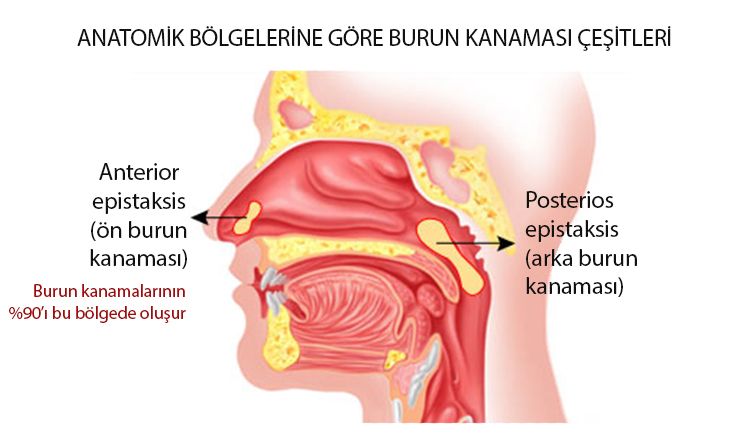
| Anterior nosebleed | Posterior nosebleed | |
|---|---|---|
| Frequency | %90-95 | %5-10 |
| From where? | From the vascular network in the front of the nasal septum (Kiesselbach plexus). Approximately %90 of anterior bleeds arise specifically from this point. | From larger vessels deep in the nasal cavity |
| How is it recognized? | Blood flows forward and out of one nostril | Blood flows toward the throat, and the person swallows or spits it out; it often comes from both nostrils |
| In whom? | More common in children and young people | Older people, those taking blood thinners |
| What is done? | Usually stops with correct pressure at home | Usually does not stop on its own; medical intervention is required |
Some sources mix the statements "anterior bleeds account for %90" and "%90 of anterior bleeds arise from this point", making them seem contradictory. The correct explanation is: %90-95 of all nosebleeds are anterior; approximately %90 of these anterior bleeds arise from a single vascular network in the front of the nasal septum. Two separate %90 figures, two different levels of the same thing.
Common Causes
| Cause | Explanation |
|---|---|
| Dryness | The most common cause. Heated indoor environments in winter, low humidity and high altitude dry and crack the nasal lining. |
| Trauma and nose picking | The most common trigger, particularly in children. Forceful nose blowing and repeated sneezing also damage vessels. |
| Allergy, colds, sinusitis | Irritate the lining and create a constant need to clear the nose. Also, the use of corticosteroid and decongestant nasal sprays thins the lining and makes bleeding easier. |
| Medicines | Blood thinners, aspirin and similar painkillers. These should be considered not the cause of bleeding, but factors increasing its duration and severity . |
| Clotting disorders | Hemophilia, von Willebrand disease, low platelets, severe liver disease. Clue: accompanied by bleeding gums, easy bruising and small red spots on the skin. |
| High blood pressure | ⚠ This relationship is not as strong as commonly thought — see below. |
| Alcohol, chemical exposure, a foreign body in the nose, pregnancy | Less common causes |
This is one of the most firmly established popular beliefs: a person with a nosebleed immediately has their blood pressure checked. In a meta-analysis combining ten studies, the association between hypertension and nosebleeds was OR 1,53 (%95 CI 1,18-1,99) — a weak association. The authors' own concluding statement is clear: this finding "does not support a causal relationship."
Part of this association most likely arises from something else: a person with a nosebleed becomes anxious, and anxiety raises blood pressure with the measurement taken at that moment. In other words, cause and effect are often reversed.
What to do in practice? Do not panic over a high blood pressure reading during bleeding; however, if you already have hypertension, regular monitoring is of course necessary. Saying "my nose bled because my blood pressure rose" often delays the search for the real cause (dryness, medication, trauma).
The Most Commonly Overlooked Cause of Recurrent Nosebleeds: HHT
Hereditary hemorrhagic telangiectasia — an inherited disease in which blood vessel walls do not develop normally. Approximately, in 5.000 people, 1 is affected; it is rare, but not as rare as commonly thought. Small vessels develop dilations that bleed easily (telangiectasias), while larger vessels develop abnormal connections between arteries and veins (AVMs).
Why in this article? Because it is the most characteristic and most frequently overlooked cause of recurrent nosebleeds: %95 of carriers have nosebleeds, the average onset age is 12, and in %90 they appear by age 30. For years, it is dismissed as "my nose has bled since childhood".
There are four criteria. With three, diagnosis is definite; with two, possible; with one, unlikely is the assessment:
- Spontaneous and recurrent nosebleeds
- Telangiectasias — small red dilated vessels that blanch with pressure, at characteristic sites such as the lips, inside the mouth, fingers and nose
- Internal organ involvement — vascular tangles (AVMs) in the lungs, liver, brain or spinal cord, and telangiectasias in the digestive tract
- Family history — an HHT diagnosis in a first-degree relative
Why Should It Be Taken Seriously? Nosebleeds are the most visible but least harmful aspect of this disease. Its real importance lies in internal organ involvement: vascular tangles in the lungs in %30-50, in the liver in %40-70, and in the brain in approximately %10 are found. A lung AVM may allow clots and microbes traveling through veins to bypass the lung filter and go directly to the brain — posing a risk of stroke and brain abscess, and this risk can be treated.
And this is a family disease: the children, siblings and parents of a diagnosed person should also be evaluated. A diagnosis made because of nosebleeds may protect several people at once.
The Cancer Connection: Which Pattern Matters?
Now to the main question. The relationship between nosebleeds and cancer is real but rare, and occurs in a specific pattern . Recognizing this pattern prevents both unnecessary fear and unnecessary delay.
- Always from the same nostril recurrent bleeding
- On the same side nasal blockage lasting for weeks — a blockage that does not switch sides or clear
- Bloody or purulent, one-sided nasal discharge
- An enlarging, painless neck mass
- Fullness in one ear, reduced hearing or recurrent middle ear fluid — especially important if one-sided and persistent in an adult
- Facial pain, numbness or tingling; pain or loosening of upper teeth; double vision
- Loss of smell
In contrast, the following pattern is not concerning: bleeds a few times a year, from different sides, in dry weather or after nose picking, stopping with pressure and without other findings.
Nasopharyngeal Cancer: What Really Matters Here
Nasopharyngeal carcinoma is the cancer associated with nosebleeds most important from the patient's perspective — because its symptoms are insidious, early diagnosis is difficult and its response to treatment is good at an early stage.
| Feature | What to know |
|---|---|
| How does it present? | The classic presentation combines three findings: a painless neck mass (the most common first finding), fullness in one ear / reduced hearing / fluid in the middle ear (because the tumor blocks the opening of the Eustachian tube), and nosebleeds or bloody nasal discharge. When these three occur together, prompt evaluation is necessary. |
| One-Sided Middle Ear Fluid in an Adult | Common and harmless in children; when one-sided and persistent in an adult, the nasopharynx must be evaluated. This is the one sentence that must not be overlooked. |
| Viral relationship | Strongly associated with Epstein-Barr virus. |
| The situation in Türkiye | According to global cancer statistics, annually in Türkiye, 973 new cases are reported; it ranks 24th in frequency. A risk-factor study from Türkiye highlighted rural residence (OR 3,95), farming (OR 4,24) and smoking (OR 3,15) — so the "salted fish and southern China" narrative repeated in international articles is not decisive for Türkiye. |
We could not find a verifiable answer to "what percentage of nasopharyngeal cancers present with nosebleeds", so we do not give a rate. What is known is that nosebleeding in this cancer, on its own , is not a typical first finding — a neck mass is more often the first finding — but it is common as part of the triad.
Nasal and Sinus Cancers
Cancers originating in the nasal cavity and paranasal sinuses are genuinely rare. Their typical presentation is the pattern described above: one-sided blockage, recurrent mild one-sided bleeding, bloody discharge and, in advanced cases, facial numbness, eye findings and loosening of upper teeth.
According to the cancer research authority's classification, for nasal-sinus cancer , Group 1 agents (definitely carcinogenic in humans) are wood dust, leather dust and nickel. Carpenters, furniture workers and leather workers are therefore at risk.
Formaldehyde is different: its Group 1 classification is for nasopharyngeal cancer and leukemia ; for nasal-sinus cancer, it is explicitly stated that evidence is insufficient. Most patient information texts report this the other way around.
Blood Cancers: Leukemia and Lymphoma
In leukemia, nosebleeds result not from a tumor pressing on the nose, but from a reduced platelet (clotting cell) count . Bleeding is therefore typically not heavy but difficult to stop and does not occur alone: small red spots on the skin (petechiae), easy bruising, bleeding gums, fatigue, pallor and frequent infections accompany it. Spontaneous bleeding usually occurs when the platelet count falls below 10.000/µL.
In lymphomas, there are two separate pathways: low platelets due to bone marrow involvement, or a rare type developing directly in the nasal region — nasal NK/T-cell lymphoma. This type is associated with Epstein-Barr virus, is more common in Asia and Latin America, and involves one-sided blockage, persistent bleeding and tissue destruction.
Does Lung Cancer Cause Nosebleeds?
No. The expected bleeding sign in lung cancer is coughing up blood (hemoptysis) — its source is the respiratory tract, not the nose. Nosebleeding is not an expected symptom of lung cancer. If both occur, there are most likely two separate problems (such as blood thinner use or nasal dryness), and both should be evaluated separately.
One-Sided Bleeding in an Adolescent Boy: A Diagnosis to Remember
It is not cancer — benign but locally aggressive, a tumor with an exceptionally rich blood supply. It occurs almost exclusively in boys aged 7-19 . It accounts for only %0,05 of head and neck tumors, so it is very rare. The typical presentation: one-sided nasal blockage (%80-90) and recurrent nosebleeds (%45-60).
Why should it be known? Because this tumor is highly vascular, and taking a biopsy in an office setting can cause severe bleeding. Diagnosis is made by imaging, and treatment is planned at experienced centers. One-sided blockage and recurrent bleeding in an adolescent boy should not be dismissed as "he must be picking his nose".
Nosebleeds in People Receiving Cancer Treatment
For cancer patients and their families, this is the article's most practical section — because in oncology, a nosebleed is generally not cancer's symptom but an adverse effect of treatment with known, manageable causes.
| Cause | What to know |
|---|---|
| Vascular-targeted medicines (bevacizumab and similar VEGF pathway inhibitors) |
Nosebleeding is one of their most common adverse effects. Frequencies reported in approved product information: in colorectal cancer, %35 (in the control arm %10), in non-small cell lung cancer, %26, in glioblastoma, %19. The important detail is: all but one were of the mildest grade (Grade 1). Thus, it is common but usually minor. Rates of serious bleeding range across studies from %0,4-6,9. What should you do? Mild bleeding that stops spontaneously does not require stopping treatment; keeping the inside of the nose moist is the most effective precaution. However, persistent, recurrent or increasing bleeding must be reported to your team. |
| Chemotherapy-Related Low Platelets | Chemotherapy suppresses bone marrow; clotting cells decrease. Spontaneous bleeding typically begins when the platelet count falls below 10.000/µL. A new nosebleed during chemotherapy requires a blood count. |
| Radiotherapy to the Head and Neck | Radiation treatment thins and dries the nasal and nasopharyngeal lining and makes it prone to crusting; this continues after treatment. Moisturizing here is not a comfort measure but an essential part of care. |
Patients who have received head and neck radiotherapy face a very rare but life-threatening condition: rupture of the major neck artery (carotid blowout). A possible warning sign is bleeding from the mouth or nose that stops spontaneously, a "sentinel" bleed.
In someone who has had head and neck radiotherapy or surgery, sudden heavy bleeding from the mouth or nose is an emergency — call 112. Even if the amount is small, unexpected bleeding in a patient with this history should be evaluated the same day.
Note: We do not provide figures because we could not obtain verified frequency and mortality rates for this condition; however, its rarity does not reduce its urgency.
How Do You Stop a Nosebleed?

- Sit upright and tilt your head slightly FORWARD. Tilting the head backward is the most common mistake: it sends blood down the throat, causes nausea and hides the amount of bleeding.
- Firmly pinch the soft part of the nose closed. Using your thumb and index finger, pinch the soft wings just below the bony bridge, not the bridge itself.
- Apply pressure for at least 10-15 minutes without releasing it. The second most common mistake is repeatedly checking "has it stopped?" — every release disrupts the newly forming clot. Use a timer.
- Do not swallow the blood; spit it out. Swallowed blood causes nausea and vomiting and also hides how much you have bled.
- After it stops, do not blow your nose for several hours. If you need to sneeze, keep your mouth open. Keep the inside of the nose moist with saline or a very small amount of petroleum jelly at the entrance.
Putting ice on the back of the neck or forehead is a very common habit. The body assessing international first aid evidence states: "No studies evaluating cold application in the management of acute nosebleeds were identified." Cold applied to the neck or forehead has not been shown to change blood flow inside the nose.
So ice is not prohibited and is harmless — but it does not replace pressure and its effect is unproven. What actually works is correct, uninterrupted pressure.
- Not stopping after 15-20 minutes despite correct pressure bleeding
- If blood flows down the throat or fresh blood comes from both nostrils (this may be posterior bleeding)
- Blood loss greater than a glassful; dizziness, fatigue, feeling faint, pallor
- After trauma, bleeding begins (a blow to the nose or head)
- Difficulty breathing
- Accompanying fever, skin rash or bleeding gums are present
- If you take blood thinners or have a known clotting disorder and bleeding does not stop
- If you have had head and neck radiotherapy or surgery and unexpected bleeding occurs
What Does the Doctor Do?
First, the inside of the nose is examined to locate the bleeding point. If visible, silver nitrate or electrical cautery is used to cauterize the vessel. If it is not visible or bleeding is heavy, nasal packing is applied; different packs are used for anterior and posterior areas and generally remain for 24-48 hours. In persistent cases, vessel ligation or vessel occlusion (embolization) may be considered. For recurrent or persistent one-sided bleeding, nasal endoscopy is performed; blood tests and imaging are added if necessary.
Applying the hemostatic medicine tranexamic acid inside the nose has been much discussed in recent years. An honest account is as follows:
- The NoPAC study (496 patients) was negative: after simple measures failed, applying tranexamic acid-soaked packing did not change the outcome (%43,7 versus %41,3; OR 1,11; %95 CI 0,77-1,59).
- In contrast, a meta-analysis combining 8 studies and 1.299 patients reported a positive result — but this meta-analysis deliberately excluded NoPAC, because NoPAC used the medicine as first-line not as such, but as rescue treatment in its trial.
- The American otolaryngology guideline makes no recommendation on tranexamic acid.
Thus, the medicine may work as first-line treatment but did not work as rescue treatment; this is not a contradiction, but two different answers to two different questions. The decision belongs to the physician.
An additional note of honesty: none of the 14 recommendations in the American otolaryngology guideline is a "strong recommendation"; all are at the "recommendation" or "option" level. The evidence in this field is thinner than commonly thought.
Prevention
- Keep the inside of the nose moist. Use saline spray or drops several times daily. For people receiving cancer treatment or who have had radiotherapy, this is the single most effective precaution.
- Humidify the environment. Especially in winter, especially in the bedroom.
- A very small amount of petroleum jelly at the nasal entrance or nasal moisturizing gel should be applied — only at the entrance, not deep inside.
- Do not pick your nose; blow gently, one nostril at a time. Teach children too; keep fingernails short.
- Open your mouth when sneezing.
- Avoid smoking and smoky environments.
- Do not neglect allergy and sinusitis treatment; do not use decongestant sprays long term. When using a corticosteroid nasal spray, point the tip outward, not toward the nasal septum — this simple detail markedly reduces spray-related bleeding.
- Do not stop your blood thinner on your own. Tell your physician if you have nosebleeds; they make the decision.
- Protective equipment during sports should be used.
Frequently Asked Questions
- Is a Nosebleed a Sign of Cancer?
- An occasional nosebleed on its own is almost never a sign of cancer. Approximately %60 of people experience a nosebleed at some point in life. What should raise concern is the pattern, not the amount: for weeks, always from the same nostril , bleeding, persistent blockage on the same side, a painless neck mass, fullness in one ear or facial numbness require evaluation. Without this pattern, there is no need for concern.
- Did My Nose Bleed Because My Blood Pressure Rose?
- Probably not — and the sequence is often reversed. In a meta-analysis of ten studies, the association was weak (OR 1,53) and, in the authors' own words, does not support a causal relationship. A person with a nosebleed becomes anxious, anxiety raises blood pressure, and the measurement is taken then. If you already have hypertension, regular monitoring is of course needed; but saying "it was because of blood pressure" delays looking for the real cause (dryness, medication, trauma).
- My Child Often Has Nosebleeds. Should I Worry?
- Nosebleeds are very common in children, and the vast majority are harmless — nose picking, dryness and infections are the main causes. Situations requiring evaluation: bleeding recurring several times a week, lasting longer than 15 minutes, enough blood loss to make the child pale, and accompanying easy bruising, small red skin spots, fatigue, frequent infections or enlarged lymph nodes . Also, a description of "nosebleeds since childhood", if accompanied by a family history, should be evaluated for HHT — in this disease, nosebleeds begin at an average age of 12.
- I Am Receiving Chemotherapy and Have a Nosebleed — Must I Stop Treatment?
- Mild bleeding that starts and stops on its own generally does not require stopping treatment. With vascular-targeted medicines such as bevacizumab, nosebleeds may occur in up to one-third of patients, and almost all are of the mildest grade. Still report it: new bleeding during chemotherapy requires checking the platelet count. Persistent, recurrent or increasing bleeding must be reported to your team.
- Does Putting Ice on the Neck or Forehead Work?
- There is no evidence. In the words of the international first aid evidence committee, no studies evaluating cold application in acute nosebleeds were identified. It is harmless, but does not replace pressure. What works is uninterrupted pressure on the soft part of the nose for 10-15 minutes.
- Blood Clots Come Out When I Blow My Nose. Is That Normal?
- If you recently had a nosebleed or have a small crack inside, yes, this is normal — a clot is the body's way of stopping bleeding and is expelled later. The important thing is not to blow forcefully; dislodging a fresh clot restarts bleeding. If bleeding is frequent enough to form repeated clots, focus on keeping the inside of the nose moist and consult a physician if it recurs.
Glossary
- Epistaxis
- The medical term for a nosebleed.
- Anterior / posterior bleeding
- The distinction indicating whether bleeding comes from vessels in the front of the nose or deeper inside. Anterior bleeds account for %90-95 and are milder.
- Telangiectasia
- A small dilated vessel visible on the skin or mucosa that blanches with pressure.
- AVM (arteriovenous malformation)
- An abnormal connection between an artery and a vein without an intervening capillary network. In HHT, it may occur in the lungs, liver and brain.
- HHT (Osler-Weber-Rendu)
- Hereditary hemorrhagic telangiectasia. The most characteristic inherited cause of recurrent nosebleeds; requires family screening.
- Platelet
- Cells enabling blood to clot. Spontaneous bleeding may begin when the count falls below 10.000/µL.
- Petechiae
- Pinhead-sized red spots on the skin that do not blanch with pressure. A characteristic sign of low platelets.
- Nasopharynx
- The area behind the nasal cavity. Cancer originating here typically presents with a neck mass, fullness in one ear and nosebleeds.
- Cauterization
- Sealing a bleeding vessel by burning it with silver nitrate or electricity.
- OR (odds ratio)
- A measure showing how many times a factor changes risk. Values close to 1 indicate a weak association.
DROZDOGAN Academy Commentary
"My nose bled; is it cancer?" is a very common question in clinics, and the answer is almost always no. But answering only "no" is not enough — because, although rare, there is a group for whom the answer is "yes", and that group has a recognizable signature.
⚡ Why Does This Matter?
Nosebleeding is among the most frightening yet least serious symptoms. The real risk lies at two extremes: many people living with unnecessary fear, and a few people waiting for months because they mistake weeks of one-sided blockage for "sinusitis". What distinguishes the second group from the first is the pattern, not the amount.
✅ Strengths / What Is Improving
There are clear things patients can be told in this field. The figures are reassuring: approximately %60 experience it, %6 see a doctor, and two in a thousand are hospitalized. An important noncancer diagnosis — HHT — can be identified through nosebleeds and, once identified, protects both patient and family. The classic triad of nasopharyngeal cancer can be learned, and treatment response is good at an early stage. Correct first aid can be explained in three sentences.
⚠️ Limitations / What Should Not Be Overstated
The evidence in this field is thinner than commonly thought. In the American otolaryngology guideline, none of the fourteen recommendations is a "strong recommendation". There is not even one study evaluating ice application. For tranexamic acid, the guideline is silent, the largest study is negative, and the meta-analysis is positive while excluding that study. The hypertension-nosebleed relationship falls far short of popular belief. And one question we could not verify would have been the most useful: what percentage of patients presenting with nosebleeds ultimately have cancer? We do not have that number, so we did not write it.
🩺 Our Practical Approach
- We ask about side and duration, not amount. "Always from the same side?" and "for how long?" — these two questions make most of the distinction.
- When we see persistent one-sided middle ear fluid in an adult, we examine the nasopharynx. This is the most commonly missed gateway.
- We do not dismiss "my nose has bled since childhood". Family history and examination of the lips and fingers can bring HHT into consideration within minutes.
- For one-sided blockage + bleeding in an adolescent boy, we refer for imaging, not biopsy.
- We do not blame blood pressure. A high reading during bleeding is often the result of anxiety rather than the cause.
- When starting vascular-targeted treatment, we explain nosebleeds in advance and recommend moisturizing from the outset — this prevents many subsequent anxious consultations.
- We consider unexpected bleeding in a patient with a history of head and neck radiotherapy an emergency.
❓ Open Questions
The rate of malignancy among patients presenting with nosebleeds is unknown — yet this would be the most useful number both for reassurance and for defining a screening threshold. Whether tranexamic acid really works as first-line treatment needs clarification in a new study that does not repeat the NoPAC design. And the true incidence of nasopharyngeal cancer and the distribution of risk factors in Türkiye need to be established using data beyond single-center studies.
- Corrections: The statement "only %6 of nosebleeds require advanced intervention" was corrected — this figure is not advanced intervention, but seeking medical care (hospitalization %0,16-0,2). The internal contradiction in anterior/posterior bleeding rates was resolved (%90-95 of all bleeds are anterior; ~%90 of anterior bleeds arise from a single vascular network). The high blood pressure relationship was rewritten using meta-analysis data and the authors' statement that it "does not support a causal relationship"; the claim "blood pressure prolongs/worsens bleeding" was removed because we could not verify it. The occupational exposure section was corrected to state that formaldehyde, for nasopharyngeal cancer and leukemia , is Group 1, while for nasal-sinus cancer evidence was found insufficient. In headings, id tags were removed. The explanation in the stress section that "vessels constrict with excitement, then bleed when they relax" was removed as unsupported.
- Additions: HHT (with Curaçao criteria), juvenile nasopharyngeal angiofibroma, the classic triad of nasopharyngeal cancer and the warning about one-sided middle ear fluid in adults, a section on cancer treatment-related nosebleeds (vascular-targeted medicines, low platelets, radiotherapy), the carotid blowout warning, evidence on ice application, and the tranexamic acid debate.
- No figures provided because they could not be verified: the rate of malignancy among patients presenting with nosebleeds; the percentage of nasopharyngeal cancers presenting with nosebleeds; carotid blowout frequency and mortality; nosebleed frequency after radiotherapy; and the rate of nosebleeds as the first sign of leukemia. An age-standardized rate reported for Türkiye was not used because it appeared inconsistent with the case count; only annual case counts were provided. Two percentages in a biopsy series from Istanbul were not reported because they most likely represented diagnostic value (positive predictive value), not symptom frequency.
- Türkiye: No information is provided on reimbursement, medicine availability or lists of centers.
- Internal links ("Related topics") are estimated addresses; they should be replaced with actual site addresses before publication.
This article is for information and does not replace personalized medical advice. Do not stop blood thinners on your own; consult a physician for recurrent or one-sided nosebleeds.
Sources
- Tunkel DE, Anne S, Payne SC, et al. Clinical Practice Guideline: Nosebleed (Epistaxis). Otolaryngol Head Neck Surg. 2020;162(1_suppl):S1-S38.
- Min HJ, Kang H, Choi GJ, Kim KS. Association between hypertension and epistaxis: systematic review and meta-analysis. Otolaryngol Head Neck Surg. 2017;157(6):921-927.
- McDonald J, Pyeritz RE. Hereditary Hemorrhagic Telangiectasia. GeneReviews [Internet]. University of Washington, Seattle.
- Shakir HJ, et al. Juvenile nasopharyngeal angiofibroma. StatPearls [Internet].
- Nasopharyngeal Carcinoma. StatPearls [Internet].
- International Agency for Research on Cancer. IARC Monographs — Formaldehyde; Wood dust; Leather dust; Nickel compounds.
- GLOBOCAN / Global Cancer Observatory. Türkiye fact sheet.
- Reuter G, et al. Genotoxic and epidemiological risk factors for nasopharyngeal carcinoma in Turkey. (Türkiye risk-factor study)
- Reuben AD, et al. The NoPAC randomized clinical trial: tranexamic acid in epistaxis. Ann Emerg Med. 2021.
- International Liaison Committee on Resuscitation (ILCOR). Cryotherapy for epistaxis — evidence review.
- U.S. Food and Drug Administration. Bevacizumab (Avastin) prescribing information — adverse reactions.
- Epistaxis. StatPearls [Internet].
- Platelet disorders and thresholds for spontaneous bleeding. StatPearls [Internet].
Was this article helpful?
Your feedback helps us improve our content.




Reader comments
Share your comment
Your name and comment are published only after administrator approval. Your email address is never shown to visitors.
Be the first to comment.