
Lower MSI in MSH6-Mutant Lynch Syndrome Colorectal Cancers: What Does It Mean?

In this article
Lynch Syndrome Is Not Uniform
Lynch syndrome (LS), the most common hereditary cause of colorectal cancer, arises from mismatch repair (MMR) genes carrying inherited mutations that impair correction of DNA mismatches. The most commonly mutated MMR genes in this disease are MLH1, MSH2, MSH6 and PMS2.
Each gene may influence cancer development differently. In colorectal cancers arising in people with Lynch syndrome, biological behavior, immune interactions and treatment sensitivity may therefore also differ.
On March 19, 2025, Modern Pathology published a study finding that colorectal cancers in Lynch syndrome patients carrying MSH6 mutations have markedly lower microsatellite instability than tumors associated with other MMR gene mutations .
Key Terms
-
MSI (Microsatellite Instability): Instability in short repeated DNA sequences, or microsatellites, reflecting increased mismatches. High MSI (MSI-H) is generally associated with better immunotherapy responses.
-
Frameshift Peptides: Protein fragments produced by shifts in the genetic sequence that may be perceived as new or foreign by the immune system.
-
cMS (Coding Microsatellites): Microsatellite sequences in protein-coding gene regions. Mutations may generate new antigenic structures.
Study Summary and Numerical Findings
Patient Numbers:
-
MSH6-mutated CRC: 39 cases
-
MLH1 mutation: 18 cases
-
MSH2 mutation: 16 cases
-
PMS2 mutation: 22 cases
-
Sporadic MSI-H colorectal cancers: 35 cases
In each tumor, 20 coding microsatellite regions were analyzed, and mutation frequency and mutant allele ratio (mAR) were calculated.
cMS mutations are MSI -associated tumor changes, namely somatic indel mutations . They were analyzed in tumor tissue.
Findings:
-
MSH6-mutant tumors, compared with other MMR gene-mutated tumors, had fewer cMS mutations .
-
Specifically, in the MSH6 group, mutation frequency was 15% , whereas the average in other MSI-H tumors was 29% .
-
cMS mutation patterns could differ even between regions of the same tumor.
-
Frameshift peptides (new protein sequences generated by frameshift mutations) had low predicted potential for immune recognition (immunogenicity).
-
Age at diagnosis: Median age in MSH6-mutant patients was 65 , versus in MLH1-mutant patients, 48 (P = 0.046)
-
No correlation between cMS mutation count and age; this suggests that accumulation relates to when MMR deficiency begins, rather than to age.
-
cMS mutation patterns varied between tumors and between regions of the same tumor.
These findings suggest that cell clones strongly recognized by the immune system may have been eliminated through negative selection .
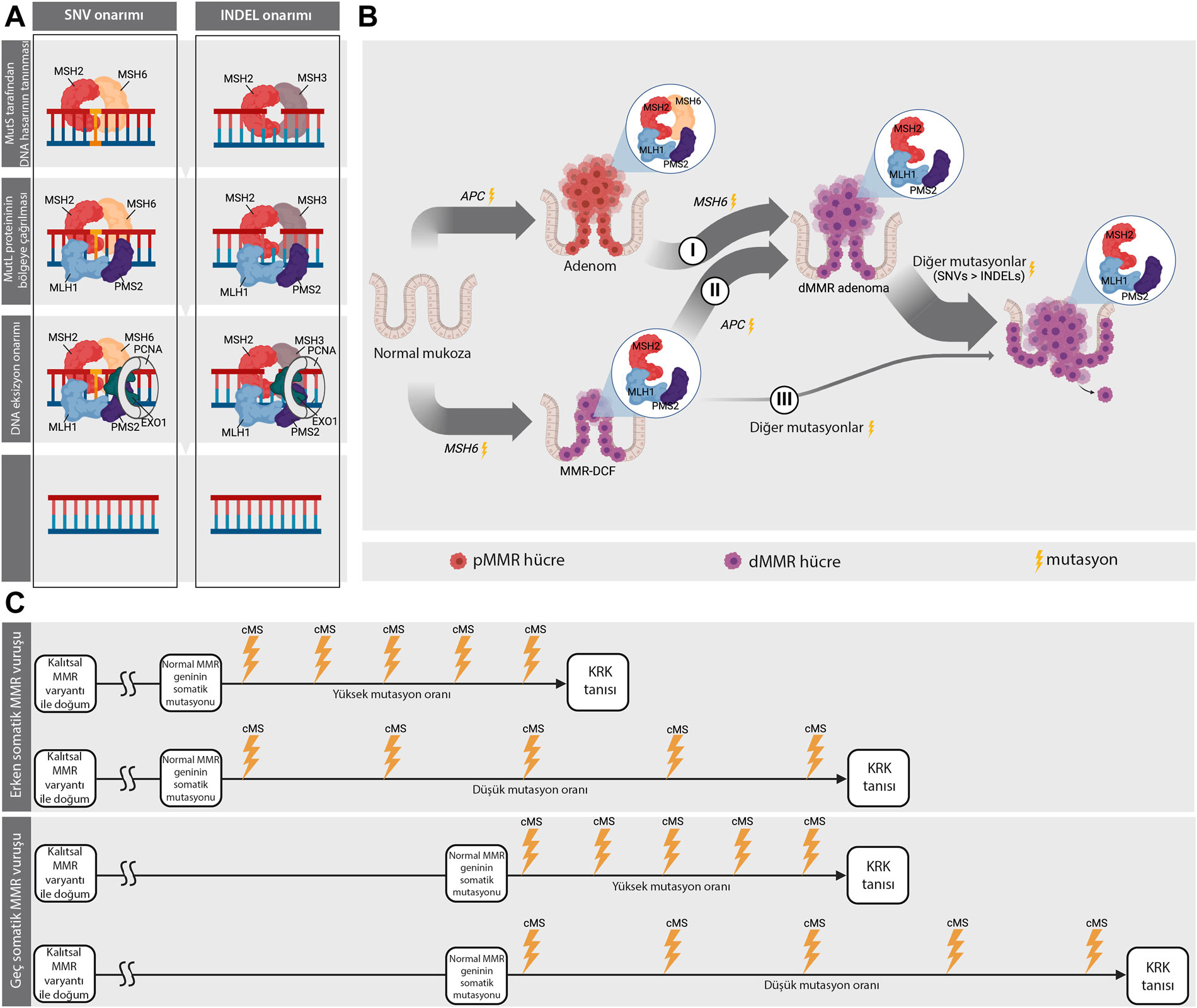
The figure summarizes the effects of MSH6 mutations on DNA repair, adenoma–carcinoma pathways and microsatellite mutation timing in three sections:
Panel A — DNA Repair Mechanism (SNV and INDEL Repair)
Terms in the Heading:
-
SNV: Single Nucleotide Variant
-
INDEL: Insertion/Deletion Mutation
The MSH2 + MSH6 heterodimer recognizes SNVs.
The MSH2 + MSH3 heterodimer recognizes INDELs.
What the Panel Shows:
-
MSH6 plays an important role in SNV repair by pairing with MSH2.
-
In INDEL repair, MSH3 takes the place of MSH6 and pairs with MSH2.
-
This difference explains why fewer INDELs arise with MSH6 mutations.
Panel B — Colorectal Cancer Evolution With MSH6 Mutation
Developmental Pathways:
-
Adenoma–Carcinoma Pathway (I): The classic pathway starts in normal mucosa. An MMR-proficient adenoma develops → MSH6 loss produces a dMMR adenoma → carcinoma
-
MMR-DCF Adenoma Pathway (II): Adenoma arising directly from MMR-deficient crypts → carcinoma
-
Direct Carcinoma Pathway (III): More typical of MLH1, bypassing the adenoma stage to progress directly to cancer.
The panel emphasizes that SNVs are more prominent than INDELs in MSH6-mutated tumors, altering immune interactions.
Panel C — Timing of MMR Deficiency and cMS Mutation Accumulation
3 scenarios are presented:
-
Early second hit (somatic hit) → high mutation rate → early diagnosis
-
Late second hit → low mutation rate → late diagnosis
-
Late mutation but rapid cMS accumulation → early diagnosis nevertheless
This section explores why MSH6-mutant patients are generally diagnosed later. cMS mutations begin accumulating once MMR deficiency starts.
What Does the Figure Show Overall?
In people with MSH6-associated Lynch syndrome, this infographic explains:
-
How DNA repair works,
-
Which molecular pathways lead to colorectal cancer,
-
And the timing of cMS mutations and their immune-system relationships, in clear mechanistic terms.
The figure also shows why MSH6 mutations have a different clinical course from other MMR genes such as MLH1, explaining this at the molecular level.
Clinical Interpretation and Importance
This study indicates that patients with MSH6-associated Lynch syndrome, compared with classic MSI-H colorectal cancers:
-
Have less microsatellite instability (MSI),
-
Produce fewer frameshift peptides capable of stimulating immunity,
-
And therefore may respond less well to immunotherapies .
What Does It Mean?
MSH6-mutant colorectal cancers interact less with the immune system and should therefore be considered a biologically distinct subgroup .
This supports future classification of LS by genetic subgroup and personalization of treatment strategies.
Implications for Immunotherapy and Vaccines
-
FSP-based vaccine strategiesare promising for early intervention in LS. However, lower mutation rates in the MSH6 group suggest that these vaccines may be less effective in this group .
-
Vaccines targeting mutations shared across all groups should be developed. Proposed targets include:
-
BANP
-
TAF1B
-
ASTE1
-
MARCKS
-
BANP mutations are among the most frequent, high-mAR mutations in both MSH6 and other MMR groups.
Conclusion
Colorectal cancer in patients with MSH6-associated Lynch syndrome:
-
Has less microsatellite instability (15% versus 29%),
-
Produces less immune stimulation,
-
And for these patients, standard immunotherapy approaches may not always be effective.
These findings are important for personalized oncology. Genetic profiling is becoming essential not only for diagnosis but also for treatment decisions.
Sources
Was this article helpful?
Your feedback helps us improve our content.




Reader comments
Share your comment
Your name and comment are published only after administrator approval. Your email address is never shown to visitors.
Be the first to comment.