Melanoma Progressing After Immunotherapy: What Did We Learn From IL-15–Engineered TIL?
In this article
Melanoma Progressing After Immunotherapy: What Did We Learn From IL-15–Engineered TIL?
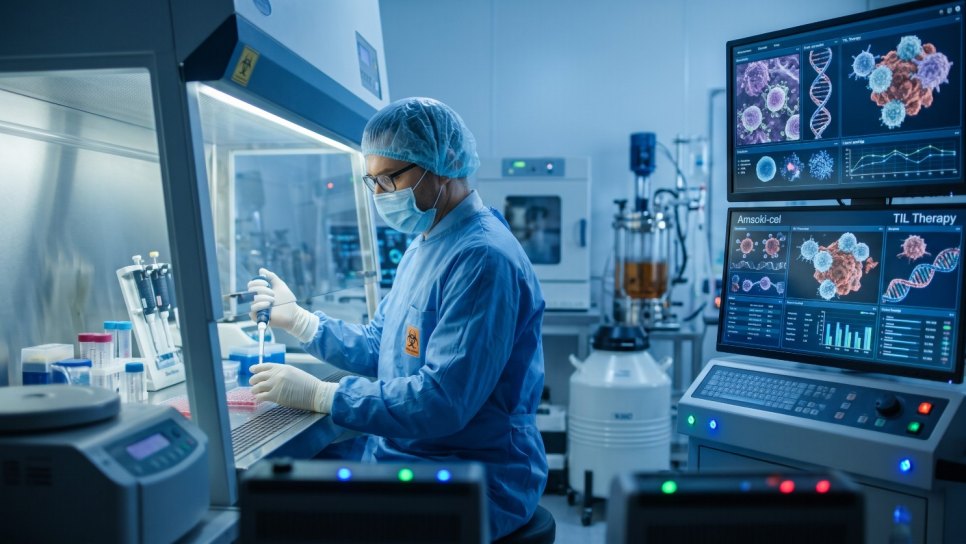
Immune checkpoint drugs (immunotherapy) have extended the lives of many people with advanced melanoma, but options remain limited for patients whose disease progresses despite them. TIL therapy, made from immune cells taken from the patient's own tumor, is one of the approaches being tested to fill this gap. According to results published in Nature Medicine in November 2026 and updated at SITC 2026, a new genetically engineered TIL product with IL-15 added, amsoki-cel (formerly OBX-115), shrank tumors in 10 of 15 patients treated at the recommended dose. In this article we explain how the therapy works, what the results mean, and the practical questions our patients ask most: where it is given, whether outside patients are accepted, and when approval can be expected. You can find the basics of melanoma in our malignant melanoma guide (in Turkish).
- What? Amsoki-cel is an experimental TIL therapy made from T cells taken from the patient's tumor, with an IL-15 gene added that can be "switched on" with an acetazolamide tablet taken by mouth. Unlike classic TIL, it does not require high-dose IL-2.
- Result: In melanoma resistant to immune drugs (93% of patients had received dual immunotherapy), 10 of 15 patients responded at the recommended dose (67%; 2 complete responses), median progression-free time was 8.3 months, and 5 patients were still responding at month 12.
- Safety: No treatment-related loss of life, ICU transfer, or neurologic toxicity (ICANS) was reported in 37 patients; one patient had grade 3 cytokine release syndrome.
- In practice: Not approved. The therapy can be accessed only through the Agni-01 trial (NCT06060613) in the US and Australia; the company does not offer an individual early access program. Results from the registration-enabling cohort are expected at the end of 2027.
Why does this matter?
Immune checkpoint drugs such as nivolumab, pembrolizumab and ipilimumab were the first treatments to make long-term control possible in advanced melanoma (first-line treatment in advanced melanoma, ipilimumab and nivolumab; both in Turkish). However, in a considerable share of patients the disease either does not respond at the outset or progresses again after a while. In that case targeted drugs are considered for those with a BRAF mutation, and chemotherapy and clinical trials for the others; the effect of these options is usually limited and short-lived (survival in stage 4 melanoma, in Turkish).
TIL therapy is based on multiplying, in the laboratory, billions-fold, the immune cells that have already entered the tumor and recognize it, and then giving them back to the patient. The method works, but its classic form is a heavy treatment: intensive preparative chemotherapy, followed by high-dose IL-2 through a vein to support the cells, a phase that is often spent in hospital and sometimes in intensive care. Amsoki-cel aims to apply the same approach with a lighter regimen. For this reason the results matter both for the therapy's effectiveness and for how many more patients and centers it could reach (immunotherapies and cancer vaccines, in Turkish).
What is amsoki-cel (OBX-115)?
Amsoki-cel (amsokigene autoleucel, formerly OBX-115) is an experimental cell therapy made from T cells taken from the patient's own tumor, with an added IL-15 gene whose protein stays on the cell surface and can be activated with an acetazolamide tablet taken by mouth. It is being studied in advanced melanoma resistant to immune drugs; it has no FDA approval.
TIL stands for "tumor-infiltrating lymphocytes." These cells have already recognized the tumor, but in the suppressive environment inside the tumor they have become exhausted and too few. In the treatment, a small piece of tumor is taken, the cells are multiplied in the laboratory and given back to the patient. The difference from CAR-T therapy is that no artificial target-recognition molecule is added to the cells: TIL cells recognize many different targets in the tumor on their own. This feature is seen as an advantage in solid tumors, where targets are highly varied (CAR-T therapy, tumor mutational burden; both in Turkish).
Figure 1 · Amsoki-cel treatment step by step
Five steps from a tumor sample to a tablet
How does the IL-15 "on switch" work?
For T cells to survive and multiply in the body they need support signals called cytokines. In classic TIL therapy this support comes from high-dose IL-2 given through a vein; IL-2 can cause serious side effects such as fever, low blood pressure, vascular leak and kidney problems. In amsoki-cel a gene has been added that lets the cells produce IL-15 on their own surface. A "drug-sensitive lock" is attached to this IL-15 protein: when acetazolamide is not taken, the protein is broken down inside the cell, and when the tablet is taken it becomes stable and stays on the cell surface. Acetazolamide is a well-known drug used for years in glaucoma and altitude sickness; here it is used only to switch this lock on.
Figure 2 · IL-15 switched on by a tablet
The cell without the tablet and with the tablet
Binding IL-15 to the cell surface aims to limit the spread of the cytokine through the whole body and to reduce side effects. Being able to switch it on and off with a tablet gives the physician the option to adjust when and for how long the support is given. In the Agni-01 protocol the tablet is given for up to two weeks after the infusion (or until the lymphocyte count in the blood reaches a certain level), and a second course is given at week 6.
What did the study find?
The Nature Medicine publication is a pooled analysis of two studies: a single-center phase 1 study conducted at Stanford (NCT05470283) and the multicenter phase 1/2 Agni-01 study in the US and Australia (NCT06060613). The studies enrolled adults with advanced melanoma whose disease progressed during or after treatment with immune checkpoint drugs. This was a hard-to-treat group: 93% of patients had previously received dual immunotherapy (PD-1 and CTLA-4 drugs) and 73% had progressed despite this dual treatment. The first author of the publication and the investigator who presented it is Dr. Rodabe Amaria of MD Anderson Cancer Center.
Efficacy was assessed in 15 patients treated at the recommended phase 2 dose (data cutoff 25 September 2026; median follow-up 14.3 months). Tumors shrank markedly in 10 patients (67%): 2 had a complete response and 8 a partial response. In 5 of the 10 responders the response is still ongoing; the median duration of response has not yet been reached. Median time without disease progression was 8.3 months. 12 months after treatment, 5 of 15 patients (33%) were in a deep and ongoing response; in 4 of them the measured tumors had disappeared completely.
Responses at the recommended dose (15 patients)
Agni-01 phase 1/2 study; data cutoff 25 September 2026; RECIST 1.1 criteria.
The numbers are small: in 15 patients, the difference of one patient is about 7 percentage points. This is an early-stage, single-arm study without a control group; the results need to be confirmed in the larger registration-enabling cohort.
Figure 3 · What happened in 15 patients?
Each square is one patient
How do these results compare with other TIL therapies?
There is no direct comparison. In the registration study of the approved TIL product lifileucel, the response rate was 31% in 153 patients whose disease progressed after a PD-1 drug. In the phase 3 study in the Netherlands, academic TIL therapy was compared with ipilimumab: response rate 49% versus 21%, median progression-free time 7.2 months versus 3.1 months; this corresponded to an approximately 50% relative reduction in the risk of disease progression. However, most patients in that study had not previously received ipilimumab. Amsoki-cel's 67% rests on only 15 patients and does not represent the same patient groups as these studies (nivolumab and relatlimab, in Turkish).
Response rates in melanoma after immune drugs
From different studies; not compared in the same patients.
Comparison across different studies is indirect; patient groups, prior treatments and follow-up times differ. Most patients in the academic TIL study had not received ipilimumab, whereas most patients in the amsoki-cel and lifileucel studies had received dual immunotherapy.
Figure 4 · Classic TIL and amsoki-cel
What changes in treatment burden?
Safety: Which side effects were seen?
Safety was assessed in the pooled data of 37 patients treated in the two studies. No dose-limiting toxicity, treatment-related loss of life, neurologic side effect called ICANS, or ICU transfer was reported. Most of the common non-blood side effects were grade 1 or 2. One patient developed grade 3 cytokine release syndrome (cytokine release syndrome, in Turkish). A temporary drop in blood counts is expected because of the preparative chemotherapy; during this period it is necessary to watch for signs of infection (leukopenia and neutropenia, signs of infection; both in Turkish).
For comparison: the lifileucel prescribing information carries a boxed warning for treatment-related loss of life, prolonged severe low blood counts, severe infection, and heart-lung and kidney problems; a significant part of these risks is linked to the intensive preparative chemotherapy and IL-2. Amsoki-cel's lighter regimen aims to reduce this burden. Even so, 37 patients is a small number for revealing rare but serious side effects.
How should we read the results?
- Early and small: Efficacy rests on only 15 patients; the difference of a single patient is about 7 percentage points. There is no control group.
- Selected patients: The studies enrolled patients in good general condition, with a removable tumor, suitable for cell manufacturing. Results may differ in everyday practice.
- Limited durability: In one of every two responders the disease progressed again after a while. Median progression-free time is 8.3 months.
- Company-sourced: The latest data were shared through a company statement and a congress poster; the peer-reviewed publication contains an earlier data cutoff.
- Confirmation on the way: In the registration-enabling cohort, confirmation of responses by independent, blinded radiology review is planned (how to read phase 1 studies, in Turkish).
Practical information for patients
Approval stage: When could the therapy come into use?
Amsoki-cel is not approved in any country. The FDA granted the drug Fast Track status in July 2024 and RMAT status (priority status for advanced therapies) in September 2024; these designations do not mean approval, they only provide more frequent meetings with the company and the possibility of faster review. After talks with the FDA, the company started a single-arm registration-enabling cohort: the first patient was treated in August 2026, enrollment is expected to be completed at the end of March 2027 and the first results to be announced at the end of 2027. If these results are positive, an accelerated approval application is planned; the company has not yet announced an application date. On this timeline, a possible approval in the US should not be expected before 2028 at best; no application plan has been announced for Europe or Türkiye (drug approval process, in Turkish).
Figure 5 · Path to approval
Key dates for lifileucel and amsoki-cel
At which centers is it given?
The therapy is currently given only within clinical trials. The first phase 1 study at Stanford University has completed enrollment. The multicenter Agni-01 study (NCT06060613) is, according to the company, ongoing at centers in the US and Australia; the registration-enabling cohort in melanoma and the cohorts in lung cancer and early-line melanoma are enrolling. Centers named in the company's earlier presentations as opened or planned to open included Stanford, USC, Angeles Clinic, University of Louisville, Orlando Health, Allegheny Health Network, Memorial Sloan Kettering, Ohio State and MD Anderson. Because centers change over time, the current and definitive list, with contact details, should be checked in the study record on clinicaltrials.gov (what is a clinical trial?, in Turkish).
Are outside or international patients accepted?
The published eligibility criteria of the study contain no item excluding patients of foreign nationality; however, neither the company nor the centers have published a clear policy on accepting international patients. Each application depends on the assessment of the center and the sponsor. The company states that it does not offer treatment through individual early access (compassionate use) or the US "right to try" law, and that the only way to access the therapy is a clinical trial. The company recommends that patients first talk with their own physicians; a separate contact address for physicians ([email protected]) has been shared.
What is practically worth knowing: the patient must stay near the center during tumor sampling, the several weeks of cell manufacturing, the preparative chemotherapy, the infusion and the initial follow-up period; after that, returning to the center is requested for regular imaging and check-ups. In clinical trials the investigational treatment is usually free of charge; however, who will cover travel, accommodation, visa and non-study medical costs should be learned from the center in writing before applying.
Figure 6 · Eligibility criteria
Main headings for the Agni-01 melanoma cohorts
Three points often cause problems for eligibility. The first is the number of prior treatments: in the melanoma cohorts at most two lines of systemic treatment for advanced disease are accepted. The second is brain metastasis: patients with untreated or active brain metastasis are not accepted, while patients with a few treated brain metastases may be assessed case by case (brain metastasis in melanoma, in Turkish). The third is steroid use: patients taking steroids above the equivalent of 10 mg of prednisone per day are not eligible (dexamethasone, in Turkish). Eye melanoma (uveal melanoma) is outside the scope of this study (eye melanoma, in Turkish).
Figure 7 · A roadmap for patients considering applying
Preparation in five steps
The situation in Türkiye
- Licence: There is no licensed TIL therapy in Türkiye. Amsoki-cel is experimental; lifileucel is approved only in the US and Canada, and its European application has been withdrawn.
- Importing from abroad: TIL therapies are made for each patient from their own tumor. For this reason they cannot be brought from abroad like a boxed drug; the therapy can be given only at a center authorized to administer the product (obtaining drugs from abroad, access in Türkiye to FDA-approved drugs; both in Turkish).
- Clinical trial: At the time of writing we did not identify any trial in Türkiye enrolling patients with amsoki-cel or another TIL product.
- Today's options: In melanoma progressing after immune drugs, targeted drugs are considered if there is a BRAF mutation; combinations containing ipilimumab or nivolumab-relatlimab if they have not been used before; and, in suitable patients, local treatments such as surgery and radiotherapy, as well as chemotherapy (BRAF-mutant melanoma, triple therapy, immunotherapy reimbursement conditions; all in Turkish).
What does this mean for oncology?
Amsoki-cel represents an important direction in the cell therapy field: making treatment lighter, shorter and deliverable at more centers while keeping the effect. The idea of genetically "reinforcing" cells and being able to control them with a tablet is also being tried in CAR-T and other cell therapies. The company is also studying the same product in lung cancer, with first results expected in the first half of 2027. In melanoma, together with mRNA vaccines and new combinations, the options for the period after immunotherapy are widening (mRNA melanoma vaccine, pembrolizumab; both in Turkish).
Questions you can ask your physician
- Is my melanoma considered "resistant" to immune drugs, and what are my options after this?
- How many lines of systemic treatment have I received so far, and does this affect my eligibility for clinical trials?
- Do I have a tumor that can be removed and measured?
- Is my brain imaging up to date, and if there is brain metastasis, is it considered treated?
- If we apply to a study abroad, which treatment should I continue here while waiting?
- "Amsoki-cel has been approved." No. It is not approved in any country; it is given only within clinical trials.
- "Two thirds of patients are cured." No. Tumors shrank in 10 of 15 patients; in half of them the disease later progressed again. The share of patients with a response ongoing at month 12 is 33%.
- "If I pay, I can get this therapy abroad." Not at present. The company offers no individual early access; the only way is to join a clinical trial by meeting the eligibility criteria.
- "TIL is the same as CAR-T." No. An artificial target-recognition molecule is added to CAR-T cells, whereas TIL cells recognize many targets in the tumor on their own.
- "Acetazolamide alone treats melanoma." No. This tablet is used only to switch on the IL-15 added to the cells; it is not a cancer treatment on its own (side effects of immunotherapy, in Turkish).
Frequently Asked Questions
- What is amsoki-cel (OBX-115)?
- Amsoki-cel is an experimental TIL cell therapy made from T cells taken from the patient's own tumor, with an IL-15 gene added that can be switched on with an acetazolamide tablet. It is being studied in advanced melanoma resistant to immune drugs and does not require high-dose IL-2.
- How effective is amsoki-cel?
- Tumors shrank in 10 of 15 patients treated at the recommended dose (67%); 2 patients had a complete response. Median progression-free time was 8.3 months and the response was ongoing in 5 patients at month 12. The results rest on a small, uncontrolled study.
- At which centers is amsoki-cel given, and are patients accepted from abroad?
- The therapy is given only within the Agni-01 trial (NCT06060613) in the US and Australia. There is no clear policy on accepting international patients; each application is assessed by the center. The company does not offer individual early access.
- When might amsoki-cel be approved?
- The first results of the registration-enabling cohort are expected at the end of 2027, and an FDA application is planned afterward. For this reason a possible approval in the US should not be expected before 2028. No application plan has been announced for Europe or Türkiye.
Glossary
- TIL
- Tumor-infiltrating lymphocytes; immune cells that recognize the tumor and are multiplied in the laboratory for treatment.
- IL-15
- A cytokine that supports the survival and multiplication of T cells.
- IL-2
- A cytokine given in high doses in classic TIL therapy to support the cells, which can have serious side effects.
- Acetazolamide
- A drug used in glaucoma and altitude sickness; in amsoki-cel it is used to switch on the IL-15 in the cells.
- Lymphodepletion
- Preparative chemotherapy before cell therapy that reduces the lymphocytes in the blood to make room for the newly given cells.
- Objective response rate
- The share of patients whose tumors shrink by a defined amount (partial response) or disappear (complete response).
- Progression-free survival
- The time after treatment during which the disease does not progress.
- Registration-enabling study
- A study or patient cohort designed so that its results can be used in a drug approval application.
- RMAT
- An FDA status given to promising cell and gene therapies that provides faster, closer-contact review.
- Cytokine release syndrome
- A condition with symptoms such as fever and low blood pressure, caused by substances released by activated immune cells.
DROZDOGAN Academy Commentary
Amsoki-cel is one of the first serious steps to address the biggest problem of TIL therapy, namely how heavy the treatment is. The results are promising, but this is not yet a standard treatment; it is an early answer to a well-designed question.
⚡ Why it matters
In melanoma that progressed after dual immunotherapy, high and in part lasting responses were obtained without IL-2 and with low-dose preparative chemotherapy. This could pave the way for TIL therapy to spread to more patients and centers.
✅ Strengths
A pooled analysis published in a peer-reviewed journal; a hard-to-treat patient group; serious side effects remaining limited; manufacturing possible from needle biopsy as well; and independent radiology review planned in the registration-enabling cohort.
⚠️ Limits
Efficacy rests on only 15 patients; there is no control group. The patients were selected; manufacturing time and the manufacturing failure rate were not shared in detail. The latest data were presented through a company statement and a congress poster.
🩺 In practice
For our patients whose disease progresses after immunotherapy, who are in good general condition and whose brain metastases are under control, we recommend discussing clinical trial options early. If an application abroad is being considered, our priority while documents are prepared is to continue effective treatment without interruption.
❓ Open questions
Will the responses hold in a larger group and under independent review? What will the effect on survival be in the long term? What is the optimal setting for tablet dose and duration? Will the therapy also work in earlier lines before immunotherapy and in lung cancer?
Bottom line: Amsoki-cel shows that a lighter TIL therapy may be possible in melanoma resistant to immunotherapy. For now the only route to access is a clinical trial; a possible approval could come up in 2028 at the earliest.
- This article was prepared in November 2026.
- The information was taken from the article published in Nature Medicine on 3 November 2026 (data cutoff 5 May 2026), the statement by Obsidian Therapeutics dated 6 November 2026 (efficacy data cutoff 25 September 2026), the trial records and the company's website.
- The center list is based on the company's earlier congress presentations and may have changed. Because no verified information was found on international patient acceptance, costs and length of stay, general principles are given. The statement "should not be expected before 2028" is our own assessment based on the company's timeline.
- The chart showing response rates of different studies is an indirect comparison. The drawings are simplified. The Academy commentary is our own.
- This article is not medical advice; make your health decisions together with your physician.
References
- Amaria R, et al. Regulatable membrane-bound IL-15 engineered TIL cell therapy for immune checkpoint inhibitor-resistant advanced melanoma: pooled analysis of phase 1 and 1/2 trials. Nat Med 2026. doi:10.1038/s41591-026-04743-6. nature.com
- Obsidian Therapeutics. Obsidian Therapeutics to present updated amsoki-cel efficacy and pooled safety data in advanced melanoma at SITC 2026 Annual Meeting. 6 November 2026. obsidiantx.com
- Obsidian Therapeutics. First patient enrolled in the registration-enabling cohort of phase 1/2 Agni-01 study. August 2026. businesswire.com
- ClinicalTrials.gov. Safety and efficacy of OBX-115 in advanced solid tumors (Agni-01). NCT06060613. clinicaltrials.gov
- Stanford Medicine. Phase I study of tumor infiltrating lymphocytes engineered with membrane bound IL15 plus acetazolamide. NCT05470283. stanford.edu
- Obsidian Therapeutics. OBX-115 clinical program page (centers, early access policy, physician contact). obsidiantx.com
- Pharmacy Times. FDA grants regenerative medicine advanced therapy designation for OBX-115. September 2024. pharmacytimes.com
- Rohaan MW, et al. Tumor-infiltrating lymphocyte therapy or ipilimumab in advanced melanoma. N Engl J Med 2022;387:2113-2125. nki.nl
- Chesney J, et al. Efficacy and safety of lifileucel, a one-time autologous tumor-infiltrating lymphocyte (TIL) cell therapy, in patients with advanced melanoma after progression on immune checkpoint inhibitors and targeted therapies: pooled analysis of consecutive cohorts of the C-144-01 study. J Immunother Cancer 2022;10:e005755. doi.org
- European Medicines Agency. Amtagvi: withdrawal of application. July 2025. ema.europa.eu
- CGTLive. Lifileucel approved for advanced melanoma in Canada. August 2025. cgtlive.com
- OncLive. OBX-115 with acetazolamide induces safe and durable antitumor responses in advanced melanoma. onclive.com
Was this article helpful?
Your feedback helps us improve our content.