
The Bispecific Antibody Mosunetuzumab May Be the Next Major Advance After CAR T-Cell Therapy

In this article
The bispecific antibody mosunetuzumabdemonstrated activity in early clinical studies in patients with non-Hodgkin lymphoma (NHL), including patients resistant to or relapsing after chimeric antigen receptor (CAR) T-cell therapy as third-line treatment. If the preliminary findings are confirmed in further studies, mosunetuzumab and perhaps other bispecific antibodies may herald a new era for patients with B-cell lymphoma and leukemias who no longer have treatment options, following CAR T-cell therapy . Results from a global, open-label, multicenter study of mosunetuzumab, a phase I / Ib clinical trial , demonstrated favorable tolerability and durable responses in 270 heavily pretreated patients with relapsed or refractory B-cell non-Hodgkin lymphoma, including complete responses in some patients whose disease progressed after CAR T-cell therapy. These findings were presented at the 2019 American Society of Hematology (ASH) Annual Meeting; from among 3 thousand submitted abstracts, these findings were selected as one of the top 6 presentations. Experts might ask why this early dose-finding phase Ib study was selected for the ASH plenary session. The reason is that everyone wants to hear these data. If these early results are confirmed in larger datasets and trials, mosunetuzumab may have a role as a bridge to CAR T-cell therapy or as a potential salvage treatment for those who do not respond to CAR T-cell therapy. Other bispecific antibodies are under development, and early studies of some of these agents were also presented at the ASH meeting.
How Does Mosunetuzumab Work?
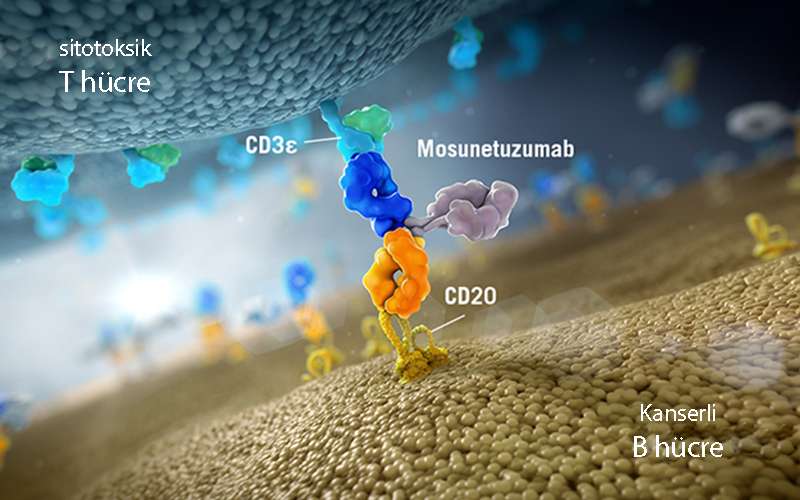
Mosunetuzumab binds to CD20 on the surface of malignant B cells and CD3 on the surface of cytotoxic T cells, resulting in cross-linking of the T-cell receptor and subsequent activation of an immunological T-cell response. In preclinical lymphoma models, mosunetuzumab triggered T-cell proliferation and B-cell death. Mosunetuzumab is an off-the-shelf product and requires no manufacturing time, whereas producing CAR T cells is a laborious process taking 3 to 4 weeks and relying on each patient’s own T cells. Mosunetuzumab is administered by intravenous (into a vein) infusion.

Details of the Study
CAR T-cell therapy is the first effective treatment in approximately the past 20 years for patients with B-cell lymphoma who do not respond to second-line treatments (since the introduction ofrituximab ). The good news is that approximately one-third of these patients maintained remissions (absence of active disease) within 5 years after third-line CAR T-cell therapy. Regardless of the data source, long-term follow-up of various CAR T-cell products shows that approximately one-third of patients remain in remission. However, as clinicians we see 100% of the patients, so we need something to offer the two-thirds who have no reliable treatment option after they stop responding to available treatments. The vast majority of these patients will live only a few more months, and we need serious solutions for them. The study reported by Dr. Schuster at the ASH meeting enrolled precisely this group of patients. "No patient with lymphoma in this situation had a good prognosis (disease course)," he said. Of the 270 patients treated with mosunetuzumab to date, 193 were eligible for efficacy analysis, and 67 (35%) had aggressive lymphoma (predominantly diffuse B-cell lymphoma or transformed follicular lymphoma), while 67 (35%) had indolent lymphoma (mostly follicular lymphoma). Although these patients were classified as indolent (slow-growing), they needed this treatment because they had no other treatment options left. The overall patient group included those with disease progression after stem cell transplantation and those with relapsed or refractory disease after CAR T-cell therapy. For all patients enrolled in the dose-finding study, the median number of previous treatments was three (1-14).
Important Findings
In the aggressive lymphoma group, 46 (37%) had an objective response and 24 (19%) were in complete remission. In the indolent lymphoma group, 42 (63%) had an objective response and 29 (43%) achieved complete remission. Of the 30 patients in the study who had previously received CAR T-cell therapy, 18 were evaluable for response. Schuster said, "These 18 patients were treated with mosunetuzumab for approximately 3 months, which is the metric we use to measure CAR T-cell response. Of these 18 patients, 7 (39%) had an objective response and 4 (23%) had a complete response. Some of the patients in the complete response group are even currently off treatment," he said. In some patients previously treated with CAR T-cell therapy, molecular testing revealed an increase in CAR T-cell counts after treatment with mosunetuzumab. Schuster said, "This may mean that mosunetuzumab not only has the ability to kill cancer, but may also help CAR T cells reassemble and enhance the effect of previous CAR T-cell therapy," he said. This theory, of course, needs to be confirmed.
Side Effects
Side effects leading to treatment discontinuation were rare, occurring in approximately 5.5% of patients. Cytokine release syndrome (a major concern with CAR T-cell therapy) was mostly mild (grade 1 and 2) and occurred in 28.4% of patients, mainly early in treatment. Severe (grade 3) cytokine release syndrome occurred in 1.4% of patients. Tocilizumab was used to manage cytokine release syndrome in three cases, all of which resolved. Neurological side effects (another concern with CAR T-cell therapy) occurred in 44% of patients: 27.4% were grade 1, 12.6% grade 2 and 3.7% grade 3. The most common neurological side effects were headache (15.6%), insomnia (9.3%) and dizziness (9.3%). Three patients experienced grade 1 or 2 confusion during the first two cycles of treatment. Schuster said, "A nonlinear relationship emerged between cytokine release syndrome, neurological effects and exposure to mosunetuzumab, probably because of the step-up dosing. This dosing strategy greatly reduces acute toxicities and permits the administration of higher doses."
Was this article helpful?
Your feedback helps us improve our content.




Reader comments
Share your comment
Your name and comment are published only after administrator approval. Your email address is never shown to visitors.
Be the first to comment.