
What Are the Most Effective First-Line Treatments for Advanced Melanoma?

In this article
Melanomaaccounts for only about 5% of skin cancers, but its potential for rapid spread requires close monitoring. Worldwide, approximately 325000 people are diagnosed with melanoma each year, and 20% to 25% have advanced (stage III-IV) disease at presentation. Knowing current, effective treatment options for advanced melanoma is therefore vital for patient management.
A major milestone was the FDA's approval in 2011 of the CTLA-4 inhibitor ipilimumab (Yervoy) . This enabled immunotherapies to launch a new era in advanced melanoma, fundamentally changing treatment as the first immunological approach to provide long-term survival. In particular, patients without a BRAF mutation (BRAF wild-type) now receive immunotherapy as standard first-line treatment.
However, molecular features must also be considered when deciding on immunotherapy. The BRAF gene is particularly important. Its most common mutation, V600E, affects the MAPK/ERK pathways controlling cell growth and is detected in approximately 40-50% of patients with melanoma. The mutation determines eligibility for targeted therapies with BRAF and MEK inhibitors, so testing is recommended before treatment in all patients with advanced melanoma.
The approach to selecting first-line systemic therapy for stage 4 cutaneous melanoma without brain metastases is summarized below:
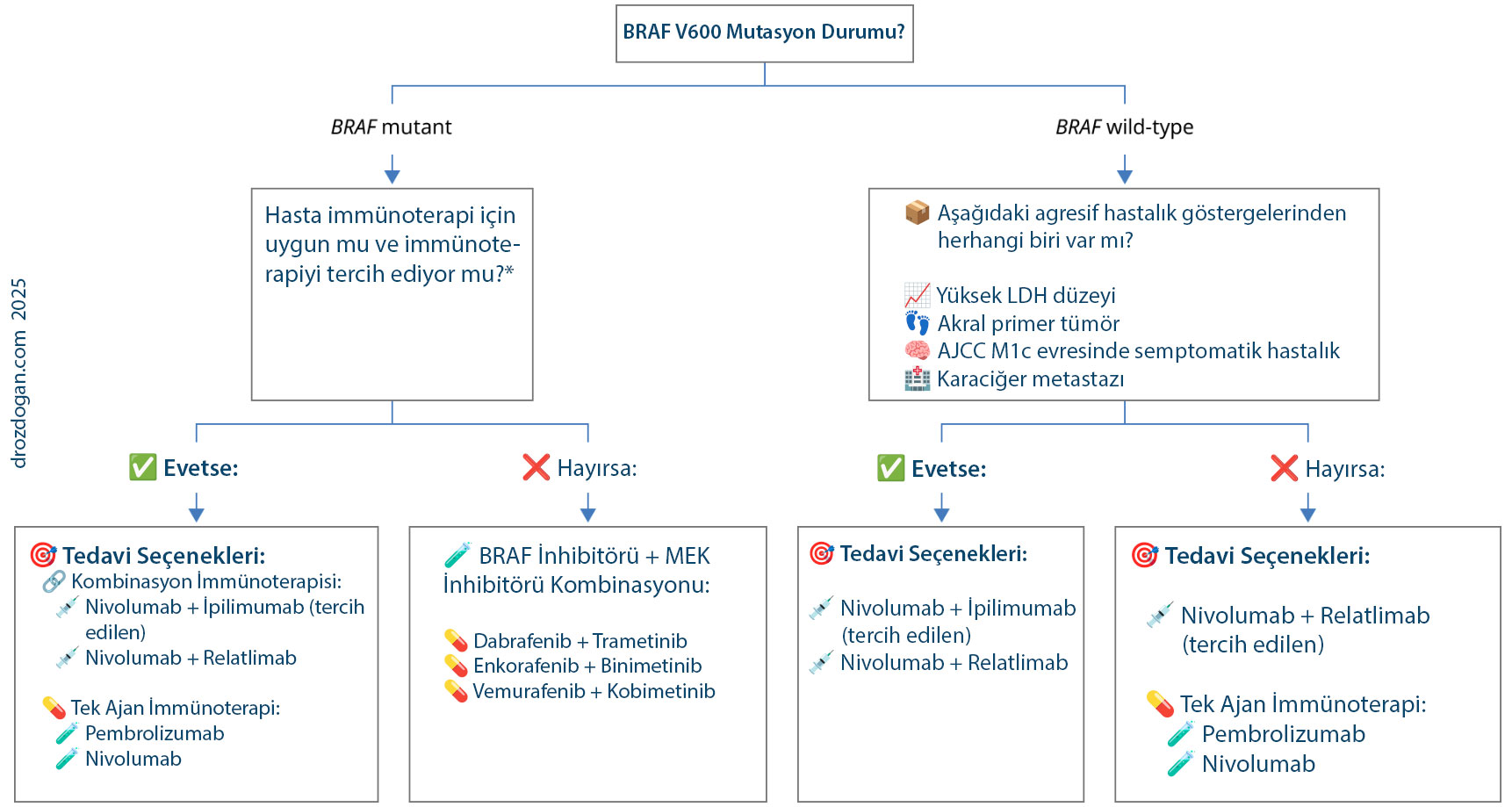
Against this scientific and clinical background, the most effective first-line options for advanced melanoma and their clinical significance are:
The Most Effective First-Line Treatment Options
1. Nivolumab + Ipilimumab (Preferred Combination)
Why Is It Preferred?
Nivolumab (a PD-1 inhibitor) plus ipilimumab (a CTLA-4 inhibitor) offers the longest survival outcomes reported to date in metastatic melanoma. It stands out particularly in aggressive melanoma, including high LDH levels and liver or brain metastases.

CheckMate-067 Results
-
10-year overall survival (OS):
-
Nivolumab+Ipilimumab: 43%
-
Nivolumab alone: 37%
-
Ipilimumab alone: 19%
-
-
10-year progression-free survival (PFS):
-
Nivolumab+Ipilimumab: 31%
-
Nivolumab: 23%
-
Ipilimumab: 6%
-
-
10-year melanoma-specific survival (MSS):
-
Nivolumab+Ipilimumab: 52%
-
Nivolumab: 44%
-
Ipilimumab: 23%
-
In the BRAF wild-type subgroup:
-
10-year OS:
-
Nivolumab+Ipilimumab: 39%
-
Nivolumab: 37%
-
Ipilimumab: 17%
-
Side Effects:
-
Grade ≥3 adverse events occur in 63%, but long-term benefit may persist even after treatment is discontinued.
2. Nivolumab + Relatlimab (Better-Tolerated Alternative Combination)
For Whom Is It Preferred?
For patients unlikely to tolerate nivolumab+ipilimumab because of toxicity risk, but who need an approach more effective than single-agent PD-1 treatment.

RELATIVITY-047 Results
-
Median PFS:
-
Nivolumab+Relatlimab: 10 months
-
Nivolumab: 5 months
-
-
2-year PFS:
-
Nivolumab+Relatlimab: 39%
-
Nivolumab: 29%
-
-
3-year overall survival (OS):
-
Nivolumab+Relatlimab: 56%
-
Nivolumab: 48%
-
Side Effects:
-
The Grade ≥3 adverse-event rate is lower, at 21%.
3. Single-Agent PD-1 Inhibitors (Nivolumab or Pembrolizumab)
For Whom Are They Preferred?
An ideal option for patients who cannot tolerate combinations or have a lower disease burden.
Clinical Findings:
-
Pembrolizumab (KEYNOTE-006)
-
7-year OS: 38%
-
7-year PFS: 24%
-
-
Nivolumab (CheckMate-066)
-
3-year OS: 51% (dacarbazine control: 22%)
-
3-year PFS: 32% (control: 3%)
-
Side Effects:
-
Less frequent and milder than with combinations.
Important Points in Treatment Decisions
-
Nivolumab+ipilimumab is the most effective option for survival, but its high toxicity risk must be considered.
-
Nivolumab+relatlimab is a better-tolerated alternative that is more effective than single-agent treatment.
-
Single-agent PD-1 inhibitors, nivolumab or pembrolizumab, offer a safe option particularly for older patients or those with comorbidities.
Other Current and Investigational Approaches
Pembrolizumab + Lenvatinib (LEAP-004)
-
Shows promising results, particularly after resistance to PD-1/PD-L1 inhibitors.
-
In LEAP-004, the objective response rate (ORR) was 21% and median response duration 8 months; ORR was 33% in patients previously receiving dual immunotherapy.
-
This combination has not entered routine practice and remains investigational.
Pembrolizumab + Ipilimumab
-
Found effective in early-phase studies such as KEYNOTE-129.
-
Shown to have the potential for similar activity with less toxicity than nivolumab + ipilimumab.
-
However, insufficient randomized trial evidence means it is not yet recommended as standard treatment.
GM-CSF + High-Dose Ipilimumab (E1608)
-
Adding GM-CSF improved survival and reduced toxicity.
-
More evidence is needed before adoption in clinical practice.
Microbiota and FMT
-
The gut microbiome has an important effect on immunotherapy response.
-
Fecal microbiota transplantation (FMT) has shown activity in early-phase studies of immunotherapy-resistant melanoma.
-
This approach remains investigational.
T-VEC + Immunotherapy
-
Combining the oncolytic virus T-VEC with immunotherapy showed promise in early studies.
-
However, it remains experimental because phase III trials did not show a significant overall survival benefit.
Brain Metastases
-
Nivolumab + ipilimumab may provide substantial clinical benefit in patients with brain metastases.
-
Multidisciplinary management and neuro-oncological assessment are required.
Noncutaneous Melanoma (Mucosal and Uveal)
-
These subtypes generally lack BRAF mutations.
-
Systemic treatment differs and requires separate assessment.
Immunotherapy Duration and Decisions About Continuation
-
Patients with stable disease or partial responses generally receive 2 years of immunotherapy.
-
In complete responders, treatment may be stopped after at least 6 months.
Treatment After Progression
-
After progression on nivolumab + ipilimumab: clinical trials, TIL therapy or alternatives such as nivolumab + relatlimab.
-
After progression on relatlimab: nivolumab + ipilimumab may be preferred again.
-
After a single-agent PD-1 inhibitor: combination immunotherapy may be considered
Summary and Conclusion
In advanced melanoma without a BRAF mutation, first-line treatment should be selected according to disease severity, extent and the patient's overall condition.
-
Most effective option: Nivolumab + Ipilimumab
-
Better-tolerated alternative: Nivolumab + Relatlimab
-
Single-agent option with a low-toxicity profile: Nivolumab or Pembrolizumab
Immunotherapy-based approaches in advanced melanoma have become successful examples of personalized medicine and significantly extend survival.
Was this article helpful?
Your feedback helps us improve our content.




Reader comments
Share your comment
Your name and comment are published only after administrator approval. Your email address is never shown to visitors.
Be the first to comment.