
Miniature Robots Will Bring a New Perspective to Modern Medicine

In this article
Imagine tiny robots working in diseased areas of our bodies—for example, inside tumors, in blood vessels about to become blocked and even inside our intestines—making the necessary repairs and carrying and releasing various drugs only in these diseased areas. This subject has actually featured in several science-fiction films. But these ideas, which sound imaginary, seem likely to become reality in the future.
Among small medical robots, millirobots are robots whose internal components measure 1 millimeter or more. Microrobots are much smaller, with dimensions ranging from 1 micrometer to 1 millimeter.
Note: These robots are called millirobots because their structures in the first prototypes resembled millipedes. In Latin, “mille (a thousand)”-“pedes (feet)” means “millipede.”
Types of miniature robots
Capsule endoscopes
Capsule endoscopes are a good example of millirobots (Figure 1). Today, capsule endoscopy is entering clinical practice at an increasing pace. These pill-sized robots contain a camera. After being swallowed, they film the stomach and intestines as they pass through them and generally transmit these images to a recording device outside the body. Doctors can then examine the images to diagnose gastrointestinal diseases. Their main advantage over conventional endoscopic methods is patient comfort. Among the main shortcomings needing future improvement are their inability to take biopsy samples from diseased areas or perform interventional treatments. However, capsule endoscopes capable of taking biopsies are also being developed.

Soft robots guided by magnetic currents
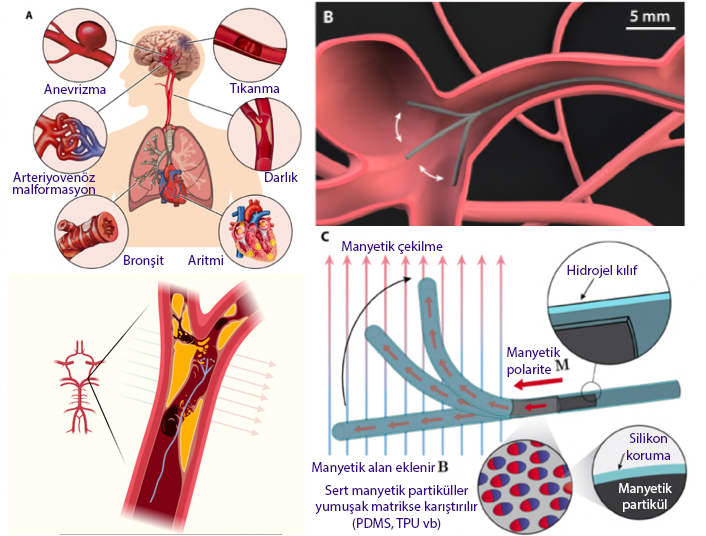
Another example is the recently developed ferromagnetic soft continuum robots. These robots have a thin, elongated structure and actually resemble catheters (Figure 2). The magnetic material in their structure allows them to be moved using an externally applied magnetic field. Last year, researchers showed that they could guide these robots through a nonliving model mimicking the brain's vasculature. These robots are expected to be used particularly for cerebral vascular aneurysms (ballooning) and the mechanical opening of blood clots in acute ischemic strokes (brain paralysis).
Medical microrobots cover a much wider range. Many prototypes have been developed so far. Their applications range from delivering drug molecules to moving immune cells and transporting them to the desired diseased areas.
Microswimmer robots
In fact, researchers are focusing on solving fundamental problems in most prototypes. Engineers and scientists face many challenges, such as moving and steering these tiny robots, crossing biological membranes and barriers, loading drug molecules and avoiding immune cells' responses to foreign structures.
Our pioneering scientist in miniature robots, Prof. Dr. Metin Sitti, and his work
Making Turkey proud through research in this field, Prof. Dr. Metin Sitti and his team at the Max Planck Institute in Germany are producing increasingly influential research. In their recently published work, they showed that microswimmer helical microrobots with different numbers of turns in their structures elicit different responses from immune cells, and that changing the number of helical turns can allow microrobots to evade the body's immune cells (Figure 3). In this way, they aim to reduce the risk of microrobots causing dangerous allergic reactions in the human body.

Microroller robots
Also this year, in their study published in the scientific journal Science Robotics, Metin Sitti and his team proposed that microroller robots could be used for drug delivery under blood flow (Figure 4). The cores of these microrobots are made of silica, and their outer surfaces are coated with gold/nickel.

These robots are moved by a magnetic field, and targeted therapeutic agents can be loaded onto the silica component. They are expected to move by rolling inside blood vessels. Sitti and his research team use models representing living environments in the laboratory to test them experimentally.
Using bacteria as microrobots
Another system they designed works as follows: bacteria are attached to human red blood cells (erythrocytes) through the biotin-avidin complex, a form of binding with the highest known binding strength among noncovalent bonds. The erythrocytes are loaded with iron oxides that can be guided by a magnetic field and, at the same time, with a drug such as the anticancer drug doksurubisin. While bacterial flagella provide the energy needed for movement, magnetic steering may allow these structures to be transported to the desired area of the body (Figure 5).

In conclusion, as we can see, many prototypes are being developed in this field and experiments are continuing. However, there may be a long way to go before medical microrobots can lead to groundbreaking treatments in the future, because the field is currently working on fundamental problems and testing in in vivo (living) models has not yet begun. Nevertheless, research progressing at a dizzying pace encourages us to look to the future with hope.
Who is Metin Sitti?
Prof. Metin Sitti received his bachelor's and master's degrees from Boğaziçi University's Department of Electrical and Electronics Engineering and his doctorate from the University of Tokyo's Department of Electrical Engineering in 1999. He worked as a postdoctoral researcher and faculty member at the University of California, Berkeley, in the United States from 1999-2002, and as a professor at Carnegie Mellon University from 2002-2016. Since 2014, he has been a director at the Max Planck Society's Institute for Intelligent Systems in Germany. Since 2018, he has also worked as a part-time professor in Koç University's faculties of medicine and engineering. His research covers a wide range of topics within microrobotics and intelligent systems, such as medical microrobots and devices, nature-inspired miniature robots and soft robots. In 2009, he founded the startup nanoGriptech Inc. in the United States to commercialize the microfiber adhesives he invented, inspired by the foot hairs of gecko lizards. This highly innovative adhesive has been used in many products on the market since 2018.
Metin Sitti's many awards and titles include the Rahmi Koç Medal of Science in 2018, an ERC Advanced Grant Award in 2019, the Best Paper Award at the Robotics Science & Systems Conference in 2019, IEEE Fellow in 2014, the IEEE/ASME Best Mechatronics Paper Award in 2014, the SPIE Nanoengineering Pioneer Award in 2011 and the National Science Foundation CAREER Award in 2005. He has more than 450 papers in peer-reviewed journals and conferences. Over 250 journal articles have been published in leading journals including Nature, Nature Materials, Nature Communications, Proceedings of the National Academy of Sciences, Science Robotics, Science Advances and Advanced Materials. These papers have received over 22,000 citations to date. His latest book, “Mobile Microrobotics,” was published by MIT Press in 2017. He has given over 200 invited talks at leading conferences, universities and companies in his field. He is also editor-in-chief of Progress in Biomedical Engineering and Journal of Micro-Bio Robotics.
Sources
2. Yasa, I. C., Metin Sitti et al. (2020). "Elucidating the interaction dynamics between microswimmer body and immune system for medical microrobots." Science Robotics 5(43).
3. Alapan, Y., Metin Sitti et al. (2020). "Multifunctional surface microrollers for targeted cargo delivery in physiological blood flow." Science Robotics 5(42).
4. Alapan, Y., Metin Sitti et al. (2018). "Soft erythrocyte-based bacterial microswimmers for cargo delivery." Science Robotics 3(17).
Was this article helpful?
Your feedback helps us improve our content.




Reader comments
Share your comment
Your name and comment are published only after administrator approval. Your email address is never shown to visitors.
Be the first to comment.