
Timing Makes a Difference in Immunotherapy: ASCO 2025 and the Lung Cancer Study

In this article
The Role of Timing in Treatment Effectiveness
Our physiological processes are regulated in cycles of approximately 24 hours. This internal clock is called the “circadian rhythm.” Many functions, from the sleep–wake cycle to the immune system, hormone release and body temperature, depend on this biological clock. Recent years have revealed a role for circadian rhythm that cannot be overlooked, particularly in cancer treatment. The 2025 ASCO Congressfeatured striking results from a new phase III study that provide a scientific basis for this view.
ASCO 2025: Timing Makes a Difference in Patients With Lung Cancer
A randomized controlled phase III study conducted in China and presented at the 2025 ASCO Congress investigated the effect of immunotherapy administration time on treatment outcomes in patients with advanced non-small cell lung cancer (NSCLC). A total of 210 patients were randomly assigned to receive their first four immunotherapy infusions either in the morning before 15:00 (early timing) or after 15:01 (late timing).
The Findings Are Striking:
-
Progression-Free Survival (PFS): 13.2 months in the early group versus 6.5 months in the late group (HR: 0.43; p < 0.0001)
-
Overall Survival (OS): Median OS was not yet reached in the early group, versus 17.8 months in the late group (HR: 0.43; p = 0.0003)
-
Response Rate (ORR): 75.2% in the early group versus 56.2% in the late group (p = 0.007)
These differences were consistent regardless of age, sex, performance status, tumor stage, PD-L1 expression or the immunotherapy agent used.
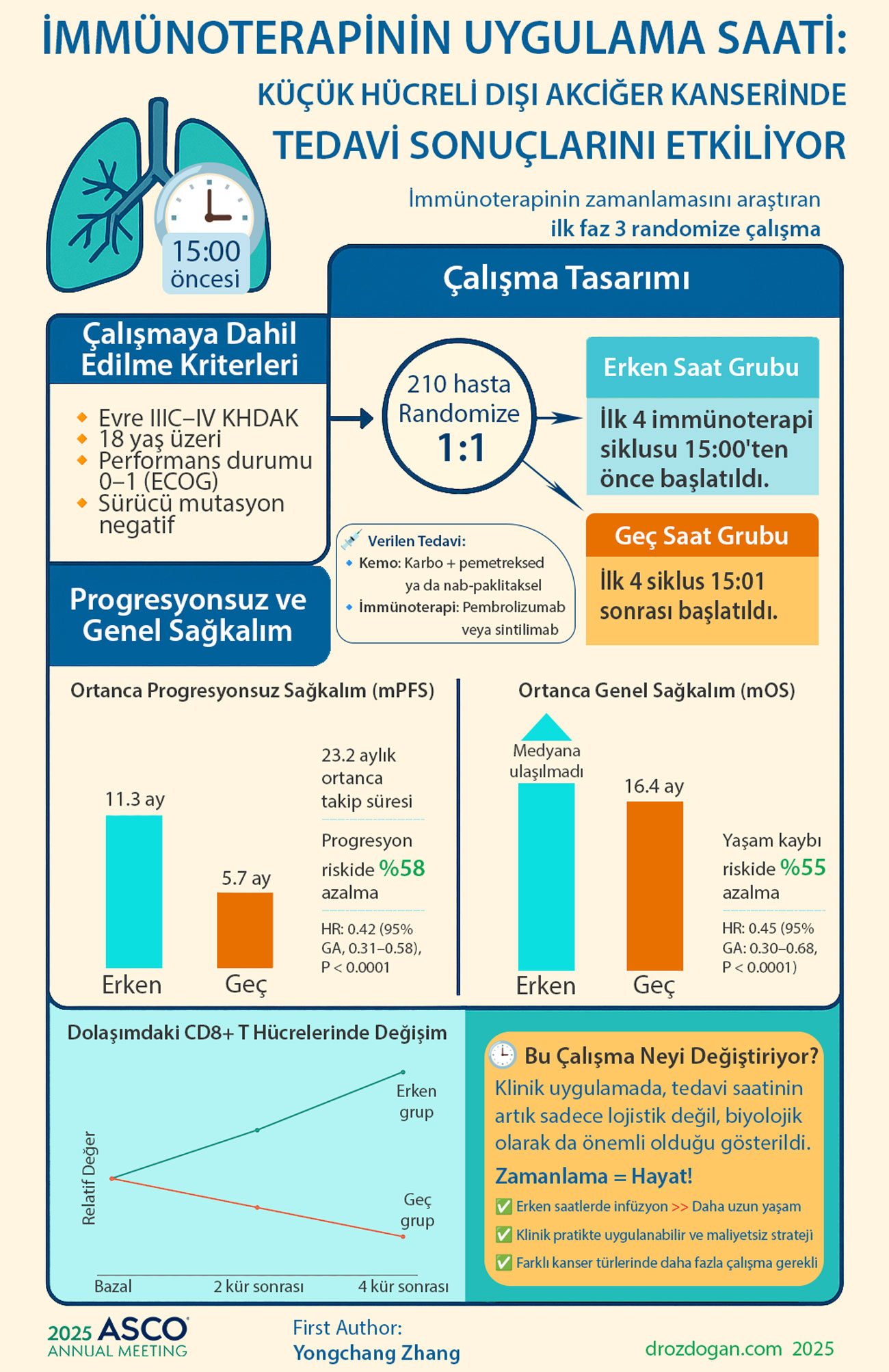
Study Details
Patient Profile:
-
Stage IIIC–IV NSCLC
-
Negative for driver mutations such as EGFR and ALK
-
Newly starting treatment (1st-line systemic therapy)
-
ECOG performance status 0–1
-
Patients with stable brain metastases included
-
Median age: 61 | Proportion of men: 90.5%
The Findings Are Striking:
-
Median Progression-Free Survival (PFS):
-
Early group: 11.3 months (95% CI, 9.3–13.3)
-
Late group: 5.7 months (95% CI, 5.1–6.5)
-
HR: 0.42 (95% CI, 0.31–0.58), P < 0.0001 → 58% reduction in the risk of progression
-
-
Median Overall Survival (OS):
-
Early group: Median not reached
-
Late group: 16.4 months (95% CI, 13.5–19.3)
-
HR: 0.45 (95% CI, 0.30–0.68), P < 0.0001 → 55% reduction in the risk of death
-
-
Objective Response Rate (ORR):
-
Early group: 75.2% (95% CI, 66.8–83.6)
-
Late group: 56.2% (95% CI, 46.5–65.8)
-
P = 0.007
-
In subgroup analyses, this advantage was maintained regardless of age, sex, tumor stage, PD-L1 level and the immunotherapy agent used.
Circadian Rhythm: The Power of the Molecular Clock
Circadian rhythm is controlled by the suprachiasmatic nucleus (SCN) at the base of the brain. However, peripheral organs are now also known to have their own clock genes. The Nobel Prize-winning work of Aziz Sancar and his teamshowed that DNA repair systems are synchronized with this clock, providing a scientific basis for the importance of timing in chemotherapy.
What Is Chronotherapy?
Chronotherapy aims to improve treatment effectiveness by administering drugs at times aligned with biological rhythms. Processes that vary throughout the day, such as DNA repair, drug absorption, distribution and elimination, can produce major differences in treatment outcomes.
Clinical Evidence Is Growing:
-
Morning Immunotherapy in Melanoma (2023): Treatment administered in the morning extended overall survival to 24.9 months, compared with only 5.5 months for afternoon administration.
-
Temozolomide in Glioblastoma (2021): Survival was 25.5 months in patients taking it in the morning versus 19.5 months in those taking it in the evening.
-
Discovery of the Kidney Clock: A study published in the Journal of the American Society of Nephrology showed that the Bmal1 gene in the kidneys regulates drug elimination and metabolism.
Mechanism: Why Is Morning More Effective?
-
DNA repair mechanisms are more active at certain times of day.
-
Because cancer drugs act by damaging DNA, administration at times when repair activity is low increases the likelihood of success.
-
Blood-brain barrier permeability, immune cell activity and susceptibility to apoptosis also vary with the rhythm.
Aziz Sancar's Contributions and the Example of Cisplatin
Aziz Sancar's work showed that chemotherapy should be administered during periods when repair mechanisms are weakest. For drugs such as cisplatin, administration when DNA repair activity is lowest has been shown to have the potential to reduce side effects and increase effectiveness.
Future Perspective: Personalized Timing
-
Circadian biomarkers could be used to create individualized treatment plans.
-
Infusion times may need to be incorporated into treatment protocols.
-
Prospective multicenter studies could support wider adoption of this strategy.
Conclusion
Timing is more than a detail: it is a potential treatment strategy. The 2025 ASCO study showed that administering highly effective treatments such as immunotherapy in the morning could dramatically improve progression-free and overall survival. Chronotherapy is no longer experimental; it is an approach that should be integrated into clinical decision-making.
Sources
Randomized trial of relevance of time-of-day of immunochemotherapy for progression-free and overall survival in patients with non-small cell lung cancer. Presented at: American Society of Clinical Oncology (ASCO) Annual Meeting 2025; Abstract #8516. DOI: 10.1200/JCO.2025.43.16_suppl.8516
Was this article helpful?
Your feedback helps us improve our content.


Reader comments
Share your comment
Your name and comment are published only after administrator approval. Your email address is never shown to visitors.
Be the first to comment.