
What Causes Hard Lumps and Swelling Under the Skin?

In this article
Noticing a hard lump under the skin can be worrying, but there is rarely a serious underlying disease. Several factors can cause lumps and swelling under the skin, and they can generally be treated without difficulty.
This article discusses hard lumps under the skin, their types, causes, treatments and when to see a doctor.

What Is a Lump?
A lumpis an abnormal growth of tissue anywhere in the body. These masses can form under the skin or on organs and may be soft, hard, painful or painless. Although usually harmless, they may sometimes signal a serious underlying health problem. In particular, hard swelling under the skin, swelling at the nape and back of the head or swelling on the head are signs for which it is important to consult a specialist.
What Causes Hard Lumps and Swelling Under the Skin?
Noticing a hard lump under the skin can be worrying, but there is rarely a serious underlying disease. Several factors can cause lumps and swelling under the skin, and they can generally be treated without difficulty.
Cysts
A cystis a closed pocket of tissue containing fluid or debris (tissue remnants). Cysts can form anywhere in the body. Their consistency varies with the tissue trapped inside the pocket.
- “I have swelling on my head that hurts when touched” may describe a condition caused by a cyst.
- “A pimple-like lump in my armpit hurts when touched” may generally indicate an inflamed hair follicle or a fatty lump.
A cyst may develop because of a blocked oil gland or hair follicle. Cysts near the skin surface feel like soft blisters, but those deeper under the skin feel like hard lumps.
A hard cyst near the skin surface usually contains trapped dead skin cells or proteins.
Types of cysts include:
- Ganglion cysts, common on wrists and hands
- Synovial cysts developing in the spine
- Pilar cysts appearing on the scalp
- Mucous cysts that can form on feet, toes or inside the mouth
Cysts rarely require treatment and generally stop growing, then disappear on their own. Sometimes a blackhead develops near the center of a cyst. When this happens, it may open and release white or yellow discharge.
An infected cyst is red, swollen or painful and is treated with:
- Antibiotics
- Needle aspiration (draining the inflammation with a needle)
- Corticosteroid injections
- A surgical procedure to remove the cyst

Dermatofibroma
Dermatofibromas are hard brown or red lumps under the skin. They generally develop on exposed skin of the legs, arms and back. They do not turn into cancer and usually require no treatment.
People with dermatofibromas generally have no other symptoms. In some cases, however, a dermatofibroma may itch or be irritated or tender.
Dermatofibromas develop through an accumulation of the skin’s thickest layer, called the dermis.
Their exact cause remains unclear, but potential causes include:
- Skin trauma or injury
- Insect or spider bites
- A splinter
Dermatofibromas generally need no treatment, but tend to remain on the skin for the rest of a person’s life.
People may request surgical removal if a dermatofibroma looks unsightly or is in an uncomfortable area.
Other treatment options for dermatofibroma include:
- Freezing with liquid nitrogen
- Corticosteroid injections
- Shaving the upper layers of the growth
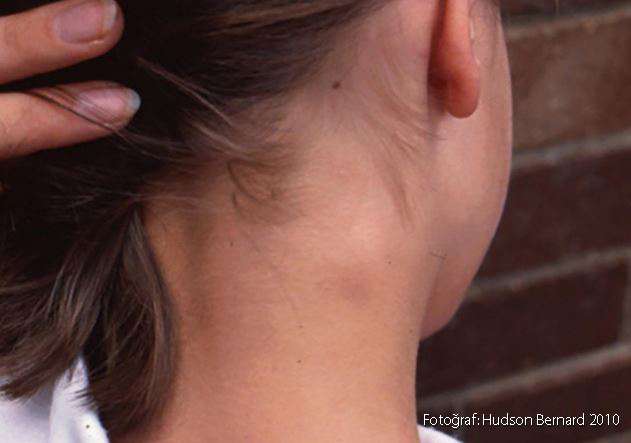
Swollen Lymph Node
A cold or another viral infection can cause swollen lymph nodes.
Symptoms such as a chickpea-sized swelling in the neck generally arise from lymph nodes.
Also:
- Infections
- Immune system disorders
- Infection-related swellings
can cause swelling at the nape or back of the head.
Lymph nodes are small glands that filter harmful substances from lymph, the clear fluid traveling through lymphatic vessels.
These small, bean-shaped glands are a basic component of the immune system. They produce and store white blood cells that destroy disease-causing pathogens and waste.
Sometimes lymph nodes swell in response to bacterial or viral infections. They may feel hard and painful.
Swollen lymph nodes generally occur on the head, neck, nape, armpits or groin.
Several factors can cause swollen lymph nodes, including:
- A cold or another viral infection
- Bacterial infections
- Dental infections
- Ear infections
- Medical conditions affecting the immune system, such as rheumatoid arthritis or lupus
People with lymph nodes swollen because of infection are likely to have additional symptoms such as:
- Runny nose
- Cough
- Sore throat
- Fever
- Headache
- Fatigue
In most cases, swollen lymph nodes improve on their own without medical treatment. If they do not, treatment should focus on the underlying cause, generally an infection.
A swollen lymph node that feels hard, rubbery or fixed (immobile) may indicate a more serious medical condition.
Some cancers, such as lymphoma, leukemia and breast cancer, can affect lymph nodes. Anyone worried about swollen lymph nodes should see a doctor.

Lipomas
A lipoma is a benign tumor containing fatty tissue. These noncancerous lumps develop just under the skin and look pale or colorless. Lipomas generally feel soft and move easily.
Lipomas generally cause no symptoms or complaints. However, a lipoma containing many blood vessels or nerves may feel soft or painful.
The exact cause of lipomas is unknown. Some genetic conditions, such as Gardner syndrome, can increase the likelihood of developing them.
Lipomas need no medical treatment unless painful, uncomfortable or interfering with a person’s ability to function normally.
Treatment options for lipomas include:
- Liposuction (fat removal)
- Drainage
- Steroid injections
- Surgical excision (removal by surgery)
Fibroadenoma
A fibroadenoma is a benign breast tumorconsisting of fibrous and glandular tissue. It usually occurs in young women and is painless, but may be surgically removed if it grows or causes discomfort.
Fibroadenomas occur most often in women in their 20s and 30s, but can occur at any age. They are generally solid/firm but mobile.
Fibroadenomas can develop because of high estrogen levels. They may grow during pregnancy because of increased hormone levels. Conversely, they may shrink during menopause.
Fibroadenomas that are not painful or growing require no medical treatment. However, people should monitor any changes in size or appearance.
A doctor may recommend removal of a fibroadenoma if:
- It causes pain
- The person complains of changes in breast shape or appearance
- The person has a family history of breast cancer
When Should You See a Doctor?
In general, a noncancerous lump feels soft and mobile. However, anyone concerned about a hard swelling under the skin should see a doctor for diagnosis. Hard lumps are usually nothing more than a cyst or swollen lymph node.
People should seek medical help for a lump under the skin if:
- Any change in its size or appearance is noticed
- It feels painful and tender (“I have swelling on my head that hurts when touched” is an example of such a complaint)
- It looks red or inflamed
- The person also experiences unintentional weight loss
- A chickpea-sized swelling in the neck or swelling at the nape and back of the head has been noticed
- A hard swelling under the skin has developed
- The swelling grows or becomes painful
A doctor should definitely be consulted.
Diagnosis
A doctor can diagnose swelling under the skin by examining the lump and reviewing the patient’s medical history. During the physical examination, lumps may be gently squeezed or compressed.
The doctor will also ask how long the lump has been under the skin and whether its size or appearance has changed.
A lump that looks irritated or abnormally shaped may require further tests. These may include:
- Imaging tests. MRI, CT scans, X-rays and ultrasound.
- Blood test. The doctor may request a blood test to assess a person’s white blood cell count or check for hormonal imbalances.
- Biopsy. During a biopsy, a healthcare professional removes a small tissue sample from the lump for further evaluation and sends it to a pathology laboratory.
Summary
Lumps under the skin are usually benign. However, “what causes swelling on the head?”, “a pimple-like lump in my armpit hurts when touched” and similar questions require medical evaluation for clear answers.
With early diagnosis and appropriate treatment, most lumps under the skin can be treated successfully.
A hard lump under the skin does not necessarily indicate cancer. Infections, blocked glands and hormonal changes can cause noncancerous lumps or swelling under the skin.
People should not try to remove a lump themselves. This can cause infection or make lumps grow.
People should talk to a doctor if concerned about a new or changed lump under their skin.
Most lumps need no medical treatment unless growing or causing pain. If swelling under the skin causes discomfort, treatment options should be discussed with a doctor.
*
You may be interested: Stage 4 cancer: what are metastasis and metastatic disease, what are the symptoms, and why does cancer metastasize?
Was this article helpful?
Your feedback helps us improve our content.


Reader comments
Share your comment
Your name and comment are published only after administrator approval. Your email address is never shown to visitors.
Be the first to comment.