
What Is the Innate Immune System and How Does It Work? Its Critical Role in Coronavirus Infection

In this article
The immune system has two branches, one being the innate immune system, a common defense against all microorganisms present in every person.
This article first explains innate immunity, how it works and its cells, followed by its relationship with the novel coronavirus (SARS-CoV-2) .
Innate (sometimes called “natural”) immune responses are the first responses to pathogens to prevent infection and are evolution’s oldest defense system. Although innate immunity recognizes pathogens by very general structures and gives similar responses, its defining feature is rapid responses . We owe this to inheritance of ready-made genetic information for innate immunity. Its defense cells can distinguish the individual’s own cells from pathogens, so healthy cells are not harmed.
TABLE 1: Innate immune defense generally has two options: 1. Structural (anatomical) barriers, 2. Functional (physiological) barriers.

Which innate immune cells kill pathogens?
As noted above, innate immunity forms the first defense against microbes. Pathogens nevertheless cause disease partly because they resist these mechanisms. Innate immune cells are programmed to destroy invaders and leave the bloodstream to flock to the attack site.
Innate immunity contains 2 cellular lineages:
- Myeloid cells (granulocytes, macrophages and dendritic cells)
- Lymphoid cells (natural killer cells)
FIGURE 1: Below are blood and basic immune cells and the blood stem cell from which they originate:

FIGURE 2: Below are “innate” and “adaptive / specific / acquired” immune cells:

1. Myeloid cells of innate immunity (granulocytes, macrophages and dendritic cells)
Myeloid cells mainly recognize pathogens, engulf them (phagocytosis) and break them down. Because of this ability, they are also called “phagocytes.”
Myeloid phagocytic cells are attracted to the invaded region by special chemical molecules called chemotaxins . These may be bacterial or viral molecules or specific help signals secreted by local body cells. Myeloid cells also release their own chemotaxins, calling more related cells to the infection. Phagocytes have special surface recognition receptors. If they detect a molecule or cell that should not normally be there, they engulf it. This occurs through inward folding of the cell membrane, creating a vesicle called a phagosome . This vesicle combines with an intracellular structure containing chemicals used for digestion inside the cell, the lysosome , to destroy the pathogen.
FIGURE 3: The stages of phagocytosis are shown.

A special form of phagocytosis is autophagy. The 2016 Nobel Prize in Medicine or Physiology was awarded to Yoshinori Ohsumi for discoveries concerning autophagy mechanisms. This is a type of cellular recycling mechanism in which the lysozyme enzyme again acts, recovering, for example, aged cell parts in vesicles called autophagosomes.
TABLE 2: Granulocytes are divided into neutrophils, basophils and eosinophils.
Macrophages
They originate in bone marrow through differentiation of monocytes, another immune cell. Macrophages settle at strategic entry points for microbes, quickly recognizing foreigners and producing a killing response. It is important not to recognize healthy self cells as enemies or respond against them. Through surface receptors, macrophages recognize and eliminate foreign substances and remnants of damaged, aged or body-killed cells. Similar to neutrophils in many ways, they remain at inflammation sites longer and live longer. Another distinction is their secretion of cytokines , chemical stimuli regulating inflammation and initiating the other branch of immunity, specific / acquired immunity , discussed later.
TABLE 3: Important cytokines released by macrophages and their effects
Dendritic cells
Like macrophages, dendritic cells break down pathogens and present them to other immune cells to initiate responses. They can particularly be considered the first step in a specific immune response (see Dendritic cells and dendritic cell cancer vaccine).
2. Lymphoid cells of innate immunity (natural killer cells)
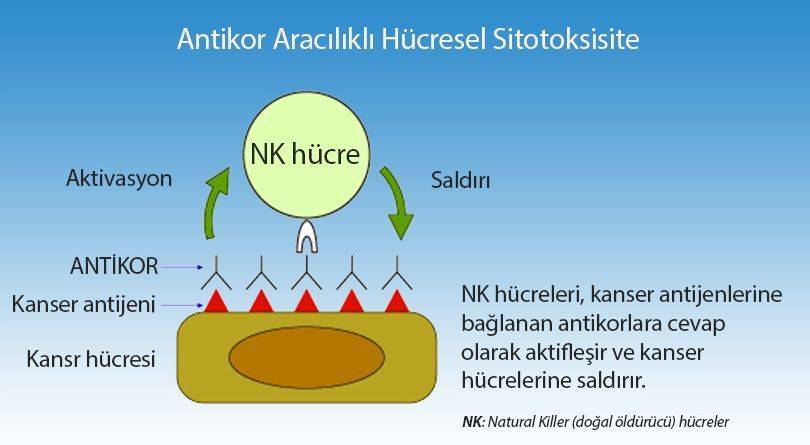
NK (natural killer) cells are large lymphocytes with many granules. Their main physiological roles are defense against infections caused by intracellular pathogens, especially viruses, and killing cancer cells. These innate response cells need no prior encounter with the pathogen and can kill foreign cells on first contact.
Natural Killer Cells (NK)can kill infected and tumor cells. They cause target cells to die through apoptosis , the programmed cell death mechanism. NK cells secrete special chemicals called interferons . Interferon-alpha and interferon-beta prevent intracellular viral multiplication, while interferon-gamma activates macrophages and other immune cells. Interferon-alpha is used in kidney cancer and malignant melanoma treatment.
FIGURE 4: A simple illustration shows how natural killer cells attack antibody-marked cancer cells.
Infected or damaged tissues trigger an inflammatory response called inflammation . Its purpose is to attract leukocytes and plasma proteins. It has three main tasks: recruit immune cells and chemical regulators to infection, create a physical barrier preventing spread, and enable tissue regeneration. Cytokines released during tissue damage or infection have many effects. For example, they trigger histamine release from mast cells. Histamine dilates vessels, causing heat and redness and increasing their permeability to white blood cells.
How do immune cells recognize target pathogens?
Defense cells use surface receptors to distinguish friend from foe. Pathogens such as bacteria have species-specific surface molecular structures called pathogen-associated molecular patterns (PAMPs). Their structural features have been conserved through evolution. Innate immune cells carry receptors recognizing these motifs, called pattern recognition receptors (PRRs). Because PAMPs are absent from human body cells, PRR-bearing innate cells cannot damage their own tissues.
TABLE 4: Examples of pathogen-specific molecular motifs targeted in innate responses, their recognizing receptors and immune responses

The novel coronavirus (SARS-CoV-2) and innate immunity
With this information, let us examine how innate immunity responds to SARS-CoV-2.
First, it must be emphasized that humans are encountering the novel coronavirus for the first time , so our only natural weapon is innate immunity.
COVID-19 infectionand our immune response to it have not yet been fully clarified. However, reports from some studies show that in SARS-CoV-2-infected individuals (a study of 99 people), total neutrophils increased by %38, while total lymphocytes (cells of the specific / acquired immune system, discussed in our next article) fell by %35, and serum IL-6 and C-reactive protein (CRP) increased by %52 and %84, respectively. Briefly, their functions are;
IL-6: Secreted by many cells (macrophages, granulocytes, lymphocytes and others), this protein has many functions. IL-6 secretion begins with pathogen attack, increases in tissues and blood, delivers messages to target cells and stops when the attack ends. Viral infections particularly increase IL-6. IL-6 also plays an important role in specific immunity.
C-reactive protein (CRP): An acute-phase protein produced by the liver and increased in blood during inflammation. Its main role is attaching to pathogen surfaces to facilitate elimination through phagocytosis.
Type 1 interferon (IFN-1): One of the most important steps in effective innate antiviral immunity is secretion of type 1 interferon (IFN-1) and its stimulated signaling pathways. Type 1 interferons include IFN-alpha and IFN-beta. Their secretion is stimulated by viruses, other microorganisms and double-stranded RNA. IFN-beta release is primarily an antiviral response and also regulates specific immunity. The first step required for type-1 IFN secretion is recognition of virus-specific PAMPs by innate cells. A series of pathways then stimulates type-1 IFN and suppresses viral replication early. However, SARS-CoV and MERS-CoV block the body’s type-1 IFN secretion, proportionally to disease severity. One method disrupts molecules detecting viral RNA. SARS-CoV-2, genetically similar to these viruses, is thought to use similar mechanisms to evade the host’s innate immune response .
Severe and fatal SARS-CoV and MERS-CoV infections show greatly increased neutrophil and macrophage levels. Contrary to expectations, large increases in these cells and high type-1 IFN release caused adverse effects, including pneumonia or acute respiratory distress syndrome and lung damage . A similar sequence may apply to SARS-CoV-2 and the COVID-19 it causes. In COVID-19 patients, the virus is thought to delay the early type-1 IFN response, leaving immunity insufficient to prevent viral replication.
RELATED TOPICS
- How can the same virus cause no symptoms in one person but death in another?
- How much does our GENETIC makeup affect severe SARS-CoV-2 infection (COVID-19)?
All this information shows how important innate immunity is in coronavirus infections.
FIGURE 5: The infographic below shows SARS-CoV-2 structure, the clinical course of COVID-19, the viral life cycle and the immune response.
FIGURE 6: The infographic below shows organs affected in COVID-19 and the mechanism of damage
*
- ALL OUR CORONAVIRUS ARTICLES -
*
The Immune System – Graphical Summary
FIGURE 7: Below are the immune system’s two main branches, “innate” and “acquired,” and how they work.

Sources
Immunobiology, 5th edition
The Immune System in Health and Disease
Was this article helpful?
Your feedback helps us improve our content.




Reader comments
Share your comment
Your name and comment are published only after administrator approval. Your email address is never shown to visitors.
Be the first to comment.