
A New Chemotherapy-Free Treatment for PD-L1-Negative Head and Neck Cancer: Eftilagimod Alfa

In this article
An Effective Immunotherapy Combination Against Cold Tumors!
A cold tumoris one in which immune cells, particularly T cells, do not adequately enter the tumor microenvironment, resulting in poor responses to immunotherapy. Antigen presentation is weak and immune activity is suppressed.
Although immunotherapy has transformed the treatment of head and neck squamous cell carcinoma (HNSCC), effectiveness remains limited in patients with low-PD-L1 “cold tumors.” There is no approved chemotherapy-free immunotherapy combination for this group. However, new findings reported in 2025 from the phase 2b TACTI-003/KEYNOTE-C34 study cohort B suggest the potential to address a major unmet need.

The TACTI-003 Study: A Substantial Increase in Survival
In TACTI-003, patients with PD-L1 CPS <1 , meaning low PD-L1 expression, and recurrent or metastatic HNSCC received only eftilagimod alfa (efti) + pembrolizumab (Keytruda) .
How Does Eftilagimod Alfa Work?
-
Eftilagimod alfa, a form of LAG-3 (Lymphocyte Activation Gene-3) , is a soluble fusion protein .
-
This drug interacts with important antigen-presenting cells called dendritic cells by binding to their MHC class II molecules.
-
This binding stimulates the activation and proliferation of T cells, particularly CD8+ cytotoxic T cells .
-
It may also activate natural killer (NK) cells .
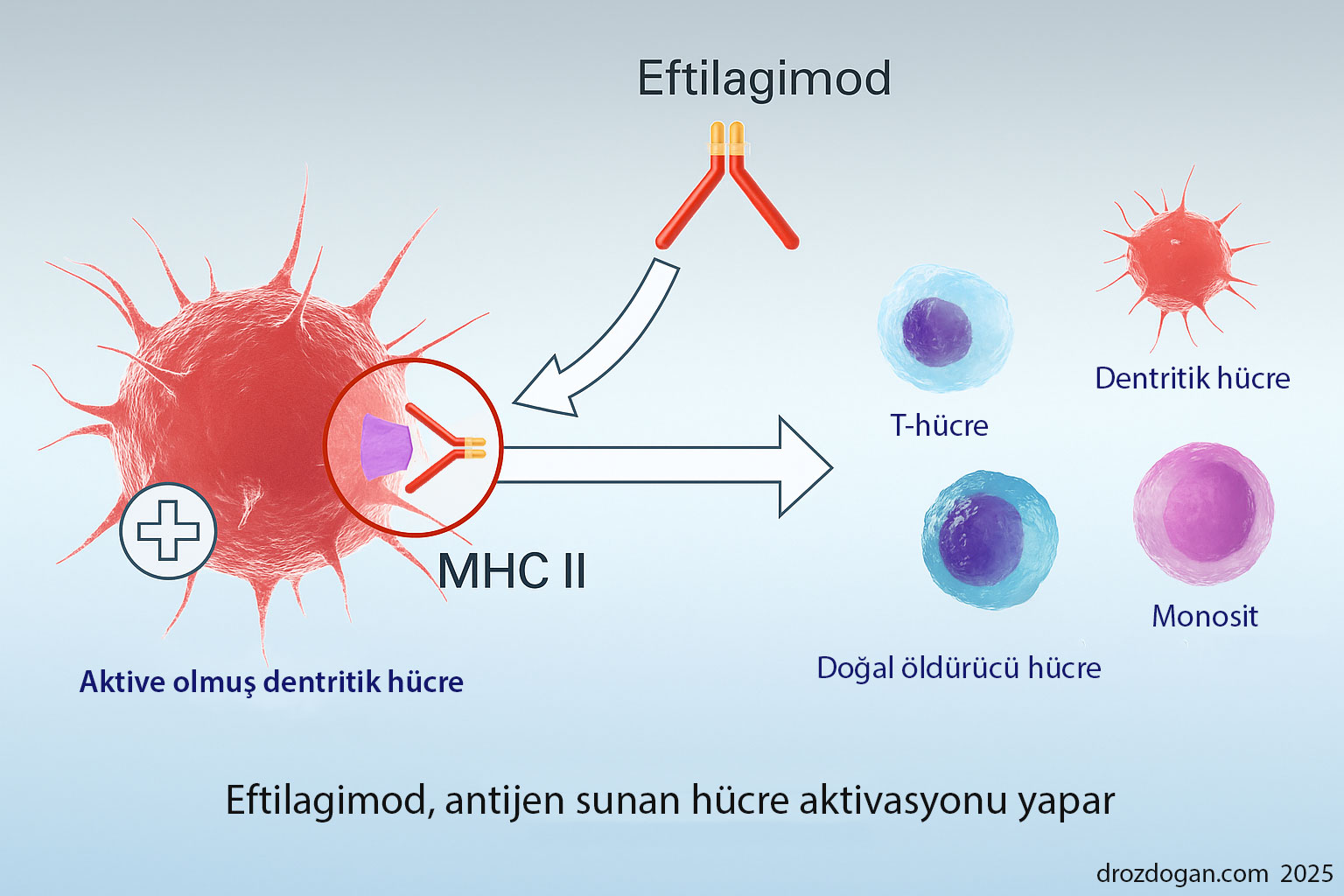
Overall, eftilagimod enhances antigen presentation and the T-cell response, creating stronger and more durable antitumor immunity.
Pembrolizumab and similar PD-1 inhibitors synergistically stimulate different components of the immune system when used with efti:
-
Efti: Initiates T-cell activation
-
Pembrolizumab: Prevents the tumor from suppressing this response
A 2-Fold Increase in Survival
-
Study type: Open-label, multicenter phase 2b clinical trial
-
Participant profile:
- Patients with metastatic or recurrent HNSCC
- Tumors originating in the oral cavity, oropharynx, hypopharynx, or larynx, without the possibility of cure through local treatment
- ECOG performance score 0–1
-
Cohort A: PD-L1 CPS ≥1 → Efti + pembrolizumab vs. pembrolizumab alone (randomized)
-
Cohort B: PD-L1 CPS <1 → Efti + pembrolizumab only
-
Primary endpoint: Objective response rate (ORR)
-
Secondary endpoints: Overall survival (OS), disease control rate (DCR), progression-free survival (PFS), safety, quality of life
Cohort B Results (Patients with PD-L1 CPS <1)
- Number of evaluable patients: 31
- Data cutoff: March 31, 2025
Median Overall Survival (OS):
| Treatment Option | Median Overall Survival |
|---|---|
| Efti + Pembrolizumab | 17.6 months |
| Cetuximab + chemotherapy | 10.7 months |
| Pembrolizumab + chemotherapy | 11.3 months |
| Pembrolizumab alone | 7.9 months |
The efti combination nearly doubled survival: almost a 2-fold increase!
A 7-Fold Increase in Response Rates
Compared with earlier data, efti + pembrolizumab produced striking response rates:
-
Objective response rate (ORR): 35.5%
(Historical ORR: 5.4%) -
Disease control rate (DCR): 58.1%
(Historical DCR: 32.4%)
These findings demonstrate the effectiveness of combined immunotherapies even in tumors considered immunologically “cold.”
Safety Findings: No New Safety Signal
In TACTI-003, efti + pembrolizumab was not associated with any new safety signal . This suggests that treatment is effective and tolerable .
Regulatory Process: FDA Grants Fast Track Designation
Following these promising findings:
-
In April 2021, the FDA granted the efti + pembrolizumab combination Fast Track designation.
-
Regulatory discussions are planned at a meeting between Immutep and the FDA.
-
The final analyses and further updates are to be announced during 2025 .
Commentary and Conclusion
Seeing such strong survival findings in low-PD-L1 head and neck cancer is exciting. Compared with anti-PD-1 monotherapy, this combination produced a 7-fold higher response rate and 2-fold longer survival .
The efti + pembrolizumab combinationoffers a potentially groundbreaking development, particularly for patients with cold tumors in HNSCC. With promising efficacy and safety findings, it could become a new immunotherapy standard in the near future.
During 2025, broader study findings and an FDA decision are expected to be announced.
Sources
2. Immutep reports positive results in first line head and neck squamous cell carcinoma patients with negative PD-L1 expression. News release. Immutep. July 12, 2024. Accessed May 6, 2025. https://tinyurl.com/yj7vvezt
3. Immutep achieves fast track designation from US FDA for efti, a soluble LAG-3 protein, in first line recurrent/metastatic head & neck cancer. News release. Immutep. April 8, 2021. Accessed May 6, 2025. https://tinyurl.com/y7vwfp4b
4. Combination study with eftilagimod alpha (a soluble LAG-3 fusion protein) and pembrolizumab in patients with recurrent or metastatic HNSCC (TACTI-003). ClinicalTrials.gov. Updated March 3, 2025. Accessed May 6, 2025. https://tinyurl.com/53vp7vwc
Was this article helpful?
Your feedback helps us improve our content.




Reader comments
Share your comment
Your name and comment are published only after administrator approval. Your email address is never shown to visitors.
Be the first to comment.