
About breast cancer vaccines and ovarian cancer vaccines

Vaccines developed to activate the immune system against cancer are called “therapeutic cancer vaccines.” Contrary to popular belief, their history long predates the Cuban cancer vaccine… This article discusses breast and ovarian cancer vaccines undergoing clinical trials.
There are many approaches to stimulating the immune system against cancer cells ( Immunotherapies and Cancer Vaccines describes immunotherapy types in great detail). Cancer vaccines are a type of immunotherapy, produced through different approaches. Two are dendritic cell vaccines and whole tumor cell vaccines.
In dendritic cell vaccines, dendritic cells, a type of immune cell taken from the patient, are mixed with cancer cells in the laboratory. They become activated by cancer-specific structures (antigens); returned to the patient, they aim to enable recognition and destruction of cancer cells.
In whole tumor cell vaccines, tumor cells collected from the patient are first genetically modified, then weakened with radiation and returned. This activates the patient’s T cells to attack cancer cells.
Scientific research into cancer vaccines worldwide
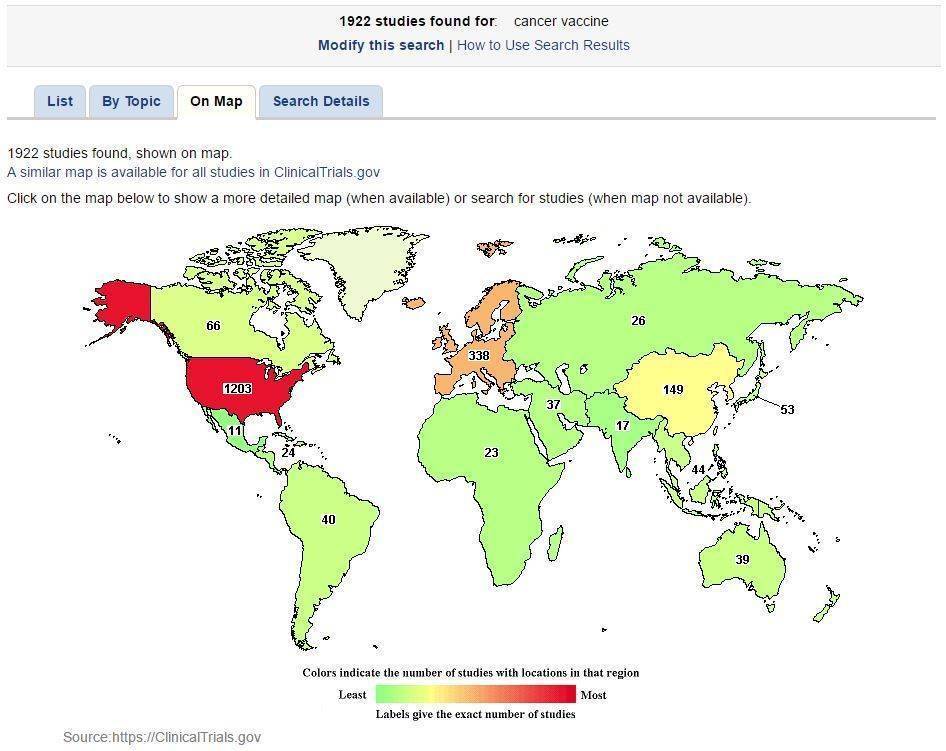
As stated at the beginning, cancer vaccine research long predates Cuba. The image above shows 1922 cancer vaccine studies worldwide, only 24 ongoing in Cuba. Despite so much research, very few have proven effective and received approval. The first was Oncophage in 2008 in Russia for early-stage kidney cancer. It belongs to an American company but is not yet approved in the United States. It is made from tumor-derived “heat shock protein gp96.” A phase-2 glioma brain tumor study continues. In 2010, the FDA then approved a dendritic cancer vaccine for prostate cancer, shown to extend survival by an average of 4 months, Sipuleucel-T (brand name Provenge). Finally, in 2015, for surgically unresectable malignant melanoma skin cancer, it approved the oncolytic virus vaccine Talimogene laherparepvec (brand name Lmlygic)… The Cuban vaccines CimaVax and Racotumomab (brand name Vaxira), tested for lung cancer, have not received FDA approval.
Despite all this effort and research, why have cancer vaccines not been as effective as expected:
The main reasons are the tumor microenvironment and tumor-associated cells. Some immune cells (such as regulatory T cells) suppress T cells activated by vaccines, reducing efficacy. Tumor-associated macrophages also promote resistance. The immune activation from vaccination is often short-lived or temporary. Another reason is that cancers have far more antigens than vaccines target. Vaccines targeting a single antigen therefore have limited treatment effects.
Breast and ovarian cancer vaccines that have reached clinical trials:
HER2-targeting dendritic cell breast cancer vaccine
The HER2 (Human Epidermal Growth Factor Receptor 2) protein is one of the most important proteins in breast cancer cell growth and multiplication. Some cells produce large amounts, so drug development frequently targets it.
- You may be interested in: Targeted drug treatments according to breast cancer type
This vaccine activates CD4 helper T cells, a special T-cell type, against HER-2 protein. It aims to prevent breast cancer recurrence after treatment.
TPIV 110 and TPIV 200 cancer vaccines

These vaccines share the ability to target cancer cells by activating CD4 and CD8 molecules on T cells through their peptide antigens. Both are currently in Phase 2 studies.
The TPIV 110 vaccine uses HER2 protein as the source of its peptide antigen, the HER2/neu peptide. Administration is intended 6 weeks before standard breast cancer surgery.
The TPIV 200 vaccine uses “folate receptor alpha” as its peptide antigen, a protein frequently produced in ovarian and some other cancers. It is being studied in Phase 2 trials in both triple-negative breast and ovarian cancer.
Nelipepimut-S (NeuVax) breast cancer vaccine
This T-cell vaccine uses the nelipepimut-S peptide, part of HER2 protein, to activate T cells against cancer cells. This most promising breast cancer vaccine is currently tested in two Phase 2 studies in HER2-positive breast cancer.
Ad/HER2/neu dendritic cell breast cancer vaccine
In this other dendritic cell vaccine, cells taken from patients are programmed to produce HER2/neu protein. When returned, the immune system recognizes the protein, attacks cancer cells and destroys them. This Phase 1 vaccine is being tested in breast cancer.
OncoImmune ovarian cancer vaccine
For this vaccine, DNA from healthy blood cells and cancer cells of patients in remission, meaning no disease findings after treatment, with stage 3 or 4 ovarian cancer, is sequenced to identify the most important genetic differences. These form the cancer’s “fingerprint” (each patient’s cancer differs). The study plans personalized vaccine production based on these differences. It is currently in Phase 1.
Conclusion
Although these ovarian and breast cancer studies are promising, the vaccines remain experimental and appear effective only when given with or sequentially with disease-specific chemotherapy. We will investigate and share developments in cancer vaccines for you.
Sources
Recruitment begins for world's first ovarian cancer vaccine trial.
University of Connecticut; April 20, 2017.
2. Study of Oncoimmunome for the Treatment of Stage III/IV Ovarian Carcinoma. ClinicalTrials.gov Identifier: NCT02933073
3. Ad/HER2/Neu Dendritic Cell Cancer Vaccine Testing. ClinicalTrials.gov Identifier: NCT01730118
4. Nelipepimut-S Plus GM-CSF Vaccine Therapy in Treating Patients With Breast Cancer. ClinicalTrials.gov Identifier: NCT02636582
5. Combination Immunotherapy With Herceptin and the HER2 Vaccine NeuVax. ClinicalTrials.gov Identifier: NCT01570036
6. Phase II Trial of Combination Immunotherapy With NeuVax and Trastuzumab in High-risk HER2+ Breast Cancer Patients (HER3+). ClinicalTrials.gov Identifier: NCT02297698
7. Folate Receptor Alpha Peptide Vaccine With GM-CSF Versus GM-CSF Alone in Patients With Platinum Sensitive Ovarian Cancer. ClinicalTrials.gov Identifier: NCT02978222
8. TPIV200/huFR-1 (A Multi-Epitope Anti-Folate Receptor Vaccine) Plus Anti-PD-L1 MEDI4736 (Durvalumab) in Patients With Platinum Resistant Ovarian Cancer. ClinicalTrials.gov Identifier: NCT02764333
9. HER-2 Pulsed DC Vaccine to Prevent Recurrence of Invasive Breast Cancer (Adjuvant). ClinicalTrials.gov Identifier: NCT02063724
Was this article helpful?
Your feedback helps us improve our content.


Reader comments
Share your comment
Your name and comment are published only after administrator approval. Your email address is never shown to visitors.
Be the first to comment.