
From Al-Andalus to Today: Al-Zahrawi and the Birth of Modern Mastectomy

In this article
Day 33 (Cancer History in 365 Days Series)
The surgeon's blade confronts the "Crab." The birth of modern mastectomy, the tragedies of ignorant surgeons and the ring-of-fire strategy that "imprisons" cancer.
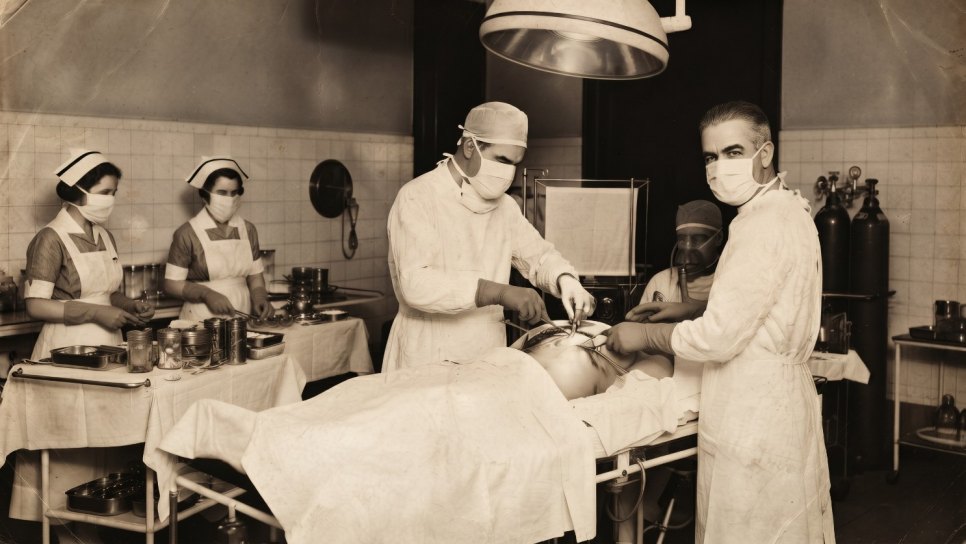
Al-Zahrawi had invented his instruments in his laboratory (Day 32). Now we open the heavy operating-room doors with their metallic smell of blood. To him, cancer (sartan) was a biological "enemy" that clung to the body and sent its roots deep. Al-Zahrawi approached this disease, which Galenic medicine largely considered "untouchable," with unprecedented technical courage, planning and risk management. He was not merely cutting out the tumor; he was also defining the boundaries of surgery.
The Birth of Modern Mastectomy
Al-Zahrawi established principles of "Radical Excision" for breast cancer surgery 1000 years ago that remain relevant even today. Rather than cutting at random, he used an "engineering" strategy that also considered wound healing.
THE AL-TASRIF PROTOCOL
-
1Preoperative Marking (A First in History): Al-Zahrawi recommended drawing incision lines on the skin with ink before surgery. The surgeon should see the plan on the skin before applying the scalpel. This is the ancestor of "Patient Safety."
-
2Elliptical (Crescent-Shaped) Incision: He recommended two curved incisions for large tumors. These incisions joined with the tumor in the center. Unlike a straight incision, an elliptical incision allowed the wound to close properly despite tissue loss.
-
3En Bloc Removal: It was essential to remove the tumor in "one piece" with the surrounding healthy tissue, without breaking it apart. Leaving the roots inside invited recurrence.
The Roots of Plastic Surgery: Gynecomastia
Al-Zahrawi was concerned not only with cancer but also with the patient's "appearance." The technique he developed for breast enlargement in men (gynecomastia) is an early example of aesthetic surgery. By making a crescent-shaped incision above rather than below the breast, he aimed to pull the skin upward during healing and hide the scar in natural folds. This reflects profound genius in tissue geometry.
The Tragedy of the Ignorant Surgeon
The neck was a surgeon's nightmare because of its concentration of vessels and nerves. Al-Zahrawi used a horrifying story as a "cautionary tale" to explain why those without anatomical knowledge should not touch this area:
This anecdote is a bloody lesson showing how vital Al-Zahrawi's principle of "Anatomy First, Surgery Second" was. He argued that surgery was a matter not only of courage but also of knowledge.
A "Ring of Fire" for Cancer
When a blade could not be used or bleeding needed to be stopped, Al-Zahrawi turned to "cauterization." Yet this was not random burning. He had developed a special geometric strategy for cancer:
The area around the tumor is cauterized in a circle. This "imprisons" the cancer, cuts off blood flow to the tumor and prevents its spread. It is a primitive form of the idea of inducing ischemic necrosis.
Burning the center of the tumor directly is a mistake. This "provokes" the tumor, causing it to ulcerate, become infected and grow faster.
DROZDOGAN Academy Commentary
When we read Al-Zahrawi's "Al-Tasrif," we encounter not merely a historical figure but a modern colleague. The idea of "marking the skin before surgery" is fundamental to the World Health Organization's (WHO) Surgical Safety Checklist today. But the greatest lesson we should take from him is honesty. His ability to say "I could not cure any patient with advanced cancer" proves that surgery is not only manual skill, but also the art of knowing one's limits and being transparent with the patient. His legacy is wisdom at the tip of a scalpel.
Was this article helpful?
Your feedback helps us improve our content.


Reader comments
Share your comment
Your name and comment are published only after administrator approval. Your email address is never shown to visitors.
Be the first to comment.