
Probiotics, Prebiotics, and Fecal Transplantation in Cancer Treatment: Manipulating Bacteria

In this article
Cancer treatment has advanced at an unprecedented pace in recent years. Beyond conventional approaches targeting the tumor alone, we now use breakthroughs such as immunotherapy to arm the immune system against cancer. However, these powerful treatments may be less effective than expected in some patients, while others develop resistance over time. Investigating the reasons behind this complexity, scientists uncovered a surprising fact: the trillions of microorganisms in our bodies—the microbiome—directly affect immunotherapy success.
This groundbreaking discovery opened a new door in cancer treatment: Microbiome modulation. This strategy aims to strengthen the immune system, particularly by changing the gut microbiome’s composition, thereby improving immunotherapy efficacy. In one of medicine’s most respected journals, JCO, a recent review published on July 11, 2025details the latest scientific studies and clinical findings in this area.
🌿 Gut Flora: A Hidden Partner in the Fight Against Cancer
The human microbiome, particularly gut flora, interacts continuously and dynamically with the immune system. Preclinical studies show that certain bacteria improve responses to immune checkpoint inhibitors (ICIs). In melanoma models, for example, commensal bacteria such as Bifidobacterium and Bacteroides were found to modulate responses to ICI treatment.
Clinical research supports this relationship. In patients with solid tumors such as metastatic melanoma, renal cell carcinoma (mRCC), and non-small cell lung cancer (mNSCLC), higher fecal abundance of Ruminococcaceae, Akkermansia and Bifidobacterium was associated with better responses to anti-PD-1 antibodies and longer survival. Conversely, antibiotics used before or during ICI treatment disrupt the gut microbiome, causing high rates of primary resistance and shorter overall survival.
The microbiome’s impact on treatment is so pronounced that researchers have begun developing new biomarkers to measure this relationship. One is TOPOSCORE, a scoring system based on the gut microbiota’s ecological topology. It estimates intestinal dysbiosis and predicts the likelihood of ICI response. Validation studies in mNSCLC, mRCC, and metastatic urothelial carcinoma cohorts found a significant correlation between TOPOSCORE and overall survival.
🧪 Microbiome Modulation Strategies and Promising Clinical Findings
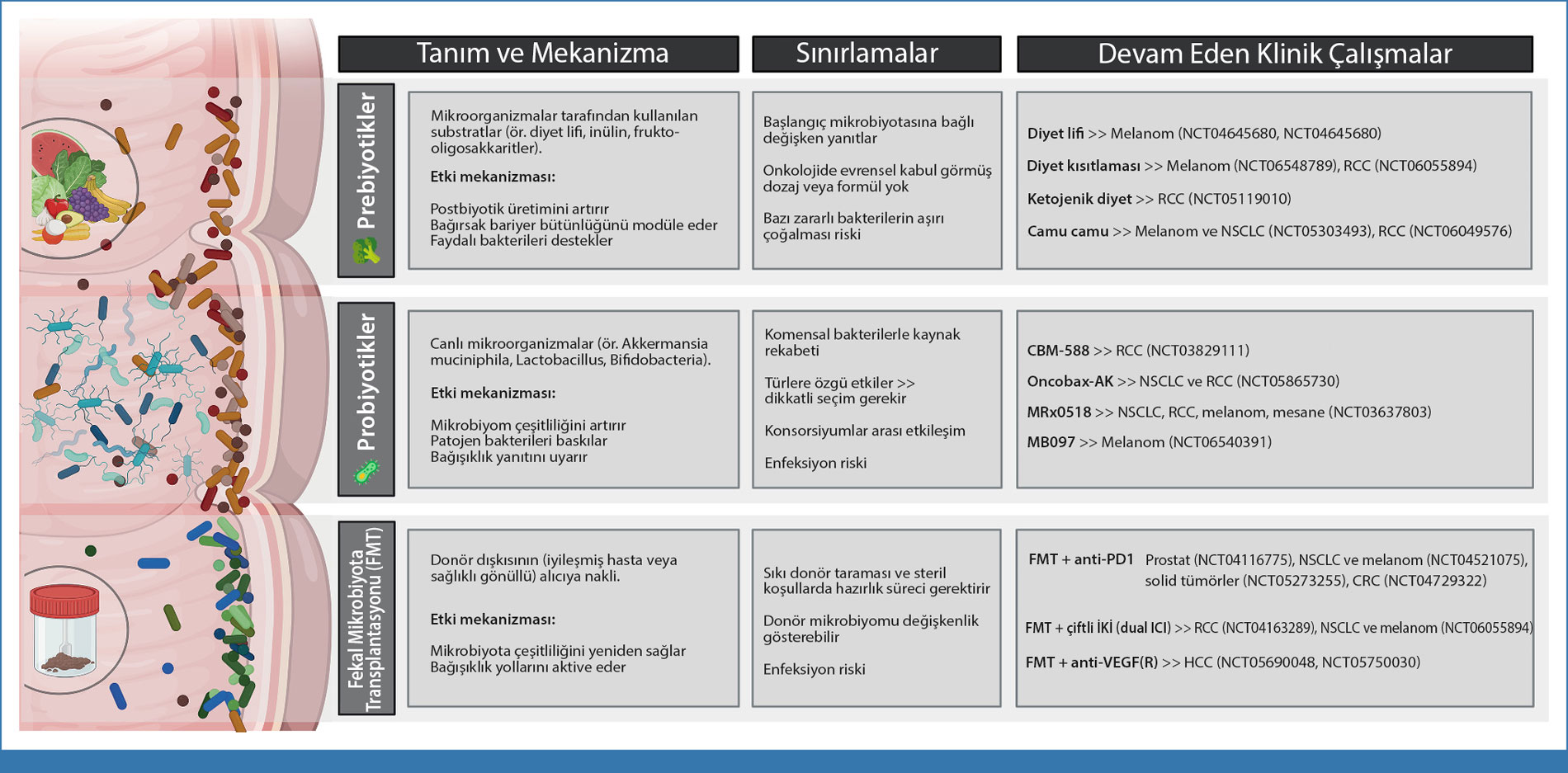
Current clinical trials evaluate various microbiome modulation approaches in cancer treatment. These prominently include prebiotics, probiotics, and fecal microbiota transplantation (FMT) as strategies.
The graphic below summarizes the main microbiome modulation approaches, their mechanisms, limitations, and ongoing clinical trials. (Doctor, a Turkish translation of the PDF’s Figure 1can be inserted here. This graphic will simplify complex information and help readers understand the subject as a whole.)
🥦 The Prebiotic Approach: The Power of Nutrition
Prebiotics are components that feed beneficial gut microorganisms and increase postbiotic production. Spencer and colleagues found in advanced melanoma patients that high dietary fiber intake significantly improved progression-free survival (PFS). Among patients consuming more than 20 grams of fiber daily, progression risk, compared with those not using probiotics, was 44% lower. Bolte and colleagues also found that a Mediterranean diet positively affected immunotherapy outcomes in advanced melanoma patients.
🦠 The Effects of Probiotics: Treatment with Living Microorganisms
Probiotics are living microorganisms thought to contribute positively to treatment. One of the most important examples is the probiotic C. butyricum MIYAIRI 588 (CBM588) in this field. Tomita and colleagues observed longer progression-free and overall survival in metastatic lung cancer (mNSCLC) patients receiving CBM588 in two retrospective series. These findings underpinned two prospective randomized trials:
- First study: Adding CBM588 in 30 mRCC patients receiving nivolumab and ipilimumab significantly increased progression-free survival and produced a higher overall response rate (58% versus 20%).
- Second study: Adding CBM588 in 30 mRCC patients receiving nivolumab and cabozantinib increased overall response to 74%, well above controls (20%). These promising results led to CBM588’s current investigation in the phase 3 SWOG BioFront trial, which will help define this probiotic’s role in standard oncology care.
💊 Fecal Microbiota Transplantation (FMT): Hope for Resistant Patients
FMT transfers fecal microbiota from a healthy donor to a patient and has produced promising results in immunotherapy-resistant patients. In two phase 1 studies of advanced melanoma resistant to anti-PD-1 therapy, adding FMT to restarted immunotherapy produced overall response rates of 30% and 20%, respectively. These are striking in a setting where ICI treatment alone produces responses below 10%.
FMT has also shown powerful effects in patients starting treatment:
- MiMic phase 1 study: In previously untreated advanced melanoma, FMT combined with anti-PD-1 therapy produced a 65% overall response rate and a 20% complete response rate. These findings suggest higher success rates than historical standard treatments.
- FMT-LUMINate phase 2 study: This trial included mNSCLC and melanoma patients. Among 20 patients in the cutaneous melanoma arm, overall response reached 75%; in the mNSCLC arm, it reached 77%. These results substantially exceed historical response rates in standard trials such as KEYNOTE 042 and KEYNOTE 024.
- TACITO phase 2 study: In metastatic kidney cancer, FMT added to pembrolizumab and axitinib increased the 12-month progression-free survival rate from 35% to 67%.
📊 Microbiome Modulation Strategies in Cancer Treatment: Summary Table
| Strategy | Mechanism | Clinical Findings | Advantages | Limitations | Ongoing Trials |
|---|---|---|---|---|---|
| Prebiotics (fiber, Mediterranean diet, camu camu, etc.) | Feed beneficial bacteria and increase postbiotic production (SCFAs, etc.) | In melanoma patients, 44% lower progression risk with ≥20 g fiber intake; better PFS/OS with a Mediterranean diet | Natural, low cost, achievable through lifestyle | No standard dose/form; excessive intake risks dysbiosis | NCT03950635 (ketogenic diet); NCT05119010 (renal cancer) |
| Probiotics (CBM588, etc.) | Living microorganisms strengthen the immune response | With CBM588 added in mRCC, ORR rose to 58–74% (controls 20%); PFS was prolonged | Potential to improve clinical response; safe | Small study samples; species selection crucial; infection risk | Phase 3 SWOG BioFront (CBM588 + ICI) |
| FMT (Fecal Microbiota Transplantation) | Healthy donor stool restructures the gut flora | In resistant melanoma, 20–30% ORR; in MiMic, 65% ORR, 20% CR; in mNSCLC in LUMINate, 77% ORR; in TACITO mRCC, 12-month PFS rose from 35% to 67% | Promising responses even in resistant patients; high success rates | Donor selection crucial; no standardization; infection risk | LUMINate (melanoma, NSCLC), TACITO (mRCC), RENMIN-215 (MSS mCRC) |
🔎 Table Abbreviations
- SCFA: Short Chain Fatty Acids
- PFS: Progression-Free Survival
- OS: Overall Survival
- mRCC: Metastatic Renal Cell Carcinoma
- ORR: Objective Response Rate
- CR: Complete Response
- ICI: Immune Checkpoint Inhibitor
- NSCLC: Non-Small Cell Lung Cancer
- MSS mCRC: Microsatellite Stable Metastatic Colorectal Cancer
🔬 Beyond the Gut: The Tumor Microbiome Also Matters
Microbiome effects extend beyond the intestine. Recent studies show that microorganisms within the tumor itself (theintratumoral microbiome) also affect treatment success. For example, some research in esophageal and lung cancers found bacteria such as Streptococcus and Escherichia within tumors to be associated with better immunotherapy responses.
🚀 Future Directions and Considerations
Microbiome modulation holds considerable potential in cancer treatment. Although early data are promising, large randomized controlled trials are required before these strategies enter routine practice. Important uncertainties remain, particularly whether interventions should be universal or personalized to each patient’s baseline microbiome composition.
Future studies will focus on refining these strategies’ design, understanding resistance mechanisms, and evaluating treatment durability. Microbiome modulation is gaining prominence as a promising supportive strategy in oncology.
Sources
DOI:10.1200/JCO-25-00374
Was this article helpful?
Your feedback helps us improve our content.




Reader comments
Share your comment
Your name and comment are published only after administrator approval. Your email address is never shown to visitors.
Be the first to comment.