
Reflections on the Surprising Findings of the Human Flourishing Study

In this article
Why Did Turkey, the United Kingdom, and Japan Rank Low in Human Flourishing?
A comprehensive study covering 22 countries worldwide was published on April 30, 2025, in Nature Mental Health . Known as the "Global Flourishing Study (GFS)," it revealed dimensions of human flourishing that extend beyond economic size. The study assessed key indicators such as happiness, health, financial security, meaning in life, and social relationships. The low rankings of countries such as Turkey, the United Kingdom, and Japan were particularly striking.
Human flourishing means more than economic or material prosperity. It also encompasses finding meaning in life, building good relationships, enjoying psychological and physical health, realizing one's potential, and living harmoniously within and contributing to one's community and environment.
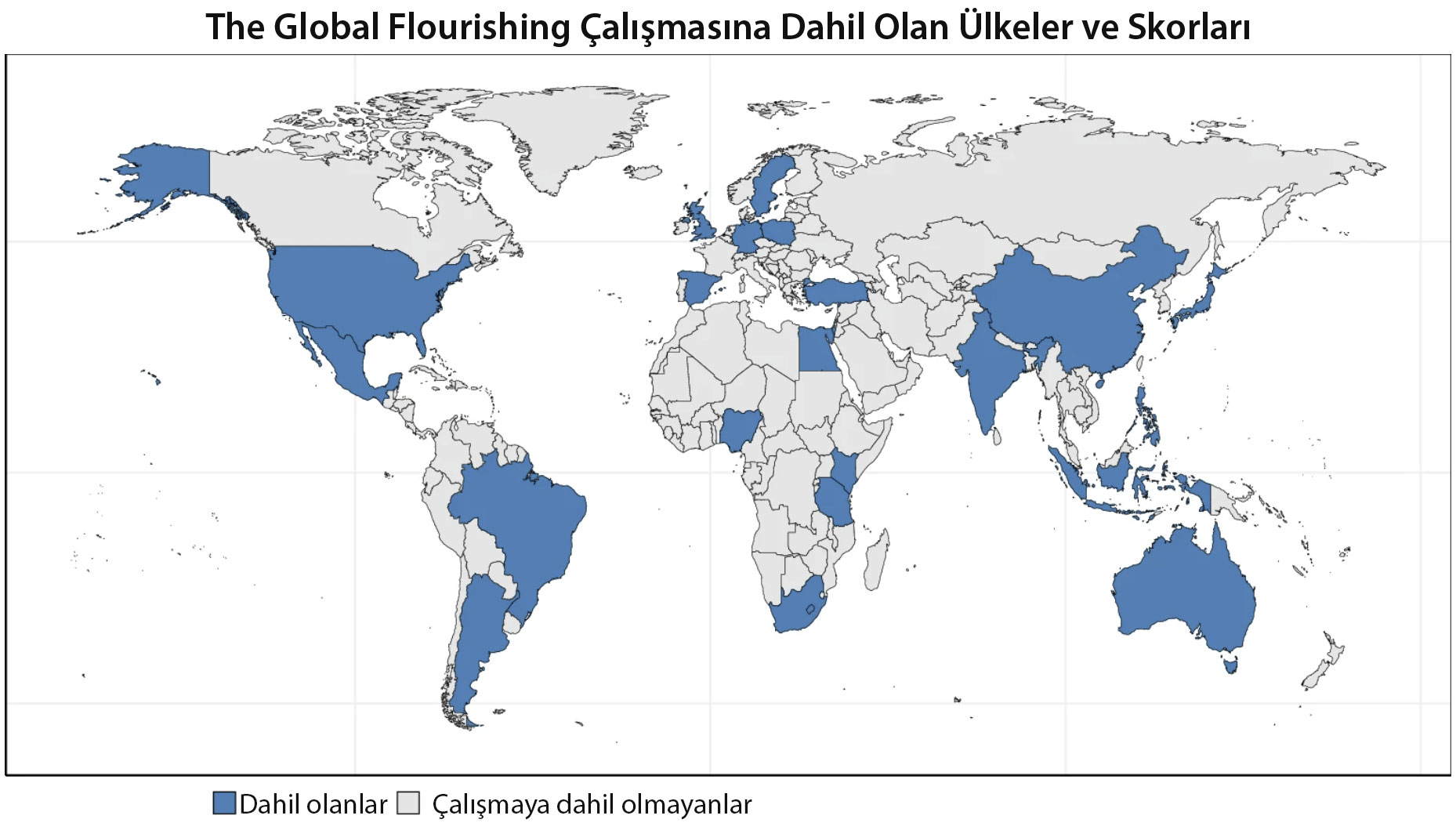
The world map above shows countries included in The Global Flourishing Study (GFS) , a five-year longitudinal study, during 2022-2023 as part of its first wave (Wave 1) . Countries shown in blueparticipated in the initial phase of the GFS and were assessed using nationally representative samples . Countries shown in gray were not included at this stage.
In keeping with the aims of the GFS, these countries were selected to provide diversity across continents and represent nearly half of the world's population.
Scores for Turkey, the United Kingdom, and Japan
The GFS composite flourishing indexis the average of 12 indicators covering six main domains:
-
Happiness
-
Physical and mental health
-
Meaning in life
-
Character/virtue
-
Social relationships
-
Financial security
Average Scores for the Three Countries (on a 0-10 Scale):
-
Turkey: 6.59
-
United Kingdom (UK): 6.88
-
Japan: 5.93 (the lowest score among all countries)
These three countries occupied the bottom three positions among the 22 countries in the GFS.
Countries With the Highest Average Flourishing Scores
-
Indonesia – 8.47
-
Israel – 8.21
-
Mexico – 8.19 (ranked second when financial security was excluded)
-
Philippines – 8.11
-
Brazil – 7.87
These countries generally stood out in "spiritual and relational" aspects of flourishing, including a strong sense of community belonging, religious participation, and robust social relationships. Although their economic prosperity was lower than that of developed countries, they scored higher in meaning in life and relationships.
What Does This Mean?
-
Turkey: Low life satisfaction among young people, economic uncertainty, and a weakening sense of community belonging are key factors behind the low scores.
-
United Kingdom: A marked decline in flourishing was observed, particularly among people aged 18-24.
-
Japan: Despite excellent objective health indicators, people's sense of meaning and satisfaction in life is very low.
How Was the Study Conducted?
The Global Flourishing Study (GFS) is a five-year multinational longitudinal panel study that began in 2022. Its first wave covered 22 countries and, as of 2023, had collected nationally representative data from 203 thousand adults. Participants were sampled to achieve balance across demographic variables such as age, sex, education, income, and religious participation.
The questionnaires were structured to create a composite flourishing index from 12 component questions across six main domains: happiness, physical and mental health, meaning in life, character/virtue, social relationships, and financial security.
Participants also answered retrospective questions about childhood, including relationships with parents, financial circumstances, health, abuse, and religious practices.
Gallup Inc. conducted international data collection using online or face-to-face surveys.
Turkey's Critical Position in Human Flourishing
Turkey stood out as one of the countries with the lowest flourishing levels among those studied. Economic uncertainty, financial insecurity, weakening social relationships, and growing dissatisfaction among young people play important roles in its low scores. Rising anxiety about the future and employment problems among young people were identified as critical factors reducing overall life satisfaction.
In Turkey, flourishing levels among young adults aged 18-24 are markedly lower than in older age groups. This reflects uncertainty in education, difficulty finding work, and concerns about economic independence. Turkey's low scores for indicators such as meaning in life and spiritual fulfillment are also notable.
Unexpected Results in the United Kingdom
Despite being economically developed, the United Kingdom ranked surprisingly low. Young people in particular appeared to have serious concerns about life satisfaction and future prospects. The article specifically notes that young people in the UK were affected by challenges such as post-pandemic social isolation and disruptions to education.
Another striking observation was an inverse relationship between economic prosperity and finding meaning in life. Although material security is high in economically strong countries such as the UK, indicators of spiritual and social fulfillment remain low.
Japan's Paradox
Japan's position was among the study's most interesting findings. Despite outstanding health indicators, such as long life expectancy and low infant mortality, it ranked last in overall flourishing. Its low scores were attributed to increasing social isolation, a sense of spiritual emptiness among young people, and difficulty finding meaning in life.
The Importance of Spiritual and Community Belonging
The study found higher adult flourishing in countries with strong religious participation and social ties. People who regularly attended religious worship or collective religious activities in childhood were particularly likely to find more meaning in adult life and have higher psychosocial well-being. In Turkey, this appears to have declined alongside the weakening of traditional and religious ties in recent years. In countries such as the United Kingdom and Japan, reduced religious and social ties were observed to lead to a lack of spiritual and community fulfillment.
The Pandemic's Effects Should Not Be Overlooked
Experts emphasize that the effects of the COVID-19 pandemic should be considered when interpreting the findings. Young people in particular were reported to have experienced substantial declines in flourishing during the pandemic because of social isolation, educational disruptions, and economic uncertainty.
Policy Recommendations for the Future
The findings highlight the importance of countries such as Turkey, the United Kingdom, and Japan developing social and spiritual policies that improve the flourishing of young people and society as a whole, alongside policies supporting economic growth. Societies need to balance economic wealth with meaning in life, social relationships, and spiritual fulfillment. Without such policies, flourishing in its fullest sense may remain unattainable.
Sources
Was this article helpful?
Your feedback helps us improve our content.




Reader comments
Share your comment
Your name and comment are published only after administrator approval. Your email address is never shown to visitors.
Be the first to comment.