
Ripretinib received FDA approval for advanced gastrointestinal stromal tumor (GIST)

In this article
On 15 May 2020, the US Food and Drug Administration approved the tablet medication ripretinib (Qinlock, Deciphera Pharmaceuticals, LLC.) for adult patients with advanced gastrointestinal stromal tumor (GIST) who had previously been treated with 3 or more kinase inhibitors, including imatinib.
What is a gastrointestinal stromal tumor (GIST), and how is it treated?
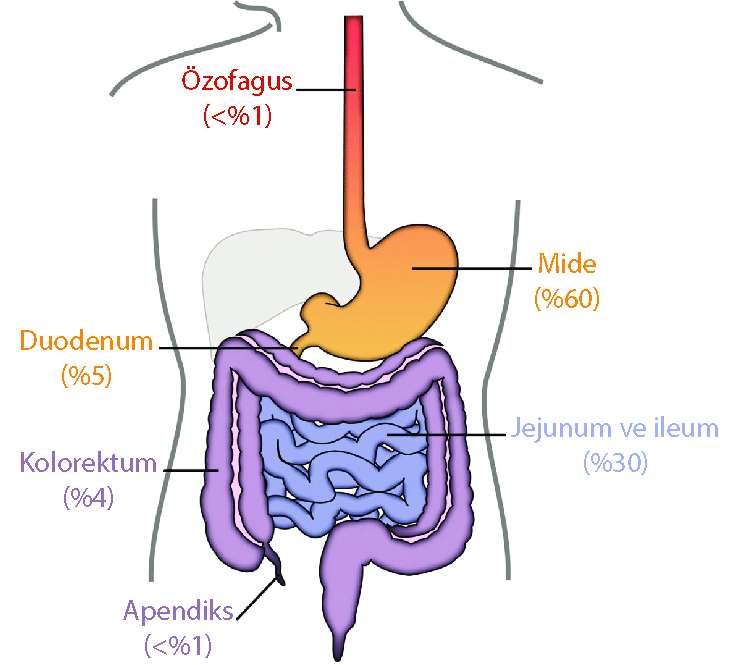
Although gastrointestinal stromal tumors (GIST) are rare tumors, they are among the most common mesenchymal cancers, with a global annual incidence of 10-15 cases per million. GIST arises from the interstitial cells of Cajal, mainly in the gastrointestinal (GI) tract, with most located in the stomach (60%).
The illustration below shows the proportions of gastrointestinal stromal tumors found in different organs of the body.
The INVICTUS study that led to FDA approval for ripretinib
The efficacy of ripretinib was evaluated in INVICTUS, an international, multicenter, randomized (2:1), double-blind, placebo-controlled study that included 129 GIST patients previously treated with imatinib, sunitinib and regorafenib.
Patients received oral ripretinib 150 mg, 150 mg, or placebo once daily until disease progression or unacceptable toxicity. Crossover at disease progression was allowed for patients randomized to placebo.
The main efficacy outcome measure was progression-free survival (PFS). Additional efficacy outcome measures included overall response rate and overall survival.
Results
- The study showed a statistically significant improvement in PFS for patients in the ripretinib arm compared with those in the placebo arm (HR 0.15; 95% CI: 0.09, 0.25; p <0.0001).
- Median PFS was 6.3 months (95% CI: 4.6, 6.9) for ripretinib versus 1.0 months (95% CI: 0.9, 1.7) for placebo.
- The objective response rate was 9% (95% CI: 4.2, 18) in the ripretinib arm versus 0% (95% CI: 0, 8) in the placebo arm, but this difference was not statistically significant.
- Median overall survival in the ripretinib arm was 15.1 months (95% CI: 0.21, 0.62), compared with 6.6 months (95% CI: 4.1, 11.6) in the placebo arm.
What is the mechanism of action of ripretinib?
Protein kinases play important roles in cellular function, and their dysregulation can lead to carcinogenesis. Ripretinib inhibits protein kinases, including wild-type and mutant platelet-derived growth factor receptor A (PDGFRA) and KIT, which causes most gastrointestinal stromal tumors (GIST). In vitro, ripretinib has been shown to inhibit PDGFRB, BRAF, VEGF and TIE2 genes.
Ripretinib binds to receptors associated with mutations in KIT gene exons 9, 11, 13, 14, 17 and 18 and PDGFRA gene exons 12, 14 and 18. A protein kinase’s "switch pocket" is normally bound to the activation loop and functions as an "on-off switch" for a kinase. Ripretinib has a unique dual mechanism of action that binds to the kinase switch pocket as well as the activation loop, thereby switching off the kinase and its ability to cause dysregulated cell growth.
With ripretinib, the most common (≥% 20) adverse effects are alopecia, fatigue, nausea, abdominal pain, constipation, myalgia, diarrhea, decreased appetite, palmar-plantar erythrodysesthesia and vomiting. Other important risks of ripretinib include new primary cutaneous malignancies, hypertension and cardiac dysfunction.
The recommended ripretinib dose is 150 mg orally once daily, with or without food.

Sources
Was this article helpful?
Your feedback helps us improve our content.




Reader comments
Share your comment
Your name and comment are published only after administrator approval. Your email address is never shown to visitors.
Be the first to comment.