
The Sitting–Rising Test: Can a Simple Movement Predict Your Quality of Life and Lifespan?

In this article
Why Should We Stay on Our Feet?
Modern lifestyles have placed physical inactivity at the center of our lives. Yet the human body is designed to move, maintain balance and use its strength . As we age, basic physical abilities such as muscle strength, flexibility and balance naturally decline. However, the speed or impact of this decline is often overlooked.
So what clues can a simple movement that we often perform in daily life— “sitting down on the floor and getting back up” —give us about our general health and even our lifespan ?
A new scientific study explores this surprising question, showing that physical fitness can be assessed not only in gyms, but even with a simple test performed at home , and revealing how critical a role this may play in preventing premature deaths .
What Is the Sitting–Rising Test (SRT) and Why Does It Matter?
The sitting–rising test (SRT), known scientifically as the Sitting–Rising Test, requires no equipment and can be performed quickly and safely. It assesses 4 important physical abilities at the same time:
- Muscle strength and power
- Flexibility
- Balance
- Body composition
The aim of the test is for the person to sit down on the floor and stand up again without support or with minimal support . SRT draws attention, particularly in cardiology , to generally overlooked yet strong predictors of survival : the non-aerobic fitness components.
The Sitting–Rising Test’s 25-Year Scientific Journey
1998–2001: Laying the Foundations
- 1998: The CLINIMEX open cohort study was launched in Brazil.
- 1999: Araújo introduced the sitting–rising test (SRT).
- 2000–2001: The first studies on reliability and the effect of body weight were conducted.
2013–2016: Strengthening Clinical Relevance
- 2014: SRT scores were found to be associated with all-cause mortality.
- 2015–2016: Non-aerobic fitness components were defined, and applications in different scenarios in cardiac patients were published.
2019–2021: Global Spread and Use Across Age Groups
- Research linked to SRT was conducted in areas such as push-up capacity, fear of falling and cognitive development in children.
- 2020: Age- and sex-specific SRT reference values were published.
2022–2024: Strong Links Between SRT and Lifespan
- Links between lifespan and single-leg standing and cardiovascular exercise tests were examined.
- 2023 (December): Data collection for the CLINIMEX cohort was completed (8566 people).
- 2024 (March): Final censoring date for causes of death and vital status data.
2025: A Key Publication and Scientific Milestone
- June 2025: A new article showing that SRT is a stronger predictor than muscle strength was published on June 18, 2025 in the European Journal of Preventive Cardiology journal.
Scoring System: How Is It Assessed?
SRT scoring is quite straightforward:
- Sitting: 5 points
- Rising: 5 points
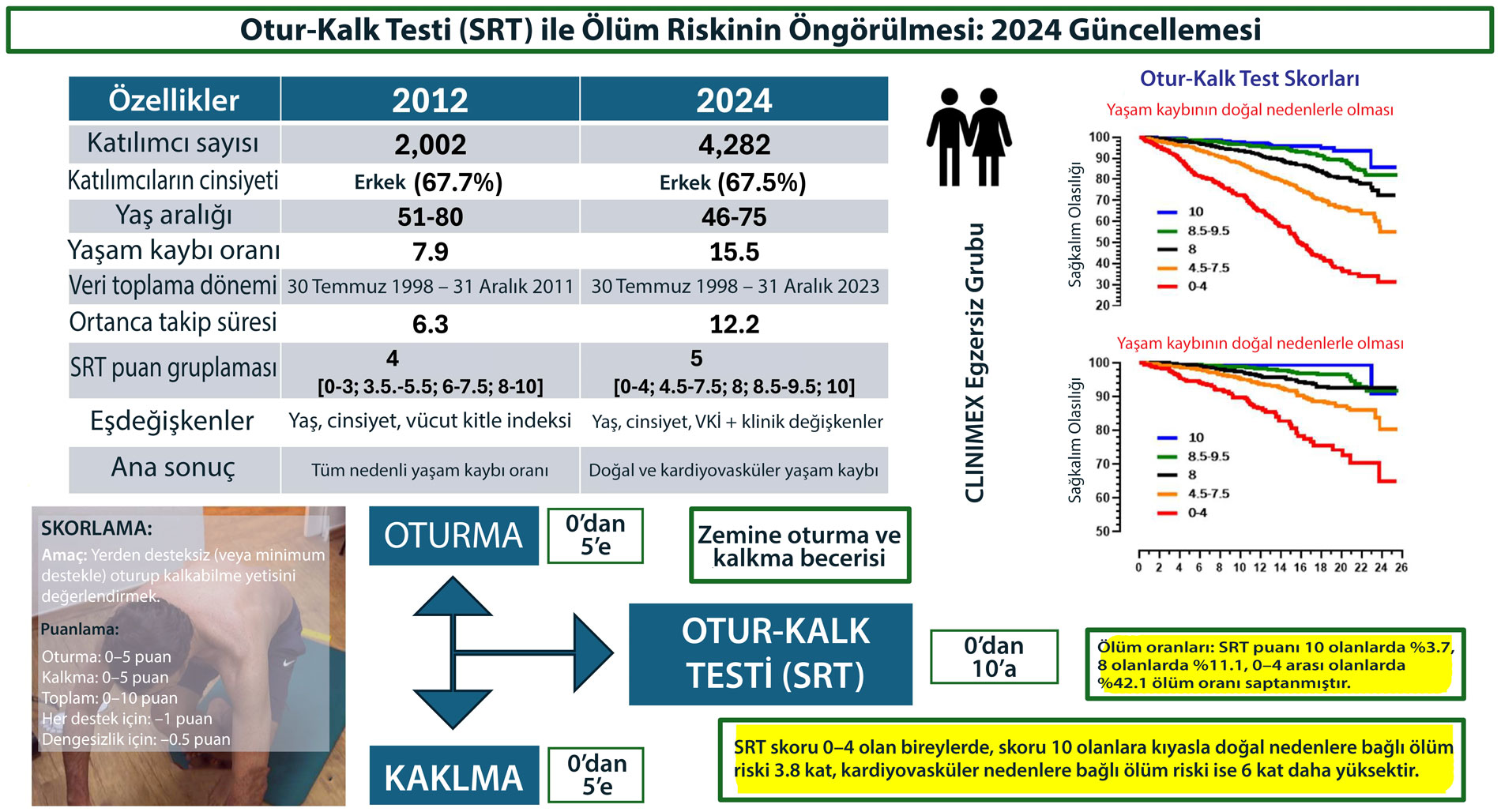
Movements performed without any support (hand, knee, forearm, side of the leg) and without wobbling receive full marks (5) . For each support used, 1 pointis deducted, and for slight instability, 0.5 points are deducted. The total SRT score therefore ranges from 0 to 10 .
What Does the Scientific Evidence Say? The Surprising Link Between the Sitting–Rising Test and Lifespan
📚 European Journal of Preventive Cardiology published a 2025 study in which 4282 adults aged 46–75 were followed over the long term. All participants underwent the SRT and were followed for an average of 12.3 years .
📉 Low Score, High Risk:
In the study, the mortality rate in the group scoring 0–4 was 42.1% , whereas among those with a full score of 10 it was only 3.7% . This means an 11.4-fold higher risk of death .
❤️ Risk of Cardiovascular Death:
Those with an SRT score of 0–4 had a risk of death from natural causes that was 3.84 times higher, and a risk of cardiovascular death that was 6.05 times higher . These differences remained significant even after adjustment for factors such as age, sex, BMI and chronic diseases .
📈 The Importance of Small Declines:
Each 1-point decreasein SRT score was associated with a 33%increase in the risk of death from natural causes and a 31% increase in the risk of cardiovascular death.
What It Means for People With Heart Disease
🫀 People with a history of coronary artery disease (CAD) also showed a strong relationship between SRT score and risk of death. In participants with CAD, there was a link between low SRT scores, on the one hand, and higher mortality risk on the other.
This finding suggests that SRT may be an effective tool not only in healthy individuals, but also in people with chronic diseases as a prognostic tool .
You can access the video mentioned in the article, which shows how to perform the sitting–rising test, here:
Why Is the Sitting–Rising Test So Important?
SRT is such a powerful predictor because it assesses multiple physical abilities with a single movement. These abilities are:
- Muscle strength and muscle weakness (dynapenia)
- Level of flexibility
- Balance ability
- Body composition (fat/muscle ratio)
The following risk factors are generally observed in people with low SRT scores:
- ⚖️ Excess body fat
- 💪 Muscle weakness
- 🧘♀️ Reduced flexibility
- 🚶♂️ Poor balance and risk of falling
These combinations may limit people’s activities of daily living, increase the risk of falls and impair their ability to exercise regularly.
Integration Into Clinical Practice and Next Steps
🏥 This study supports incorporating the sitting–rising test (SRT) into routine examinations. Completed in minutes, this simple test provides information about people’s non-aerobic fitness levels that is clinically and prognostically important .
💡 Developing personalized exercise prescriptions and making early intervention decisions can be aided by this effective tool.
🔬 Future research should focus on the following questions:
- 🏋️♀️ Which types of exercise most effectively improve SRT scores?
- 🕒 Does an increase in SRT score extend lifespan?
- 🏃♂️ Can SRT provide prognostic information beyond aerobic fitness as an additional benefit?
Conclusion: Stand Up for a Healthy Future!
The sitting–rising test (SRT)stands out in middle-aged and older individuals as a powerful predictor of death from natural and cardiovascular causes.
This simple, safe and equipment-free test assesses muscle strength, balance, flexibility and body composition at the same time, providing healthcare professionals with valuable information about these critical parameters.
✅ For anyone who is healthy or has a chronic disease—provided they have no physical limitations—having this test regularly may both extend lifespan and improve quality of life.
Sources
Was this article helpful?
Your feedback helps us improve our content.




Reader comments
Share your comment
Your name and comment are published only after administrator approval. Your email address is never shown to visitors.
Be the first to comment.