
What Are DNA Damage Response (DDR) Genes? Their Role in Cancer and Differences from HR Genes

In this article
Our bodies contain about 37 trillion human cells. Except for erythrocytes, or red blood cells, all cells contain DNA , which holds life's basic instructions and is continually damaged by internal and external factors. Because DNA carries the code of life, protecting and repairing it is vital.
Why Does DNA Become Damaged?
DNA damage has many causes, including environmental factors, lifestyle, obesity, cellular metabolism, chemicals particularly from smoking, and radiation. For example:
- Cellular Processes: Errors during DNA replication (copying) and cell division can damage DNA. The more a cell divides, the more opportunities for errors. Epithelial cells and blood stem cells are among our most frequently dividing cells. Epithelial cells are associated with breast and gastrointestinal cancers, while blood stem cells are associated with leukemias and lymphomas. As we age, division-related DNA errors accumulate or are insufficiently repaired, making aging the most important cancer risk factor.
- Free Radicals: Free radicals produced during cellular metabolism can cause oxidative DNA damage. Obesity is thought to increase oxidative damage through cellular metabolism.
- Chemicals: Chemicals in cigarette smoke and certain industrial chemicals can damage DNA.
- Ultraviolet Rays: The ultraviolet (UV) component of sunlight can cause DNA bases to form dimers.
- Radiation: Medical treatments such as radiotherapy and radioactive substances can damage DNA.
DNA and Repair Mechanisms
The body has several repair mechanisms to maintain DNA integrity. They detect damage, repair affected regions and ensure genetic information is preserved accurately. These mechanisms include homologous recombination (HR), nucleotide excision repair and base excision repair. Aziz Sancar received the Nobel Prize in Chemistry for his discoveries in nucleotide excision repair.
What Are DDR Genes?
DNA damage response (DDR) genes regulate cells' biological responses to DNA damage. They involve mechanisms that detect damage, prevent its spread and initiate repair. By protecting genetic material, DDR genes control the cell cycle and repair damaged DNA when needed.
What Are Homologous Recombination (HR) Genes?
Homologous recombination (HR) genes are an important part of cellular DNA repair and a subgroup of DDR genes. They play critical roles, particularly in repairing DNA double-strand breaks. HR repairs damaged DNA using a template from the homologous chromosome or a sister chromatid. BRCA1 and BRCA2 are among the best-known HR genes and play an important role in breast and ovarian cancer risk.
HR gene defects produce the condition known as HRD and HRD positivity is important for predicting treatment response and selecting medicines, particularly in ovarian cancer.
35 DDR Genes and Their Repair Functions
This section details 35 cancer-associated DDR genes and their repair functions. They are involved in base excision repair, damage sensing, Fanconi anemia, homologous recombination, mismatch repair, nucleotide excision repair, SWI/SNF chromatin remodeling and the TP53 pathway in DNA damage responses.
The DDR genes and their repair functions are listed below:
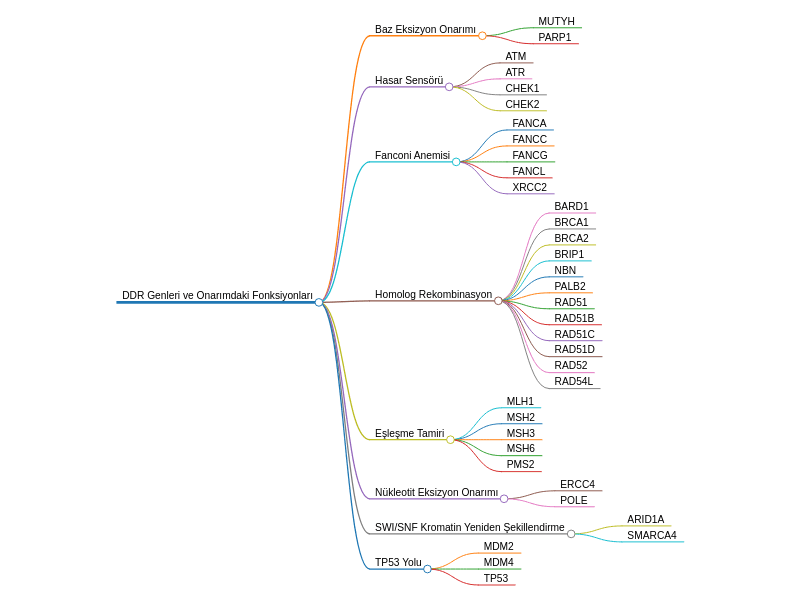
- Base Excision Repair: MUTYH, PARP1
- Damage Sensor: ATM, ATR, CHEK1, CHEK2
- Fanconi Anemia: FANCA, FANCC, FANCG, FANCL, XRCC2
- Homologous Recombination (HRR): BARD1, BRCA1, BRCA2, BRIP1, NBN, PALB2, RAD51, RAD51B, RAD51C, RAD51D, RAD52, RAD54L
- Mismatch Repair (Associated with Lynch Syndrome): MLH1, MSH2, MSH3, MSH6, PMS2,
- Nucleotide Excision Repair: ERCC4, POLE
- SWI/SNF Chromatin Remodeling: ARID1A, SMARCA4
- TP53 Pathway: MDM2, MDM4, TP53
Related topic: Inherited Cancers, Associated Gene Mutations and Risk Management
DDR and HR: Similarities and Differences
Similarities
- Roles in Repairing DNA Damage: Both HR and DDR genes participate in detecting and repairing DNA damage.
- Links to Cancer Development: Dysfunction in either group may increase cancer risk.
- Roles in the Cellular Stress Response: Both groups participate in cellular stress responses and regulate the cell cycle in response to DNA damage.
Differences
- Repair Mechanisms: HR genes mainly repair double-strand breaks through homologous recombination, whereas DDR genes encompass a broader spectrum of DNA damage responses.
- Functional Diversity: DDR genes have more varied functions, including damage detection and signaling.
- Links to Genetic Diseases: Certain specific HR mutations have been directly associated with particular cancer types.
How Are DDR Genes Tested?
Various methods are used to detect DDR gene alterations.
- Immunohistochemistry (IHC) and fluorescence in situ hybridization (FISH) are traditional techniques, alongside more advanced technologies used to detect DNA damage response (DDR) gene alterations. For example, "Comprehensive Genomic Profiling" (CGP) is a method used to identify DDR gene changes.
- In recent years, "next-generation sequencing" (NGS) has been widely used to detect DDR gene alterations. It can identify genetic changes with high sensitivity and has become an important tool in this field.
- Molecular techniques used to detect DDR changes also include "quantitative polymerase chain reaction" (qPCR) and "Southern blotting" as additional methods.
2 Notable Studies on DDR Genes and Their Findings
1. Article: "Genomic and Molecular Landscape of DNA Damage Repair Deficiency across The Cancer Genome Atlas" - Cell Reports, April 2018
Key Findings:
- Alterations in DNA damage repair (DDR) genes are common across many human cancers.
- Homologous recombination (HR) and direct repair are the most frequently altered processes.
- Loss of DDR function is associated with the frequency and types of cancer genomic abnormalities.
- Changes in HR function may be associated with better or worse outcomes depending on cancer type.
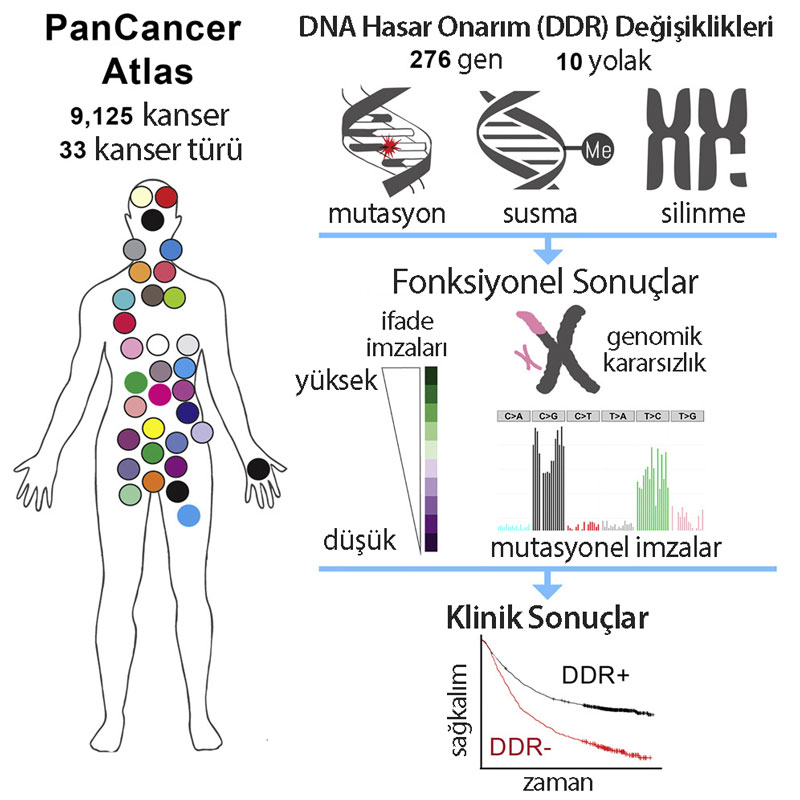
You can see this study's graphical summary below:
Summary:
- Somatic DDR gene alterations affect cancer risk, progression and treatment response.
- Mutations and loss of heterozygosity are common in DDR genes such as TP53 and BRCA1/2.
- TP53 was the most frequently altered DDR gene across all cancers (68.1%).
- Epigenetic silencing in direct repair genes such as EXO5, MGMT and ALKBH3 occurs at a rate of about 20%.
- HRD occurs at varying frequencies across many cancers, particularly ovarian cancer.
- The functional consequences of rare recurrent DDR mutations can be predicted through protein structure-based analyses.
- A new machine learning-based classifier was developed to identify harmful TP53 mutations.
2. Article: "Relationship among DDR Gene Mutations, TMB and PD-L1 in Solid Tumour Genomes Identified Using Clinically Actionable Biomarker Assays" - Nature Precision Oncology, October 2023
Key Findings:
- DDR gene mutations may increase tumor mutational burden (TMB) , a biomarker that predicts benefit from anti-PD-1/PD-L1 immunotherapies.
- The relationship between particular DDR mutations, TMB and PD-L1 expression needs better understanding to improve translational strategies.
Summary:
- Dysregulation of the DDR pathway is a critical component of tumor genomic instability.
- This study identified frequencies of genomic alterations in DDR genes selected as clinically important biomarkers.
- Mutations in the SWI/SNF chromatin remodeling genes ARID1A and SMARCA4 were significantly associated with high TMB across multiple tumor types.
- ATR mutations were associated with high TMB in colorectal and prostate cancers.
- Associations between individual DDR mutations and high PD-L1 expression are rare and tumor-specific.
- A weak association was found between high TMB and high PD-L1 expression, highlighting their roles as independent predictive biomarkers.
These two studies show that DDR alterations have important effects on cancer biology and treatment, and that research in this field is critical to the future of cancer care.
*
Image description: The article's image was generated by Microsoft Copilot using the following prompt: "Biological robots repairing DNA"
Sources
2. Wang D, Elenbaas B, Murugesan K, Shah K, Montesion M, Gounaris I, Scheuenpflug J, Locatelli G, Feng Z. Relationship among DDR gene mutations, TMB and PD-L1 in solid tumour genomes identified using clinically actionable biomarker assays. NPJ Precis Oncol. 2023 Oct 11;7(1):103. doi: 10.1038/s41698-023-00442-4. PMID: 37821580; PMCID: PMC10567713.
Was this article helpful?
Your feedback helps us improve our content.




Reader comments
Share your comment
Your name and comment are published only after administrator approval. Your email address is never shown to visitors.
Be the first to comment.