
What is a BRIP1 gene mutation? What you need to know

What is an inherited BRIP1 mutation? General information for carriers
- The name BRIP1 comes from “BRCA1 Interacting Protein 1”. The BRIP1 gene is located on chromosome 17 and helps repair damaged DNA in cooperation with BRCA1. Although these two genes work together, their mutations have different effects; people carrying a BRIP1 mutation do not have the same cancer risk as people carrying a BRCA1 mutation.
- Women carrying a BRIP1 mutation have a higher risk of ovarian cancer.
- For people with a BRIP1 mutation, guidelines exist for screening and preventing certain cancers.
- People who test positive for a BRIP mutation can also participate in clinical trials. People carrying a BRIP1 mutation who have been diagnosed with cancer may also be eligible for certain treatments, such as a PARP inhibitor, and participate in clinical trials.
- Two mutations in BRIP1 inherited by a child, one from each parent, cause a rare disease known as Fanconi anemia.
- Both men and women can carry a mutation in the BRIP1 gene.
Which cancer risks are increased by an inherited BRIP1 mutation?
If an inherited BRIP1 mutation test is positive, for a review of your and your family's cancer history and help choosing the best plan to manage your cancer risk, you are advised to contact a multidisciplinary oncology team.
Risks for women carrying a BRIP1 mutation
- The lifetime risk of ovarian cancer is approximately 6%.
- Triple-negative breast cancer is among the forms of breast cancer for which they have a potentially higher lifetime risk.
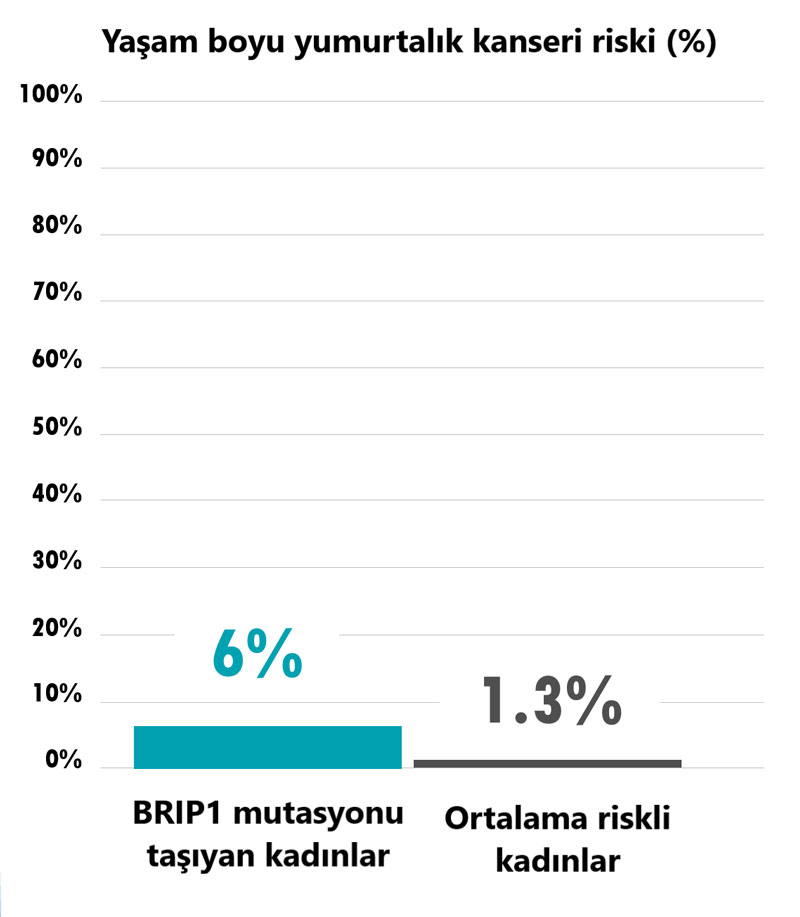
Other cancer risks for people carrying a BRIP mutation
There is currently insufficient evidence to establish that a BRIP1 mutation carries a higher risk of other adult-onset cancers. Studies of cancer risk in people carrying a BRIP1 mutation are ongoing.
Risk management for people carrying an inherited BRIP1 mutation
The US National Comprehensive Cancer Network (US-NCCN) provides risk management guidelines for people with a BRIP1 mutation. You are advised to consult a multidisciplinary oncology team that can review your and your family's cancer history and help you decide on the best risk management plan.
Recommendation for preventing ovarian cancer
The National Comprehensive Cancer Network (NCCN) recommends that women carrying a BRIP1 mutation consider risk-reducing salpingo-oophorectomy (surgical removal of the ovaries and fallopian tubes) between ages 45 – 50, or earlier if there is a family history of early ovarian cancer.
Recommendation for screening and preventing other cancers
There is insufficient research demonstrating a benefit from screening and prevention for other cancers in people carrying a BRIP1 mutation. Experts therefore recommend managing these risks based on the family history of cancer. People with a BRIP1 mutation may participate in research studies on cancer screening and prevention.
Cancer treatment for women carrying an inherited BRIP mutation
People carrying an inherited BRIP1 mutation who have been diagnosed with cancer may have different treatment options from people who do not carry a mutation.
If you have an inherited BRIP1 mutation, have been diagnosed with cancer and any of the following situations apply to you, you may wish to talk to your doctor about your medical options. You may also enroll in a clinical trial, one of the best treatment options for people with an inherited BRIP1 mutation.
- Having metastatic prostate cancer.
- Having advanced ovarian cancer.
PARP inhibitors
PARP inhibitors block a protein used to repair damaged DNA and are a type of targeted therapy. In people with inherited BRCA1 or BRCA2 mutations, they were originally developed to treat cancer. Since then, research and additional FDA approvals have expanded the use of PARP inhibitors to more situations. People with a BRIP1 mutation who have been diagnosed with cancer may wish to consult their doctors about PARP inhibitor treatment.
PARP inhibitors for metastatic prostate cancer
The PARP inhibitor Lynparza (olaparib) has received FDA approval to treat men with metastatic castration-resistant prostate cancer who have a mutation in BRIP1 or another gene associated with a certain type of DNA damage repair. Lynparza can be used after enzalutamide (Xtandi) or abiraterone (Zytiga) in patients whose prostate cancer has progressed.
PARP inhibitors for advanced ovarian, fallopian tube or peritoneal cancer
Various PARP inhibitors have been approved to treat ovarian cancer at different stages of the disease. In some situations, HRD (homologous recombination deficiency) testing, known as a tumor biomarker test, may help women carrying a BARD1 mutation who have advanced ovarian cancer determine whether they could benefit from a PARP inhibitor.
Advanced cancer recurring after third-line treatment:
- HRD testing may help women with advanced ovarian cancer that recurs after third-line treatment and an inherited BRIP1 mutation determine whether they can benefit from the PARP inhibitor Zejula (niraparib).
Maintenance treatment after first-line treatment:
- For women with advanced ovarian cancer and an inherited BRIP1 mutation, following first-line platinum chemotherapy, maintenance treatment with bevacizumab combined with the PARP inhibitor Lynparza is a combination for which HRD testing helps determine whether they could benefit.
- Zejula was approved for maintenance treatment in women who had a complete or partial response to first-line platinum-based chemotherapy for advanced ovarian, fallopian tube or primary peritoneal cancer. In this situation, HRD testing is not required for maintenance treatment with Zejula.
Maintenance treatment after treatment for recurrent cancer:
Zejula, Rubraca (rucaparib) and Lynparza have all been approved for maintenance treatment in women with recurrent epithelial ovarian, fallopian tube or primary peritoneal cancer who have a complete or partial response to platinum-based chemotherapy. None of these medicines requires HRD testing in this situation.
Sources
Was this article helpful?
Your feedback helps us improve our content.




Reader comments
Share your comment
Your name and comment are published only after administrator approval. Your email address is never shown to visitors.
Be the first to comment.