
PARP Inhibitors – A New Drug Class Transforming Ovarian Cancer Treatment

In this article
Ovarian cancer – Importance and statistics
In developed countries, among all gynecological (female-specific) cancers that cause death, ovarian cancer accounts for a substantial proportion. According to the World Health Organization (WHO), approximately 295,000 new ovarian cancer cases were identified worldwide in 2018, and 185,000 people died. Because ovarian cancer is difficult to diagnose in its early stages, most patients present with advanced disease. Research shows that 59% of people diagnosed with ovarian cancer are at a metastatic stage at diagnosis, while 21% have locally advanced disease with spread to the lymph nodes. The 5-year relative survival rate for people with metastatic epithelial ovarian cancer is only 29.2%.
For people with newly diagnosed advanced ovarian cancer, initial treatment generally begins with surgery. This includes total hysterectomy (removal of the uterus) and cytoreductive surgery, also known as surgically removing all visible tumors. The aim of cytoreductive surgery is to remove as much cancerous tissue as possible from the abdomen, including the ovaries, uterus, peritoneum, and lymph nodes. Surgery is followed by platinum-based chemotherapy together with treatment using the vascular endothelial growth factor (VEGF) inhibitor bevacizumab. The main treatment given after surgery is followed by the antiangiogenic agent bevacizumab or, in patients with a BRCA mutation, a poly ADP ribose polymerase (PARP) inhibitor used for maintenance therapy (an intervention after the main treatment to reduce the likelihood of cancer recurrence). If a person is unsuitable for surgery or the expected benefit of cytoreductive surgery is low, neoadjuvant (preoperative tumor-shrinking) treatments may be given.

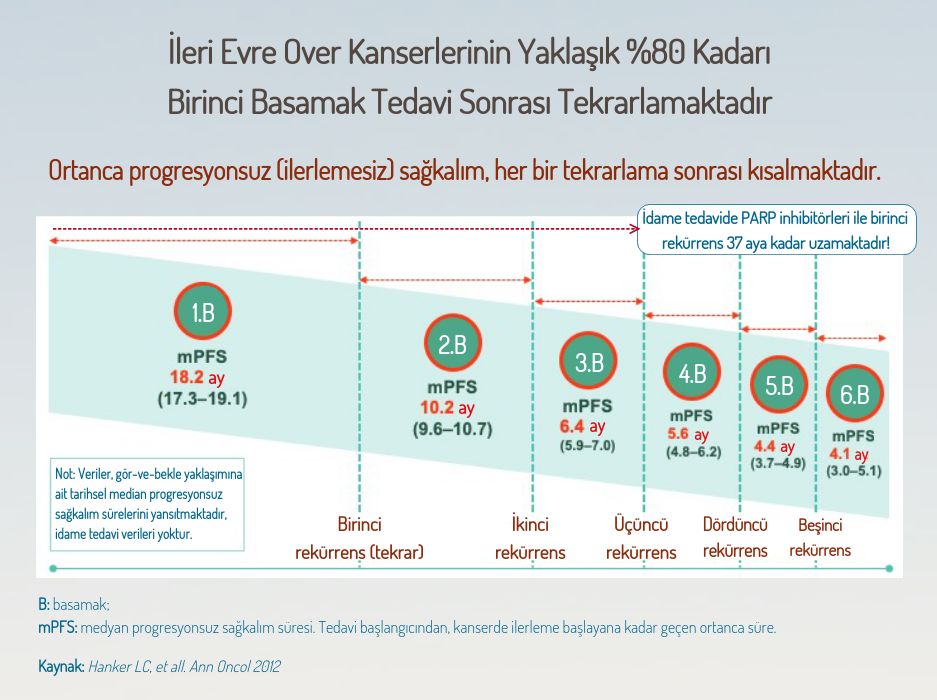
Despite a good response to first-line treatment, most people with ovarian cancer experience recurrence less than 2 years after diagnosis. However, after first-line treatments, longer progression-free survival increases the response to second chemotherapy treatments given if the cancer recurs. It is therefore extremely important to find the most suitable treatment option for the patient and identify options with higher clinical response beyond the standard protocol.
The role of genetic testing in selecting treatment options
Although many treatment options are available for women with advanced ovarian cancer, the chosen treatment is not suitable for every patient. Treatment should therefore be selected with the characteristics of the patient's tumor in mind.
Genetic / molecular testing is now indispensable in ovarian cancer treatment planning and is the first step in choosing the right treatment: every woman with ovarian cancer must undergo genetic testing to obtain the best benefit from treatment and prevent cancer in future generations carrying a gene predisposing them to ovarian cancer.

Of the most common type of ovarian cancer, approximately 50% of advanced serous ovarian cancers have germline (inherited) or somatic mutation-related homologous recombination repair deficiency. These individuals are known to benefit from PARP inhibitors.
Studies have found that the BRCA gene plays an important role in the development of ovarian/fallopian tube cancers. Approximately 10% to 15% of women with ovarian cancer have a germline (inherited) BRCA mutation, while around 7% harbor somatic (noninherited) BRCA gene mutations. In addition to this mutation, patients carry several other mutations unrelated to BRCA. Patients with ovarian cancer who carry BRCA1/2 mutations show different clinical characteristics and also differ in their treatment responses.
The BRCA gene plays a role in DNA repair through homologous recombination (HR). Mutations in BRCA genes therefore lead to HR deficiency. In patients with advanced ovarian cancer, HR deficiency and other inherited cancer genes should also be tested alongside BRCA1/2.
What is homologous recombination deficiency (HRD)?
Homologous recombination deficiency (HRD) has been defined as a deleterious or suspected deleterious BRCA mutation or genomic instability in patients whose most recent platinum-based chemotherapy response was followed by disease progression more than six months later.
How are PARP inhibitors changing cancer treatments?
The introduction of PARP inhibitors changed the course of the disease for many patients with ovarian cancer. In 2014, the United States Food and Drug Administration (FDA) approved, for advanced ovarian cancer with a deleterious germline BRCA mutation in patients who had previously received three or more lines of chemotherapy, the first PARP inhibitor, olaparib (Lynparza). Today, 3 PARP inhibitors (olaparib, rucaparib, niraparib) have been approved by the FDA for ovarian cancer. A recent additional approval also covers their use as first-line maintenance therapy in ovarian cancer with a complete or partial response to platinum-based treatment, even without a positive BRCA1/2 mutation.


The greatest advantage of PARP inhibitors is that they directly target cancer cells, using their inherited deficiencies to exert their effects while having little impact on healthy cell function. Tumors with deficiencies in the homologous recombination repair pathway are particularly vulnerable to the mechanisms of PARP inhibitors. Thus, the PARP protein, which plays an important role in DNA repair and whose effect is suppressed by inhibitors, together with the HR pathway that cannot function because of its deficiencies, prevents repair of DNA damage in tumor cells, causing cell death. This is often seen in tumors with mutations in the BRCA gene, which is responsible for producing proteins important in maintaining DNA repair mechanisms. Mechanisms other than BRCA gene mutations can also alter the homologous recombination repair pathway and help provide clinical benefit from PARP inhibitors.

PARP is a protein important for repairing single-strand breaks in DNA and helps repair cell damage. Cells are less able to repair themselves when BRCA1 and/or BRCA2 gene mutations are present. PARP inhibitors prevent DNA repair and thereby cause cell death.
Approximately 50% of advanced serous ovarian cancers have a germline- or somatic-mutation-related deficiency in the homologous recombination repair pathway, and this patient group is likely to benefit from PARP inhibitors. Studies show that, in women with ovarian cancer carrying BRCA1/2 mutations, continuing PARP inhibitors used for maintenance when the disease recurs provides, compared with placebo, up to 4 times longer progression-free survival. In addition, BRCA1/2-mutation-positive patients who respond to first-line chemotherapy and receive a PARP inhibitor as maintenance therapy face, compared with placebo, 70% lower disease progression and mortality. However, when the disease recurs, the frequently observed development of platinum resistance prevents a response to PAPR inhibitors.
New data on PARP inhibitors
We now know that all patients with ovarian cancer, rather than only those with a positive BRCA mutation, benefit from PARP inhibitors. BRCA-mutant patients and those with HR deficiency naturally benefit more, but even without a BRCA mutation, patients with a good response to the first course of platinum-based chemotherapy also benefit from PARP inhibitor maintenance therapy. In April 2019, niraparib received approval as maintenance therapy based on the PRIMA study.
The first FDA approvals for maintenance therapy in patients with advanced ovarian cancer were in patients who had received two or more lines of treatment. For maintenance therapy, the first approved drug was niraparib (March 2017), followed by olaparib and rucaparib. As noted above, giving these drugs as maintenance after successful chemotherapy has been shown to increase the time to disease progression 4-fold and reduce the risk of recurrence or death by more than 70%. This success is more pronounced in patients with BRCA mutations, but risk reduction was also around 60% in patients without a BRCA mutation.
After first-line treatment, the first PARP inhibitor approved for maintenance therapy was olaparib (December 2018). Patients receiving olaparib as maintenance after first-line treatment showed a 70% reduction in recurrence risk. The FDA approval in this setting applies to patients with BRCA mutations. The first-line maintenance study of Niraprib (PRIMA) was published in September 2019; in patients with homologous recombination deficiency, it reduced progression risk by 57% and extended the progression time 2-fold, with FDA approval following on 29 April 2020.
The latest FDA approval for PARP inhibitors was in May 2020, based on the PAOLA1 study, which assessed the efficacy and safety of PARP inhibitors together with VEGF inhibitors for the first time. In this study, the group receiving olaparib plus the antiangiogenic agent bevacizumab was compared with a placebo plus bevacizumab group. The mean progression-free survival time increased from 17.7 to 37.2 months with the PARP inhibitor, leading to FDA approval on these results (see the related approval).

Veliparib is a PARP inhibitor tested in many clinical trials but not yet approved by the FDA. In the VELIA study, whose results were published in September 2019, this PARP inhibitor was used differently: not after first-line systemic therapy, but directly during first-line systemic therapy and afterward as maintenance. In newly diagnosed advanced ovarian cancer, veliparib added to induction chemotherapy with carboplatin + paclitaxel, followed by maintenance veliparib, showed better progression-free survival than chemotherapy alone, but has not yet received FDA approval.


The importance of informing patients about PARP inhibitors
Although women with ovarian cancer may initially hesitate to begin maintenance therapy with PARP inhibitors immediately after chemotherapy, explaining all stages from the start of treatment, outlining the full treatment plan, and informing them about maintenance therapy will probably reassure them.
If a PARP inhibitor is likely to be used as maintenance, the patient should know that treatment will not end after chemotherapy. It is extremely important to convey all necessary information accurately and completely to the patient, particularly when life expectancy is short in advanced cancers.
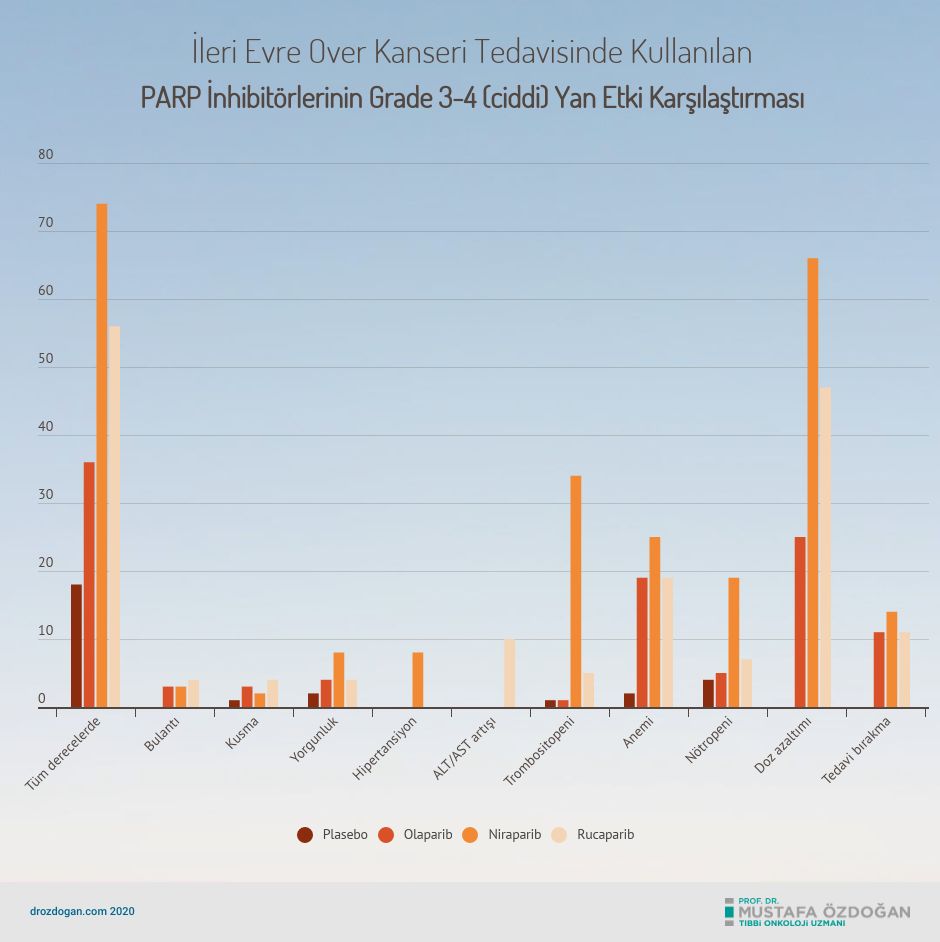
It is also extremely important to inform patients about the possible side effects of PARP inhibitors. Unlike chemotherapy, most PARP inhibitor side effects, such as nausea, fatigue, and anemia, occur at the beginning of treatment. If their timing is not explained well, patients may want to stop the PARP inhibitor within the first 2 weeks. Many patients incorrectly reduce the dose because side effects such as nausea and fatigue peak in week 2 and then decrease. We therefore generally prefer to wait 2 months after chemotherapy is completed before starting a PARP inhibitor.
Conclusion
In conclusion, PARP inhibitors are now a standard treatment for advanced ovarian cancer. Although people with BRCA mutations benefit more, we now know that those without a BRCA mutation also benefit. Looking at the groundbreaking successes of these PARP inhibitors approved by the FDA in the past 5 years, the conclusion is that every patient with ovarian cancer now needs BRCA mutation testing. However, because these drugs have not yet been approved in Türkiye, they cannot be used under reimbursement coverage. If their use is desired, a patient-specific Ministry of Health off-label approval application should be made, and obtaining the drug from abroad should be considered if approval is granted.
Note: In addition to ovarian cancer, PARP inhibitors have also received FDA approval for advanced BRCA-mutated breast (olaparib), prostate (rucaparib), and pancreatic cancer (olaparib).
*
Was this article helpful?
Your feedback helps us improve our content.




Reader comments
Share your comment
Your name and comment are published only after administrator approval. Your email address is never shown to visitors.
Be the first to comment.