
Why Are Genetic Tests Needed in Stage Four Prostate Cancer?

In this article
Prostate cancer is common in men, and advanced disease can involve complex treatment choices. ASCO has published a comprehensive guideline to optimize the use of germline (inherited) and somatic (tumor-specific) genomic testing in treating patients with metastatic prostate cancer.
Published on January 9, 2025, in JCO , the guideline is summarized below. First, let us briefly define germline genetic and somatic genomic testing.
What Is Germline Genetic Testing?
Definition: Germline testing identifies inherited genetic changes present in all the body's cells and passed down from parents.
How Is It Performed?
-
Sampling: Blood, saliva, or cells from inside the cheek are used.
-
Analysis: Genetic material is examined for inherited changes, such as BRCA1/2 mutations, usually using targeted NSG (next-generation sequencing) testing.
Purpose: Identifying hereditary cancer predisposition syndromes helps develop screening and prevention for relatives. Patients carrying inherited mutations may also respond better to medicines such as PARP inhibitors . Testing therefore matters both for individual and family risk assessment and for treatment selection.
What Is Somatic Genomic Testing?
Definition: Somatic testing identifies changes occurring only in tumor cells. They develop over time and are not inherited.
How Is It Performed?
-
Sampling: Tumor biopsy tissue or circulating tumor DNA (ctDNA) from blood is used.
-
Analysis: Testing examines mutations, copy-number changes, gene fusions, and other specific tumor alterations.
Purpose: Tumor-specific alterations guide targeted treatment choices.
Differences Between Germline and Somatic Testing
-
Source: Germline testing concerns all cells; somatic testing concerns tumor cells.
-
Inheritance: Germline mutations may be inherited, whereas somatic mutations arise during disease and are not inherited.
Genomic Testing in Metastatic Prostate Cancer
1. Guideline Purpose and Audience
Purpose: Assess the value of germline and somatic testing and recommend methods for patients with metastatic prostate cancer.
Audience: Oncologists, urologists, genetic counselors, pathologists, nurses, patients, and loved ones.
2. Why Genomic Testing?
Testing identifies treatment-relevant alterations and supports personalized strategies. Mutations in genes such as BRCA1 and BRCA2 may predict response to particular therapies.
Other Important Genes
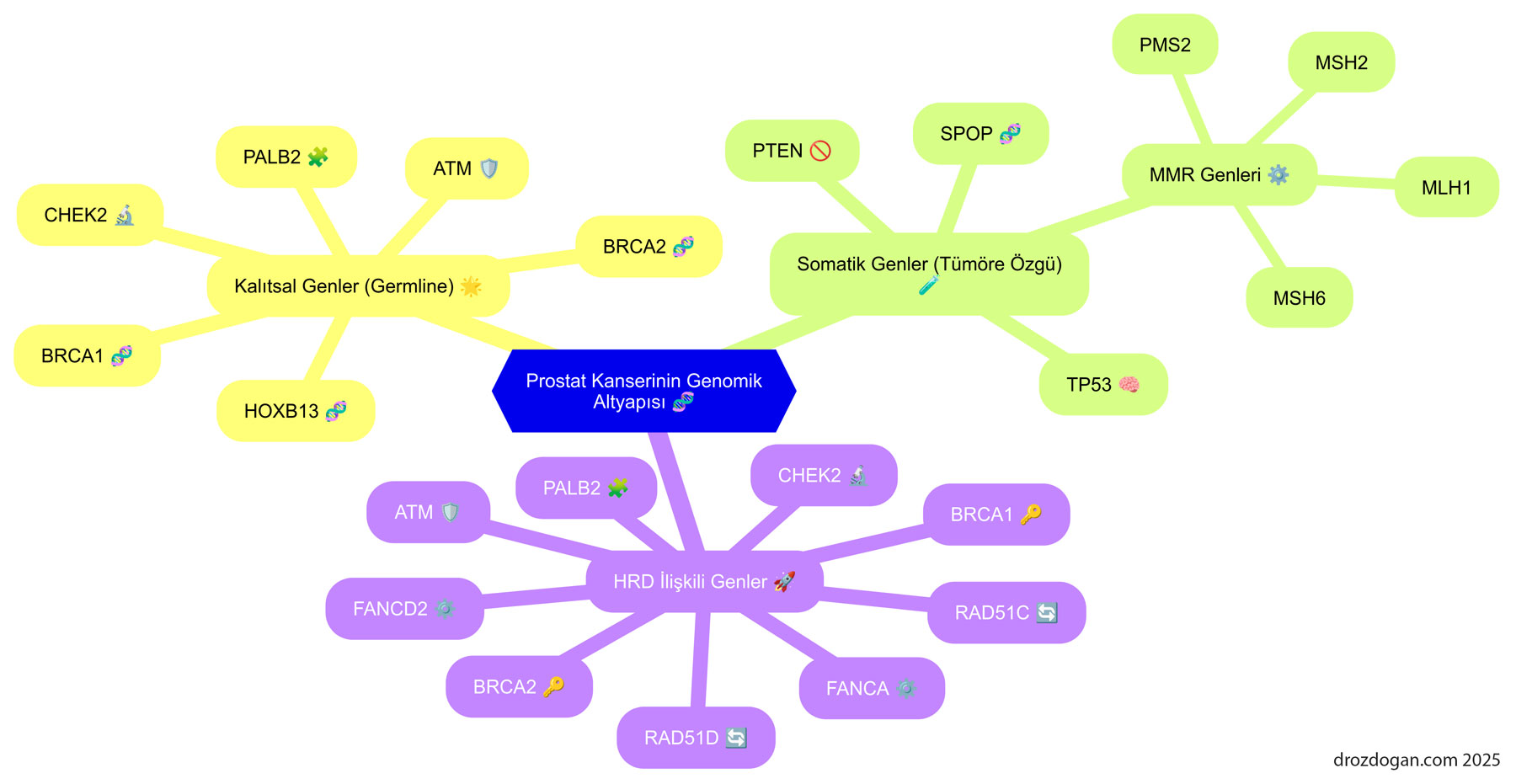
Besides BRCA1 and BRCA2, important prostate cancer-associated genes include:
-
ATM: A DNA repair gene whose mutations influence progression and may indicate potential response to PARP inhibitors.
-
CHEK2: A cell-cycle checkpoint gene associated with inherited cancer risk.
-
PALB2: Works with BRCA2 in DNA repair. Mutations are associated with high-risk prostate cancer.
-
TP53: Mutations in the tumor suppressor TP53 are associated with poor outcomes.
-
PTEN: Loss of this growth-regulating gene contributes to aggressive tumors.
-
MSH2, MSH6, MLH1, and PMS2: Mismatch repair (MMR) mutations may cause microsatellite instability and sensitivity to immunotherapy.
-
HOXB13: Associated with hereditary prostate cancer and potentially younger diagnosis.
-
SPOP: Associated with better clinical outcomes but not used for targeted treatment.
3. The Importance of HRD (Homologous Recombination Deficiency)
Definition: HRD is a defect in DNA repair that prevents effective repair of double-strand breaks, causing genetic instability. It makes cancer cells more sensitive to treatments such as PARP inhibitors.
HRD-Associated Genes: These genes are important in DNA repair. Their mutation creates an HRD-positive profile. Key genes include:
-
BRCA1 and BRCA2: Central DNA repair genes.
-
ATM: Initiates the cellular response to DNA damage.
-
PALB2: Interacts with BRCA2 to support repair.
-
RAD51C and RAD51D: Participate in homologous recombination during repair.
-
CHEK2: Regulates the cell cycle and responds to DNA damage.
-
FANCA, FANCD2: Participate in repair through Fanconi anemia pathways.
Clinical Significance of HRD
-
Treatment Response: HRD-positive tumors respond better to medicines such as olaparib or talazoparib.
-
Prognostic Value: HRD mutations are associated with unfavorable outcomes, but targeted therapy may improve this.
-
Combinations: Immunotherapy and chemotherapy combinations are being studied in HRD-positive patients.
4. Test Types and Applications
-
Germline Testing: Assesses hereditary risk and may guide screening for relatives.
-
Somatic Testing: Examines tumor alterations and identifies targeted options.
5. Timing and Sample Selection
-
Timing: At diagnosis or when the treatment plan needs to change.
-
Sample: Primary or metastatic biopsy tissue, or blood for circulating tumor DNA.
6. Clinical Recommendations
1. Who Should Have Germline Testing?
-
All patients with metastatic prostate cancer should undergo germline testing.
-
Relatives of people with inherited alterations should also be screened.
2. When Is Somatic Testing Appropriate?
-
Use when biomarker-directed treatment is planned.
-
Retesting is particularly recommended after progression.
3. Biopsy Selection:
-
Previously biopsied or surgically removed tissue is suitable initially.
-
ctDNA provides a noninvasive alternative, although fresh metastatic biopsy may be preferred with low tumor burden.
4. PARP Inhibitors and Genetic Alterations:
-
PARP inhibitors such as olaparib or talazoparib are recommended for BRCA1/2 mutations.
5. Prognostic Biomarkers:
-
Findings that have only prognostic value should not determine treatment.
7. Patient–Clinician Communication
During germline testing, explain:
-
The purpose and possible outcomes, such as positive, negative, or uninformative results.
-
Implications for familial cancer risk.
-
How results may lead to screening programs for relatives.
8. Patients With Multiple Chronic Conditions
ctDNA may be preferred for somatic testing because metastatic biopsies are more invasive and may pose safety risks.
9. Costs and Implementation
Test Types and Cost Ranges:
-
Targeted Gene Panels: 250 - 3,000 USD.
-
Whole-Exome Sequencing (WES): 1,000 - 3,000 USD.
-
Whole-Genome Sequencing (WGS): 3,000 - 5,000 USD.
Prices are expected to decline. Financial counseling should nevertheless help reduce the cost burden.
10. Implementation Challenges and Future Research
-
Increase ethnic and genetic diversity in trials.
-
Investigate new biomarkers for early resistance detection, including minimal residual disease (MRD) and ctDNA fraction monitoring.
11. Conclusion and Clinical Practice
These recommendations emphasize genomic testing in metastatic prostate cancer. Clinical teams need to interpret results and refer patients for genetic counseling. Identifying treatment-relevant biomarkers and ensuring equitable access are crucial for personalized medicine.
Sources
DOI:10.1200/JCO-24-02608
Was this article helpful?
Your feedback helps us improve our content.




Reader comments
Share your comment
Your name and comment are published only after administrator approval. Your email address is never shown to visitors.
Be the first to comment.